Idioms About the Heart: 50 Common Expressions With Meanings and Examples
Idioms about the heart are an important part of everyday English. People use these expressions to talk about love, sadness, kindness, courage, honesty, and the feelings that influence their decisions. Instead of describing an emotion in a long sentence, a speaker can use a familiar heart idiom to communicate a deeper meaning in just a few words.
For example, someone who is very kind might be described as having a heart of gold. A person who openly expresses feelings may be said to wear their heart on their sleeve. When someone changes an earlier decision because their feelings have changed, they may have a change of heart.
These expressions appear in conversations, books, movies, classroom discussions, and everyday American English. Understanding them can help students, English learners, writers, and readers recognize figurative language and communicate more naturally.
In this guide, you will learn 50 common idioms and expressions about the heart, along with straightforward definitions and original example sentences that demonstrate how each expression works in context.
What Are Idioms About the Heart?
Idioms about the heart are established English expressions that use the word heart figuratively to communicate meanings related to emotions, personality, relationships, intentions, or determination.

For example, the expression have a heart of stone describes someone who seems emotionally cold or unwilling to show compassion. It does not mean that the person’s physical heart is made of stone.
Heart expressions are not all identical in structure. Some are traditional idioms, while others are familiar figurative phrases or conventional expressions. They are often studied together because they use the heart as a symbol of human feelings and character.
Unicorn Idioms: https://learnidioms.com/unicorn-idioms/
50 Common Idioms About the Heart With Meanings and Examples
The following expressions are grouped by meaning to make them easier to understand, remember, and use.
1. Idioms About Love and Affection
These expressions describe romantic feelings, emotional closeness, and affection for other people.
1. Break Someone’s Heart
Meaning: To cause someone deep emotional pain, especially through rejection, separation, or disappointment.
Example: Jake broke her heart when he ended their relationship without explaining why.
2. Steal Someone’s Heart
Meaning: To make someone fall in love with you or develop strong affection for you.
Example: The thoughtful note he left on her desk completely stole her heart.
3. Win Someone’s Heart
Meaning: To gain another person’s love, affection, or romantic interest.
Example: Daniel won her heart by being honest, patient, and thoughtful.
4. Lose Your Heart to Someone
Meaning: To fall deeply in love with another person.
Example: She lost her heart to a musician she met at a neighborhood concert.
5. Wear Your Heart on Your Sleeve
Meaning: To show your emotions openly instead of hiding how you feel.
Example: Olivia wears her heart on her sleeve, so her friends can usually tell when something is bothering her.
6. Follow Your Heart
Meaning: To make a decision based on your deepest feelings, values, or personal desires.
Example: After thinking carefully about her future, Maya decided to follow her heart and become an artist.
7. Set Your Heart on Something
Meaning: To want something very strongly or become emotionally determined to achieve it.
Example: Ethan has set his heart on attending a university where he can study engineering.
8. Have a Heart-to-Heart
Meaning: To have an honest and personal conversation about feelings or an important issue.
Example: My sister and I had a heart-to-heart about the misunderstanding that had affected our friendship.
9. Open Your Heart
Meaning: To share your feelings honestly or become emotionally receptive to someone.
Example: It took him several months to open his heart and trust his new friends.
10. Close to Your Heart
Meaning: Very important or personally meaningful to someone.
Example: Supporting local animal shelters is a cause that remains close to her heart.
2. Idioms About Emotions and Sadness
These expressions help describe grief, nervousness, disappointment, emotional reactions, and changes in feelings.

11. Have a Change of Heart
Meaning: To change your opinion, feelings, or decision.
Example: I planned to sell my old guitar, but I had a change of heart after remembering how much it meant to me.
12. Have a Heavy Heart
Meaning: To feel deeply sad, worried, or emotionally troubled.
Example: She left the family home with a heavy heart after saying goodbye to everyone.
13. My Heart Sank
Meaning: To suddenly feel disappointed, discouraged, or distressed.
Example: My heart sank when I realized I had left my presentation at home.
14. My Heart Skipped a Beat
Meaning: To feel a sudden rush of excitement, surprise, or fear.
Example: My heart skipped a beat when I heard my name announced as the scholarship winner.
15. Have Your Heart in Your Mouth
Meaning: To feel extremely nervous, frightened, or anxious about what is happening.
Example: I had my heart in my mouth while waiting for the final results of the competition.
16. Have Your Heart in Your Throat
Meaning: To experience intense nervousness, fear, or excitement.
Example: His heart was in his throat as he stepped onto the stage for his first performance.
17. Wear Your Heart on Your Sleeve
Meaning: To make your emotions easy for other people to recognize.
Example: Because Nina wears her heart on her sleeve, everyone knew how disappointed she was about the canceled trip.
18. Pour Your Heart Out
Meaning: To express your deepest emotions or personal worries openly.
Example: After weeks of keeping everything inside, Marcus poured his heart out to his closest friend.
19. Take Something to Heart
Meaning: To take someone’s words or actions seriously, often because they affect you emotionally.
Example: She took her coach’s advice to heart and practiced more consistently.
20. Your Heart Goes Out to Someone
Meaning: To feel sympathy, compassion, or sorrow for someone experiencing difficulty.
Example: My heart goes out to the families who lost their homes in the wildfire.
3. Idioms About Kindness and Character
These phrases describe compassion, generosity, personality, and the way people treat others.
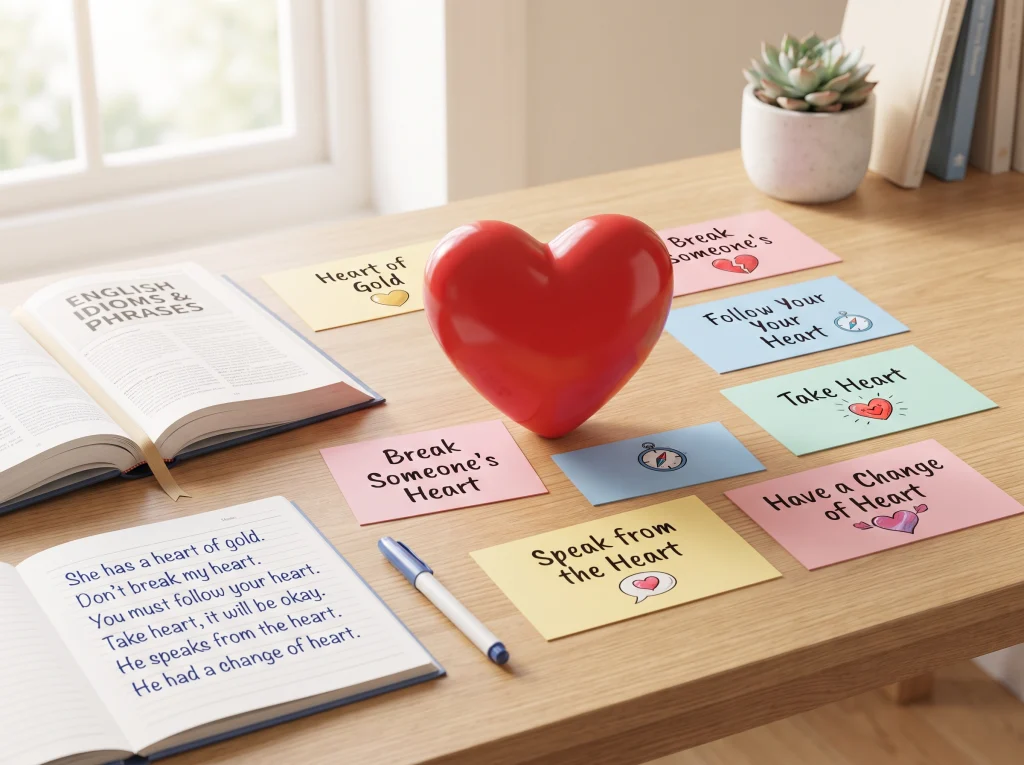
21. Have a Heart of Gold
Meaning: To be exceptionally kind, generous, and caring.
Example: Our neighbor has a heart of gold and regularly brings meals to people who need help.
22. Have a Heart of Stone
Meaning: To appear cold, unfeeling, or unwilling to show compassion.
Example: You would need a heart of stone not to feel sympathy for the frightened children.
23. Have a Big Heart
Meaning: To be generous, caring, and willing to help others.
Example: My aunt has a big heart and always makes visitors feel welcome.
24. Have Your Heart in the Right Place
Meaning: To have good intentions, even if your actions do not always produce the desired result.
Example: He sometimes gives too much advice, but he has his heart in the right place.
25. Have a Soft Heart
Meaning: To be sympathetic, gentle, or easily moved by another person’s feelings.
Example: Despite his serious appearance, Mr. Carter has a soft heart and loves helping young students.
26. Be Tenderhearted
Meaning: To be kind, caring, and sensitive to the feelings of others.
Example: The tenderhearted volunteer stayed late to comfort the nervous shelter animals.

27. Be Young at Heart
Meaning: To maintain a youthful, cheerful, or playful attitude regardless of age.
Example: My grandfather is young at heart and still enjoys riding his bicycle around the park.
28. Have a Heart
Meaning: To show kindness, pity, or understanding toward someone.
Example: Have a heart and give your brother a chance to explain what happened.
29. Do Someone’s Heart Good
Meaning: To make someone feel happy, encouraged, or emotionally satisfied.
Example: Seeing her former students succeed did her heart good.
30. Out of the Goodness of Your Heart
Meaning: To do something because you genuinely want to help, without expecting a reward.
Example: Our neighbor repaired the broken fence out of the goodness of his heart.
4. Idioms About Courage and Determination
These expressions describe hope, perseverance, confidence, and the effort someone puts into an activity.
31. Take Heart
Meaning: To become encouraged or regain hope during a difficult situation.
Example: Take heart; your progress may be slow, but your consistent effort is making a difference.
32. Lose Heart
Meaning: To become discouraged or lose confidence and hope.
Example: Do not lose heart because of one disappointing test result.
33. Put Your Heart Into Something
Meaning: To give an activity your full effort, attention, and enthusiasm.
Example: She put her heart into preparing for the school science fair.
34. Put Your Heart and Soul Into Something
Meaning: To devote yourself completely to an activity, project, or goal.
Example: The volunteers put their heart and soul into organizing the community fundraiser.
35. With All Your Heart
Meaning: With complete sincerity, enthusiasm, love, or commitment.
Example: I believe with all my heart that everyone deserves to be treated with respect.
36. Heart and Soul
Meaning: With complete dedication or wholehearted involvement.
Example: He worked heart and soul to make the neighborhood garden successful.
37. Not Have the Heart to Do Something
Meaning: To feel too sympathetic or emotionally uncomfortable to do something that might hurt someone.
Example: I did not have the heart to tell my little brother that his favorite toy was broken.
38. Your Heart Isn’t in It
Meaning: You are not emotionally interested, enthusiastic, or committed to an activity.
Example: She realized her heart was not in the job anymore and began considering other career options.
39. Keep Your Heart in Something
Meaning: To continue caring about or remaining emotionally committed to something.
Example: Even after several setbacks, he kept his heart in the project and continued working toward its goals.
40. Have Your Heart Set Against Something
Meaning: To strongly oppose or feel firmly against a particular choice or idea.
Example: My parents had their hearts set against moving until they learned more about the new neighborhood.
5. Idioms About Honesty and Sincerity
These expressions are useful when making promises, expressing gratitude, or communicating genuine feelings.

41. From the Bottom of Your Heart
Meaning: With deep sincerity and genuine emotion.
Example: I want to thank you from the bottom of my heart for supporting me during a difficult year.
42. Cross My Heart
Meaning: A familiar informal expression used to emphasize that a promise is sincere or that a statement is true.
Example: I will return your book tomorrow, cross my heart.
43. Speak from the Heart
Meaning: To say what you genuinely feel or believe rather than offering words that are insincere.
Example: During the graduation ceremony, the principal spoke from the heart about the students’ achievements.
44. In Your Heart of Hearts
Meaning: Deep down, at the most private or sincere level of your feelings or beliefs.
Example: In her heart of hearts, she knew that apologizing was the right thing to do.
45. With a Whole Heart
Meaning: With complete sincerity, enthusiasm, or emotional commitment.
Example: The community welcomed the new family with a whole heart.
6. Other Useful Heart Expressions
These additional expressions are helpful in everyday conversation, storytelling, and informal English.
46. Learn Something by Heart
Meaning: To memorize something so that you can repeat or recall it accurately.
Example: The students learned the poem by heart before the school performance.
47. Know Something by Heart
Meaning: To know something from memory without needing to read or check it.
Example: My grandmother knows the lyrics to many classic songs by heart.
48. Eat Your Heart Out
Meaning: An informal, often playful expression used to suggest that someone should feel envious of another person’s achievement or possession.
Example: Eat your heart out, professional chefs! My homemade pizza turned out beautifully.
49. At Heart
Meaning: In someone’s true nature or fundamental character.
Example: Although he works as a lawyer, he is an environmentalist at heart.
50. Get to the Heart of the Matter
Meaning: To identify or discuss the most important part of a problem, subject, or situation.
Example: Instead of arguing about minor details, let’s get to the heart of the matter and decide how to solve the problem.
How to Use Heart Idioms Naturally
Understanding an idiom’s meaning is only the first step. To use heart idioms naturally, pay attention to the situation, the emotion you want to express, and the words that commonly appear with the expression.

1. Match the Idiom to the Emotion
Choose an expression that accurately describes the feeling or situation.
- For kindness: “She has a heart of gold.”
- For sadness: “He left with a heavy heart.”
- For encouragement: “Take heart and keep trying.”
- For sincerity: “I thank you from the bottom of my heart.”
2. Learn the Complete Expression
Many idioms have a particular grammatical structure. Learning the full phrase helps you avoid unnatural combinations.
For example:
- Natural: “She had a change of heart.”
- Natural: “He learned the speech by heart.”
- Natural: “They poured their hearts out to each other.”
Remember that some expressions change according to the subject. You might say “my heart sank,” “her heart sank,” or “their hearts sank.”
3. Pay Attention to Formality
Some heart idioms work in both casual and professional settings, while others are more conversational.
“From the bottom of my heart” can express sincere gratitude in a speech or personal letter. “Eat your heart out,” on the other hand, is generally informal and often playful.
4. Avoid Using Too Many Idioms Together
Heart idioms can make writing expressive, but too many in one paragraph may make it sound unnatural. Choose one expression that communicates the intended meaning clearly, then explain the situation in ordinary language.
Heart Idioms: Quick Reference Table
| Idiom | Simple meaning |
|---|---|
| Break someone’s heart | Cause deep emotional pain |
| Steal someone’s heart | Make someone fall in love |
| Win someone’s heart | Gain someone’s affection |
| Lose your heart to someone | Fall deeply in love |
| Wear your heart on your sleeve | Show emotions openly |
| Follow your heart | Follow your feelings or values |
| Set your heart on something | Want something very much |
| Have a heart-to-heart | Have an honest personal conversation |
| Open your heart | Share your feelings |
| Close to your heart | Personally important |
| Have a change of heart | Change your feelings or decision |
| Have a heavy heart | Feel deeply sad |
| My heart sank | Feel sudden disappointment |
| My heart skipped a beat | Feel sudden excitement or fear |
| Have your heart in your mouth | Feel extremely nervous |
| Have your heart in your throat | Feel intense fear or nervousness |
| Pour your heart out | Share deep emotions |
| Take something to heart | Be deeply affected by something |
| Your heart goes out to someone | Feel sympathy |
| Have a heart of gold | Be very kind and generous |
| Have a heart of stone | Seem cold or unfeeling |
| Have a big heart | Be caring and generous |
| Have your heart in the right place | Have good intentions |
| Have a soft heart | Be sympathetic |
| Be tenderhearted | Be gentle and caring |
| Be young at heart | Have a youthful attitude |
| Have a heart | Show compassion |
| Do someone’s heart good | Make someone happy |
| Out of the goodness of your heart | Help without expecting a reward |
| Take heart | Become encouraged |
| Lose heart | Become discouraged |
| Put your heart into something | Give it your full effort |
| Put your heart and soul into something | Devote yourself completely |
| With all your heart | With complete sincerity |
| Heart and soul | With full dedication |
| Not have the heart to do something | Feel unable to do something hurtful |
| Your heart isn’t in it | Lack interest or commitment |
| Keep your heart in something | Remain emotionally committed |
| Have your heart set against something | Strongly oppose something |
| From the bottom of your heart | With deep sincerity |
| Cross my heart | Emphasize a promise or truthful statement |
| Speak from the heart | Speak sincerely |
| In your heart of hearts | Deep down inside |
| With a whole heart | With complete sincerity |
| Learn something by heart | Memorize something |
| Know something by heart | Recall something from memory |
| Eat your heart out | Playfully suggest that someone should feel envious |
| At heart | In one’s true nature |
| Get to the heart of the matter | Focus on the central issue |
Frequently Asked Questions
Conclusion
Idioms about the heart help English speakers express feelings, relationships, and personal experiences in memorable ways. Expressions such as have a heart of gold, break someone’s heart, take heart, and speak from the heart communicate meanings that go beyond the literal definition of the word.
Start with a few familiar expressions and use them when they genuinely fit what you want to say. With regular reading and conversation practice, heart idioms can become a natural and useful part of your English vocabulary.






One Comment