
50 Australian Idioms: Meanings and Examples of Aussie Expressions
Australian English has its own collection of colorful idioms, sayings, slang terms, and shortened words. Some are easy for American English speakers to understand, while others can sound completely mysterious at first.
For example, an Australian speaker might say, “No worries,” when they mean that everything is fine. Someone might describe a genuine person as “fair dinkum,” say that a problem is “a sticky wicket,” or tell a friend that “she’ll be apples” when everything will work out. Australian English also has a strong tradition of playful humor and creative expressions.
Australian idioms are useful for English learners, travelers, students, and anyone who wants to understand Australian conversations more naturally. The Australian National Dictionary Centre at Australian National University notes that many Australian idioms are distinctly home grown, while some older expressions have become less common over time.
This guide explains 50 Australian idioms and expressions with simple meanings and natural examples.
What Are Australian Idioms?
Australian idioms are expressions used in Australian English whose meanings are not always obvious from the individual words. Some developed specifically in Australia, while others are international English expressions that have become especially familiar in Australian speech.
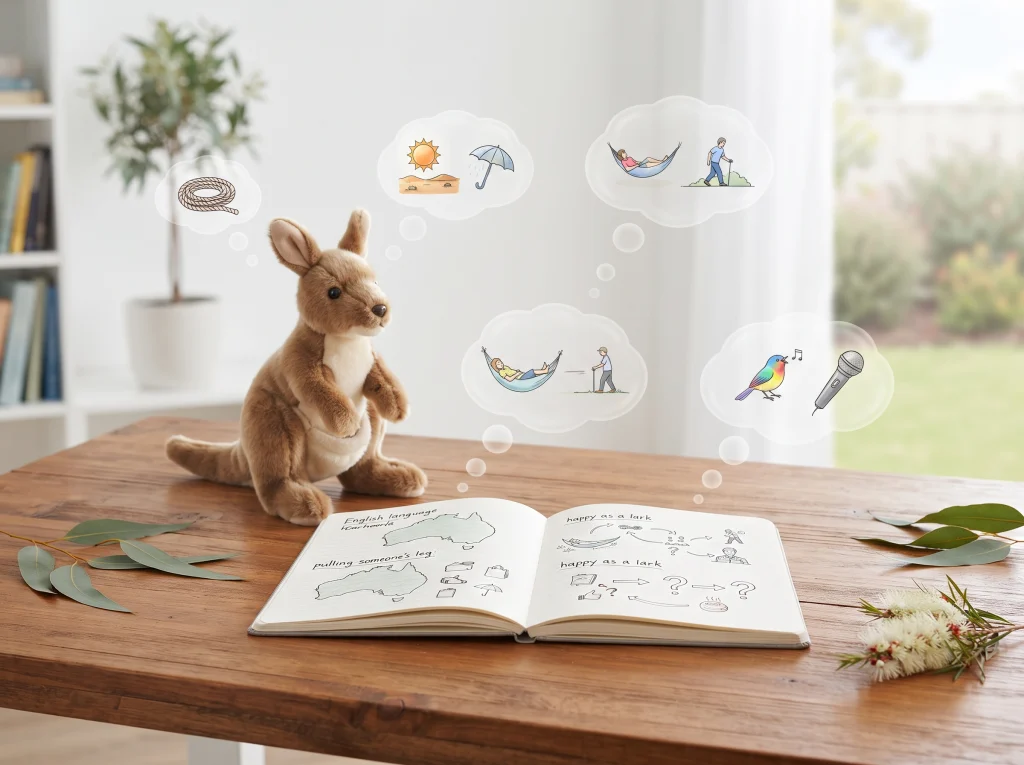
It is also helpful to separate idioms from slang. Australian slang includes informal words such as “arvo” for afternoon and “brekkie” for breakfast. Australian English is particularly known for shortening words and adding endings such as “o” and “ie.”
The expressions below include traditional Australian idioms, common Australian sayings, and widely recognized Aussie expressions.
120 Idioms for School:https://learnidioms.com/idioms-for-school/
50 Australian Idioms With Meanings and Examples
| Australian Idiom or Expression | Meaning | Example |
|---|---|---|
| 1. Fair dinkum | Genuine, honest, or truly Australian | “Is that story fair dinkum?” |
| 2. No worries | No problem; everything is fine | “Thanks for helping me.” “No worries!” |
| 3. She’ll be apples | Everything will be fine | “The car needs a repair, but she’ll be apples.” |
| 4. Good on you | Well done or congratulations | “You finished the project early. Good on you!” |
| 5. Give it a burl | Give something a try | “I have never surfed before, but I’ll give it a burl.” |
| 6. Have a crack | Try something | “Have a crack at the puzzle.” |
| 7. Hard yakka | Hard work | “Building that house was hard yakka.” |
| 8. Pull your head in | Stop behaving badly or arrogantly | “Pull your head in and listen for a moment.” |
| 9. Spit the dummy | Lose your temper or have a childish reaction | “He spat the dummy when the plan changed.” |
| 10. Have a whinge | Complain or moan | “He always has a whinge about the weather.” |
| 11. Carry on like a pork chop | Behave foolishly or make an unnecessary fuss | “Stop carrying on like a pork chop.” |
| 12. Get a wriggle on | Hurry up | “Get a wriggle on or we’ll miss the bus.” |
| 13. Chockers | Completely full | “The restaurant was chockers on Saturday night.” |
| 14. Full as a goog | Very full, especially after eating | “After that huge dinner, I’m full as a goog.” |
| 15. Flat out | Extremely busy or working very hard | “I’ve been flat out all week.” |
| 16. Chuck a sickie | Take a day off work by claiming to be sick | “He decided to chuck a sickie and spend the day at the beach.” |
| 17. Muck around | Waste time or fool around | “Stop mucking around and finish your homework.” |
| 18. Buggered | Extremely tired | “I’m completely buggered after that hike.” |
| 19. Crook | Ill or unwell | “I stayed home because I was feeling crook.” |
| 20. Take the piss | Tease, joke about, or mock someone | “My friends always take the piss out of my accent.” |
| 21. Have a go | Try or make an attempt | “Have a go at fixing it yourself.” |
| 22. Give someone a fair go | Give someone a fair opportunity | “Everyone deserves a fair go.” |
| 23. Fair shake of the sauce bottle | A fair opportunity or reasonable treatment | “Give me a fair shake of the sauce bottle before you decide.” |
| 24. A few roos loose in the top paddock | Slightly crazy or not thinking clearly | “He must have a few roos loose in the top paddock.” |
| 25. Not the full quid | Not completely sensible or mentally sharp | “He’s not the full quid if he thinks that will work.” |
| 26. A stubby short of a six pack | Slightly lacking intelligence or common sense | “He’s a stubby short of a six pack sometimes.” |
| 27. Mad as a cut snake | Extremely angry, excited, or wild | “She was mad as a cut snake when she heard the news.” |
| 28. As dry as a dead dingo’s donger | Extremely dry | “The ground is as dry as a dead dingo’s donger.” |
| 29. Go troppo | Become confused, irrational, or overly excited | “After weeks in the heat, he started to go troppo.” |
| 30. Come the raw prawn | Try to deceive or fool someone | “Don’t come the raw prawn with me. I know what happened.” |
| 31. Have tickets on yourself | Think too highly of yourself | “He certainly has tickets on himself after winning one award.” |
| 32. Tall poppy | A successful person who attracts criticism because of success | “The company became a tall poppy after its rapid growth.” |
| 33. Tall poppy syndrome | The tendency to criticize or cut down successful people | “The phrase tall poppy syndrome is often discussed in descriptions of Australian culture.” |
| 34. Stir the possum | Cause a reaction or deliberately provoke discussion | “The article was designed to stir the possum.” |
| 35. Rough end of the pineapple | An unfair or difficult situation | “The new employee got the rough end of the pineapple.” |
| 36. Come good | Improve or become successful after a difficult period | “The business struggled at first but eventually came good.” |
| 37. Hit the frog and toad | Leave or go somewhere | “It’s getting late, so we should hit the frog and toad.” |
| 38. Shoot through | Leave quickly | “I have an appointment, so I’ll shoot through.” |
| 39. Off like a bride’s nightie | Leave or move very quickly | “As soon as the doors opened, everyone was off like a bride’s nightie.” |
| 40. In the bush | In a rural or remote area | “They live way out in the bush.” |
| 41. Woop woop | A very remote or distant place | “He moved somewhere out in woop woop.” |
| 42. Bring a plate | Bring food to share at a gathering | “The invitation says to bring a plate.” |
| 43. Spit the dummy | Suddenly become angry or upset | “She spat the dummy when her plans were canceled.” |
| 44. Your blood’s worth bottling | You are a very good or valuable person | “You helped me when nobody else would. Your blood’s worth bottling.” |
| 45. You little beauty | An enthusiastic expression of approval | “We found the tickets! You little beauty!” |
| 46. She’ll be right | Everything will be fine | “Don’t worry about the delay. She’ll be right.” |
| 47. On the nose | Exactly right or accurate | “Your estimate was on the nose.” |
| 48. Come a gutser | Fall over or fail badly | “He came a gutser while trying to jump the fence.” |
| 49. A dog’s breakfast | A complete mess or badly organized result | “The report is a dog’s breakfast.” |
| 50. Onya | Short form of “good on you,” meaning well done | “Onya for finishing the job!” |
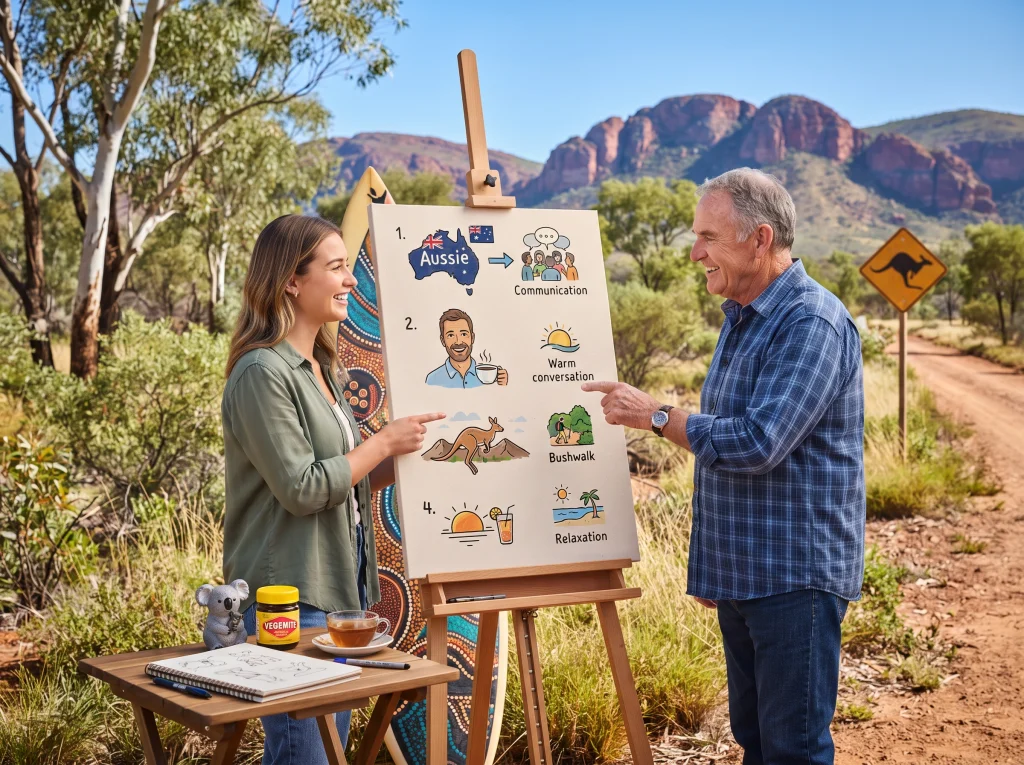
Many of these expressions are documented in Australian language resources, including material from the Australian National Dictionary Centre and Australia’s Adult Migrant English Program. The Australian National Dictionary Centre specifically identifies expressions such as “she’ll be apples,” “fair suck of the sauce bottle,” “tickets on yourself,” and “rough end of the pineapple” as examples of distinctive Australian idiomatic language.
Australian Idioms About Everyday Life
Some Australian expressions appear in ordinary conversations about work, food, plans, and social situations.
“No worries” is one of the most recognizable examples. It can communicate that something is not a problem, and it may also be used in response to thanks.
“Hard yakka” refers to difficult work. The expression can describe physical work, a demanding project, or any situation requiring substantial effort.
“Give it a burl” and “have a crack” both encourage someone to try something. For example, a friend might say, “Have a crack at fixing the bike,” meaning that the person should give it a try.
Australian English also has many shortened everyday words. “Arvo” means afternoon, while “brekkie” means breakfast. ABC Education explains that shortening words is a particularly noticeable feature of Australian slang.
Australian Idioms About People and Personality
Australian English has a strong tradition of humorous descriptions of people’s behavior.
If someone “has tickets on themselves,” the speaker means that the person thinks very highly of themselves. A person who “isn’t the full quid” is being described as lacking good sense.
The expression “a few roos loose in the top paddock” is another humorous way to suggest that someone is acting strangely or not thinking clearly. The Australian National Dictionary Centre gives this expression as an example of the distinctive imagery found in Australian idioms.
Other expressions are more positive. “Good on you” means well done, while “you little beauty” expresses enthusiastic approval.
Australian Idioms About Feelings and Situations
Many Australian idioms describe emotional reactions or difficult circumstances.
Someone who “spits the dummy” has an angry or childish reaction. A person who “has a whinge” complains. If someone is “buggered,” they are extremely tired, although this expression is informal and may not be suitable in every setting.
“Give someone a fair go” means to give them a fair opportunity or reasonable treatment. This phrase is particularly recognizable in Australian English and is also associated with Australian ideas about fairness.
Australian Slang vs. Australian Idioms
Australian slang and Australian idioms overlap, but they are not exactly the same thing.
Slang usually consists of informal words or expressions used by particular groups or in particular social situations. Australian examples include arvo, brekkie, barbie, servo, doco, and footy. ABC Education notes that Australians commonly shorten words and add endings such as “o” and “ie.”
An idiom, on the other hand, often has a meaning that cannot be understood simply by interpreting every word literally. “A few roos loose in the top paddock” is a good example. It is not literally about kangaroos. It is a humorous expression for someone who seems a little irrational or foolish.
Learning both categories is useful because everyday Australian conversations can combine slang, idioms, shortened words, humor, and ordinary English.
How to Use Australian Idioms Naturally
Australian idioms are generally more appropriate in casual conversation than in formal academic or professional writing. Australian language resources emphasize the informal nature of many slang expressions, and context is important when deciding whether a phrase is appropriate.
For example, “no worries” can comfortably appear in many casual situations, while expressions involving profanity or insults require more care. A learner should also remember that Australian English varies between individuals, generations, regions, and social settings.
The best way to learn Australian idioms is to understand both their meaning and their level of formality. Instead of memorizing a phrase in isolation, learn it together with a natural example.

Why Are Australian Idioms So Colorful?
The Australian National Dictionary Centre notes that Australian idioms include expressions connected with cultural attitudes and historical experiences. Some have remained common for generations, while others have become dated or nearly disappeared from everyday speech.
This helps explain why phrases involving kangaroos, paddocks, pineapples, sauce bottles, snakes, and other familiar images appear so frequently in Australian expressions.
Australian slang also reflects a preference for playful shortening. Words such as “brekkie,” “barbie,” “arvo,” and “servo” are examples of how Australian speakers can make everyday vocabulary shorter and more informal.

FAQS
Conclusion
Australian idioms give learners a fascinating look at Australian English and everyday communication. Expressions such as “fair dinkum,” “no worries,” “give it a burl,” “hard yakka,” and “she’ll be apples” can make conversations sound more natural when they are used appropriately.
The most important thing is to learn the meaning, context, and level of formality of each expression. Some Australian idioms are still familiar in modern conversation, while others are older expressions that may sound humorous or dated.



One Comment