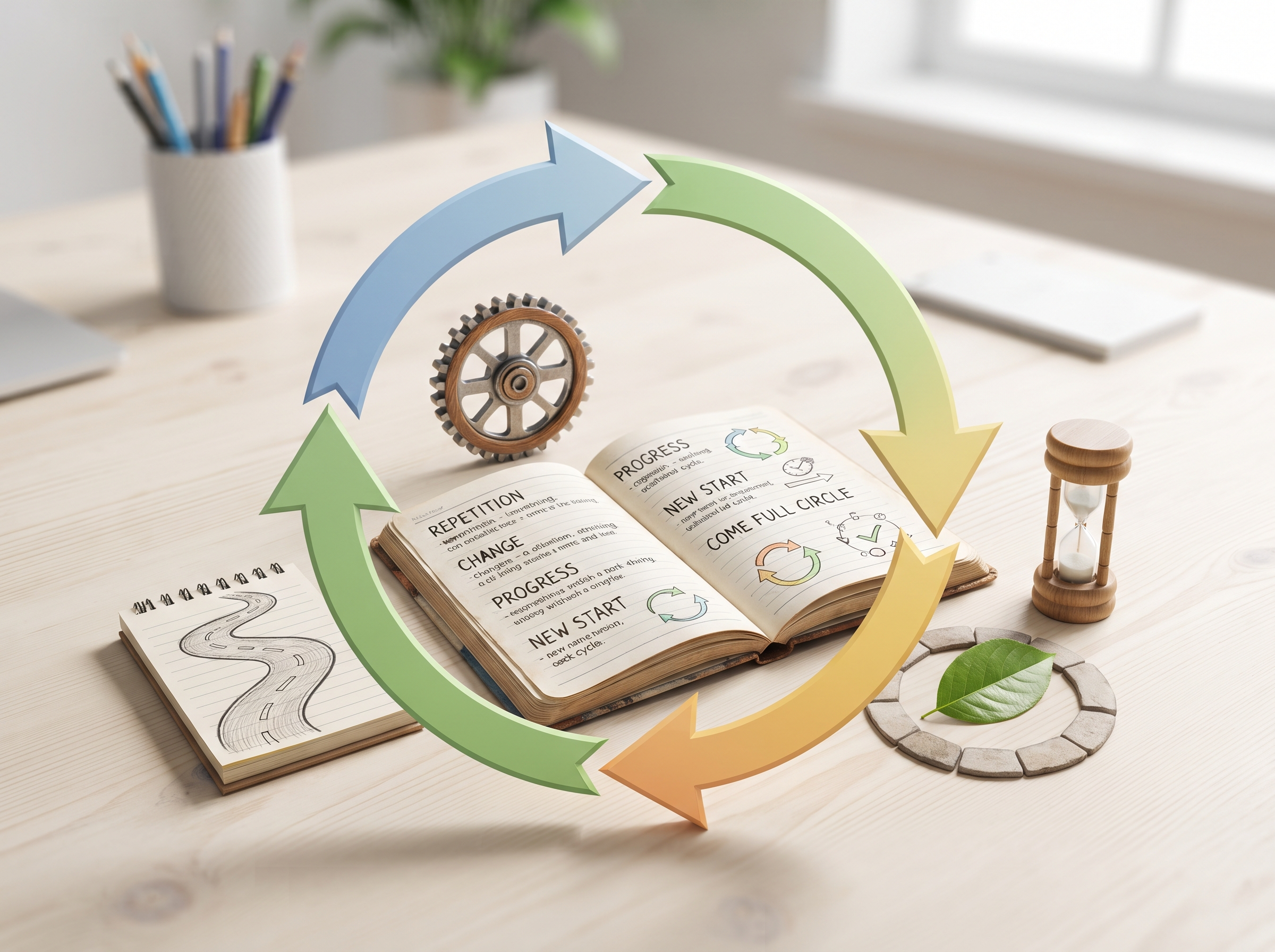
Cycle Idioms: 35 Expressions About Repetition, Change, and Life
Life often moves in repeating patterns. We develop habits, face familiar challenges, celebrate new beginnings, and sometimes find ourselves dealing with the same problems again. English speakers use idioms to describe these experiences in a memorable and natural way. Many of these expressions involve circles, wheels, movement, and the idea of returning to where something began.
Cycle idioms are useful in everyday conversations, workplace discussions, personal storytelling, and writing. You might say that a project has come full circle, that someone is stuck in a vicious cycle, or that a team needs to break the cycle of repeated mistakes. Each expression communicates an idea that would otherwise require a longer explanation.

In this guide, you will learn 35 expressions connected with cycles, repetition, progress, setbacks, and change. Each entry includes a simple meaning and an original example sentence to help you understand how the expression works in context.
What Are Cycle Idioms?
Cycle idioms are expressions that describe repeated events, recurring situations, changes over time, or movement from one stage to another. Some directly use the word cycle, while others use related ideas such as circles, wheels, and loops.
For example, break the cycle means to stop a repeating pattern, especially one that causes problems. Come full circle describes returning to an earlier situation after a period of change or development.
Not every expression connected with a cycle is a strict idiom. Some are figurative expressions, while others are common phrases used to describe repetition or progress. Learning them together can help English learners recognize how native speakers talk about recurring experiences.
Song Lyrics With Idioms: https://learnidioms.com/song-lyrics-with-idioms/
35 Cycle Idioms With Meanings and Examples
Idioms About Repetition and Recurring Problems
These expressions help describe situations that repeat, habits that continue, and problems that seem difficult to escape.
1. Break the Cycle
Meaning: To stop a repeating pattern, especially a harmful or unwanted one.
Example: She changed her spending habits to break the cycle of debt.
2. Vicious Cycle
Meaning: A series of problems in which one difficulty causes another, making the original situation worse.
Example: Missing work reduced his income, and the financial stress created a vicious cycle that made it harder to keep his job.
3. Vicious Circle
Meaning: A repeating chain of problems in which each difficulty reinforces the others. It is similar in meaning to vicious cycle.
Example: A lack of sleep made him less productive, and his unfinished work caused more stress, creating a vicious circle.
4. Go Around in Circles
Meaning: To keep doing or discussing the same things without making meaningful progress.
Example: We went around in circles during the meeting because nobody could agree on a practical solution.
5. Round and Round
Meaning: To repeat the same activity, argument, or situation without reaching a conclusion.
Example: The neighbors argued round and round about the parking spaces without settling the disagreement.
6. Spin Your Wheels
Meaning: To put effort into something without making useful progress.
Example: I was spinning my wheels trying to fix the computer until a technician identified the problem.
7. Here We Go Again
Meaning: An expression used when an unpleasant, familiar, or repetitive situation begins again.
Example: When the printer stopped working just before the deadline, Maya sighed and said, “Here we go again.”
8. Be Like a Broken Record
Meaning: To keep repeating the same words, complaints, or requests.
Example: My dad sounded like a broken record when he reminded us to lock the doors every night.
9. The Same Old Story
Meaning: A familiar situation or problem that keeps happening.
Example: Another meeting was canceled at the last minute. It was the same old story with that department.
10. On Repeat
Meaning: Happening or being played over and over again.
Example: That catchy song has been on repeat in my head all morning.
11. Keep Coming Back to the Same Thing
Meaning: To repeatedly return to one subject, concern, or problem.
Example: During our planning sessions, we kept coming back to the same thing: how to stay within the budget.
12. A Never-Ending Cycle
Meaning: A repeating process that seems to have no end.
Example: Without a better schedule, the team felt trapped in a never-ending cycle of late nights and unfinished tasks.
13. In a Rut
Meaning: Stuck in a routine or situation that feels dull, repetitive, or difficult to change.
Example: After months of following the same routine, Jordan felt he was in a rut and decided to try a new hobby.
14. The Wheel Keeps Turning
Meaning: Life or events continue moving forward, even when individual circumstances change.
Example: Some employees left and new ones arrived, but the wheel kept turning at the busy restaurant.
15. A vicious pattern
Meaning: A repeated behavior or sequence that leads to unwanted consequences.
Example: Staying up late and rushing through the morning became a vicious pattern that affected her work.
Idioms About Change, Completion, and New Beginnings
These expressions describe returning to an earlier point, moving into a new phase, or beginning again.

16. Come Full Circle
Meaning: To return to an earlier situation or starting point after a period of change or development.
Example: After years of working in different cities, Elena came full circle and returned to the small town where she grew up.
17. Full Circle
Meaning: A complete return to an original point, situation, or idea.
Example: Teaching at her former high school brought her career full circle.
18. The Wheel Has Come Full Circle
Meaning: A situation has returned to something resembling its original state after a series of changes.
Example: The family business began as a small neighborhood store, expanded nationwide, and eventually returned to its community roots. The wheel had come full circle.
19. Turn Over a New Leaf
Meaning: To make a fresh start by changing your behavior or habits.
Example: After struggling with missed deadlines, Marcus turned over a new leaf and began organizing his work each morning.
20. Back to Square One
Meaning: To return to the beginning after a plan fails or progress is lost.
Example: When the software update caused more problems than it solved, the developers were back to square one.
21. Start From Scratch
Meaning: To begin again from the very beginning without relying on previous work.
Example: The original design did not meet the client’s needs, so the team had to start from scratch.
22. A Fresh Start
Meaning: An opportunity to begin again, often with a different approach or improved circumstances.
Example: Moving to a new city gave Rachel a fresh start after a difficult year.
23. A New Chapter
Meaning: A new period or stage in someone’s life or an ongoing situation.
Example: Graduating from college marked a new chapter in his life.
24. Close the Loop
Meaning: To complete a process, resolve an outstanding issue, or provide the information needed to finish a discussion.
Example: Please email the customer with the final update so we can close the loop on the complaint.
25. Put the Past Behind You
Meaning: To stop focusing on past difficulties and move forward.
Example: After resolving the disagreement, the friends decided to put the past behind them.
Idioms About Progress, Setbacks, and Momentum
These expressions describe forward movement, recovery, effort, and the challenges that can interrupt progress.

26. Back on Track
Meaning: Returning to the right direction or making progress again after a setback.
Example: After reorganizing the schedule, the construction project was back on track.
27. Keep the Ball Rolling
Meaning: To maintain progress or continue an activity without unnecessary interruption.
Example: We finished the first part of the presentation and kept the ball rolling by assigning the next section.
28. On a Roll
Meaning: Experiencing a period of repeated success or good results.
Example: The local team was on a roll after winning three games in a row.
29. Gain Momentum
Meaning: To build increasing progress, support, or energy as something continues.
Example: The neighborhood cleanup gained momentum when more volunteers began showing up each weekend.
30. Pick Up Where You Left Off
Meaning: To resume an activity from the point where you previously stopped.
Example: After returning from vacation, I picked up where I left off on the research project.
31. Take a Step Back
Meaning: To pause or move away from an activity temporarily to reconsider a situation.
Example: We took a step back from the discussion and reviewed the project’s original goals.
32. Hit a Dead End
Meaning: To reach a point where progress or further development seems impossible.
Example: The investigation hit a dead end when the available records provided no new information.
33. Ride Out the Storm
Meaning: To endure a difficult period until conditions improve.
Example: The small business reduced unnecessary expenses to ride out the storm during a slow season.
34. Weather the Storm
Meaning: To survive or successfully endure a challenging situation.
Example: With careful planning and support from loyal customers, the store managed to weather the storm.
35. What Goes Around Comes Around
Meaning: The idea that people’s actions eventually bring consequences back to them, whether positive or negative.
Example: He regularly helped his coworkers, and years later they supported him when he needed assistance. What goes around comes around.
How to Use Cycle Idioms Naturally in Everyday English
Cycle idioms are most effective when they match the situation you want to describe. Instead of memorizing an expression alone, connect it with a realistic event, conversation, or personal experience.
Here are a few practical ways to use them.

Describe a Repeating Problem
Use vicious cycle, go around in circles, or here we go again when a situation keeps repeating.
- “We keep missing the deadline because we start planning too late. We need to break the cycle.”
- “We have discussed this issue three times, and we are still going around in circles.”
Talk About Personal Growth
Use come full circle, turn over a new leaf, or a new chapter when describing life changes.
- “After years of working in finance, she came full circle and opened the family bookstore.”
- “He turned over a new leaf and began taking his responsibilities more seriously.”
Describe Progress or Recovery
Use back on track, keep the ball rolling, or pick up where you left off when talking about work, school, or personal goals.
- “We lost a week because of the equipment failure, but the project is back on track.”
- “Let’s keep the ball rolling and finish the remaining tasks before Friday.”
Choose the Right Level of Formality
Some expressions are common in casual conversations, while others also work well in professional writing.
| Expression | Typical use |
|---|---|
| Here we go again | Casual conversation |
| Spin your wheels | Casual and workplace discussions |
| Break the cycle | Personal, social, and professional contexts |
| Come full circle | Personal stories and reflective writing |
| Close the loop | Workplace communication |
| Back on track | Everyday and professional communication |
Remember that an idiom’s meaning can depend on context. For instance, full circle usually emphasizes a return to an earlier point, while back on track emphasizes getting progress moving in the intended direction again.
FAQ
Conclusion
Cycle idioms help explain the patterns that appear in everyday life, from repeating habits and familiar problems to personal growth and new beginnings. Expressions such as break the cycle, come full circle, and back on track make it easier to communicate complicated experiences in a few memorable words.
The easiest way to learn these expressions is to practice them in sentences that reflect situations you already understand. Try using one or two in your conversations, journal entries, or workplace discussions. With regular practice, these phrases can become a natural part of your English vocabulary.





One Comment