Progress Idioms: 40 Common Expressions With Meanings and Examples
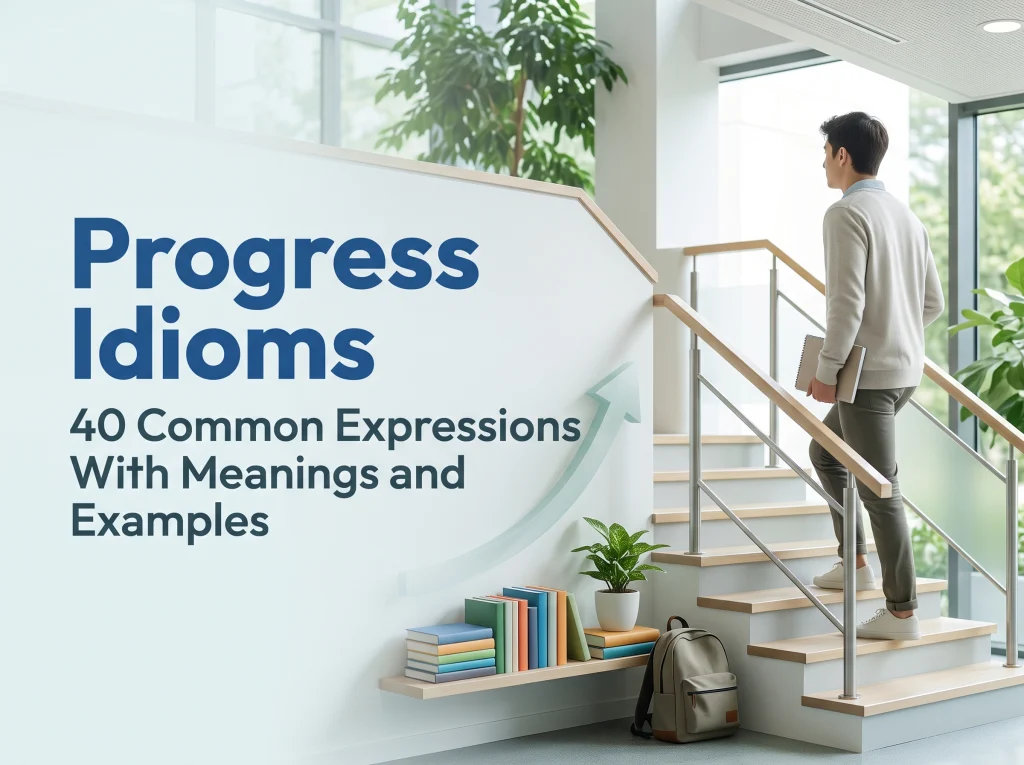
Progress idioms are expressions that describe moving forward, improving skills, reaching goals, or overcoming difficulties. In American English, phrases such as make headway, get the ball rolling, and take it to the next level help people talk about progress naturally at work, in school, and in everyday life.
These expressions can make conversations more engaging because they communicate ideas that ordinary words sometimes cannot express as effectively. Whether you are learning English, writing professionally, or talking about personal goals, understanding progress idioms can help you express your thoughts with greater confidence.
What Are Progress Idioms?
Progress idioms are common expressions that describe advancement, development, improvement, or movement toward a goal. Some emphasize steady effort, while others describe a breakthrough, a new beginning, or a successful result.
For example, make headway means to make progress toward a goal, while get the ball rolling means to start an activity or process. These phrases appear in everyday conversations, business meetings, classrooms, and discussions about personal development.
40 Common Progress Idioms With Meanings and Examples
The following progress idioms are useful for describing everything from small improvements to major achievements. Each expression includes a simple meaning and an example sentence in natural American English.
Idioms About Making Progress
These expressions are especially helpful when describing forward movement, steady improvement, or the beginning of a task.
1. Make Headway
Meaning: To make progress toward a goal or solve a problem.
Example: We are finally making headway on the new website after weeks of planning.
2. Get the Ball Rolling
Meaning: To start an activity, project, or process.
Example: Let’s get the ball rolling by assigning tasks to everyone on the team.
3. Move the Needle
Meaning: To make a noticeable or meaningful difference.
Example: Our new marketing strategy helped move the needle on monthly sales.
4. Take Steps Forward
Meaning: To make progress, even if the improvement is small.
Example: She has taken several steps forward in her English writing skills this semester.
5. Get Up to Speed
Meaning: To learn what you need to know to work effectively or understand a situation.
Example: It took me a week to get up to speed with the company’s new software.
6. Pick Up the Pace
Meaning: To work faster or increase the speed of progress.
Example: We need to pick up the pace if we want to finish the project by Friday.
7. Keep the Momentum Going
Meaning: To maintain the energy and progress already achieved.
Example: The team received positive feedback, so we need to keep the momentum going.
8. Gain Ground
Meaning: To make progress or improve your position compared with others or an earlier situation.
Example: The small business is gaining ground against its larger competitors.
9. Get Somewhere
Meaning: To make progress toward a desired result.
Example: After several practice tests, I feel like I’m finally getting somewhere with mathematics.
10. Inch Forward
Meaning: To make very slow but steady progress.
Example: Although the negotiations are difficult, both sides are inching forward toward an agreement.
Idioms About Growth and Improvement
Use these expressions when discussing learning, developing abilities, improving performance, or reaching a higher level.
11. Take It to the Next Level
Meaning: To improve something or advance it to a higher standard.
Example: She took her photography business to the next level by creating a professional website.
12. Come a Long Way
Meaning: To make considerable progress over time.
Example: His public speaking has come a long way since his first presentation.
13. Turn Over a New Leaf
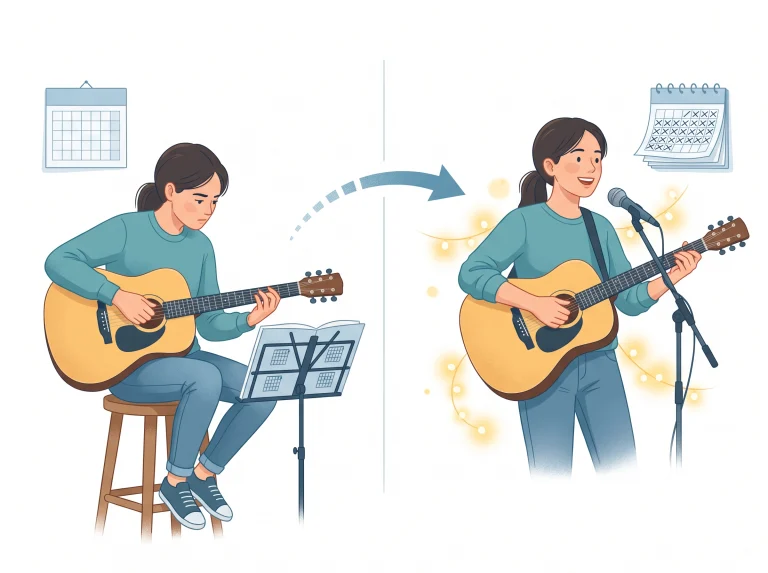
Meaning: To make a fresh start and change your behavior for the better.
Example: After struggling with poor study habits, Marcus decided to turn over a new leaf.
14. Build on Something
Meaning: To use existing progress, knowledge, or success as a foundation for further improvement.
Example: The students will build on what they learned last semester.
15. Learn the Ropes
Meaning: To learn how to do a job or handle a new situation.
Example: It took Maya a month to learn the ropes at her new job.
16. Sharpen Your Skills
Meaning: To improve your abilities through practice or learning.
Example: He took an online course to sharpen his computer programming skills.
17. Raise the Bar
Meaning: To set a higher standard of performance or quality.
Example: The new manager raised the bar by introducing better customer service standards.
18. Hit Your Stride
Meaning: To reach a point where you perform confidently and effectively.
Example: After a few weeks of training, the new employee hit her stride.
19. Find Your Feet
Meaning: To become comfortable and confident in a new situation.
Example: It took him a few months to find his feet after moving to a new city.
20. Branch Out
Meaning: To try new activities or expand into different areas.
Example: The restaurant decided to branch out by offering catering services.
Idioms About Success and Achieving Goals
These expressions help communicate achievements, successful outcomes, and progress that produces meaningful results.

21. Cross the Finish Line
Meaning: To complete a task or reach the end of a challenging process.
Example: After months of hard work, our team finally crossed the finish line and launched the product.
22. Reach New Heights
Meaning: To achieve a higher level of success than before.
Example: Her dedication helped her career reach new heights.
23. Break Through the Ceiling
Meaning: To overcome a limit that has prevented further progress.
Example: The company broke through the ceiling on annual revenue after entering new markets.
24. Make a Breakthrough
Meaning: To achieve an important discovery or overcome a major obstacle.
Example: The researchers made a breakthrough that improved the accuracy of their testing method.
25. Hit the Ground Running
Meaning: To begin an activity with energy and make progress immediately.
Example: Our new project manager hit the ground running on her first day.
26. Be on the Right Track
Meaning: To be doing the right things to achieve a goal.
Example: Your practice scores show that you’re on the right track for the final exam.
27. Pay Off
Meaning: To produce a positive result after time, effort, or investment.
Example: His months of preparation paid off when he passed the certification exam.
28. Bear Fruit
Meaning: To produce successful or useful results.
Example: Years of investment in employee training are beginning to bear fruit.
29. Reap the Rewards
Meaning: To enjoy the benefits of hard work or earlier efforts.
Example: After years of saving money, they are finally reaping the rewards of their discipline.
30. The Sky’s the Limit
Meaning: There is no obvious limit to what someone can achieve.
Example: With her talent and determination, the sky’s the limit for her career.
Idioms About Overcoming Obstacles
Progress often involves setbacks, difficult decisions, and problems that take time to resolve. These idioms help describe persistence and recovery.

31. Get Over the Hump
Meaning: To pass the most difficult part of a task or situation.
Example: Once we get over the hump of the initial setup, the rest of the project should be easier.
32. Weather the Storm
Meaning: To survive a difficult period without giving up.
Example: The business managed to weather the storm during a challenging economic year.
33. Keep Your Eye on the Prize
Meaning: To stay focused on your ultimate goal despite distractions or difficulties.
Example: She kept her eye on the prize while preparing for her professional exam.
34. Hang in There
Meaning: To remain patient and persistent during a difficult time.
Example: Hang in there. Your writing will improve with regular practice.
35. Get Back on Track
Meaning: To return to the right course after a setback or mistake.
Example: After missing several deadlines, the team reorganized its schedule to get back on track.
36. Roll With the Punches
Meaning: To adapt to difficulties or unexpected changes.
Example: Successful entrepreneurs learn to roll with the punches when plans change.
37. Keep at It
Meaning: To continue working at something despite difficulty or slow results.
Example: If you keep at it, you will gradually become more comfortable speaking English.
38. Push Through
Meaning: To continue despite difficulties, discomfort, or obstacles.
Example: We pushed through the final stage of the project and submitted it on time.
39. Go the Extra Mile
Meaning: To make more effort than is expected or required.
Example: The employee went the extra mile to help the customer solve a complicated problem.
40. One Step at a Time
Meaning: To make progress gradually by focusing on one task or stage at a time.
Example: Learning a new language can feel overwhelming, so take it one step at a time.
How to Use Progress Idioms in Everyday American English
Progress idioms are useful in casual conversations, professional communication, academic settings, and discussions about personal goals. The best expression depends on the type of progress you want to describe and the tone of the situation.
Progress Idioms at Work
In American workplaces, idioms can help people discuss projects, deadlines, performance, and business growth in a natural way.
Examples:
- “We’re making headway on the new project.”
- “Let’s get the ball rolling before the end of the week.”
- “The team needs to pick up the pace.”
- “Our new sales strategy is beginning to bear fruit.”
- “We’re on the right track to meet our quarterly goals.”
In formal reports, direct language is often clearer. For example, “We made significant progress toward our sales target” may be more appropriate than “We moved the needle” in a detailed performance report.
Progress Idioms for School and Learning
Students can use progress idioms to describe improvements in grades, study habits, language skills, and academic performance.
Examples:
- “I’ve come a long way in my writing.”
- “I’m finally getting up to speed with the course material.”
- “My daily practice is starting to pay off.”
- “I’m taking it one step at a time.”
- “I need to keep at it if I want to improve.”
These expressions are particularly useful when discussing personal development with classmates, teachers, or friends.
Progress Idioms for Personal Goals
When talking about fitness, habits, finances, or self-improvement, progress idioms can communicate determination and gradual change.
Examples:
- “I’m getting back on track with my exercise routine.”
- “She’s turning over a new leaf after a difficult year.”
- “We’re keeping the momentum going with our savings plan.”
- “He’s learning to roll with the punches.”
- “I’m keeping my eye on the prize.”
Remember that progress does not always happen quickly. Expressions such as inch forward and one step at a time are useful when describing small improvements that accumulate over time.

How to Choose the Right Progress Idiom
Choosing the right idiom becomes easier when you identify the specific message you want to communicate.
| What you want to express | Suitable idiom |
|---|---|
| Starting a project | Get the ball rolling |
| Making steady progress | Make headway |
| Improving significantly | Come a long way |
| Increasing performance standards | Raise the bar |
| Achieving a major result | Make a breakthrough |
| Staying focused on a goal | Keep your eye on the prize |
| Recovering after a setback | Get back on track |
| Continuing despite difficulties | Hang in there |
| Producing successful results | Bear fruit |
| Progressing gradually | One step at a time |
Idioms are usually most effective when they fit the context. For example, hit the ground running describes a strong start, while cross the finish line emphasizes completion. Using the right expression makes your meaning clearer.
Common Mistakes When Using Progress Idioms
Even familiar idioms can be confusing when their meanings are similar. Keep these distinctions in mind.
Make headway vs. cross the finish line: Make headway means to make progress, but it does not necessarily mean the task is complete. Cross the finish line means to reach the end.
Get the ball rolling vs. keep the momentum going: Get the ball rolling refers to starting something. Keep the momentum going means maintaining progress after it has begun.
Come a long way vs. take it to the next level: Come a long way describes substantial progress already made. Take it to the next level means to improve something further or advance it to a higher standard.
Hang in there vs. get back on track: Hang in there encourages someone to remain persistent during a difficult period. Get back on track means to return to a planned course after a setback.
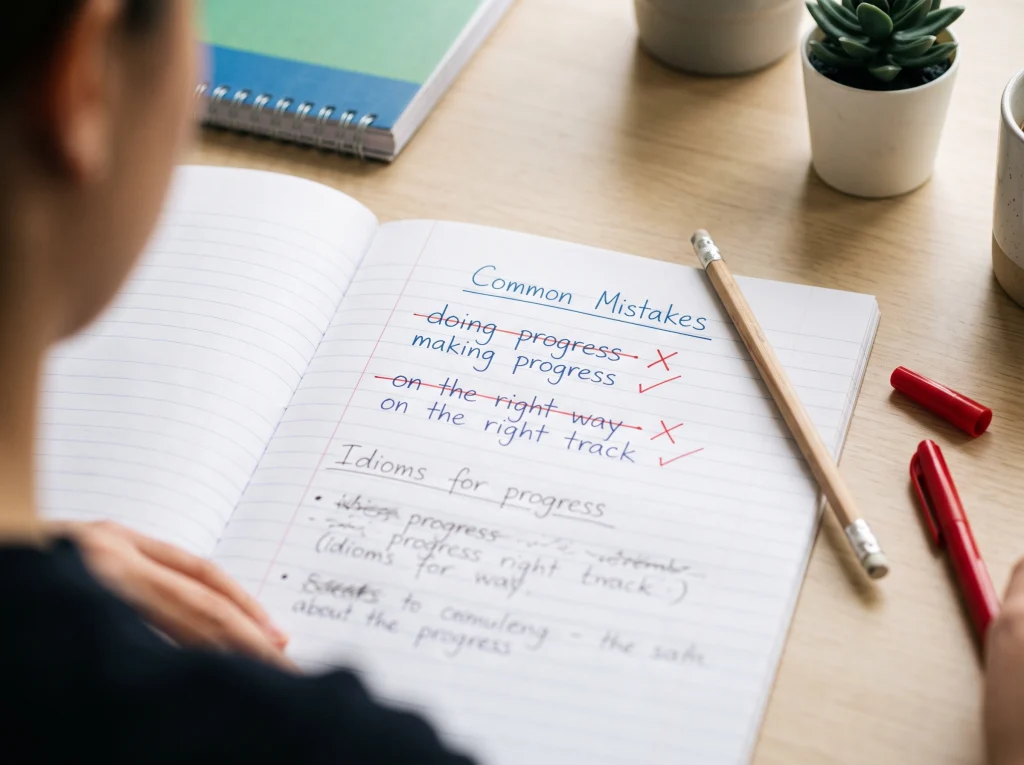
Another common mistake is using an idiom in a situation where plain language would be more suitable. Idioms generally work well in conversations, presentations, and friendly workplace discussions, but formal documents may benefit from direct and precise wording.
Frequently Asked Questions:
Conclusion
Progress idioms help you describe improvement, determination, achievement, and personal growth in natural American English. Expressions such as make headway, come a long way, get back on track, and keep your eye on the prize can make everyday conversations more expressive and memorable.