Pant or Pants? Meaning, Difference, and Correct Usage in American English
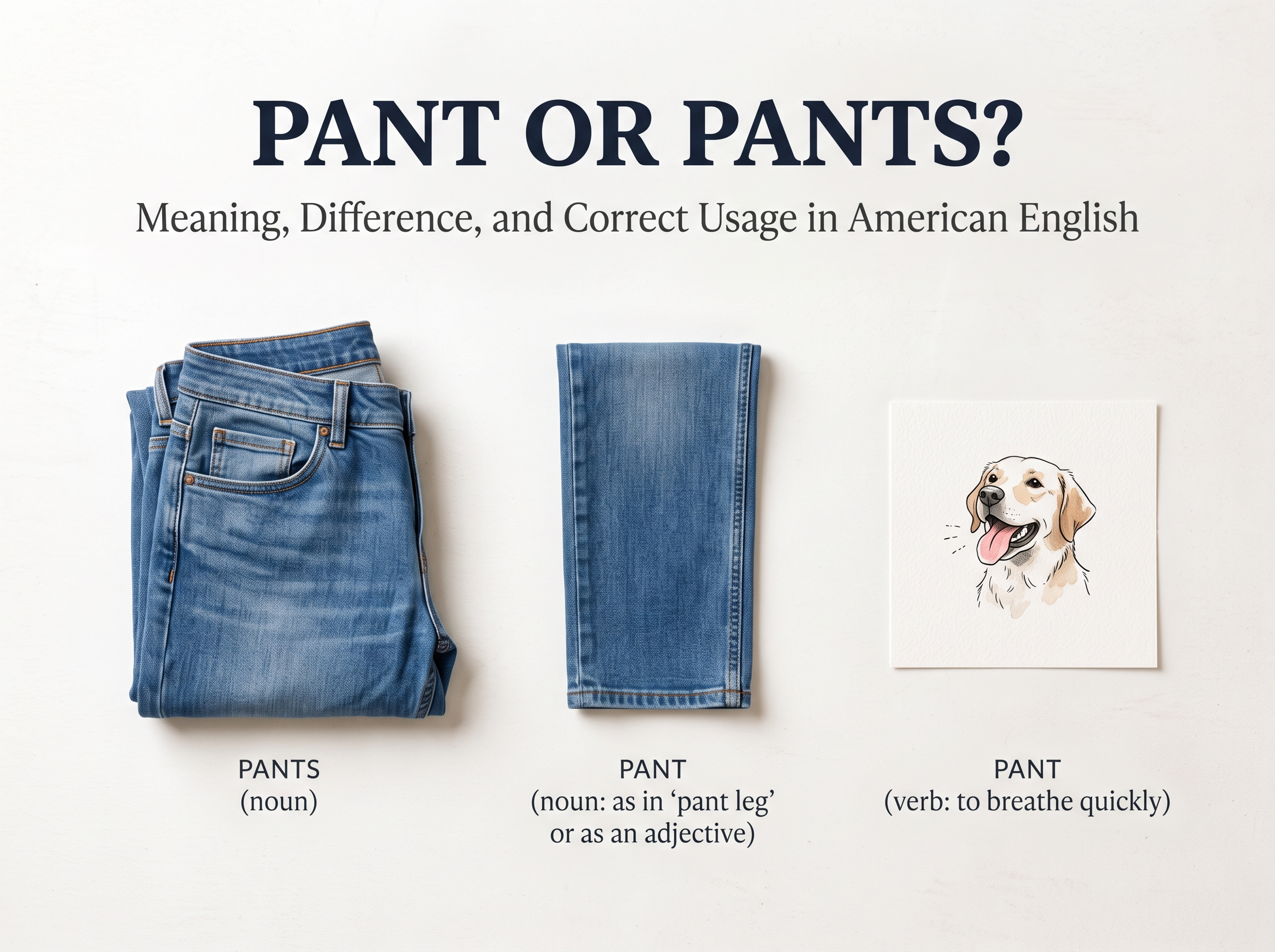
The difference between pant and pants can be confusing for English learners because the two words look almost identical but have different uses. In American English, pants is the standard word for a piece of clothing that covers the body from the waist to the ankles, while pant usually refers to breathing quickly and heavily, although it can also be used as a less common singular clothing term in certain contexts.
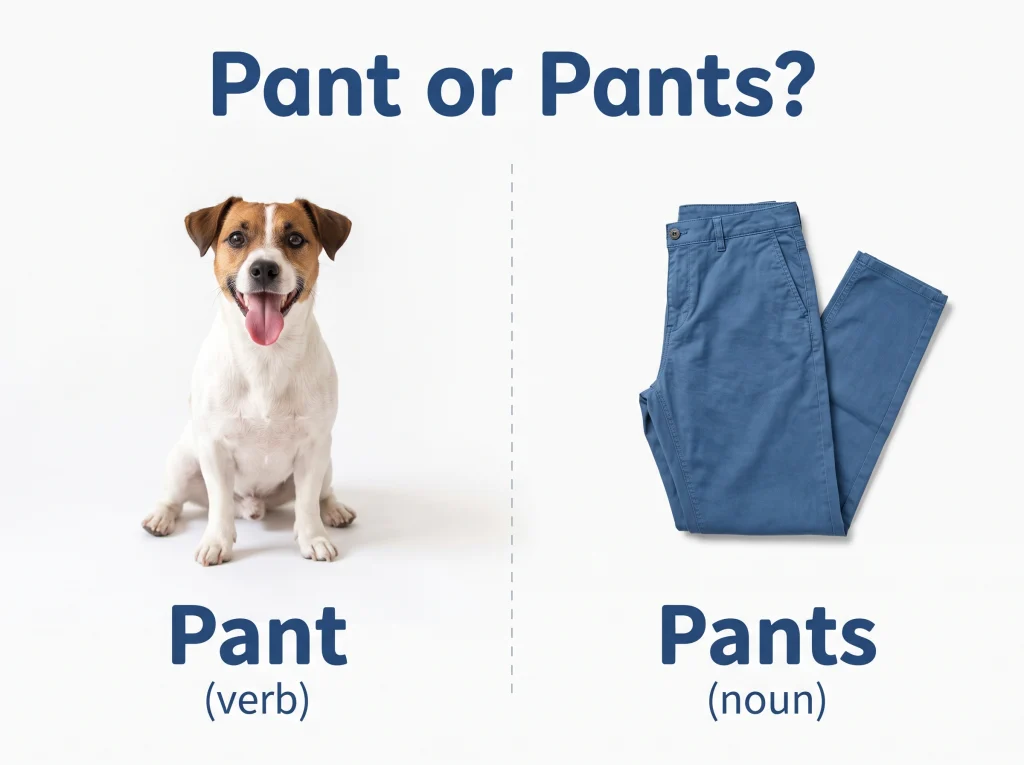
Choosing the right word depends on what you want to describe. You might say, “I bought a new pair of pants,” when talking about clothing, or “The dog began to pant” when describing heavy breathing. Understanding the difference will help you write grammatically correct sentences and communicate more naturally in everyday American English.
Pant or Pants: What Is the Difference?
Pants is the usual American English word for trousers, including jeans, dress pants, and casual pants. It is treated grammatically as a plural noun, even when referring to one garment. For example, Americans normally say, “These pants are comfortable,” rather than “This pant is comfortable.”
Pant is most commonly used as a verb meaning to breathe rapidly and heavily, often after exercise, in hot weather, or during physical effort. For example, “The runner began to pant after climbing the hill.” The word can also be a noun referring to a single leg of a pair of pants, especially in clothing descriptions or technical contexts, but this usage is much less common in everyday American conversation.
Here is the basic difference:
| Word | Main meaning | Example |
|---|---|---|
| Pant | To breathe quickly and heavily | The dog began to pant. |
| Pant | One leg of a pair of pants, in specialized usage | One pant leg was torn. |
| Pants | Clothing covering the legs from the waist down | My pants are black. |
For everyday American English, use pants when talking about clothing and pant when describing heavy breathing.
What Does Pant Mean?
The word pant has two main uses in English: a verb describing heavy breathing and a less common noun referring to a garment or a single clothing item in certain fashion contexts.
1. Pant as a verb
As a verb, pant means to breathe quickly and heavily, usually because of exercise, heat, excitement, or physical effort. People and animals can pant when they need to breathe rapidly.
Examples:
- The dog began to pant after running around the yard.
- I started to pant while climbing the steep trail.
- The athlete continued to pant after the race.
- The little puppy was panting in the summer heat.
- She had to stop and catch her breath because she was panting.
The verb also appears in different grammatical forms. Pant is the base form, pants is the third-person singular present form, panted is the simple past form, and panting is the present participle.
| Verb form | Example |
|---|---|
| Pant | I pant when I run uphill. |
| Pants | The dog pants after exercise. |
| Panted | He panted after carrying the boxes. |
| Panting | The runner was panting heavily. |
Notice that pants can be a verb as well as a noun. In the sentence “The dog pants in hot weather,” it describes an action. In “My pants are too long,” it refers to clothing.
2. Pant as a noun
In American English, pant can refer to a single garment or be used in clothing terminology, particularly in fashion and textile contexts. However, the ordinary term for the complete garment remains pants or a pair of pants.
American Heritage Dictionary
+1
Examples:
- The designer selected a lightweight pant for the summer collection.
- This pant has a narrow leg opening.
- The catalog features a classic khaki pant.
- The tailor adjusted the pant leg to improve the fit.
In everyday conversation, most Americans would naturally say “a pair of pants” rather than “a pant.” The singular form is more likely to appear in product descriptions, clothing catalogs, and specialized discussions of apparel.
What Does Pants Mean?
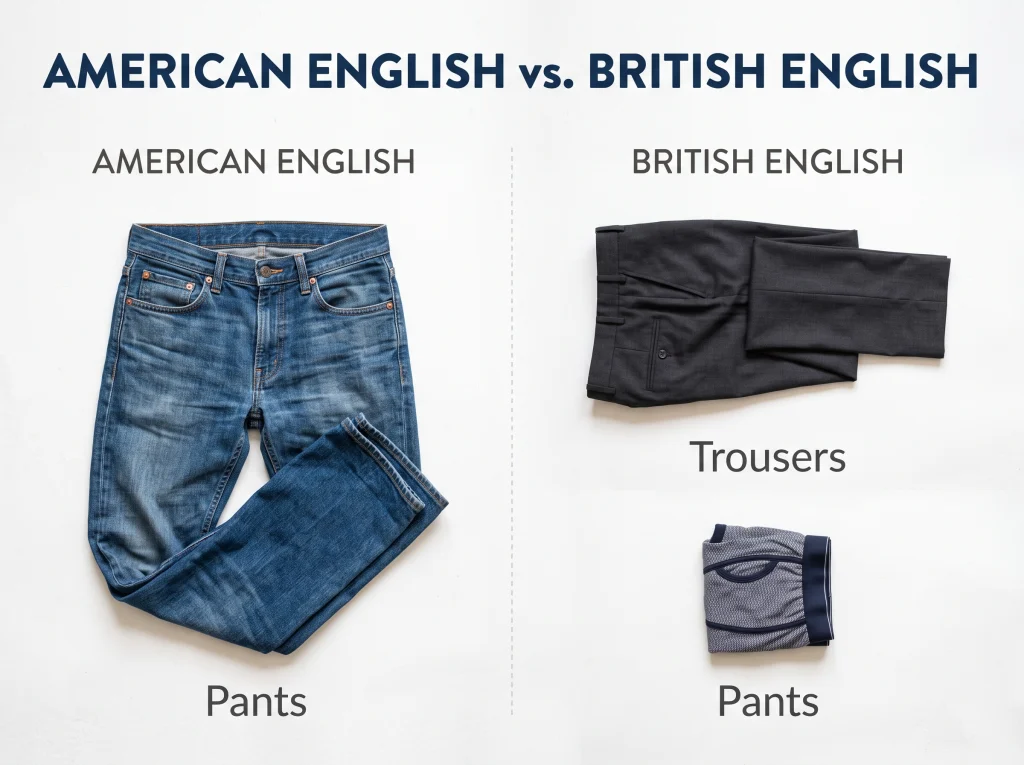
Pants is the standard American English noun for clothing that covers the lower body and has a separate section for each leg. Common examples include jeans, dress pants, sweatpants, cargo pants, and suit pants. In British English, the corresponding word is generally trousers, while pants usually refers to underwear.
definition in the Cambridge English Dictionary
+1
Examples:
- I bought a new pair of pants for work.
- These pants fit me perfectly.
- My black pants are hanging in the closet.
- He wore comfortable pants on the flight.
- The children need warmer pants for winter.
Why do Americans say “a pair of pants”?
Although pants are considered one garment, the clothing has two leg sections. English uses the expression a pair of pants to refer to the complete garment.
For example:
- Correct: I need a new pair of pants.
- Correct: My pants are in the laundry.
- Incorrect in ordinary American English: I need a new pant.
- Incorrect in ordinary American English: My pant is in the laundry.
The singular expression a pair of pants takes a singular verb because its grammatical subject is pair. By contrast, pants takes a plural verb when it is the subject.
Compare these sentences:
- A pair of pants is on the bed.
- These pants are on the bed.
- That pair of pants looks expensive.
- Those pants look expensive.
Remember that pair is the main noun in the first and third examples, so the verbs are singular.
Pant vs. Pants: Key Differences
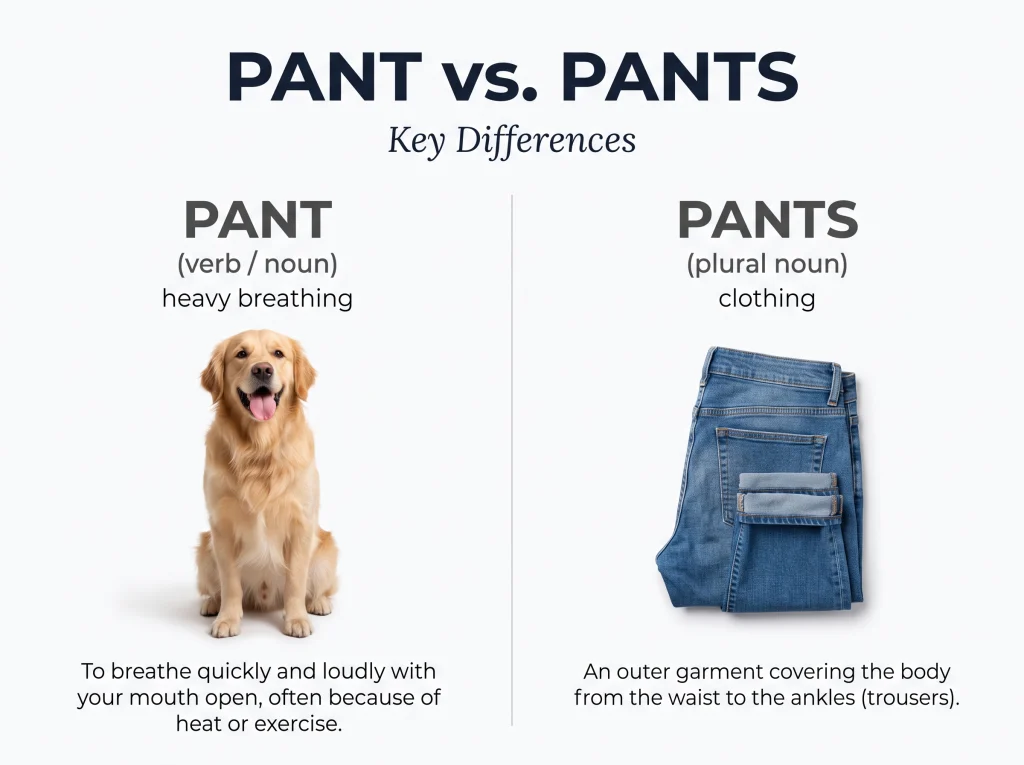
The distinction between pant and pants depends on whether the word describes an action, a specialized clothing term, or an ordinary clothing item.
| Feature | Pant | Pants |
|---|---|---|
| Common grammatical role | Verb | Plural noun |
| Main meaning | To breathe heavily | Clothing covering both legs |
| Clothing usage | Less common singular form | Standard everyday term |
| Example | The dog began to pant. | My pants are clean. |
| Common expression | Pant heavily | A pair of pants |
| Typical American usage | Describing breathing | Talking about clothing |
The most important point is that pant is not always incorrect when referring to clothing. It is simply less common as a standalone singular noun. For everyday American English, use pants for clothing and pant for heavy breathing unless a particular clothing context calls for the singular form.
American Heritage Dictionary
+1
How to Use Pant and Pants in Sentences
Understanding complete sentences is one of the easiest ways to learn the difference. Pay attention to the meaning of the word and the grammatical role it plays.
Examples of pant as a verb
- The exhausted runner began to pant near the finish line.
- My dog pants whenever we play fetch for a long time.
- After carrying the heavy suitcase upstairs, I was panting.
- The horse panted after running across the field.
- The hikers stopped to rest because they were panting.
In each example, pant or one of its forms describes breathing.
Examples of pants as a noun
- I need to buy a new pair of pants before my job interview.
- These pants are too tight around the waist.
- She wore black pants with a white blouse.
- His favorite pants have a small tear near the pocket.
- Those pants look comfortable enough for a long trip.
Here, pants refers to clothing.
Examples of pants as a verb
The word pants can also describe the action of a person or animal breathing heavily when used as the third-person singular form of pant.
- My dog pants after chasing a ball.
- The runner pants as he climbs the hill.
- The horse pants in the summer heat.
In each sentence, pants is a verb, not a clothing noun. The subject is singular, so the verb takes the ending -s.
Examples of pant as a singular clothing term
- The designer created a pant with a wide leg.
- This pant is made from lightweight fabric.
- The store offers a formal pant in several colors.
These sentences are possible in apparel-related contexts, but they are less typical of casual American conversation. When referring to a complete everyday garment, a pair of pants is the safer and more natural choice.
Is Pants Singular or Plural?
In standard American English, pants is a plural noun when it refers to clothing. Although one garment can be called a pair of pants, the noun itself normally takes a plural verb.
Oxford Learner’s Dictionaries
+1
For example, say “My pants are clean,” not “My pants is clean.”
However, when the subject is a pair of pants, use a singular verb because pair is singular.
| Sentence | Correct? | Explanation |
|---|---|---|
| My pants are new. | Correct | Pants takes a plural verb. |
| This pair of pants is new. | Correct | Pair takes a singular verb. |
| These pants fit well. | Correct | These agrees with the plural noun. |
| This pants fits well. | Incorrect | Use “these pants fit well.” |
| One pant leg is shorter. | Correct | Pant leg refers to one section of the garment. |
Can you say “one pant”?
Yes, in certain contexts. The singular pant appears in the American apparel industry, fashion catalogs, and product descriptions. In ordinary conversation, however, one pair of pants is the more natural expression for one complete garment.
American Heritage Dictionary
+1
For example:
- Everyday English: I bought one pair of pants.
- Fashion terminology: The designer introduced a new pant style.
- Clothing description: One pant leg is longer than the other.
Pant and Pants in American and British English
The words pant and pants can have different meanings depending on the variety of English being used. This distinction matters when speaking with people from different countries.
| Context | American English | British English |
|---|---|---|
| Clothing worn over the legs | Pants | Trousers |
| Underwear | Underwear, underpants, or panties, depending on the item | Pants |
| Heavy breathing | Pant | Pant |
| One section covering a leg | Pant leg | Trouser leg |
These differences can occasionally cause misunderstandings. In the United States, saying “I need to buy pants” normally means that you need trousers or similar outer clothing. In the United Kingdom, the same sentence usually refers to underwear.
definition in the Cambridge English Dictionary
+1
If you are writing for an American audience, use pants for ordinary leg-covering clothing. Use underwear, underpants, or panties when you specifically mean undergarments.
Common Mistakes When Using Pant and Pants
English learners sometimes confuse these words because the singular and plural forms can serve different grammatical purposes. The following mistakes are worth avoiding.
1. Using “pant” for an ordinary pair of pants
Incorrect: I bought a new pant yesterday.
Correct: I bought a new pair of pants yesterday.
The singular noun pant is possible in specialized clothing contexts, but a pair of pants is the normal choice in everyday American English.
2. Using a singular verb with pants
Incorrect: My pants is too short.
Correct: My pants are too short.
Because pants is grammatically plural when it refers to clothing, it takes a plural verb.
3. Confusing pants with the verb pants
Incorrect: My dog pants are dirty.
Correct: My dog’s pants are dirty.
Correct: My dog pants after running.
In the second correct example, pants is a verb describing heavy breathing. In the first, pants is a noun referring to clothing, so the sentence needs a possessive form to express ownership.
4. Forgetting the past tense of pant
Incorrect: The dog pant after the long walk yesterday.
Correct: The dog panted after the long walk yesterday.
The past tense of pant is panted. Use it when describing heavy breathing that happened in the past.
5. Confusing “pant leg” with “pants leg”
Both pant leg and pants leg are used in American English. The singular compound pant leg is especially common, while pants leg is also accepted.
American Heritage Dictionary
+1
Examples:
- The hem of my pant leg is coming undone.
- He rolled up his pants leg.
- One pant leg was stained with mud.
Tips for Remembering the Difference Between Pant and Pants
A simple way to remember these words is to connect them with their most common meanings.
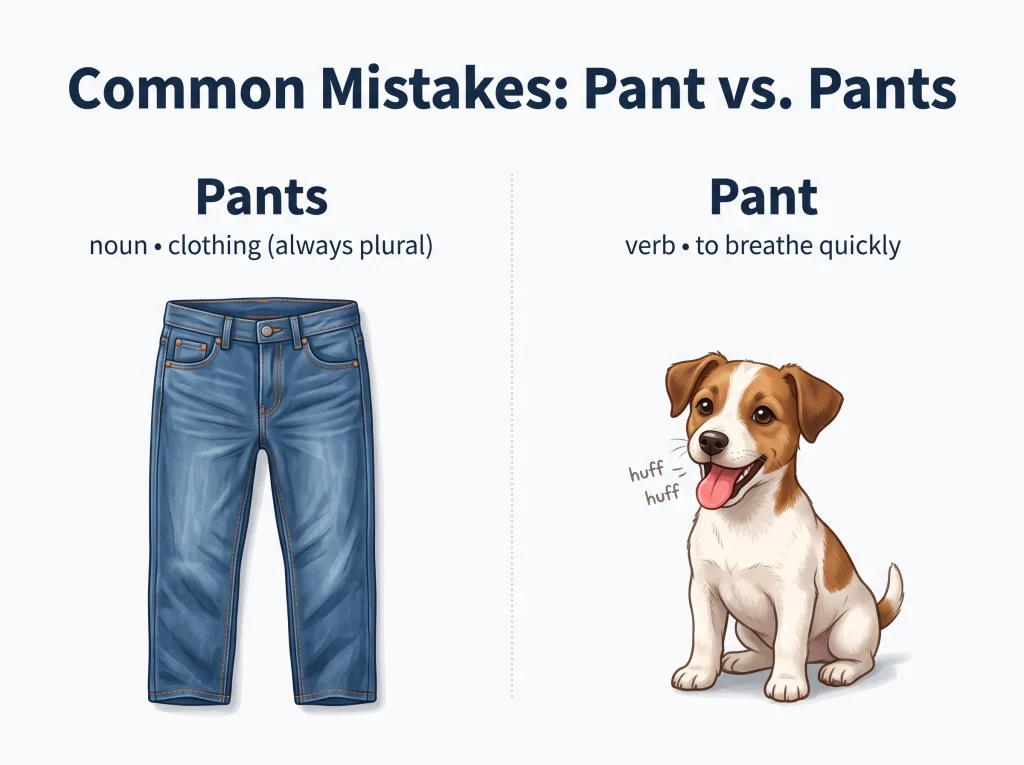
- Pant = breathe heavily. Think of a dog panting after a run.
- Pants = clothing. Think of jeans, dress pants, or sweatpants.
- A pair of pants = one complete garment. Use this expression when counting clothing items.
- Pant leg = one side of the garment. Use this expression when talking about a specific leg section.
You can also practice with two short sentences: “The dog pants after exercise” and “My pants are comfortable.” The first sentence describes an action, while the second identifies an item of clothing.
With regular practice, the difference becomes easier to recognize in conversations, reading, and writing.
FAQs:
Conclusion
The difference between pant and pants comes down to meaning and grammar. In American English, pant most commonly means to breathe quickly and heavily, while pants usually refers to clothing that covers both legs. Although pant can also appear as a singular clothing term in fashion and apparel contexts, a pair of pants is the more natural expression in everyday conversation.