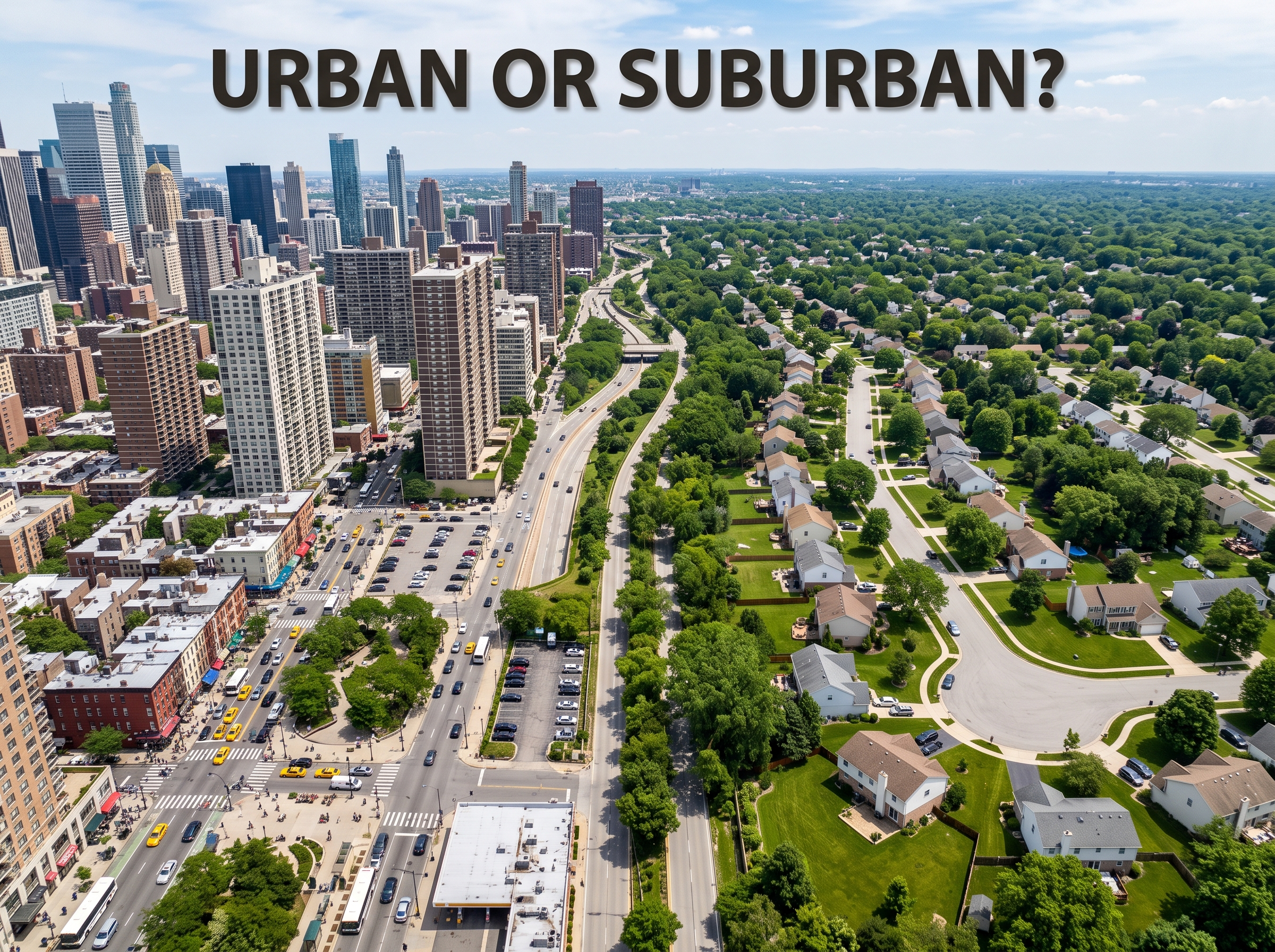
Urban or Suburban? Meaning, Differences, and Examples in American English
The words urban and suburban both describe places where people live, work, and spend their time, but they refer to different types of communities. Urban usually describes cities and densely developed areas, while suburban describes residential communities located in or around the edges of cities and metropolitan areas. The main differences involve population density, housing, transportation, land use, and access to services.
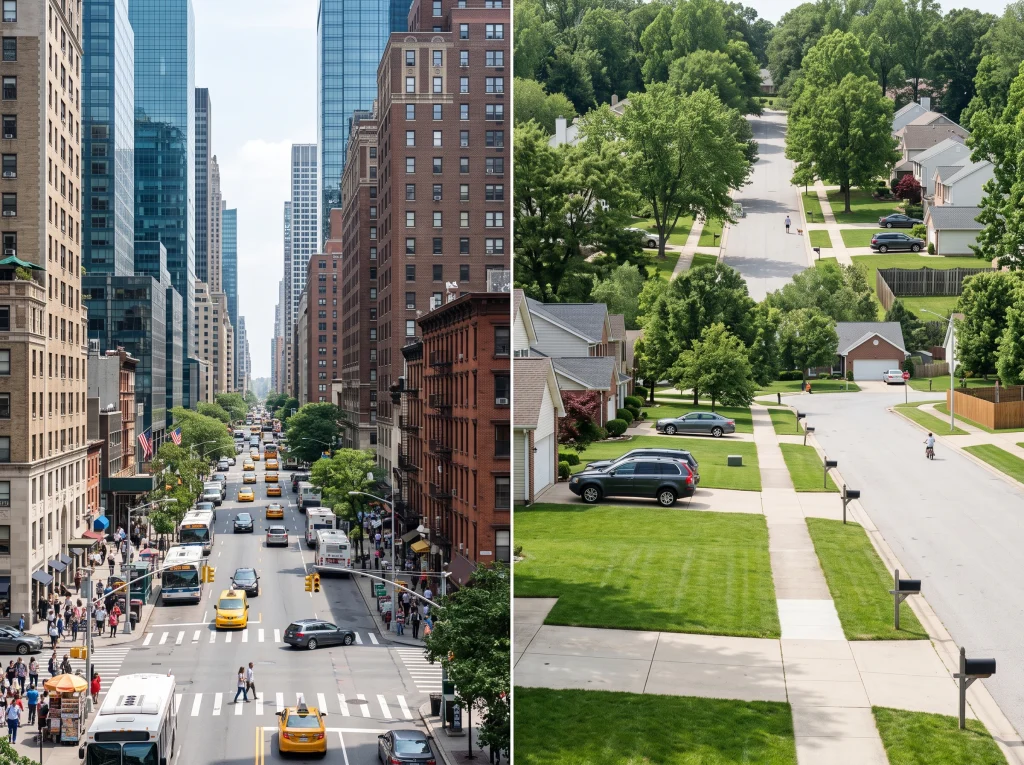
Understanding the difference between urban and suburban is useful when discussing neighborhoods, choosing a place to live, comparing housing options, or reading information about American communities. Although the two terms are closely related, they are not interchangeable. A neighborhood with apartment buildings, busy streets, and extensive public transportation may be described as urban, while a nearby community with single-family homes and residential streets may be described as suburban.
Neither term automatically means that a place is better, safer, more expensive, or more convenient. Those qualities depend on the specific location, local conditions, and individual preferences.
Urban or Suburban: What Is the Difference?
Urban means relating to a city or densely developed area, while suburban means relating to a residential community in or around a city or metropolitan area.
Urban areas often have a higher concentration of people, businesses, apartment buildings, offices, restaurants, and public transportation. Suburban areas often have more residential neighborhoods, detached houses, yards, shopping centers, and roads designed for driving. However, some suburbs have dense apartment complexes, busy downtown districts, and reliable public transit.
The distinction is not always based on distance from a city center. Some suburban communities are close to downtown, while others are farther away. Local development patterns and the way a community is classified also matter.
| Feature | Urban | Suburban |
|---|---|---|
| Basic meaning | Related to a city or densely developed area | Related to a community around a city or metropolitan area |
| Population density | Often higher | Often lower than in nearby urban centers |
| Housing | Apartments, condominiums, townhouses, and some houses | Single-family homes, townhouses, apartments, and planned communities |
| Transportation | Often more public transportation and walkable streets | Often greater reliance on cars, although transit varies |
| Land use | More concentrated buildings and businesses | Often more residential land and open space |
| Daily activities | Services and destinations may be close together | Some destinations may require driving |
| Common setting | City centers and densely developed neighborhoods | Residential communities surrounding or connected to cities |
These are general patterns rather than strict rules. A suburban downtown can be more walkable than some urban neighborhoods, and a city neighborhood can contain detached houses and large yards.
What Does Urban Mean?
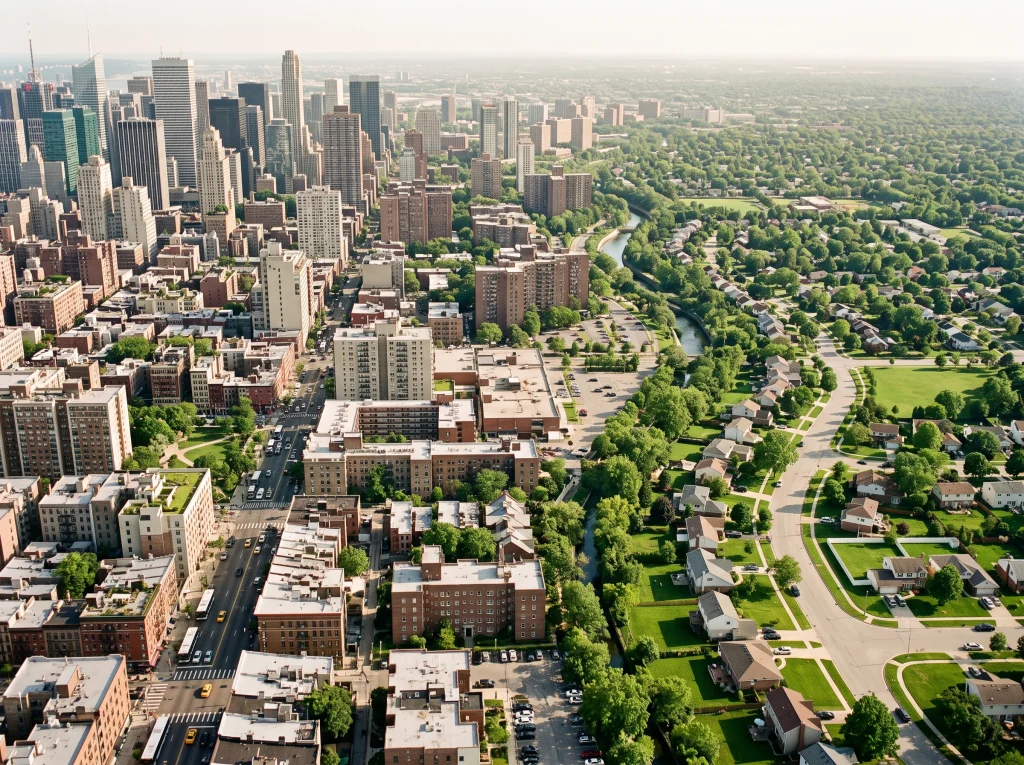
Urban is an adjective that describes a city, a densely developed area, or something associated with city life. Urban places often contain a mix of residential buildings, offices, retail stores, schools, restaurants, and public services within a relatively small area.
In American English, people commonly use urban area, urban neighborhood, urban housing, and urban lifestyle when talking about city environments. The word can describe physical surroundings as well as social, economic, and cultural aspects of city life.
For example, someone who lives in an apartment near downtown Chicago might describe their neighborhood as urban because it has nearby shops, restaurants, offices, and public transportation.
Examples of Urban in Sentences
- She prefers urban living because she can walk to work and nearby restaurants.
- The city approved a new urban housing development near the train station.
- Urban neighborhoods often have a variety of apartments, businesses, and public services.
- The local government is investing in urban infrastructure, including roads and transit.
- He moved from a small town to an urban area for a new job.
Common Urban Expressions
Urban area: A densely developed area containing homes, businesses, and other buildings.
Example: The company plans to open another office in an urban area.
Urban lifestyle: A way of living associated with city environments, often involving convenient access to work, entertainment, and services.
Example: She enjoys the urban lifestyle because she likes living near theaters and museums.
Urban development: The construction, redevelopment, or improvement of buildings and infrastructure in urban areas.
Example: Urban development has changed the appearance of the neighborhood.
Urban planning: The process of planning how land, buildings, transportation, and public spaces are used in a community.
Example: Urban planning can help cities accommodate growing populations.
What Does Suburban Mean?
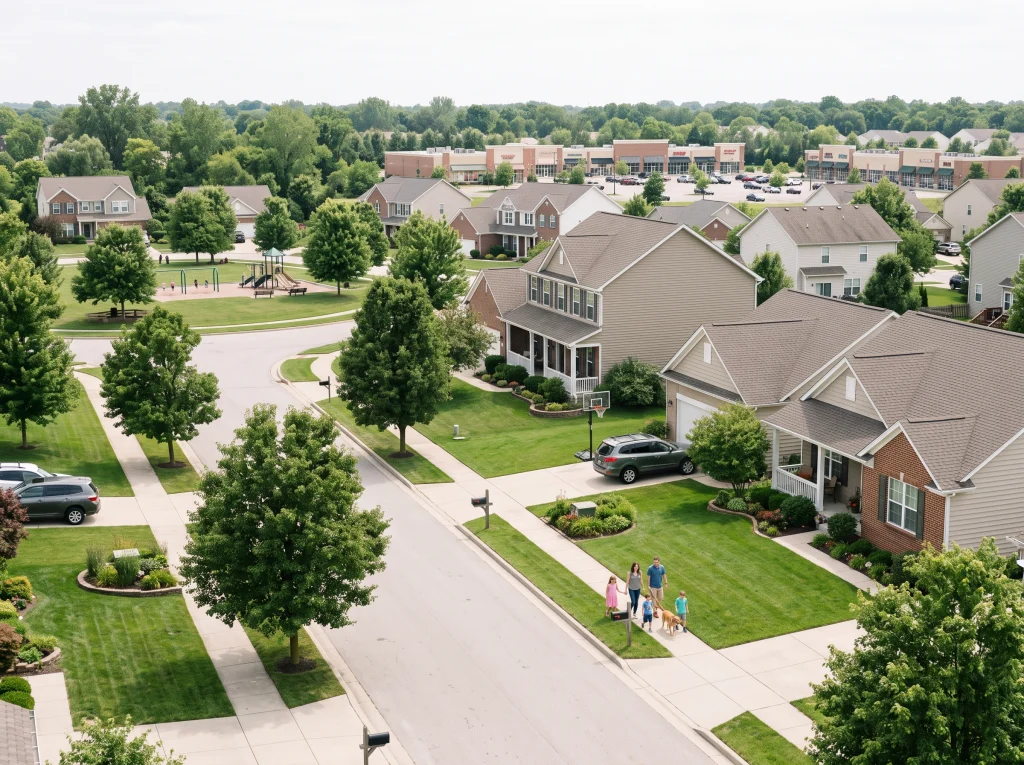
Suburban is an adjective that describes a suburb or a community associated with the area surrounding a city or forming part of a larger metropolitan region. Suburban neighborhoods often include residential streets, single-family houses, apartment complexes, schools, parks, and shopping centers.
In the United States, suburbs vary considerably. Some have quiet residential streets and large yards, while others have dense housing, office buildings, and busy commercial districts. Many suburban communities are connected to nearby cities through highways, commuter rail, buses, or other transportation options.
People use expressions such as suburban neighborhood, suburban home, suburban community, and suburban lifestyle to describe these settings.
For example, a family living in a residential community outside Philadelphia might describe its location as suburban, particularly if the community is closely connected to the city through commuting and local services.
Examples of Suburban in Sentences
- They moved to a suburban neighborhood to find a larger house.
- Her suburban home has a backyard where the children can play.
- The new suburban shopping center includes grocery stores and restaurants.
- Many suburban residents commute to nearby cities for work.
- The town is developing more housing to accommodate its growing suburban population.
Common Suburban Expressions
Suburban area: A community associated with a city or metropolitan region, typically outside its central city.
Example: The company opened a second location in a suburban area.
Suburban home: A house or other residence located in a suburban community.
Example: They bought a suburban home with three bedrooms and a garage.
Suburban lifestyle: A way of living associated with suburban communities, often involving residential neighborhoods and local amenities.
Example: He enjoys the suburban lifestyle because he likes having a yard and living near a park.
Suburban growth: The expansion of housing, businesses, and development in areas surrounding cities.
Example: Suburban growth has increased demand for roads and public services.
Urban vs. Suburban: Key Differences
Urban and suburban communities can share many characteristics, but their typical development patterns and daily routines often differ.
1. Population Density
Urban neighborhoods generally have more people living within a smaller area. Apartment buildings, condominiums, offices, and businesses may be located close together.
Suburban communities often have lower population density than nearby city centers, particularly where detached houses and larger lots are common. However, some suburbs contain dense apartment buildings and townhouses.
Example: An apartment building with hundreds of residents near downtown may be considered urban, while a neighborhood of detached houses on larger lots nearby may be considered suburban.
2. Housing and Property
Urban housing often includes apartments, condominiums, and townhouses. Some city neighborhoods also contain single-family houses, historic homes, and residential streets with gardens.
Suburban housing frequently includes detached homes, driveways, garages, and yards. Nevertheless, apartments and condominiums are also common in many suburban communities.
Example: They chose an urban apartment near the office, while their friends purchased a suburban house with a backyard.
3. Transportation
Urban areas may offer more frequent public transportation, including buses, subway systems, and commuter rail connections. Walking and cycling can also be practical when destinations are close together.
In many suburban areas, residents rely more heavily on personal vehicles to reach work, schools, grocery stores, and entertainment. Some suburbs, however, have extensive public transit and pedestrian-friendly town centers.
Example: An urban employee may walk to a subway station, while a suburban employee may drive to a commuter rail station or travel directly by car.
4. Shopping and Entertainment
Urban neighborhoods often place restaurants, stores, museums, theaters, and workplaces close together. This can make it easier to combine errands and entertainment in one trip.
Suburban communities may have shopping centers, restaurants, movie theaters, and recreation facilities spread across a larger area. The actual experience depends on how the community is designed.
Example: She can walk to several restaurants in her urban neighborhood, while her suburban friends usually drive to a nearby shopping center.
5. Housing Costs and Daily Expenses
Housing prices and living expenses vary widely in both urban and suburban locations. Some major cities have expensive apartments, while some suburban markets have costly houses and high transportation expenses.
Urban residents may spend less on driving if they can walk or use public transportation. Suburban residents may have additional vehicle, fuel, insurance, and commuting expenses, depending on their routines.
Example: A smaller urban apartment may cost more per square foot than a larger suburban home, but the total cost of living depends on rent or mortgage payments, transportation, taxes, utilities, and other expenses.
6. Lifestyle and Environment
Urban areas may appeal to people who want convenient access to workplaces, entertainment, restaurants, and cultural activities. They can also involve more street activity, traffic, noise, and limited private outdoor space in some neighborhoods.
Suburban areas may appeal to people who prefer larger homes, residential streets, parks, or more private outdoor space. However, noise, traffic, access to services, and neighborhood conditions vary from one suburb to another.
Neither setting guarantees a particular quality of life. The best choice depends on a person’s needs, budget, work location, and preferred daily routine.
Examples of Urban and Suburban Areas in the United States
American cities and their surrounding communities provide useful examples of how the terms are used in everyday conversation.

Urban example: Manhattan, New York
Manhattan has densely developed neighborhoods with apartment buildings, offices, shops, restaurants, and extensive public transportation. Many parts of the borough are commonly described as urban.

Suburban example: Naperville, Illinois
Naperville, part of the Chicago metropolitan region, includes residential neighborhoods, parks, shopping areas, and a developed downtown. It is commonly described as a suburb of Chicago, although its downtown has many urban-style features.

A community with both characteristics: Arlington, Virginia
Arlington is part of the Washington, D.C., metropolitan area. Some neighborhoods have dense high-rise buildings and Metro access, while other sections feature quieter residential streets. This shows why a single metropolitan community can contain different development patterns.
These examples illustrate common usage, not a strict federal classification of every neighborhood. The U.S. Census Bureau classifies areas as urban or rural using defined geographic criteria, but it does not specifically define suburban as a separate category in its standard urban-rural classification. As a result, places that people commonly consider suburban may still fall within Census-defined urban areas.
Census.gov
+2
Urban and Suburban in Everyday American English
In American English, urban and suburban are commonly used in conversations about housing, education, transportation, real estate, and community development. The correct word depends on the place or characteristic being described.
Urban vs. Suburban Examples in Sentences
| Urban example | Suburban example |
|---|---|
| She rents an apartment in an urban neighborhood. | She owns a house in a suburban neighborhood. |
| The urban area has several subway stations. | The suburban community has a commuter rail station. |
| Urban development has increased the number of apartment buildings. | Suburban development has expanded the residential community. |
| He enjoys the urban lifestyle and nearby entertainment. | He prefers the suburban lifestyle and a larger yard. |
| The city is improving its urban transportation network. | The county is improving roads that serve suburban neighborhoods. |

How Are Urban and Suburban Used in Real Estate?
In real estate, urban and suburban help describe a property’s location and surrounding environment.
An urban property might be an apartment in a downtown building, a condominium near public transit, or a house in a densely developed city neighborhood. A suburban property might be a detached house in a residential subdivision, a townhouse near a shopping center, or an apartment in a community outside a central city.
These descriptions do not determine a property’s value. Location, property condition, size, local demand, taxes, and access to amenities all influence real estate decisions.
How Are Urban and Suburban Used in Education?
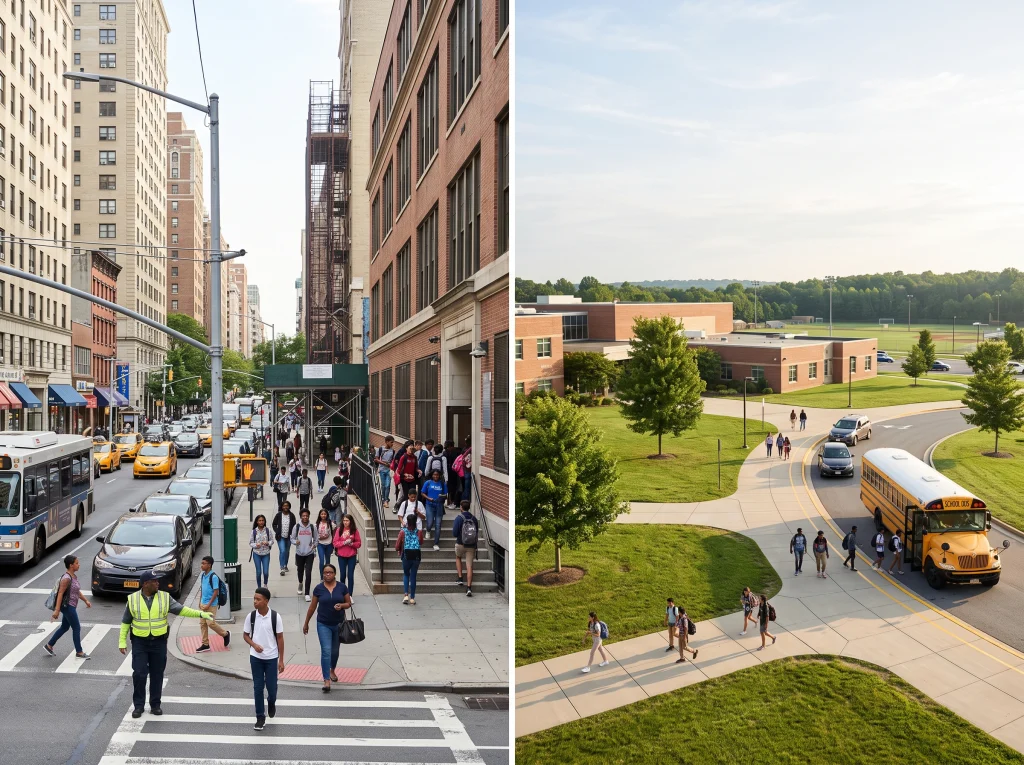
Schools may also be described as urban or suburban according to their location and the classification system being used. For example, the National Center for Education Statistics uses school locale categories that distinguish city, suburban, town, and rural settings. Its classifications use geographic criteria rather than simply relying on how a school describes itself.
Definitions
Example: The district operates schools in both urban and suburban communities.
How to Choose Between Urban and Suburban
If you are comparing places to live, work, or study, consider how each setting fits your everyday needs.
Choose an urban setting if you prefer:
- Living near offices, restaurants, stores, and entertainment.
- Having access to public transportation and walkable destinations.
- Living in an apartment or condominium close to city amenities.
- Being near cultural attractions and a wide range of services.
Consider a suburban setting if you prefer:
- Living in a neighborhood with detached homes or larger yards.
- Having access to parks, residential streets, and local recreation.
- Living outside a central city while remaining connected to its jobs and services.
- Having more housing choices that suit your preferred space and layout.
These are general considerations, not guarantees. Before choosing a property, compare the actual neighborhood, commute, transportation options, housing costs, and nearby services. An urban neighborhood may be quiet and residential, while a suburban town center may be busy and highly walkable.
Common Mistakes When Using Urban and Suburban
1. Treating Urban and Suburban as Synonyms
Although both terms relate to developed communities, they do not mean the same thing. Urban usually refers to a city or densely developed area, while suburban refers to a community associated with the outskirts or wider area of a city.
Incorrect: They moved to an urban neighborhood in the suburbs, so the words mean exactly the same thing.
Better: They moved to a suburban neighborhood with an urban-style downtown.
The revised sentence recognizes that a suburban community can contain densely developed areas.
2. Assuming Every Suburb Is Quiet
Some suburbs have quiet residential streets, but others contain busy commercial districts, apartment towers, offices, and heavy traffic. The word suburban does not automatically mean peaceful or uncrowded.
Example: The suburban business district becomes busy during the morning commute.
3. Assuming Urban Always Means Expensive
Urban housing can be expensive, especially in high-demand locations, but costs vary widely. Some suburban communities have higher housing prices than certain urban neighborhoods.
Example: The urban apartment was more affordable than the suburban house they considered.
4. Confusing Urban With Rural
Urban and rural describe different development patterns. Urban areas are generally densely developed, while rural areas are outside Census-defined urban areas and often include less densely settled land.
Suburban communities occupy a different conceptual position in everyday usage, although some are included within the Census Bureau’s urban classification.
Census.gov
+1
Example: They moved from a rural community to an urban neighborhood, while their relatives settled in a nearby suburb.
5. Using the Words Incorrectly in Sentences
Both urban and suburban are adjectives, so they normally describe nouns.
Correct examples:
- Urban neighborhood
- Urban development
- Suburban house
- Suburban community
To refer to the people or places themselves, use an appropriate noun phrase.
Example: The urban residents attended the meeting, while residents from the surrounding suburbs joined online.
Frequently Asked Questions:
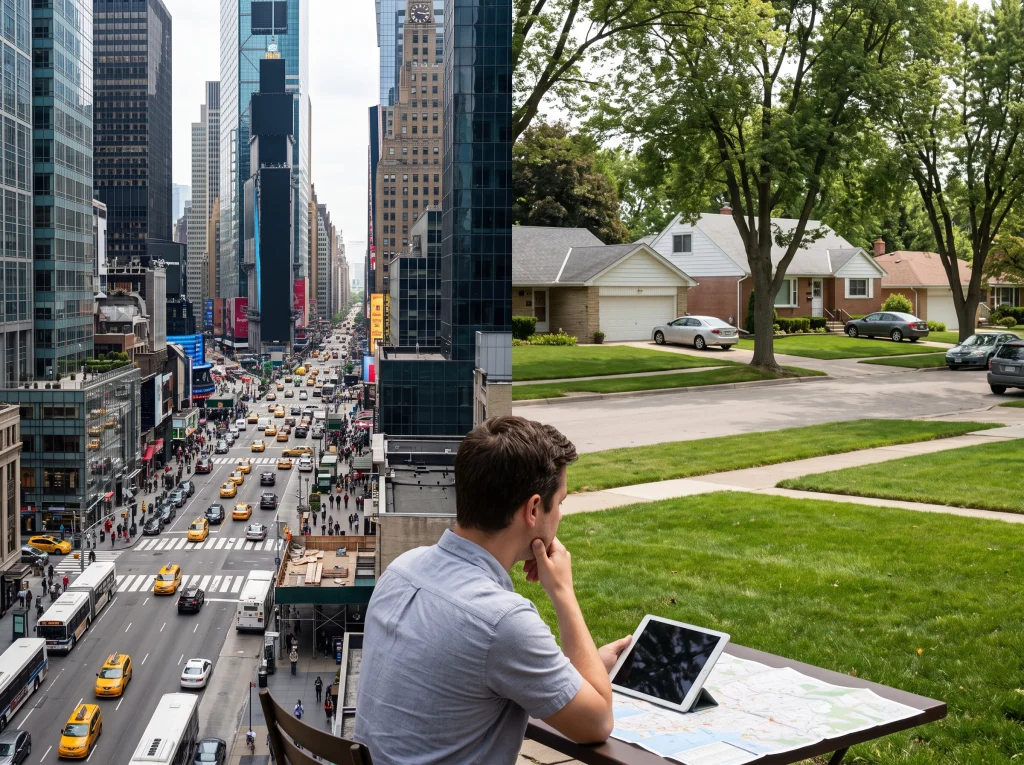
Neither is automatically better. Urban living may suit people who value walkability, public transportation, and proximity to work and entertainment. Suburban living may suit people who prefer certain types of residential neighborhoods, larger homes, or yards. The better choice depends on budget, lifestyle, location, and personal needs.
Generally, yes. Urban describes a city or a densely developed area associated with city life. However, the U.S. Census Bureau’s definition of an urban area does not depend solely on municipal city boundaries. Some densely developed areas outside an incorporated city can qualify as urban.
Census.gov
+1
Conclusion
Urban and suburban describe two related but distinct types of communities. Urban usually refers to cities and densely developed areas, while suburban refers to communities around or connected to central cities and metropolitan regions. The differences often involve housing, population density, transportation, and access to services, although individual neighborhoods can vary considerably.