
Rehireable or Rehirable? Which Spelling Is Correct in American English?
If you have ever written about an employee who could return to a former company, you may have wondered whether the correct spelling is rehireable or rehirable. Both forms appear in workplace writing, HR documents, online discussions, and employment records, which makes the choice confusing.

In American English, rehirable is the more concise form and follows the spelling pattern seen in hirable. However, rehireable is also found in actual workplace usage, and the two forms are generally understood to have the same meaning: able or eligible to be hired again.
The safest wording in formal employment communication is often eligible for rehire, especially when you want to describe an employee’s official employment status clearly. The important point is to understand how each form is used and choose one consistently.
Rehireable or Rehirable: Which Spelling Is Correct?
Rehirable is a well formed spelling meaning “able or eligible to be hired again.” Rehireable is also used with the same meaning, particularly in workplace and HR contexts.
The confusion comes from the verb rehire and the adjective-forming suffix -able. English spelling does not always treat final silent e in exactly the same way when forming adjectives. The related word hirable is itself recognized in dictionary usage, while hireable also appears as a variant.
For U.S. writing, rehirable is a clean choice when you need a single adjective. In especially formal HR communication, eligible for rehire can be even clearer.
Quick answer
- Rehirable: means able or eligible to be hired again.
- Rehireable: also appears with the same intended meaning.
- Eligible for rehire: a clear phrase commonly suited to formal workplace communication.
- Meaning: all three expressions can communicate that a former employee may be hired again.
What Does Rehirable Mean?
Rehirable is an adjective that describes a person who can be hired again by a former employer.
For example:
The former employee is rehirable if a suitable position becomes available.
The word is formed from rehire, meaning to hire someone again, and -able, meaning capable of or suitable for something.
In employment situations, being rehirable can refer to a former employee’s status with a company. However, the exact meaning can depend on the employer’s policies. A person described as rehirable may still need to apply for an open position, meet current requirements, and go through the company’s normal hiring process.
The word therefore does not necessarily mean that the person has a guaranteed right to return to the job.
What Does Rehireable Mean?
Rehireable is another spelling used to express the idea that someone can be hired again.
For example:
The manager said that the former employee was rehireable.
You may encounter this spelling in workplace communication, internal HR systems, employment discussions, and online writing. It is understandable because writers naturally see rehire and add -able, producing rehireable.
The existence of both spellings is not surprising because English has several adjectives with competing forms involving a final e. For example, dictionaries recognize both hirable and hireable.
For polished American English, however, rehirable is a straightforward choice because it parallels hirable.
Rehireable vs. Rehirable Comparison
| Feature | Rehirable | Rehireable |
|---|---|---|
| Part of speech | Adjective | Adjective |
| Basic meaning | Able to be hired again | Able to be hired again |
| Base verb | Rehire | Rehire |
| Spelling | Drops the final e | Keeps the final e |
| Workplace use | Commonly understood | Commonly encountered |
| Formal alternative | Eligible for rehire | Eligible for rehire |
| Best approach | Use consistently | Use consistently if your workplace uses it |
The central difference is simply the spelling. The intended meaning is generally the same.
If you are writing a résumé, formal letter, HR policy, or other professional document, eligible for rehire can remove any spelling uncertainty while making the employment meaning explicit.

Why Are Both Spellings Used?
The confusion comes from the way English forms adjectives with -able.
The verb hire ends in a silent e. When -able is added, English has historically allowed more than one pattern in some words. Dictionaries recognize hirable and hireable, showing that the spelling variation is not unique to rehirable and rehireable.
Once the prefix re- is added, the same issue appears:
rehire → rehirable
and
rehire → rehireable
Because both forms are easy to understand, writers may encounter either one.
This also explains why online sources do not always agree. Some writing guides describe rehirable as the preferred form, while other sources treat rehireable as an accepted variant. The safest conclusion is to recognize the usage variation rather than assume that every occurrence of one spelling is automatically a spelling error.
How the Silent E Rule Applies
A common spelling guideline says that a final silent e is often removed before a suffix beginning with a vowel.
Some familiar examples include:
- use → usable
- move → movable
- size → sizable
- like → likable
- hire → hirable
Following that pattern gives:
rehire → rehirable
This makes rehirable a natural spelling for writers who follow the drop-the-e pattern.
However, English spelling contains many exceptions and competing forms. The existence of hireable alongside hirable shows why it is better not to treat the spelling rule as an absolute law.
For learners, the easiest practical approach is to remember rehirable as the concise form and use eligible for rehire when a formal HR phrase is preferable.
Rehirable in American English
In American workplace English, you may see terms such as rehire, rehired, rehire eligibility, and eligible for rehire.
For example:
The company considered the former employee eligible for rehire.
The manager confirmed that she was rehirable.
The employee was rehired after applying for an open position.
These sentences have slightly different functions.
Rehire is commonly used as a verb or noun.
Rehired describes something that already happened.
Rehirable describes the possibility or eligibility of being hired again.
Eligible for rehire is a phrase that directly describes employment eligibility.
This distinction is useful because rehirable does not mean that a person has already been hired again.

Common Workplace Examples
Here are natural examples showing how the word can be used:
Example 1
After leaving the company on good terms, Maria was considered rehirable.
Example 2
The supervisor confirmed that the former employee was eligible for rehire.
Example 3
The company keeps records showing whether former employees are rehirable.
Example 4
He was rehired two years after leaving the company.
Example 5
The manager said that the former employee could be considered for rehire if a position opened.
Example 6
Her previous employment record did not prevent her from being considered for rehire.
These examples show why rehirable and eligible for rehire should not be confused with rehired. The first two describe a possibility or status, while rehired describes an actual event.
Common Mistakes With Rehireable and Rehirable
Mistake 1: Confusing rehirable with rehired
These words do not have the same grammatical function.
Incorrect meaning:
She is rehirable.
This means she can potentially be hired again.
Different meaning:
She was rehired.
This means the company actually hired her again.
Mistake 2: Assuming rehireable and rehirable describe different things
In ordinary workplace usage, the two spellings are generally intended to communicate the same idea.
The difference is primarily spelling rather than meaning.

Mistake 3: Treating rehirable as a guarantee of employment
Being described as rehirable does not necessarily mean that a former employee will receive another job offer.
A company may still require an application, interview, background check, reference check, or other hiring steps.
Mistake 4: Mixing spellings in the same document
If you choose rehirable, use it consistently. If your organization’s established terminology uses rehireable, changing between the two forms can make a document look inconsistent.
Consistency is especially important in HR policies and internal documentation.
How to Remember the Spelling
A simple memory trick is to connect rehirable with hirable:
hire → hirable
rehire → rehirable
The prefix re- means again. It changes hire into rehire, but the adjective pattern remains connected to hirable.
You can also remember:
rehirable = re + hirable
This gives you a quick way to recall the spelling when writing an email, résumé, employment document, or workplace message.
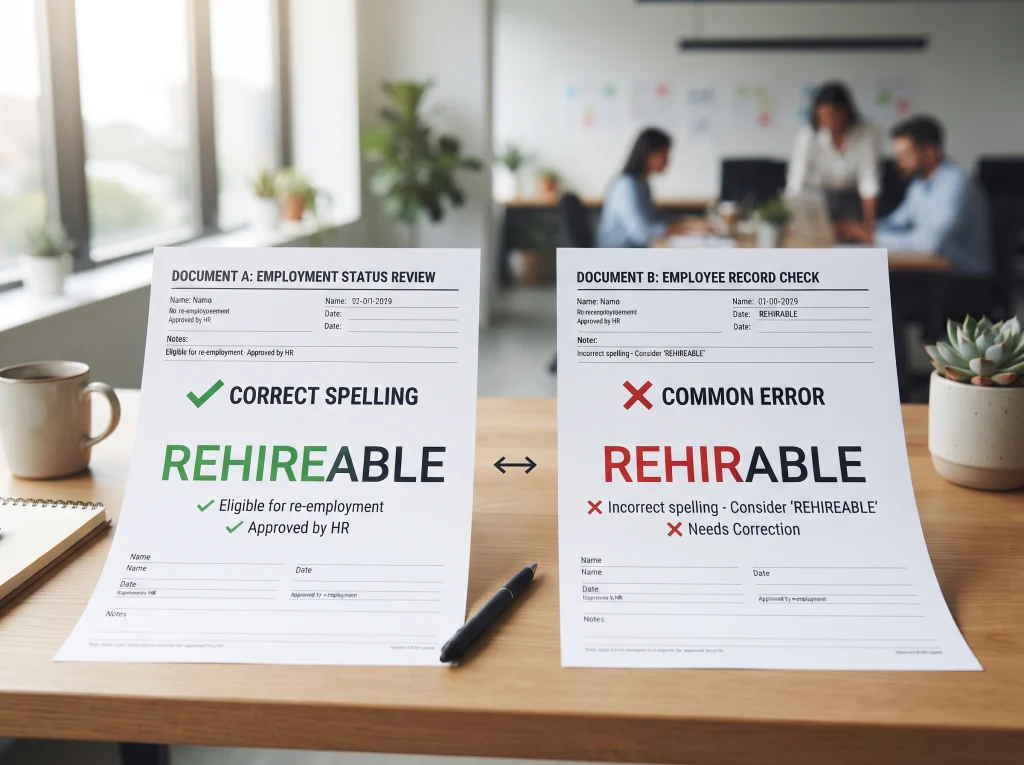
Rehirable vs. Eligible for Rehire
Although rehirable is concise, eligible for rehire can be a particularly clear phrase in professional communication.
Compare these examples:
The employee is rehirable.
The employee is eligible for rehire.
The second sentence makes the employment context completely explicit. It is useful when discussing company records, employment applications, or a former employee’s status.
However, the phrase does not automatically mean that the company intends to hire the person again. It simply communicates eligibility or potential consideration for future employment.
The exact criteria for rehire eligibility can vary by employer, so workplace policies should be checked when the distinction has legal or employment consequences.
Frequently Asked Questions
Conclusion
The spelling question rehireable or rehirable can be confusing because both forms appear in workplace writing. Rehirable is the concise form and follows the spelling pattern of hirable, while rehireable is also encountered with the same intended meaning.
For clear American English, rehirable is a useful choice. In formal HR communication, eligible for rehire can be even more explicit.