Stary or Starry: Which Spelling Is Correct? Meaning and Examples
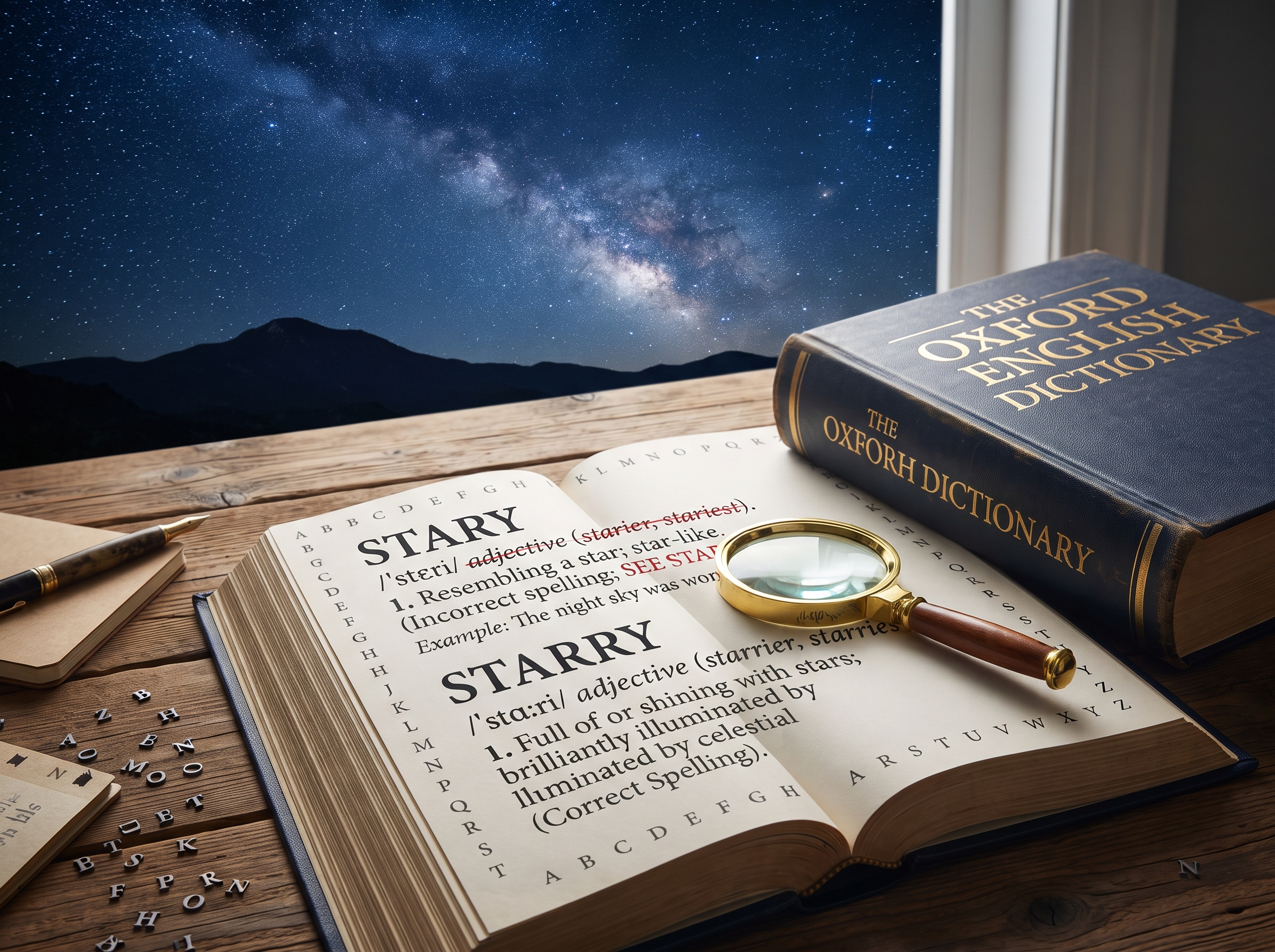
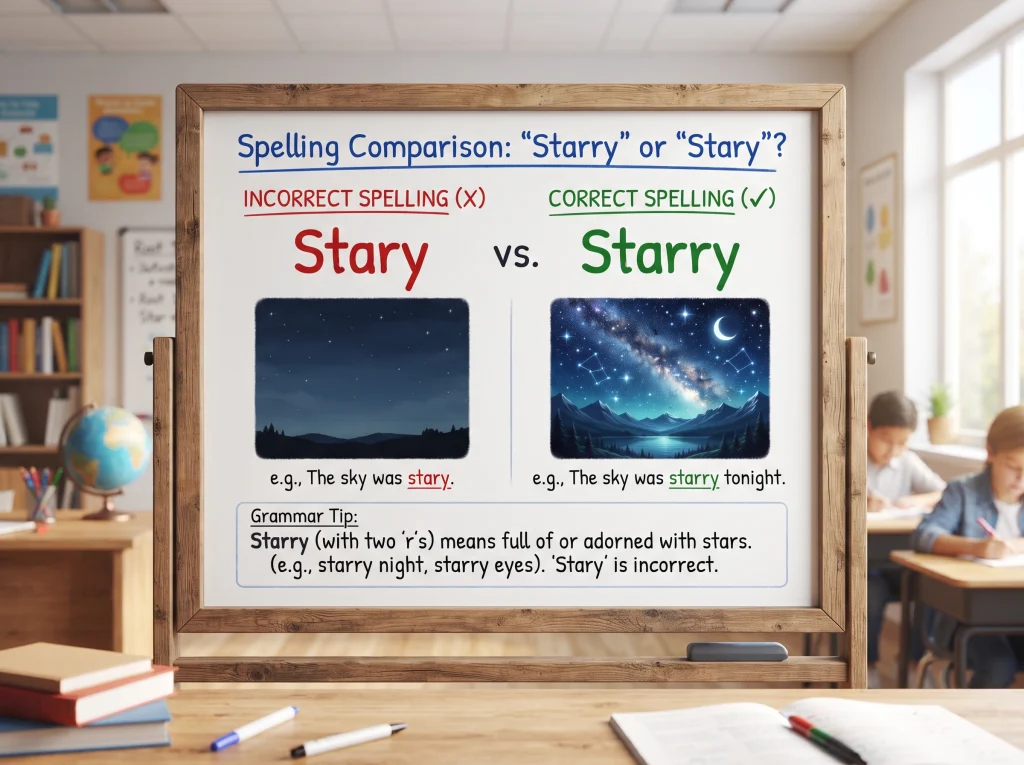
If you are wondering whether the correct spelling is stary or starry, the correct word is starry. The spelling stary is generally a misspelling when you mean something full of stars or lit by stars.
In American English, starry is an adjective meaning “full of stars” or describing something lit by stars. For example, you can talk about a starry night, a starry sky, or a starry evening. Cambridge Dictionary lists starry as the standard American English adjective with the meaning “full of stars.”
The easiest way to remember it is simple:
Correct: starry
Incorrect: stary
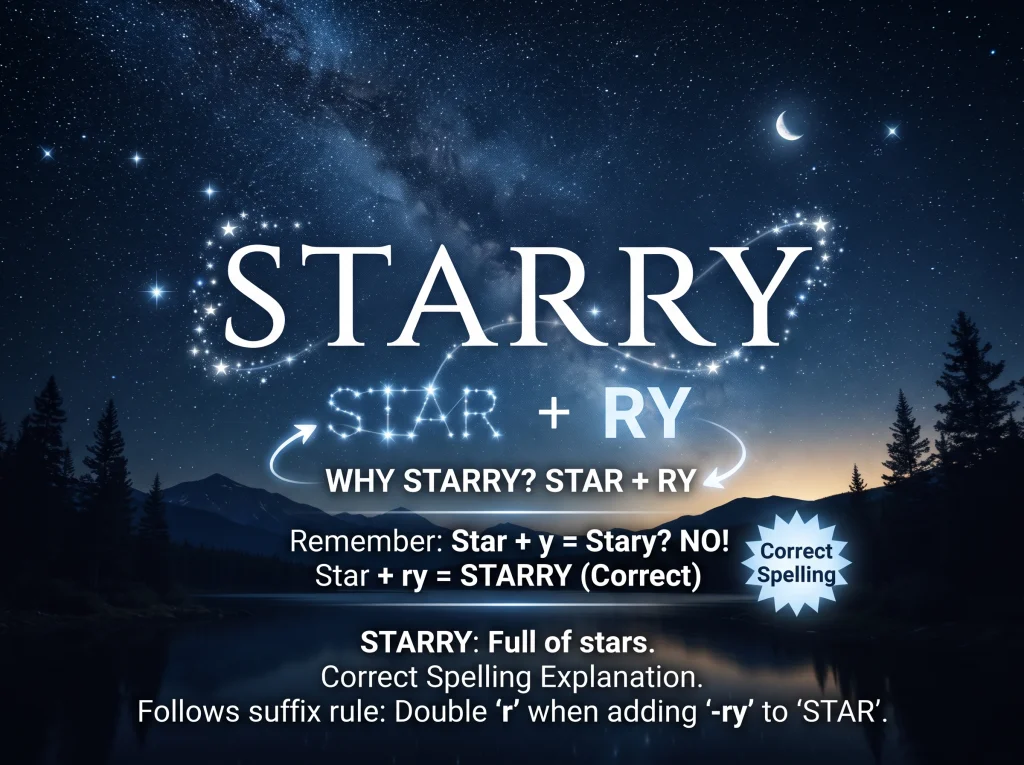
The word starry contains two r’s because it is formed from star with the adjective ending -y.
Stary or Starry: Which Is Correct?
Starry is the correct spelling.
| Spelling | Correct? | Example |
|---|---|---|
| Starry | Yes | We sat outside under a starry sky. |
| Stary | No | We sat outside under a stary sky. |
The extra r is important. The base word is star, so adding -y produces:
star + y = starry
Not:
star + y = stary
This spelling pattern also appears in other English words where a consonant is doubled before an ending. Learning the complete word rather than trying to spell it only from pronunciation can help prevent this mistake.
Why Is Starry the Correct Spelling?
Starry comes from the noun star and describes something associated with or filled with stars. In standard English spelling, the final r in star is retained and another r appears before the y ending.
Cambridge Dictionary defines starry in American English as meaning “full of stars.” It gives examples involving a starry night or sky.
For example:
The children looked at the starry sky.
Here, starry describes the sky because the sky is filled with visible stars.
The same spelling is used whether you are writing about astronomy, nature, literature, photography, or everyday experiences.
Starry Meaning in American English
In American English, starry is an adjective. Its most common meaning is full of stars or lit by stars.
For example:
We walked home beneath a starry sky.
The word can describe:
- a starry sky
- a starry night
- a starry evening
- a starry landscape
- a starry background
- a starry scene
The word can create a visual description of a night sky filled with stars.
Cambridge Dictionary also records an informal use of starry relating to someone who expects to be treated like a famous star. However, this meaning is much less common than the sense referring to stars in the sky.

Stary vs. Starry
The difference between stary and starry is mainly a spelling issue.
Starry is the standard spelling when you mean full of stars or lit by stars.
Stary is generally an incorrect spelling of that adjective.
Compare these sentences:
Correct: We spent the evening under a starry sky.
Incorrect: We spent the evening under a stary sky.
Another example:
Correct: It was a beautiful starry night.
Incorrect: It was a beautiful stary night.
If you are writing an email, school assignment, article, social media post, or professional document, use starry.
How to Spell Starry Correctly
The correct spelling is:
S T A R R Y
A simple way to break it down is:
STAR + RY = STARRY
The word starts with star, which already contains an r. When the -y ending is added, the standard spelling becomes starry with two consecutive r’s.
Remember:
starry ✓
stary ✗
You can also connect the spelling with familiar phrases:
starry sky
starry night
starry eyes
starry-eyed
Seeing the word in common phrases can make the spelling easier to remember.

How to Remember the Spelling
One useful memory trick is to look at the base word:
STAR → STARRY
Keep both r’s from the spelling pattern in mind:
STA + RR + Y
Another simple trick is to remember that a star becomes starry when you describe something as being full of stars.
Think:
One star → starry sky
The extra r helps you remember that the correct form is starry, not stary.
You can also practice it in a sentence:
I love looking at the starry sky.
Once you associate the word with this familiar phrase, the correct spelling becomes easier to recall.
Examples of Starry in Sentences
Here are natural examples of starry in American English.
1. We sat outside and watched the starry sky.
2. It was a warm summer night with a clear, starry sky.
3. The children looked up at the starry heavens.
4. She took a picture of the beautiful starry night.
5. The cabin offered a wonderful view of the starry sky.
6. We walked along the beach beneath a starry sky.
7. The artist painted a starry background behind the mountains.
8. The desert looks especially beautiful on a starry night.
9. They spent hours talking under the starry sky.
10. The bedroom has a ceiling decorated with a starry pattern.
In each example, starry works as an adjective describing something connected with or filled with stars.

Common Mistakes With Starry
Mistake 1: Writing Stary
The most common spelling mistake is leaving out one r.
Incorrect:
The night was stary.
Correct:
The night was starry.
Remember that the correct form contains two r’s.
Mistake 2: Confusing Starry With Star
Star is a noun or verb, while starry is an adjective.
For example:
The star is bright.
Here, star is a noun.
The sky is starry.
Here, starry describes the sky.
These words are related, but they serve different grammatical purposes.
Mistake 3: Confusing Starry With Starred
Starry and starred have different meanings.
Starry means full of stars or related to stars.
Starred can mean marked with a star or featuring someone in a performance. Cambridge Dictionary gives examples such as items marked with an asterisk and a person who appears as an important performer.
For example:
The sky was starry.
The starred items on the list need attention.
Using one word in place of the other can change the meaning of a sentence.
Starry and Related Words
Learning related forms can help expand your vocabulary.
| Word | Part of Speech | Meaning |
|---|---|---|
| star | Noun | A large astronomical object or a famous performer |
| starry | Adjective | Full of stars or lit by stars |
| starred | Adjective/Verb form | Marked with a star or featured in a performance |
| starry-eyed | Adjective | Unrealistically or excessively positive about something |
For example:
The star is shining brightly.
The sky is starry tonight.
The starred items need to be reviewed.
She was starry-eyed about her new plans.
Starry vs. Starry-Eyed
Starry and starry-eyed are related expressions, but they do not mean the same thing.
Starry describes something connected with or full of stars.
Example: We slept beneath a starry sky.
Starry-eyed describes someone who is very idealistic or unrealistically positive about something. Cambridge Dictionary defines starry-eyed as having thoughts or opinions that are unreasonably positive and therefore not fully realistic.
For example:
She was starry-eyed about becoming a famous singer.
In this sentence, starry-eyed does not describe literal stars. It describes an overly idealistic attitude.
When to Use Starry
Use starry when you want to describe a sky, night, scene, or other setting that has many stars or appears illuminated by stars.
Common combinations include:
- starry sky
- starry night
- starry evening
- starry heavens
- starry landscape
- starry background
The word is especially common in descriptive writing because it creates a clear picture of a night scene.
For everyday American English, starry night and starry sky are particularly natural combinations.
Frequently Asked Questions:
Final Answer: Stary or Starry?
If you are asking “Is it stary or starry?”, the correct spelling is starry.
Starry is an adjective meaning full of stars or lit by stars. It is commonly used in expressions such as starry sky and starry night.
The spelling stary is generally incorrect when you mean this adjective.
The easiest form to remember is:
STARRY ✓
STARY ✗
Remember STAR + Y = STARRY, with two r’s.