
120 Idioms for School: Meanings and Examples for Students
School is full of opportunities to learn new things, make friends, solve problems, and prepare for the future. When students talk about homework, exams, teachers, and classroom experiences, they often use expressions that have meanings beyond their literal words. These expressions are called idioms, and they are an important part of everyday American English.
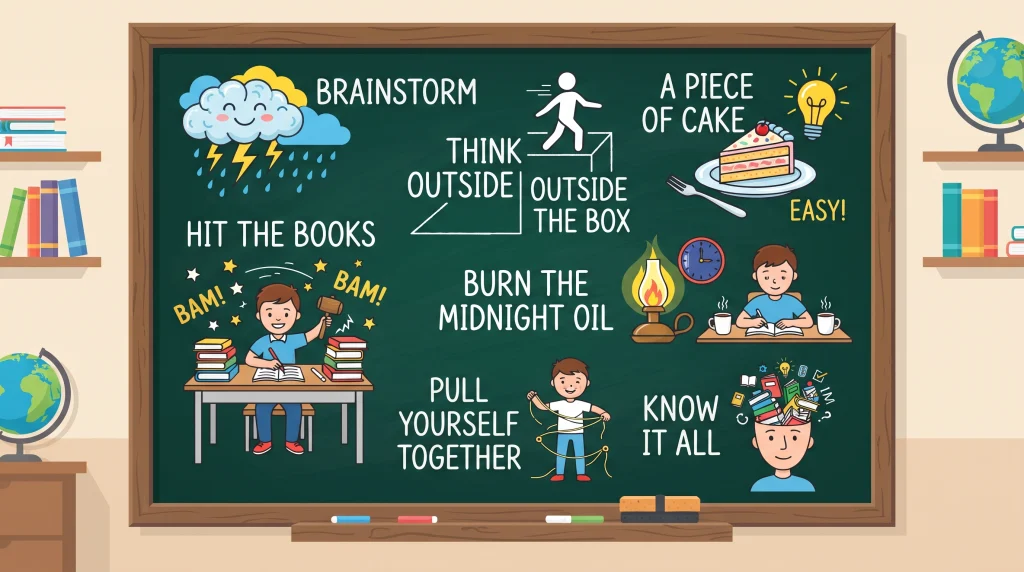
Learning idioms for school can help students understand conversations, improve their writing, and express their thoughts more naturally. For example, when someone says, “I need to hit the books,” they mean they need to study seriously, not physically strike their textbooks. Similarly, “pass with flying colors” means to succeed very well, especially on a test or assignment.
Language Systems International
+2
This guide includes 120 useful school related idioms and expressions, with simple meanings and example sentences. The expressions are organized by topic, making them easier to understand, remember, and use in conversations, essays, and classroom activities.
What Are Idioms for School?
Idioms for school are expressions used to describe learning, studying, academic performance, classroom behavior, and student experiences. Their meanings are often figurative rather than literal.
For example, “burn the midnight oil” means to stay up late working or studying. “A piece of cake” describes something easy, while “learn the hard way” means gaining knowledge through a difficult experience.
Some expressions are closely connected to school, while others are common everyday idioms that students frequently use when discussing education. Understanding the context helps you decide when each expression sounds natural.
130+ Idioms in Russian: https://learnidioms.com/idioms-in-russian/
120 Common Idioms for School With Meanings and Examples
The following expressions are grouped into six categories to help you learn them more easily. Each entry includes a straightforward definition and an example sentence.
1. Idioms About Studying and Learning
These idioms describe studying, understanding lessons, remembering information, and developing new skills.
Idioms 1–20
1. Hit the books
To begin studying seriously.
Example: I have a biology test tomorrow, so I need to hit the books tonight.
2. Burn the midnight oil
To work or study late into the night.
Example: Mia burned the midnight oil to finish her research paper.
3. Learn by heart
To memorize something completely.
Example: We had to learn the poem by heart for English class.
4. Crack a book
To open a book and study, often after avoiding studying.
Example: He finally cracked a book before his final exam.
5. Put on your thinking cap
To think carefully about a problem.
Example: Put on your thinking cap and try to solve this math question.
6. Get the hang of it
To learn how to do something.
Example: The science experiment seemed difficult until I got the hang of it.
7. Learn the ropes
To learn how a new activity or system works.
Example: Our new student learned the ropes during her first week.
8. Brush up on
To review and improve an existing skill or knowledge.
Example: I need to brush up on my grammar before the English test.
9. Read between the lines
To understand a meaning that is not directly stated.
Example: Our teacher asked us to read between the lines of the short story.
10. Know something inside out
To understand something extremely well.
Example: Jordan knows the history chapter inside out.
11. A quick study
A person who learns something quickly.
Example: Lena is a quick study and understood the new lesson immediately.
12. School of hard knocks
Learning through difficult real life experiences.
Example: He learned the importance of responsibility in the school of hard knocks.
13. Learn your lesson
To understand something after making a mistake or experiencing a consequence.
Example: After forgetting her homework twice, Ava learned her lesson.
14. Put two and two together
To figure something out from available clues.
Example: I put two and two together and realized why the experiment had failed.
15. A light bulb moment
A sudden moment of understanding or realization.
Example: I had a light bulb moment when the teacher explained the formula.
16. Get something down pat
To learn or practice something until you can do it reliably.
Example: Practice the multiplication tables until you have them down pat.
17. Take a leaf out of someone’s book
To copy someone’s successful behavior or approach.
Example: I took a leaf out of my sister’s book and started reviewing my notes daily.
18. Know the ropes
To know how a system or activity works.
Example: Ask Marcus for help because he knows the ropes in the school library.
19. Pick someone’s brain
To ask someone questions to benefit from their knowledge.
Example: I picked my teacher’s brain about preparing for the debate.
20. Put knowledge into practice
To use information or skills you have learned.
Example: The science fair allowed us to put our knowledge into practice.

2. Idioms About Exams, Grades, and Academic Success
Students often use these expressions when discussing tests, results, preparation, and achievement.
Idioms 21–40
21. Pass with flying colors
To succeed very well in a test or challenge.
Example: Sofia passed her final exam with flying colors.
22. Ace a test
To achieve an excellent result on a test.
Example: I studied all week and aced my math test.
23. Make the grade
To meet the required standard.
Example: His project made the grade and qualified for the school exhibition.
24. A piece of cake
Something that is very easy to do.
Example: The vocabulary quiz was a piece of cake.
25. Cram for a test
To study intensively in a short period, usually just before an exam.
Example: I had to cram for the geography test last night.
26. Draw a blank
To be unable to remember something when you need to.
Example: I drew a blank when the teacher asked me the first question.
27. Scrape through
To pass or succeed by a very small margin.
Example: He scraped through the final exam with a passing grade.
28. Come through with flying colors
To complete a challenge very successfully.
Example: The debate team came through with flying colors at the competition.
29. Not make the grade
To fail to meet a required standard.
Example: My first essay did not make the grade, so I revised it.
30. Get a head start
To begin early and gain an advantage.
Example: Starting my project during the weekend gave me a head start.
31. Beat the clock
To finish something before a deadline.
Example: We beat the clock and submitted our assignment just before class ended.
32. In the nick of time
At the last possible moment.
Example: I handed in my paper in the nick of time.
33. On the right track
Making progress in the correct direction.
Example: Your answer is on the right track, but explain your reasoning.
34. Raise the bar
To set a higher standard.
Example: The winning science project raised the bar for next year’s competition.
35. Go the extra mile
To make more effort than is expected.
Example: Our teacher went the extra mile to help us understand algebra.
36. Pull an all-nighter
To stay awake all night working or studying.
Example: He pulled an all-nighter to finish his history presentation.
37. Keep your eye on the prize
To stay focused on an important goal.
Example: I kept my eye on the prize while preparing for the scholarship exam.
38. Come out on top
To finish in a leading or successful position.
Example: Our team came out on top in the academic quiz.
39. Make a comeback
To recover after a setback or poor performance.
Example: After a difficult first semester, Nina made a comeback in the spring.
40. Get your act together
To become organized and start behaving or working effectively.
Example: I need to get my act together before the finals begin.

3. Idioms About Teachers, Classrooms, and School Life
These expressions can describe classroom behavior, school routines, rules, and interactions with teachers and classmates.
Idioms 41–60
41. Teacher’s pet
A student believed to receive special favor from a teacher.
Example: Some classmates jokingly called Ben the teacher’s pet because he always volunteered.
42. Class clown
A student who regularly makes jokes and entertains classmates.
Example: The class clown made everyone laugh during lunch.
43. Learn the hard way
To learn through a difficult or unpleasant experience.
Example: I learned the hard way that ignoring instructions can ruin a project.
44. Play by the rules
To follow established rules.
Example: Our coach reminded us to play by the rules during the tournament.
45. By the book
According to rules or official procedures.
Example: The teacher graded every assignment by the book.
46. Break the ice
To make people feel more comfortable in a new or awkward situation.
Example: The teacher told a funny story to break the ice on the first day.
47. Get out of hand
To become difficult to control.
Example: The classroom discussion got out of hand when everyone started shouting.
48. Keep an eye on
To watch or monitor someone or something.
Example: Please keep an eye on the science equipment while I get the instructions.
49. In the same boat
To be in the same difficult or challenging situation as others.
Example: We are all in the same boat because everyone has a big assignment due Friday.
50. On the ball
Alert, capable, and quick to respond.
Example: Our class president is always on the ball when organizing school events.
51. Get carried away
To become overly excited or involved in something.
Example: We got carried away decorating the classroom for the party.
52. Have your hands full
To be very busy with responsibilities.
Example: Our teacher has her hands full preparing the class for the school play.
53. A class act
A person who behaves with impressive kindness, skill, or dignity.
Example: The student who helped everyone prepare for the competition was a class act.
54. Call it a day
To stop working for the day.
Example: We finished the poster and decided to call it a day.
55. Cut corners
To do something carelessly or skip necessary steps to save time or effort.
Example: If you cut corners on your lab report, you might leave out important results.
56. Pull your weight
To do your fair share of work.
Example: Everyone in the group must pull their weight on the presentation.
57. Get the ball rolling
To begin an activity or process.
Example: Our teacher got the ball rolling by asking us to brainstorm ideas.
58. Be all ears
To listen with complete attention.
Example: I’m all ears if you have a suggestion for our group project.
59. Speak of the devil
Said when someone appears just after being mentioned.
Example: Speak of the devil, here comes our English teacher.
60. Make a long story short
To explain something briefly by leaving out unnecessary details.
Example: To make a long story short, our class won the spelling contest.

4. Idioms About Homework, Deadlines, and School Challenges
These expressions help students talk about busy schedules, difficult assignments, preparation, and managing responsibilities.
Idioms 61–80
61. Snowed under
To have so much work that it feels overwhelming.
Example: I’m snowed under with homework and two science projects.
62. Up to your ears
To be extremely busy or deeply involved in something.
Example: We are up to our ears in assignments this week.
63. A tough nut to crack
A difficult problem or person to understand.
Example: The final algebra question was a tough nut to crack.
64. Back to square one
To return to the beginning after a plan fails.
Example: Our computer crashed, so we were back to square one with the presentation.
65. In hot water
In trouble because of something you have done.
Example: He was in hot water after missing the project deadline.
66. The last straw
The final problem that makes a difficult situation unbearable.
Example: Another missed deadline was the last straw for our group.
67. Bite off more than you can chew
To take on more work or responsibility than you can manage.
Example: I bit off more than I could chew when I joined three clubs during exam week.
68. Keep your head above water
To manage a difficult or demanding situation.
Example: I’m trying to keep my head above water with all these assignments.
69. At the eleventh hour
At the last possible moment.
Example: We finished the poster at the eleventh hour.
70. Put something on the back burner
To postpone something so you can focus on another priority.
Example: I put my art project on the back burner until I finished studying for finals.
71. The ball is in your court
It is your turn to take action or make a decision.
Example: I’ve finished my section of the group report, so the ball is in your court.
72. Miss the boat
To miss an opportunity by acting too late.
Example: I missed the boat on signing up for the school trip.
73. In over your head
In a situation that is too difficult to manage comfortably.
Example: I felt in over my head when I chose an advanced physics course.
74. A mountain of work
A very large amount of work.
Example: We have a mountain of work to finish before winter break.
75. Work against the clock
To work quickly because time is limited.
Example: We worked against the clock to finish the classroom display.
76. Get down to business
To begin focusing seriously on the task at hand.
Example: After a short discussion, we got down to business and started our essays.
77. Leave no stone unturned
To try every possible approach when searching or solving something.
Example: The students left no stone unturned while researching their history project.
78. Think outside the box
To use creative or unusual ideas to solve a problem.
Example: We had to think outside the box to design our school science experiment.
79. A race against time
A situation in which something must be completed quickly.
Example: Finishing the set before the school play began was a race against time.
80. Easier said than done
Something that sounds simple but is difficult to accomplish.
Example: Staying calm during finals is easier said than done.
5. Idioms About Friendship, Teamwork, and Student Behavior
School is also a place where students learn to cooperate, communicate, solve disagreements, and build friendships. These idioms are useful for describing those experiences.

Idioms 81–100
81. See eye to eye
To agree with someone.
Example: My lab partner and I see eye to eye on how to present our results.
82. Get along like a house on fire
To become friendly and enjoy each other’s company quickly.
Example: The two new students got along like a house on fire.
83. Through thick and thin
During both good times and difficult times.
Example: My best friend supported me through thick and thin during the school year.
84. Two heads are better than one
Working with another person can help solve a problem more effectively.
Example: Let’s check the difficult questions together because two heads are better than one.
85. Be on the same page
To share the same understanding or plan.
Example: Our group met after class to make sure everyone was on the same page.
86. Join forces
To work together toward a shared goal.
Example: The science and art clubs joined forces to create the school exhibition.
87. Lend a hand
To help someone.
Example: Several classmates lent a hand when we moved the classroom supplies.
88. A shoulder to cry on
Someone who provides comfort and support.
Example: My friend was a shoulder to cry on after I received a disappointing grade.
89. Stick together
To remain united and support one another.
Example: Our team stuck together even when the competition became difficult.
90. Rub someone the wrong way
To annoy or irritate someone.
Example: His constant interruptions rubbed some of his classmates the wrong way.
91. Get on someone’s nerves
To annoy someone.
Example: The loud tapping during the lesson was getting on my nerves.
92. Make up
To become friendly again after an argument.
Example: The two friends made up before the school dance.
93. Bury the hatchet
To end a disagreement and make peace.
Example: Our classmates buried the hatchet and worked together on the assignment.
94. A fair share
The amount of something that is reasonable for each person.
Example: Everyone needs to complete a fair share of the group project.
95. Go hand in hand
To be closely connected or naturally occur together.
Example: Good communication and teamwork go hand in hand.
96. Have someone’s back
To support or defend someone.
Example: My classmates had my back when I felt nervous about the presentation.
97. Stand out from the crowd
To be noticeably different from others.
Example: Her creative science project helped her stand out from the crowd.
98. Be in someone’s good books
To be viewed favorably by someone.
Example: Returning the borrowed books on time kept me in the librarian’s good books.
99. Get off on the wrong foot
To begin a relationship or activity badly.
Example: I got off on the wrong foot with my lab partner because I arrived late.
100. Make a good impression
To cause others to think positively of you.
Example: I practiced my introduction to make a good impression on the interview panel.

6. Idioms About Effort, Mistakes, and Personal Growth
These expressions describe perseverance, responsibility, improvement, and the lessons students gain from their experiences.
Idioms 101–120
101. Practice makes perfect
Repeated practice helps you improve a skill.
Example: I kept practicing my speech because practice makes perfect.
102. Rome wasn’t built in a day
Important achievements take time and patience.
Example: Learning a new language takes time, so remember that Rome wasn’t built in a day.
103. Where there’s a will, there’s a way
Determination can help people find ways to overcome difficulties.
Example: She kept working on the assignment because where there’s a will, there’s a way.
104. Keep at it
To continue working at something despite difficulty.
Example: Your essay is improving, so keep at it.
105. Hang in there
To remain patient and not give up during a difficult time.
Example: Hang in there; the semester will be over soon.
106. Get back on your feet
To recover after a setback.
Example: After struggling with the first test, he got back on his feet and prepared carefully for the next one.
107. Turn over a new leaf
To make a fresh start and improve your behavior.
Example: I turned over a new leaf and began completing my homework on time.
108. Actions speak louder than words
What people do matters more than what they say.
Example: Our class showed that actions speak louder than words by helping clean the school garden.
109. Every cloud has a silver lining
Even difficult situations can have a positive side.
Example: Although I missed the trip, every cloud has a silver lining because I spent time with my family.
110. No pain, no gain
Achieving something worthwhile often requires effort.
Example: Preparing for the spelling bee took patience and practice; no pain, no gain.
111. The sky’s the limit
There is no obvious limit to what someone can achieve.
Example: With hard work and curiosity, the sky’s the limit for your future.
112. Rise to the occasion
To respond successfully to a difficult or important situation.
Example: Our class rose to the occasion when the school assembly needed extra volunteers.
113. Make the most of
To use an opportunity or resource as effectively as possible.
Example: I made the most of study hall by reviewing my notes.
114. Learn from your mistakes
To use errors as opportunities to improve.
Example: Good students learn from their mistakes and try a different approach.
115. Take responsibility
To accept that you are accountable for your actions.
Example: I took responsibility for forgetting my part of the group assignment.
116. Face the music
To accept the consequences of your actions.
Example: After missing several assignments, he had to face the music and speak with his teacher.
117. Own up to
To admit that you did something wrong.
Example: She owned up to copying the wrong answers and apologized.
118. A lesson for life
An experience that teaches something valuable beyond the immediate situation.
Example: Working with different classmates taught me a lesson for life about patience.
119. Put your best foot forward
To make a strong and positive effort.
Example: I put my best foot forward during my first class presentation.
120. Finish on a high note
To end an activity or period successfully or positively.
Example: Our class finished the school year on a high note with a successful charity event.
How to Use School Idioms Naturally
Knowing an idiom’s meaning is only the first step. To use it correctly, pay attention to the situation, the people you are speaking with, and whether the expression sounds casual or formal.

1. Learn idioms in context
Instead of memorizing an expression by itself, connect it to a realistic school situation.
For example:
- “I need to hit the books” works when you are talking about serious studying.
- “The quiz was a piece of cake” works when you want to say a quiz was easy.
- “I’m snowed under with homework” works when you have a heavy workload.
Context makes the meaning easier to remember.
2. Practice with your own sentences
Choose three idioms each day and write a sentence about your actual school routine. You could describe a test, a group assignment, a classroom conversation, or a challenge you recently faced.
For example, instead of only memorizing “get a head start,” write, “I got a head start on my research paper by choosing my topic on Monday.”
3. Use idioms in the right setting
Many school idioms are informal and work naturally in conversations with friends or classmates. Expressions such as “hit the books,” “a piece of cake,” and “crack a book” are common in casual speech.
For formal essays and academic reports, use idioms selectively. A clear literal phrase may be more appropriate when explaining a scientific result, defining a concept, or presenting evidence. Follow your teacher’s assignment requirements.
4. Listen for idioms in everyday English
Pay attention when teachers, classmates, family members, or speakers in English-language videos use figurative expressions. Try to understand the meaning from the surrounding conversation before checking a definition.
You can also keep an idiom notebook with three columns: the expression, its meaning, and your own example sentence.
5. Review regularly
Reviewing a few expressions each day is often more manageable than trying to memorize all 120 at once. Cover the meanings and see whether you can explain each idiom in your own words.
You can also practice with a classmate by taking turns choosing an idiom and creating a sentence that demonstrates its meaning.
Common Mistakes to Avoid When Using School Idioms
Idioms can make English more expressive, but using them incorrectly can confuse your listener. Keep these points in mind.
- Do not interpret idioms literally. “Hit the books” means study, not strike a textbook.
- Use the correct wording. The established expression is “pass with flying colors,” not “pass with flying flags.”
- Pay attention to tense. You can say, “I hit the books yesterday,” or “I am hitting the books tonight.”
- Avoid forcing idioms into every sentence. Too many expressions can make your writing sound unnatural.
- Choose an appropriate tone. Casual idioms may fit conversations with friends but may not suit every formal assignment.
- Understand the difference between related phrases. “Cram for a test” suggests intensive preparation in a short period, while “hit the books” simply means studying seriously.
The goal is not to use as many idioms as possible. It is to understand them well enough to recognize their meanings and use them when they genuinely fit the situation.
Frequently Asked Questions About Idioms for School
Conclusion
Learning idioms for school is a useful way to build English vocabulary and understand how people communicate in everyday situations. Expressions such as “hit the books,” “pass with flying colors,” and “think outside the box” can help you describe studying, academic success, creative thinking, and classroom experiences more naturally.
Start with a few expressions that are relevant to your daily routine. Practice their meanings, write your own examples, and listen for them in conversations. With regular practice, you can become more comfortable recognizing idioms and choosing the right expressions when speaking or writing in English.






One Comment