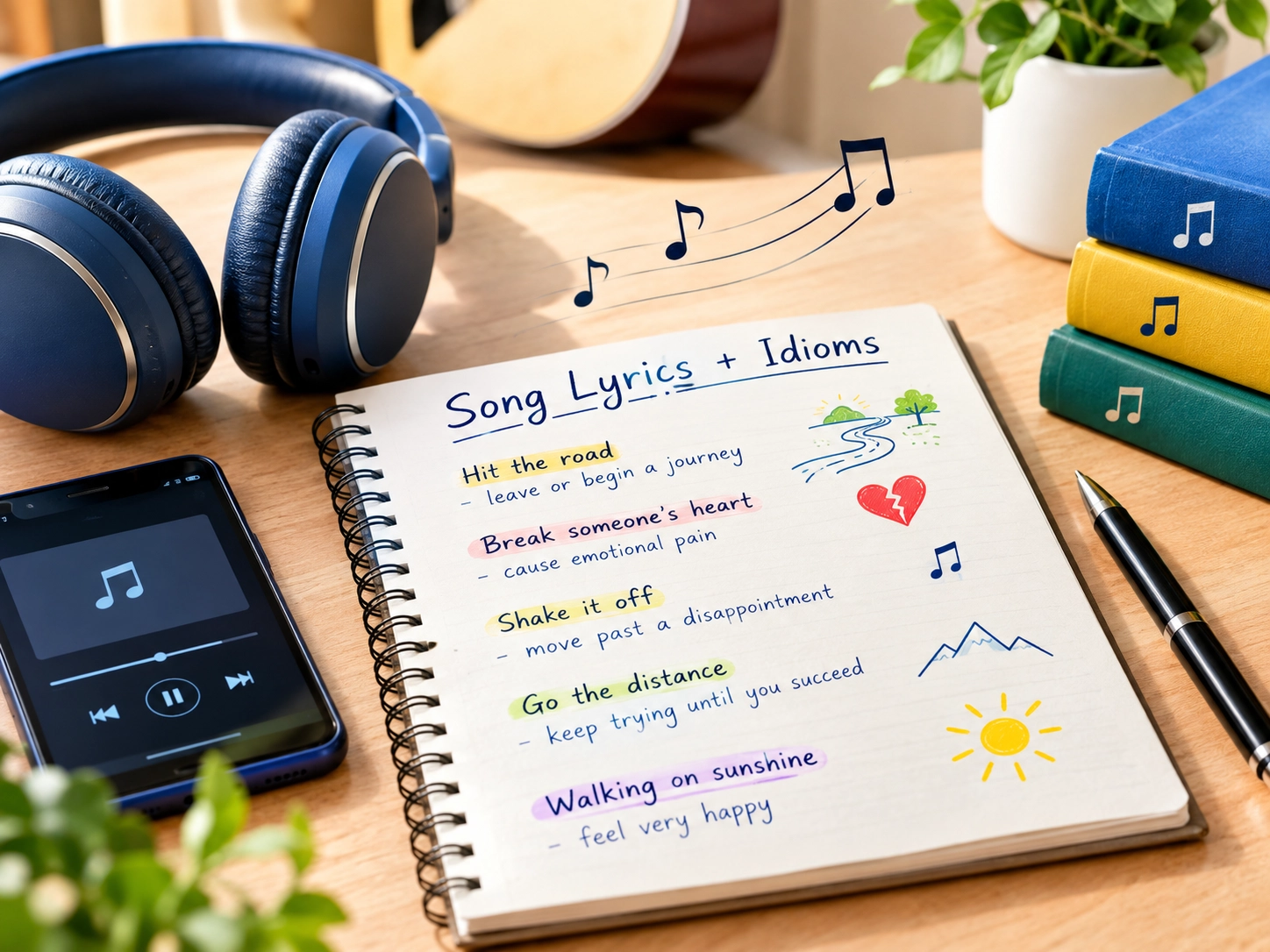
Song Lyrics With Idioms: 25 Expressions and Meanings
What Are Idioms in Song Lyrics?
Idioms in song lyrics are expressions whose intended meanings differ from the literal meanings of their individual words. Songwriters use them to communicate feelings, tell stories, and make language more vivid.
For example, the expression break someone’s heart means to cause emotional pain, especially through rejection or the end of a relationship. It does not describe physically breaking a heart.

Idioms are a form of figurative language, although not every metaphor or imaginative phrase in a song is a traditional idiom. The context matters when deciding how an expression should be classified.
you need to known the following: Hiking Idioms
FluentU
+1
Why Do Songwriters Use Idioms?
Songwriters use idiomatic expressions for several reasons:
- Emotional expression: Idioms can communicate sadness, excitement, anger, or affection in a compact way.
- Memorable language: Familiar expressions can make a song easier to remember and understand.
- Storytelling: Figurative phrases help listeners imagine situations without lengthy explanations.
- Natural conversation: Idioms make song language sound closer to the way people speak in everyday life.
- Creative meaning: A familiar expression can take on an additional meaning when used in a particular musical context.
For English learners, listening to music can provide opportunities to notice pronunciation, vocabulary, rhythm, and the way expressions work in context.
FluentU
+1
25 Song Lyrics With Idioms and Their Meanings
The following examples connect familiar idioms and idiomatic expressions with songs or musical works. The explanations focus on the expressions rather than reproducing copyrighted lyrics.
Note: Some song titles contain idioms, while other songs use figurative expressions that may be classified differently depending on the context. A song title alone does not establish that every use of a phrase in the song is idiomatic.
1. Hit the Road
Song association: Hit the Road Jack by Ray Charles

Meaning: To leave a place or begin a journey. It can also be used to tell someone to go away.
Everyday example: We need to hit the road early tomorrow if we want to reach the beach before noon.
How it helps learners: The phrase is common in informal American English and is useful when talking about travel or leaving a location.
learnidiom.com
+1
2. Shake It Off
Song association: Shake It Off by Taylor Swift

Meaning: To stop worrying about something upsetting, dismiss criticism, or move past a negative experience.
Everyday example: I made a mistake during the presentation, but I decided to shake it off and keep going.
Usage note: This expression is often used to encourage someone not to let criticism or disappointment affect them for too long.
learnidiom.com
+1
3. Break Someone’s Heart
Song association: Break My Heart by Dua Lipa

Meaning: To cause someone deep emotional pain, especially through romantic rejection, betrayal, or separation.
Everyday example: She broke his heart when she ended their relationship without explaining why.
Usage note: This expression is strongly associated with relationships, but it can also describe other painful disappointments.
learnidiom.com
+1
4. Go Crazy
Song association: Let’s Go Crazy by Prince
Meaning: To behave wildly or become extremely excited, angry, or overwhelmed. In casual speech, it can also mean enjoying something enthusiastically.
Everyday example: The crowd went crazy when the band returned for an encore.
Usage note: The intended meaning depends on the situation. It does not necessarily refer to a medical or psychological condition.
FluentU
5. Bite the Dust
Song association: Another One Bites the Dust by Queen

Meaning: To fail, be defeated, or come to an end. In some contexts, the expression can also mean to die.
Everyday example: Our old family computer finally bit the dust after years of use.
Usage note: This is an informal expression. Its meaning can range from an ordinary breakdown to a much more serious defeat or ending.
Lingvatopia
6. Too Little, Too Late
Song association: Too Little Too Late by JoJo
Meaning: An action or offer that comes too late or is insufficient to solve a problem.
Everyday example: The company offered refunds after most customers had already canceled their orders. For many people, it was too little, too late.
Usage note: This expression often communicates disappointment when someone makes an effort only after the opportunity has passed.
FluentU
7. Work It Out
Song association: We Can Work It Out by The Beatles
Meaning: To find a solution, resolve a disagreement, or successfully deal with a difficult situation.
Everyday example: We disagree about the schedule, but I am sure we can work it out.
Usage note: This expression is common in conversations about relationships, work, planning, and everyday problems.
FluentU
8. Go the Distance
Song association: Go the Distance from Disney’s Hercules
Meaning: To make the effort needed to achieve a goal, endure difficulties, or complete a challenging task.
Everyday example: She studied every evening because she was determined to go the distance and finish her degree.
Usage note: Although the expression can refer to physical distance, it is often used figuratively for persistence and commitment.
learnidiom.com
9. Eye of the Tiger
Song association: Eye of the Tiger by Survivor
Meaning: A determined, focused, and competitive attitude.
Everyday example: The young athlete had the eye of the tiger during the championship match.
Usage note: This familiar expression is often associated with motivation, competition, and perseverance. It is also an example of language that can be understood figuratively rather than literally.
learnidiom.com
+1
10. Walking on Sunshine
Song association: Walking on Sunshine by Katrina and the Waves
Meaning: Feeling extremely happy, cheerful, or excited.
Everyday example: After receiving her acceptance letter, Maya felt like she was walking on sunshine.
Usage note: This is a vivid figurative expression. Depending on the definition used, it may be described as an idiomatic expression or a metaphorical phrase.
learnidiom.com
11. Let It Go
Song association: Let It Go from Disney’s Frozen
Meaning: To stop holding on to a worry, resentment, disappointment, or situation that cannot be changed.
Everyday example: The argument happened last week. It is time to let it go and move forward.
Usage note: The phrase can also have a literal meaning, such as releasing an object. Its figurative meaning depends on the context.
Examples.com
12. Rolling in the Deep
Song association: Rolling in the Deep by Adele
Meaning: The phrase is associated with emotional depth and intense involvement in the song’s context. It is also a useful example of why learners should consider a song’s imagery instead of assuming that every unusual phrase is a standard everyday idiom.
Everyday example: The friends were deeply involved in the project and supported each other through every challenge.
Usage note: The song title is figurative, but its exact interpretation should not automatically be treated as a fixed dictionary definition.
Examples.com
+1
13. High Hopes
Song association: High Hopes by Panic! at the Disco
Meaning: Strong expectations, ambitions, or confidence that something good will happen.
Everyday example: We have high hopes for the new restaurant because the chef has years of experience.
Usage note: The expression is used frequently in ordinary American English, especially when discussing goals, plans, and expectations.
Mary’s English Blog
14. Kick the Bucket
Song association: Kick the Bucket by Charlie Winston
Meaning: An informal idiom meaning to die.
Everyday example: He joked that he wanted to visit every national park before he kicked the bucket.
Usage note: This phrase is casual and can sound insensitive when discussing a real person’s death. Use more respectful wording in serious situations.
Lingvatopia
15. Skeletons in the Closet
Song associations: Skeletons by Stevie Wonder and Skeletons in the Closet by Alice Cooper
Meaning: Hidden secrets, especially embarrassing or troubling things from someone’s past.
Everyday example: The biography revealed a few skeletons in the closet that the public had never heard about.
Usage note: The phrase is generally figurative and does not refer to actual skeletons.
Lingvatopia
16. Paint It Black
Song association: Paint It, Black by The Rolling Stones
Meaning: The title uses an image of making something black to communicate a dark emotional outlook. It is better understood as figurative imagery than automatically classified as a conventional idiom.
Everyday example: After the disappointing news, he seemed to see everything in a negative light.
Usage note: When studying this song, pay attention to how color imagery communicates mood rather than memorizing the title as a fixed idiom.
Examples.com
17. Highway to Hell
Song association: Highway to Hell by AC/DC
Meaning: A figurative image of a path leading toward trouble, danger, or an undesirable outcome.
Everyday example: Ignoring every warning sign could put the business on a path toward serious trouble.
Usage note: The title is an example of figurative language. A road or highway can represent a course of action, while the destination suggests its consequences.
Examples.com
18. Break a Leg
Song association: Break a Leg by Foo Fighters
Meaning: An expression used to wish someone good luck, particularly before a performance.
Everyday example: You have worked hard for this audition. Break a leg!
Usage note: The phrase is not intended as a literal wish for an injury. It is a conventional expression associated with the performing arts.
Examples.com
19. Dig a Little Deeper
Song association: Dig a Little Deeper from Disney’s The Princess and the Frog
Meaning: To investigate further, look beyond the surface, or make a greater effort to understand something.
Everyday example: We could not find the cause of the problem, so the technician decided to dig a little deeper.
Usage note: The phrase can describe literal digging, but it is often used figuratively when talking about research, personal reflection, or problem-solving.
Examples.com
20. Kiss the Girl
Song association: Kiss the Girl from Disney’s The Little Mermaid
Meaning: The phrase itself can be literal. In a romantic context, it may also suggest taking an opportunity to express affection.
Everyday example: He had been planning to tell her how he felt, but he kept waiting for the right moment.
Usage note: Do not assume that every phrase in a song title is an idiom. The phrase’s meaning depends on how it is used in the song and the surrounding story.
Examples.com
21. Part of Your World
Song association: Part of Your World from Disney’s The Little Mermaid
Meaning: A figurative way of expressing a desire to belong to another person’s environment, community, or way of life.
Everyday example: After spending time with the team, she hoped she could become part of their world.
Usage note: This phrase can communicate belonging or inclusion, but it is not necessarily a fixed idiom in every context.
Examples.com
22. Just Dance
Song association: Just Dance by Lady Gaga
Meaning: The words are literal when they refer to dancing. In a broader musical context, dancing can also symbolize enjoying the moment or temporarily setting aside worries.
Everyday example: We had a stressful week, so we went out to dance and enjoy ourselves.
Usage note: This is a useful example of the difference between literal language and a figurative interpretation of a song’s message.
Examples.com
23. Man in the Mirror
Song association: Man in the Mirror by Michael Jackson
Meaning: A symbolic reference to examining yourself, your behavior, or your personal responsibility.
Everyday example: Before blaming everyone else, he took a moment to look at his own actions.
Usage note: The image of a mirror is commonly associated with self-reflection. In literary analysis, it is often discussed as a symbol rather than a strict idiom.
Examples.com
24. High Hopes for a Living
Song association: High Hopes by Panic! at the Disco
Meaning: The expression high hopes means having strong ambitions or positive expectations. The additional wording in a song can shape the interpretation without changing the basic meaning of the expression.
Everyday example: She had high hopes of becoming a published author.
Usage note: Learn the core expression first, then use the rest of the sentence to understand the speaker’s intended meaning.
Mary’s English Blog
25. Too Little, Too Late
Song association: Little Too Late by Pat Benatar
Meaning: An effort that is insufficient and arrives after it can make a meaningful difference.
Everyday example: The team tried to correct the mistake after the deadline had passed. Their response was too little, too late.
Usage note: This expression is useful for describing missed opportunities, unsuccessful apologies, and delayed attempts to solve problems.
FluentU
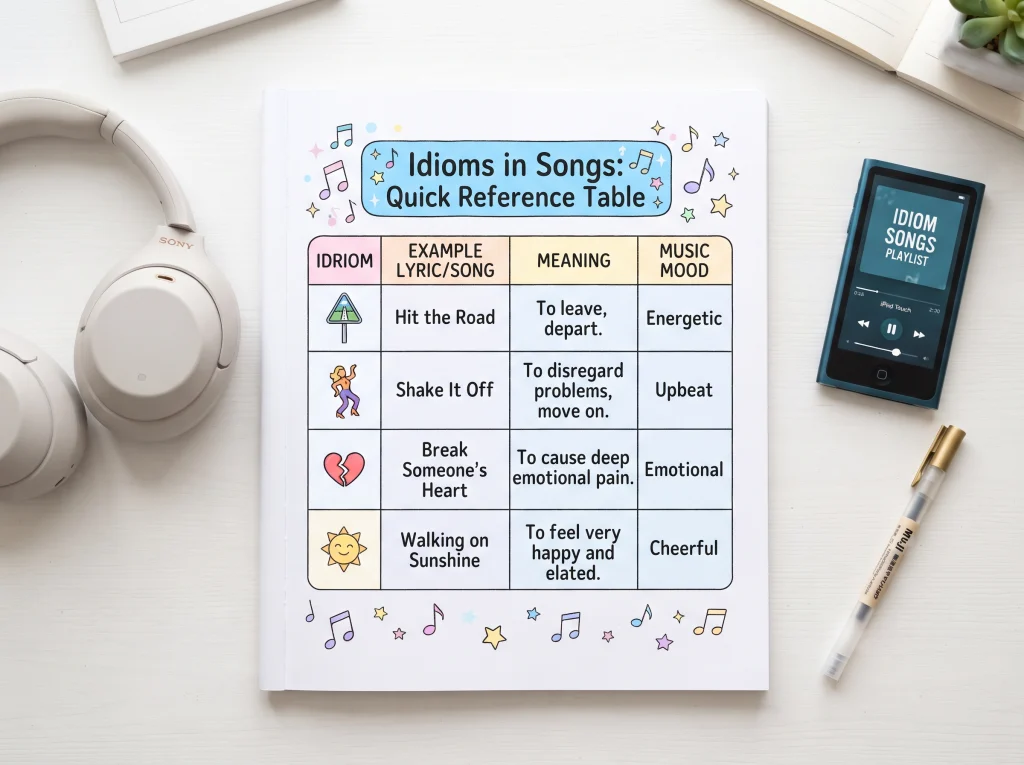
Idioms in Songs: Quick Reference Table
| Expression | Meaning |
|---|---|
| Hit the road | Leave or begin a journey |
| Shake it off | Move past a disappointment |
| Break someone’s heart | Cause emotional pain |
| Go crazy | Become extremely excited or behave wildly |
| Bite the dust | Fail, be defeated, or come to an end |
| Too little, too late | An insufficient effort made too late |
| Work it out | Resolve a problem |
| Go the distance | Persist until a goal is reached |
| Eye of the tiger | Determination and focus |
| Walking on sunshine | Feel extremely happy |
| Let it go | Stop holding on to a worry or resentment |
| High hopes | Strong expectations or ambitions |
| Kick the bucket | Die, expressed informally |
| Skeletons in the closet | Hidden or embarrassing secrets |
| Break a leg | Wish someone good luck |
| Dig a little deeper | Investigate further |
| Man in the mirror | Self-reflection or personal responsibility |
Some song-related phrases above are metaphors, symbols, or figurative expressions rather than universally recognized idioms. The classification depends on how the phrase is used.
How to Learn English Idioms Through Songs
Music can be a helpful supplement to English study because it gives learners examples of language in context. Instead of memorizing a long list of expressions without context, try the following approach.

Step 1: Choose a familiar song
Start with a song you enjoy. Familiar music can make it easier to focus on the words and notice expressions you may have heard before.

Step 2: Identify unfamiliar expressions
Use an authorized lyrics source or the song’s official materials when available. Write down unfamiliar phrases and separate possible idioms from ordinary descriptive language.

Step 3: Check the meaning
Look up each expression in a reputable dictionary. Consider the surrounding context because a phrase may have both literal and figurative meanings.

Step 4: Write your own sentences
Create two or three original sentences using each idiom. Try examples related to school, work, family, hobbies, or everyday situations in the United States.

Step 5: Practice speaking
Say your sentences aloud and pay attention to pronunciation and natural phrasing. Review the expressions later to help retain their meanings.
Idioms vs. Metaphors in Song Lyrics
Idioms and metaphors both belong to figurative language, but they are not identical.
| Feature | Idiom | Metaphor |
|---|---|---|
| Main characteristic | A conventional expression with an established meaning | A comparison or representation that describes something in terms of something else |
| Meaning | Often cannot be understood by interpreting every word literally | Often communicates an idea through an imaginative comparison |
| Example | Hit the road, meaning to leave | Describing a difficult period as a storm |
| In music | May reflect expressions used in everyday conversation | May create imagery, mood, or symbolism |
Some expressions can function as both idioms and metaphors. Classification can vary depending on the linguistic framework and how the phrase is used. Research on song lyrics also examines how idiomatic expressions contribute to a song’s themes and meanings.
journal.unupurwokerto.ac.id
+2
Common Mistakes When Learning Idioms From Songs
English learners should avoid a few common mistakes when interpreting musical language.
- Taking every expression literally: A broken heart usually refers to emotional pain, not a physical injury.
- Assuming every song title is an idiom: Some titles are literal phrases, metaphors, symbols, or creative images.
- Ignoring context: A phrase can have different meanings depending on the surrounding words and situation.
- Using informal expressions in every setting: Some idioms are casual and may not be suitable for formal writing or professional communication.
- Copying unusual poetic grammar into ordinary conversation: Songwriters sometimes change normal word order or phrasing to fit the music.
Learning an idiom’s meaning, tone, and appropriate context will help you use it more accurately.
Frequently Asked Questions
Conclusion
Song lyrics with idioms offer an enjoyable way to explore the richness of English. Familiar expressions can communicate emotions, describe difficult experiences, and make everyday language more colorful. By studying the meanings of phrases such as hit the road, shake it off, and work it out, learners can build a stronger understanding of conversational American English.
The key is to pay attention to context. Some musical expressions are established idioms, while others are metaphors or creative imagery. Learning the difference will help you understand songs more accurately and use English expressions with greater confidence.






One Comment