
Idioms About Trees: 50 Common Tree Idioms With Meanings and Examples
Idioms about trees are common expressions that use trees, roots, branches, leaves, forests, fruit, and other parts of nature to express ideas about people and everyday situations. You may hear someone say, “Don’t bark up the wrong tree,” when another person has made a wrong assumption, or “We need to branch out” when someone wants to try something different.
These expressions are useful because their figurative meanings are often very different from their literal meanings. A person who is “out on a limb” is not necessarily sitting on a tree branch. The phrase usually means that the person is taking a risk or putting forward an uncertain opinion. Likewise, someone who “puts down roots” is usually settling into a place rather than planting an actual tree.
Tree related expressions appear in everyday American English, education, business conversations, writing, family discussions, and casual speech. Some are traditional idioms, while others are familiar sayings or fixed expressions based on tree imagery.
Learning these phrases can make English easier to understand because many of them describe familiar situations such as making mistakes, starting over, growing a business, dealing with problems, taking risks, or talking about family similarities.
90 Idioms for ESL Students PDF : https://learnidioms.com/90-idioms-for-esl-students-pdf-with-meanings/
What Are Idioms About Trees?
Idioms about trees are figurative expressions that use tree related words or images to communicate an idea that goes beyond the literal meaning of the words.

For example:
“Branch out” means to try something new or expand into a different area.
“Put down roots” means to settle in a place and establish a stable life there.
“The apple doesn’t fall far from the tree” means that children often resemble their parents in behavior, personality, interests, or abilities.
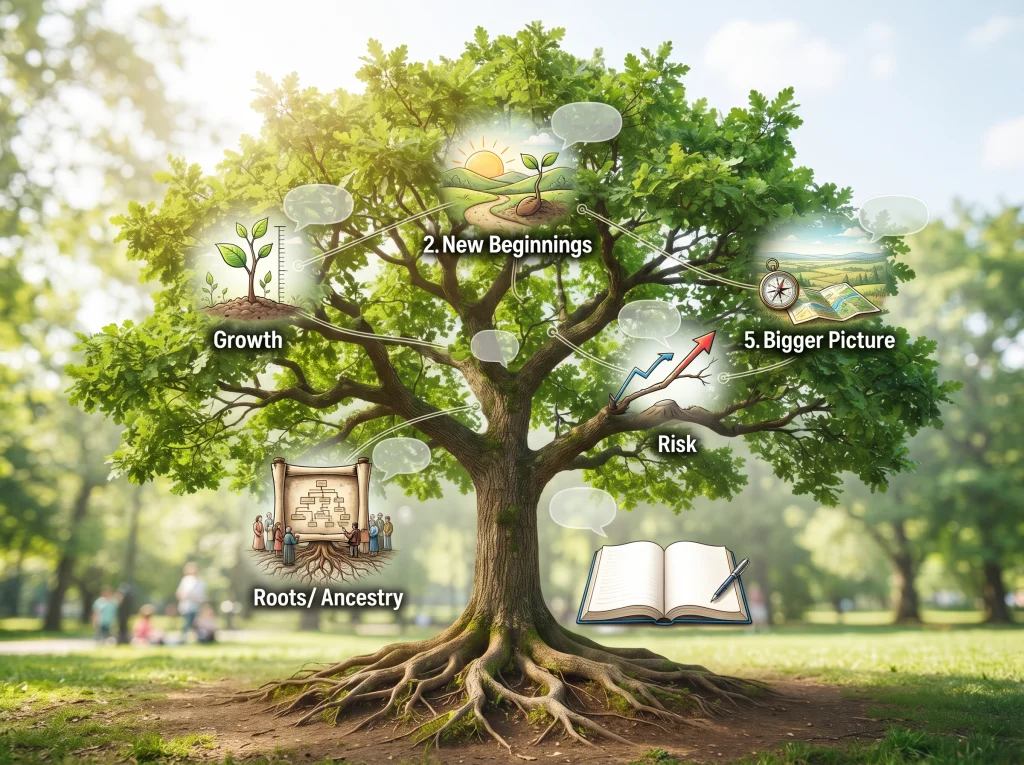
Many tree expressions are memorable because their meanings are connected to familiar parts of a tree. Roots can represent beginnings or stability, branches can represent expansion, and leaves can represent change or a fresh start.
50 Idioms About Trees With Meanings and Examples
Here are 50 useful tree related idioms, sayings, and fixed expressions with simple meanings and natural examples.
| # | Idiom or Expression | Meaning |
|---|---|---|
| 1 | Bark up the wrong tree | Blame the wrong person or pursue the wrong approach |
| 2 | Can’t see the forest for the trees | Focus so much on details that you miss the big picture |
| 3 | The apple doesn’t fall far from the tree | Children often resemble their parents |
| 4 | Branch out | Try something new or expand into another area |
| 5 | Go out on a limb | Take a risk or express an uncertain opinion |
| 6 | Put down roots | Settle in a place |
| 7 | Turn over a new leaf | Make a fresh start or change your behavior |
| 8 | Money doesn’t grow on trees | Money is limited and should not be wasted |
| 9 | Nip it in the bud | Stop a problem at an early stage |
| 10 | Root of the problem | The main cause of a problem |
| 11 | Bear fruit | Produce a useful or successful result |
| 12 | From little acorns mighty oaks grow | Big things can develop from small beginnings |
| 13 | Out of the woods | No longer in serious difficulty |
| 14 | Shake the tree | Try to produce a response or find useful information |
| 15 | Deadwood | People or things considered unproductive |
| 16 | Grow like a weed | Grow very quickly |
| 17 | Shake like a leaf | Tremble because of fear, cold, or nervousness |
| 18 | Rooted to the spot | Unable to move because of surprise, fear, or shock |
| 19 | Uprooted | Forced or caused to leave a familiar place or situation |
| 20 | Take root | Become established or firmly accepted |
| 21 | Deeply rooted | Strongly established |
| 22 | Root and branch | Completely or thoroughly |
| 23 | Branch into | Expand into a new area |
| 24 | Leaf through | Quickly look through a book or document |
| 25 | Turn over a fresh leaf | Begin again with a positive change |
| 26 | Family tree | A diagram or record showing family relationships |
| 27 | Tree of knowledge | A symbolic expression connected with knowledge and learning |
| 28 | Tree-lined | Describing a road or street bordered by trees |
| 29 | Tree hugger | An informal term for someone strongly concerned about environmental protection |
| 30 | Tall oaks from little acorns grow | Great achievements can begin with something small |
| 31 | Old chestnut | An old story, joke, or argument that has been repeated many times |
| 32 | Cherry-pick | Select only the most desirable items or information |
| 33 | Knock on wood | A phrase used after mentioning good fortune to avoid supposedly tempting bad luck |
| 34 | Let the chips fall where they may | Accept whatever consequences result from an action |
| 35 | Go against the grain | Act or think differently from what is usual or expected |
| 36 | A thorn in someone’s side | A persistent source of irritation or difficulty |
| 37 | Bear the fruit of | Produce the expected results of an effort |
| 38 | Branch off | Separate from a main path, group, or subject |
| 39 | Put down new roots | Establish a new home or life in another place |
| 40 | Uproot yourself | Leave a familiar home, community, or lifestyle |
| 41 | Rooted in tradition | Strongly connected to established customs |
| 42 | Rooted in history | Closely connected with events or practices from the past |
| 43 | In full bloom | At a stage of strong development, beauty, or activity |
| 44 | A tree of life | A symbolic image representing life, connection, or continuity |
| 45 | Branch of knowledge | A particular area of study |
| 46 | Branch of government | One of the major divisions of government |
| 47 | Family roots | A person’s family background and origins |
| 48 | Grow from the same roots | Develop from a shared source or origin |
| 49 | Forest for the trees | The larger situation viewed beyond individual details |
| 50 | A strong oak | A person or thing viewed as strong, dependable, or resilient |
Some entries in this list are strict idioms, while others are established sayings, metaphors, compounds, or fixed expressions. This distinction matters because not every tree related expression functions as a traditional idiom.

Tree Idioms About Mistakes and Problems
Several tree expressions are especially useful when talking about mistakes, confusion, or difficult situations.
Bark up the wrong tree
Meaning: To make a wrong assumption, accuse the wrong person, or use the wrong approach.
Example:
“If you think I deleted the files, you’re barking up the wrong tree.”
This expression is especially common when someone needs to correct another person’s mistaken assumption. The image comes from the idea of a dog barking at the wrong tree while hunting.
Can’t see the forest for the trees
Meaning: To focus so heavily on individual details that you fail to understand the larger situation.
Example:
“She spent hours fixing tiny formatting issues and couldn’t see the forest for the trees.”
This expression works well in school, business, planning, and problem solving.
Root of the problem
Meaning: The fundamental cause of a problem.
Example:
“We need to find the root of the problem before changing the entire system.”
This expression is particularly natural in professional and analytical contexts.
Nip it in the bud
Meaning: Stop a problem before it becomes more serious.
Example:
“The manager addressed the disagreement early to nip it in the bud.”
The image comes from stopping unwanted plant growth while it is still developing.
Tree Idioms About Growth and Change
Trees naturally grow, spread, produce fruit, and develop roots. English uses these ideas to describe personal growth, business development, and change.
Branch out
Meaning: Try something new or expand into a different area.
Example:
“After years of teaching, she decided to branch out into online writing.”
Businesses can also branch out into new products, services, or markets.
Put down roots
Meaning: Settle in one place and establish a stable life.
Example:
“After moving several times, they finally put down roots in Colorado.”
The expression compares building a permanent life with a tree establishing roots in the ground.
Take root
Meaning: Become established or firmly accepted.
Example:
“The new idea began to take root among the employees.”
The expression can describe ideas, traditions, relationships, habits, or movements.
Turn over a new leaf
Meaning: Make a fresh start, usually by changing behavior.
Example:
“After struggling with missed deadlines, he decided to turn over a new leaf.”
The expression is often used when someone wants to leave an old pattern behind and behave differently.
Bear fruit
Meaning: Produce a positive or useful result.
Example:
“Years of research finally bore fruit when the company released the new product.”
It can describe work, plans, efforts, relationships, or ideas.
Tree Idioms About Family and Relationships
Tree imagery is also useful when discussing family history and similarities between generations.
The apple doesn’t fall far from the tree
Meaning: A child often resembles a parent.
Example:
“Her mother is an excellent artist, and she is becoming one too. The apple doesn’t fall far from the tree.”
The phrase can refer to personality, talents, habits, interests, or behavior.
Family roots
Meaning: A person’s family background, origins, or ancestry.
Example:
“He returned to the town where his family roots began.”
Unlike some figurative expressions, “family roots” can be used naturally in both casual conversation and more formal writing.
Family tree
Meaning: A record or diagram showing relationships among family members.
Example:
“She created a family tree to help her children learn about their grandparents and great grandparents.”
“Family tree” is often used in genealogy and family history.
Tree Idioms About Risk and Challenges
Trees and branches also provide useful images for talking about uncertainty, courage, and difficult situations.

Go out on a limb
Meaning: Take a risk or express an opinion when you are not completely certain.
Example:
“I’ll go out on a limb and say the project will be finished by Friday.”
The expression creates the image of someone moving away from the safety of a tree trunk onto a weaker branch. It is common in everyday American English.
Out of the woods
Meaning: No longer facing a serious problem or difficult situation.
Example:
“The repairs are going well, but we’re not out of the woods yet.”
This expression is frequently used when a difficult situation has improved but has not completely ended.
Rooted to the spot
Meaning: Unable to move because of fear, surprise, or shock.
Example:
“She was rooted to the spot when she heard the unexpected news.”
Shake like a leaf
Meaning: Tremble strongly because of fear, nervousness, or cold.
Example:
“He was shaking like a leaf before giving his first speech.”
Tree Expressions About Money and Everyday Life
Money doesn’t grow on trees
Meaning: Money is not unlimited, so people should spend it carefully.
Example:
“We can’t replace the phone every few months. Money doesn’t grow on trees.”
This is a familiar saying, especially when someone is being reminded to avoid unnecessary spending.

Cherry-pick
Meaning: Select only the most favorable or desirable items from a larger group.
Example:
“The report was criticized for cherry-picking statistics that supported its conclusion.”
The expression is common in everyday and professional English.
Let the chips fall where they may
Meaning: Accept whatever consequences follow from an action or decision.
Example:
“I’ve said what I believe, so now I’ll let the chips fall where they may.”
The expression is based on the image of wood chips falling naturally while wood is being cut.
How to Use Tree Idioms Naturally
The easiest way to learn tree idioms is to connect each expression with a situation rather than memorizing a definition alone.
For example, imagine a coworker blaming you for a mistake you did not make. You could say, “You’re barking up the wrong tree.” If you are starting a new hobby, you might say that you are branching out. If you have finally settled into a new city after several moves, you can say that you have put down roots.
Pay attention to tone as well. Expressions such as “bark up the wrong tree,” “go out on a limb,” and “money doesn’t grow on trees” are natural in casual conversation. Expressions such as “root of the problem” can also fit professional discussions.
Avoid putting several idioms into one sentence simply to sound more fluent. Native speakers normally choose an expression because it fits the situation, not because they want to use as many idioms as possible.
Common Mistakes With Tree Idioms
One common mistake is changing the wording of an established idiom. For example, the standard expression is “bark up the wrong tree,” not “bark the wrong tree.”
Another common mistake is using the literal meaning when the context requires the figurative meaning. If someone says, “We’re finally out of the woods,” they may be talking about a difficult project rather than an actual forest.
Learners also sometimes confuse “branch out” with simply changing direction. “Branch out” generally suggests expanding into a new area or trying something different.
It is also important to remember that some tree expressions are sayings or fixed phrases rather than strict idioms. “Money doesn’t grow on trees,” for example, communicates a familiar lesson about money, while “family tree” is a figurative compound term commonly used for genealogy.
Why Tree Idioms Are Easy to Remember
Tree idioms are often easier to remember because they create strong mental pictures. Imagine a dog barking at the wrong tree, a person standing on a branch, roots spreading into the ground, or a new leaf appearing on a plant.
You can also group expressions by meaning. Use “branch out,” “take root,” “bear fruit,” and “turn over a new leaf” when studying growth and change. Use “bark up the wrong tree,” “root of the problem,” and “can’t see the forest for the trees” when discussing mistakes or problems.
Finally, create your own short sentences. Personal examples are usually easier to remember than definitions alone.
FAQS
Conclusion
Idioms about trees give English speakers a memorable way to talk about growth, family, mistakes, risks, problems, money, and change. Expressions such as “bark up the wrong tree,” “branch out,” “put down roots,” “go out on a limb,” and “turn over a new leaf” are useful because they appear in many everyday situations.