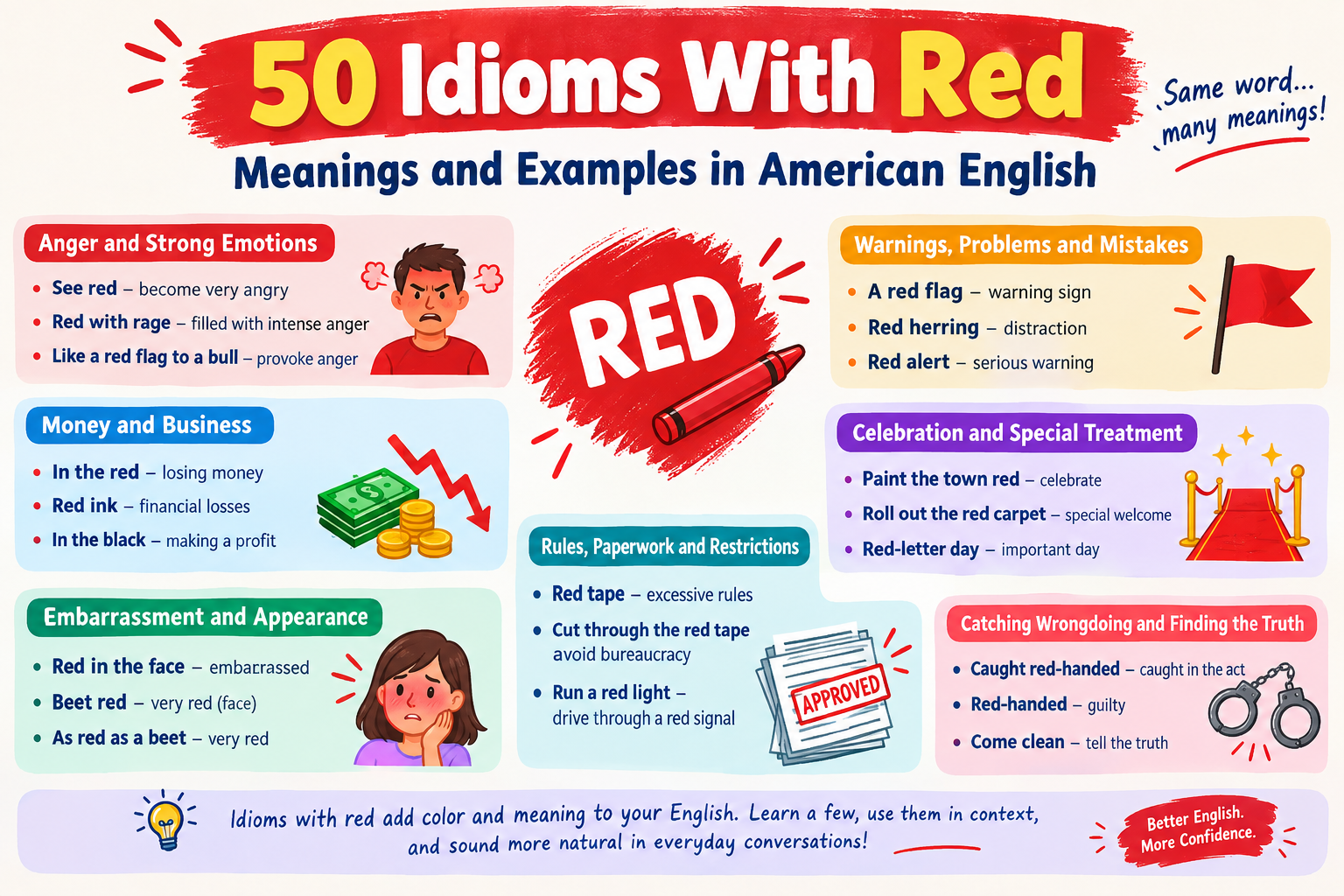
50 Idioms With Red: Meanings and Examples in American English
Idioms with red are common English expressions that use the color red to describe feelings, warnings, celebrations, money, and everyday situations. Some are heard in casual conversations, while others appear in books, movies, news reports, and workplace discussions.
When I began learning American English, I noticed that many expressions made little sense when translated word for word. Understanding the meaning behind phrases like “see red” and “in the red” helped me recognize how Americans use figurative language in everyday conversations.
If you are learning English, these expressions can help you understand what people mean beyond their literal words. Let’s look at 50 useful idioms and phrases, with simple definitions and natural examples.
Vacation Idioms: https://learnidioms.com/vacation-idioms/
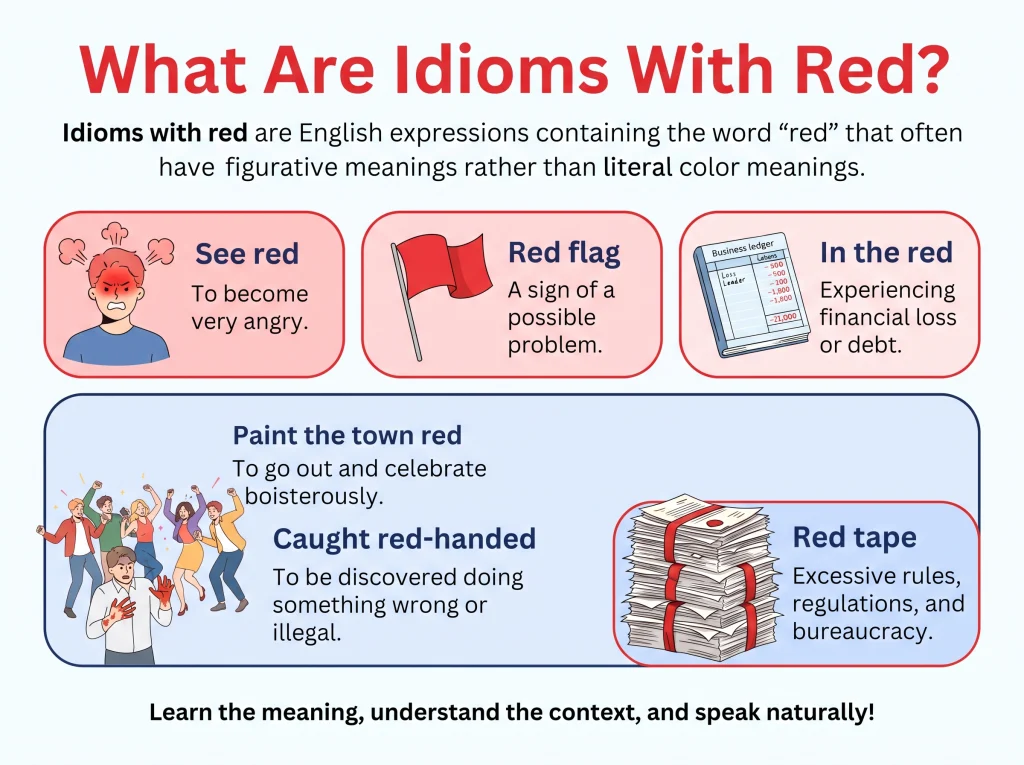
What Are Idioms With Red?
Idioms with red are expressions that contain the word red but often communicate a figurative meaning rather than a literal color. For example, “red tape” refers to excessive rules or paperwork, not a piece of red ribbon.
In American English, these expressions can describe anger, embarrassment, financial problems, special treatment, and warning signs. Learning them in context makes it easier to understand conversations and use the phrases correctly.
50 Common Idioms With Red, Their Meanings, and Examples
The following expressions include widely recognized idioms, common figurative phrases, and related expressions that English learners may encounter. Some are more common in American conversations than others.
Idioms About Anger and Strong Emotions
These expressions help describe anger, frustration, and intense reactions.
| Idiom or expression | Meaning | Example sentence |
|---|---|---|
| 1. See red | To become extremely angry | I saw red when someone scratched my new car. |
| 2. Seeing red | Feeling very angry | She was seeing red after hearing the unfair accusation. |
| 3. Red with anger | Extremely angry | He was red with anger when he discovered the damage. |
| 4. Red with rage | Filled with intense anger | The customer was red with rage after the argument. |
| 5. Like a red flag to a bull | Something that provokes a strong angry reaction | Mentioning his mistake is like a red flag to a bull. |
| 6. Get someone’s blood boiling | To make someone extremely angry | The unfair decision really got my blood boiling. |
| 7. Red mist | A state of intense anger that affects judgment | The red mist came down, and he stopped thinking clearly. |
Idioms About Warnings, Problems, and Mistakes
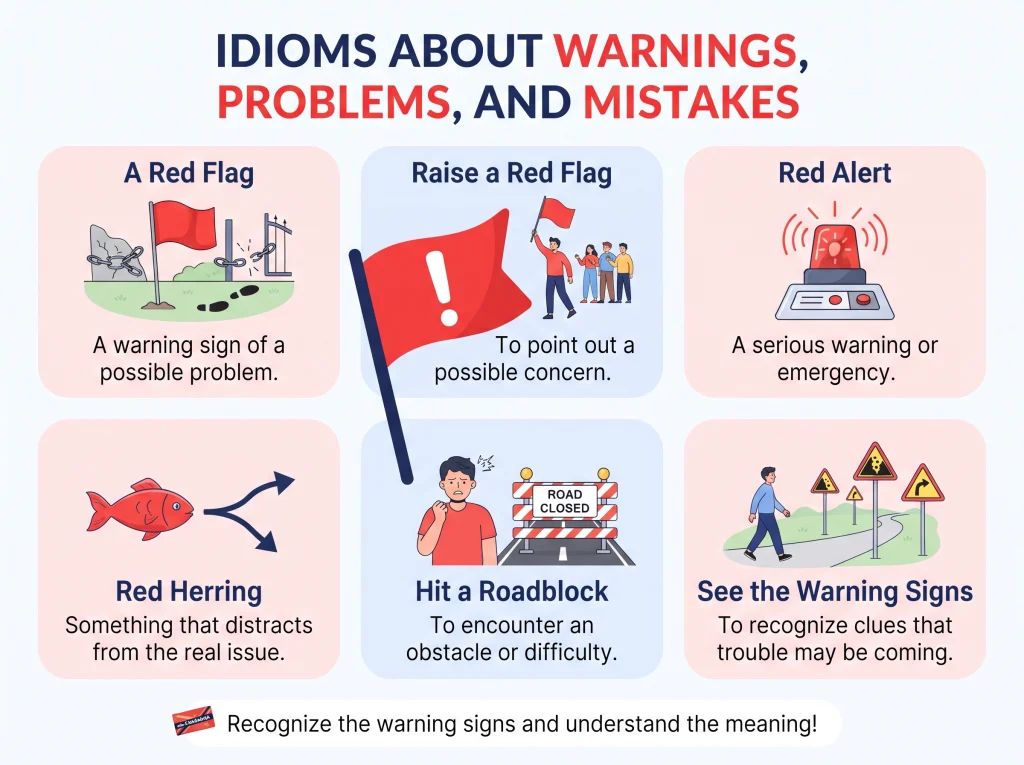
These expressions are useful when discussing concerns, danger, or misleading information.
| Idiom or expression | Meaning | Example sentence |
|---|---|---|
| 8. A red flag | A warning sign of a possible problem | His refusal to answer basic questions was a red flag. |
| 9. Raise a red flag | To point out a possible concern | The unusual charges raised a red flag for the accountant. |
| 10. Red alert | A state of serious warning or emergency | The storm warning put the coastal town on red alert. |
| 11. Red herring | Something that distracts from the real issue | The missing wallet was a red herring in the investigation. |
| 12. Red flag warning | A warning that something may be wrong | The sudden change in the contract was a red flag warning for the team. |
| 13. See the warning signs | To recognize clues that trouble may be coming | We should have seen the warning signs before the deal failed. |
| 14. Stop someone in their tracks | To make someone stop suddenly, often through shock or surprise | The unexpected news stopped me in my tracks. |
Idioms About Money and Business
These expressions are especially useful for conversations about budgets, business, and financial situations.
| Idiom or expression | Meaning | Example sentence |
|---|---|---|
| 15. In the red | Losing money or having a financial deficit | The small business was in the red after a difficult month. |
| 16. Out of the red | No longer experiencing a financial deficit | After several successful months, the company was finally out of the red. |
| 17. Red ink | Financial losses or negative figures in accounts | The quarterly report showed plenty of red ink. |
| 18. Not a red cent | No money at all | I didn’t spend a red cent on the online game. |
| 19. Bleeding red ink | Losing money rapidly or continually | The store was bleeding red ink because sales had fallen. |
| 20. In the black | Making a profit or having a positive financial balance | The restaurant is finally in the black this year. |
Idioms About Celebration and Special Treatment
Use these expressions to talk about parties, important occasions, and generous welcomes.
| Idiom or expression | Meaning | Example sentence |
|---|---|---|
| 21. Paint the town red | To go out and celebrate energetically | We passed our exams, so we’re going to paint the town red. |
| 22. Roll out the red carpet | To welcome or honor someone with special treatment | The hotel rolled out the red carpet for its celebrity guest. |
| 23. Red-carpet treatment | Very special or VIP treatment | The guests received red-carpet treatment at the event. |
| 24. Red-letter day | A memorable or especially important day | My graduation was a red-letter day for my family. |
| 25. A day to remember | A particularly memorable occasion | Our team’s championship victory was a day to remember. |
| 26. Make a big splash | To attract a lot of attention | The new singer made a big splash with her first performance. |
Idioms About Embarrassment and Appearance
These phrases describe blushing, embarrassment, and visible reactions.
| Idiom or expression | Meaning | Example sentence |
|---|---|---|
| 27. Red in the face | Embarrassed, ashamed, or sometimes physically flushed | I was red in the face when I called my teacher by the wrong name. |
| 28. Beet red | Extremely red in the face, often from embarrassment | He turned beet red when everyone started laughing. |
| 29. As red as a beet | Very red in the face | She was as red as a beet after her surprise speech. |
| 30. Red as a lobster | Very red, usually from sunburn | I forgot my sunscreen and came home red as a lobster. |
| 31. Red-faced | Looking embarrassed or flushed | The red-faced speaker paused after forgetting his lines. |
| 32. Have egg on your face | To look foolish after making a mistake | The company had egg on its face after announcing the wrong results. |
Idioms About Rules, Paperwork, and Restrictions
These expressions often appear in discussions about government offices, businesses, and procedures.
| Idiom or expression | Meaning | Example sentence |
|---|---|---|
| 33. Red tape | Excessive official rules and paperwork | The permit was delayed by months of red tape. |
| 34. Cut through the red tape | To get past unnecessary bureaucracy | The manager helped us cut through the red tape. |
| 35. Caught in red tape | Delayed or trapped by complicated procedures | Our application got caught in red tape. |
| 36. Run a red light | To drive through a red traffic signal | The driver was fined for running a red light. |
| 37. Hit a roadblock | To encounter an obstacle or difficulty | We hit a roadblock while trying to finish the project. |
Idioms About Catching Wrongdoing and Finding the Truth
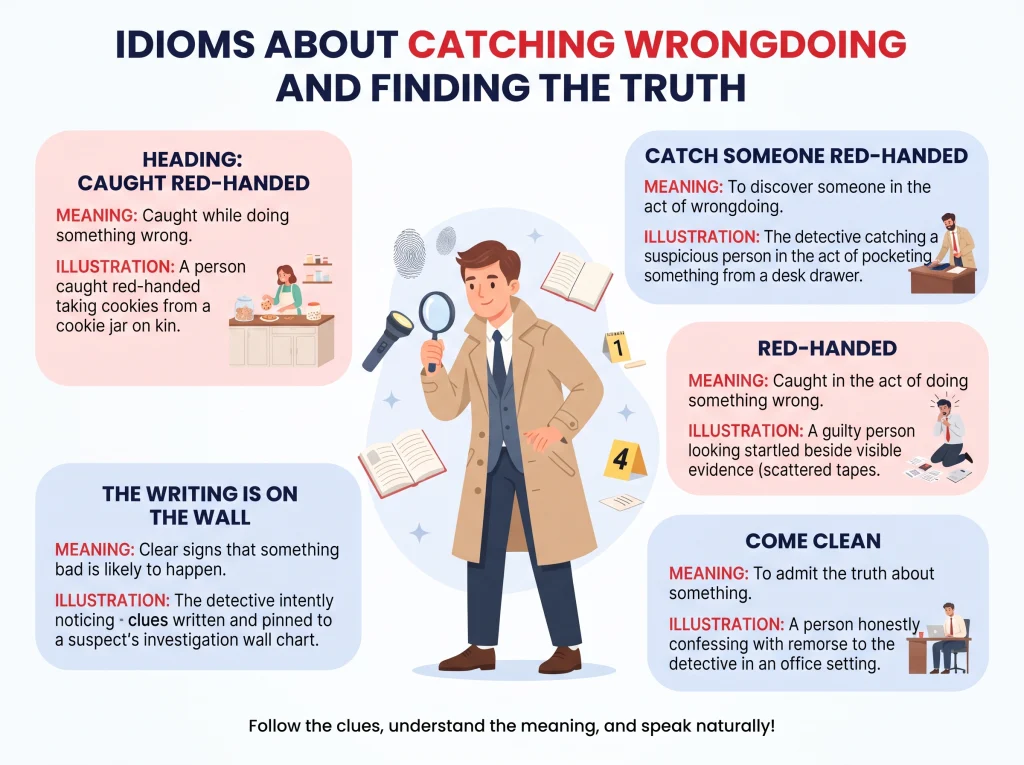
These expressions are useful when talking about dishonesty, evidence, and investigations.
| Idiom or expression | Meaning | Example sentence |
|---|---|---|
| 38. Caught red-handed | Caught while doing something wrong | The child was caught red-handed taking cookies before dinner. |
| 39. Catch someone red-handed | To discover someone in the act of wrongdoing | The security guard caught the shoplifter red-handed. |
| 40. Red-handed | Caught in the act of wrongdoing | The suspect was found red-handed with the stolen items. |
| 41. The writing is on the wall | There are clear signs that something bad will happen | After losing several major clients, the writing was on the wall. |
| 42. Come clean | To admit the truth about something | He finally came clean about breaking the window. |
Other Useful Red Expressions
These phrases describe popularity, travel, competition, and other situations.
| Idiom or expression | Meaning | Example sentence |
|---|---|---|
| 43. Red-hot | Extremely popular, exciting, or in high demand | That new restaurant is a red-hot topic around town. |
| 44. Red-hot market | A market with unusually strong demand or activity | The city has a red-hot housing market this year. |
| 45. Red-eye flight | An overnight flight, usually arriving early in the morning | I took a red-eye flight from Los Angeles to New York. |
| 46. Red zone | An area marked as dangerous or restricted, depending on context | The hikers were told to stay out of the red zone. |
| 47. Red in tooth and claw | Fiercely competitive, harsh, or ruthless | The documentary showed nature red in tooth and claw. |
| 48. Red carpet event | An event featuring a formal celebrity-style welcome | The actor arrived at the red carpet event with her family. |
| 49. Red sky at night | A traditional weather saying associated with a red evening sky and good weather ahead | My grandfather often quoted, “Red sky at night, sailor’s delight.” |
| 50. Red-letter moment | A particularly significant or memorable moment | Scoring the winning goal was a red-letter moment for the young player. |
Usage note: Some entries are established idioms, while others are common expressions or figurative phrases. Their frequency and familiarity can vary by region and context.
Idioms With Red That Express Anger
Several red idioms describe strong feelings, especially anger and frustration. The most familiar example is “see red,” which means to become extremely angry.
Here are three useful examples:
- See red: “I saw red when I learned that someone had lied to me.”
- Red with rage: “He was red with rage after the heated argument.”
- Like a red flag to a bull: “Bringing up that old disagreement is like a red flag to a bull.”
The phrase “like a red flag to a bull” is also found in American English as “like waving a red flag in front of a bull.” Both describe something likely to provoke anger.
Oxford Learner’s Dictionaries
+1
Idioms With Red That Describe Warnings and Mistakes
Red is often associated with warning signs and problems in English expressions. “Red flag” is particularly useful when you want to point out a possible concern without claiming that something is definitely wrong.
For example, you might say, “The missing paperwork was a red flag,” or “The sudden price increase raised a red flag.” These phrases suggest that someone should pay attention and investigate further.
A “red herring,” on the other hand, is a distraction that leads attention away from the main issue. In a mystery story, a suspicious clue might turn out to be a red herring rather than evidence of who committed the crime.
Talk in Idioms
+1
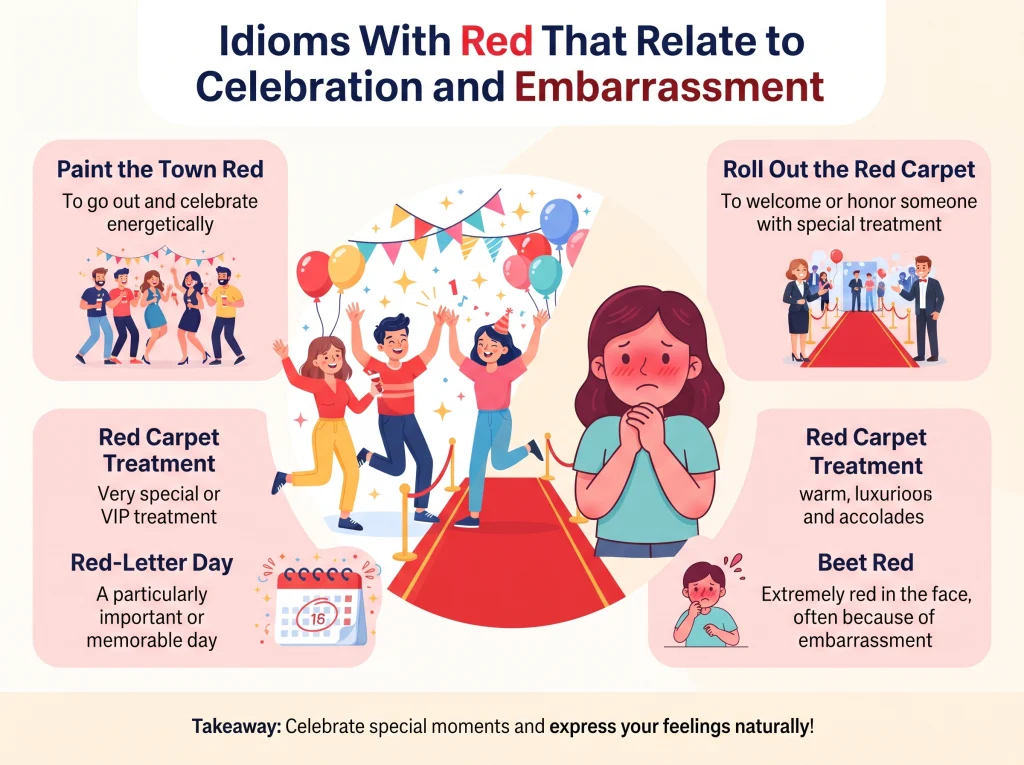
Idioms With Red That Relate to Celebration and Embarrassment
Some red expressions describe positive occasions, while others refer to uncomfortable moments. “Paint the town red” means going out to celebrate, and “roll out the red carpet” means giving someone a special welcome.
For example, friends might paint the town red after graduating from college. A company might roll out the red carpet when welcoming an important visitor.
Expressions such as “red in the face” and “beet red” usually describe someone who is embarrassed or visibly flushed. “Red as a lobster” is commonly used for someone whose skin has become very red from sun exposure.
BBC Downloads
+2
How to Use Red Idioms Naturally in American English
Learning an idiom is not only about memorizing its definition. You also need to understand when it sounds natural and whether it suits the situation.
1. Learn the expression in a complete sentence
Instead of memorizing only “in the red,” learn a sentence such as, “The business is in the red this month.” This shows how the phrase fits into a real conversation.
2. Pay attention to the situation
Some idioms are casual, while others work in professional settings. “Paint the town red” is informal, but “red tape” can be used when discussing official procedures at work.
3. Practice with everyday examples
Try using one expression in a sentence about your own day. For example, “I saw red when my computer crashed just before the deadline.”
4. Listen for idioms in context
Pay attention to how people use expressions in American movies, interviews, podcasts, and conversations. Notice the speaker’s tone and the situation before trying the phrase yourself.
5. Avoid using too many idioms at once
A natural speaker usually chooses an expression that fits the moment. Using several unrelated idioms in one sentence can make your English sound confusing.
Here’s the thing: you do not need to use every idiom you learn. Start with familiar expressions such as “red flag,” “see red,” and “in the red,” then add others as you become more comfortable.
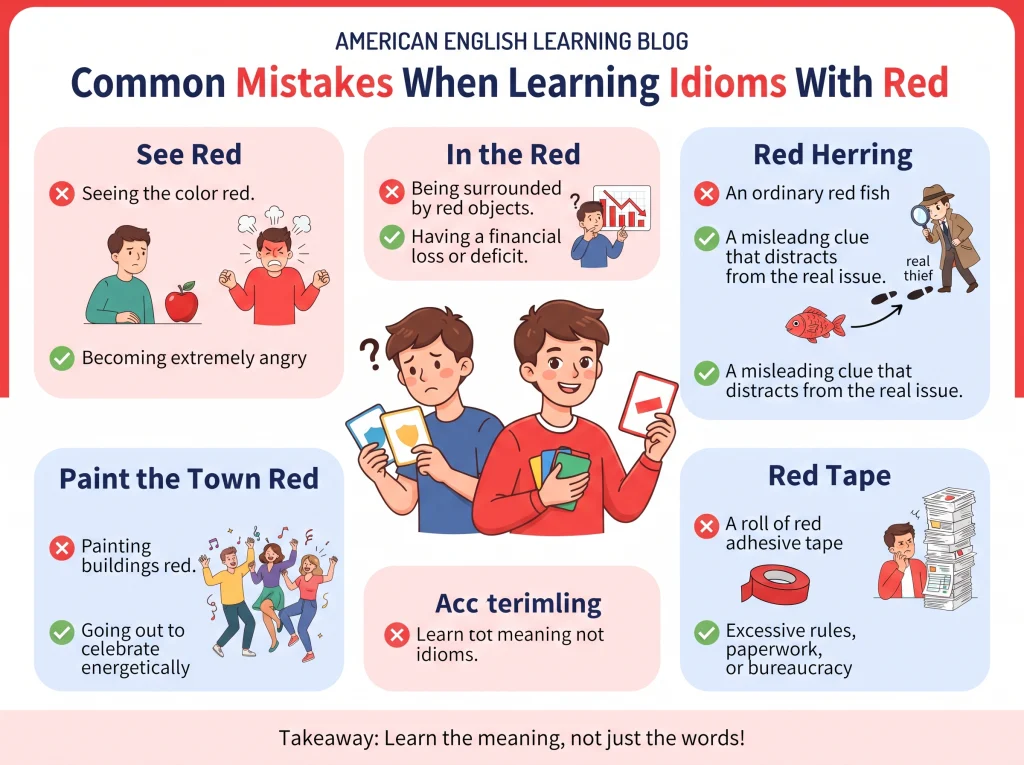
Common Mistakes When Learning Idioms With Red
English learners sometimes understand the individual words but miss the figurative meaning. Remember that the intended meaning of an idiom may be quite different from its literal wording.
| Common mistake | Correct understanding |
|---|---|
| Thinking “see red” means looking at something red | It means becoming very angry. |
| Thinking “in the red” means being surrounded by the color red | It means losing money or having a financial deficit. |
| Using “red herring” to mean any ordinary mistake | It refers to something misleading or distracting from the main issue. |
| Thinking “red tape” means a physical ribbon | It refers to excessive bureaucracy, rules, or paperwork. |
| Using “paint the town red” for a quiet evening at home | It usually describes going out and celebrating energetically. |
The key is to learn each expression as a complete unit of meaning. Once you recognize the situation in which it is used, choosing the right idiom becomes much easier.
FAQ: Idioms With Red
Conclusion
Idioms with red add color and meaning to American English. They help speakers describe anger, embarrassment, celebrations, financial problems, warnings, and everyday experiences in a memorable way.
Start by practicing a few common expressions, such as “red flag,” “caught red-handed,” “red tape,” and “paint the town red.” With regular reading and listening, you will become more familiar with how these phrases work in real conversations.






One Comment