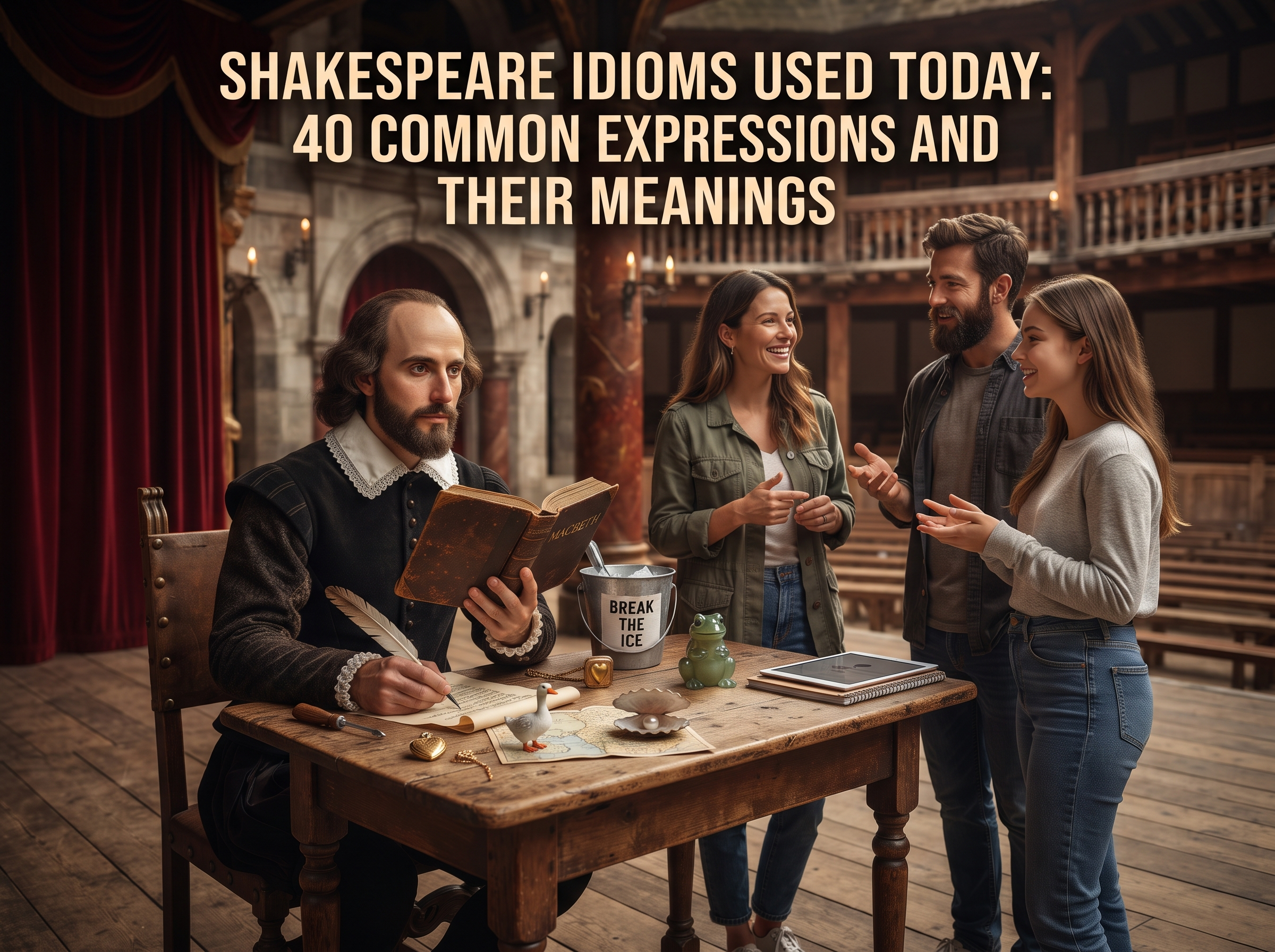
Shakespeare Idioms Used Today: 40 Common Expressions and Their Meanings
William Shakespeare wrote more than 400 years ago, but many expressions associated with his plays are still familiar to English speakers today. Some are used so naturally that speakers may not realize they are quoting or echoing Shakespeare.
The Royal Shakespeare Company notes that many words and phrases first recorded in Shakespeare’s works remain part of everyday language. Examples include elbow room, heart of gold, tower of strength, and wild-goose chase.
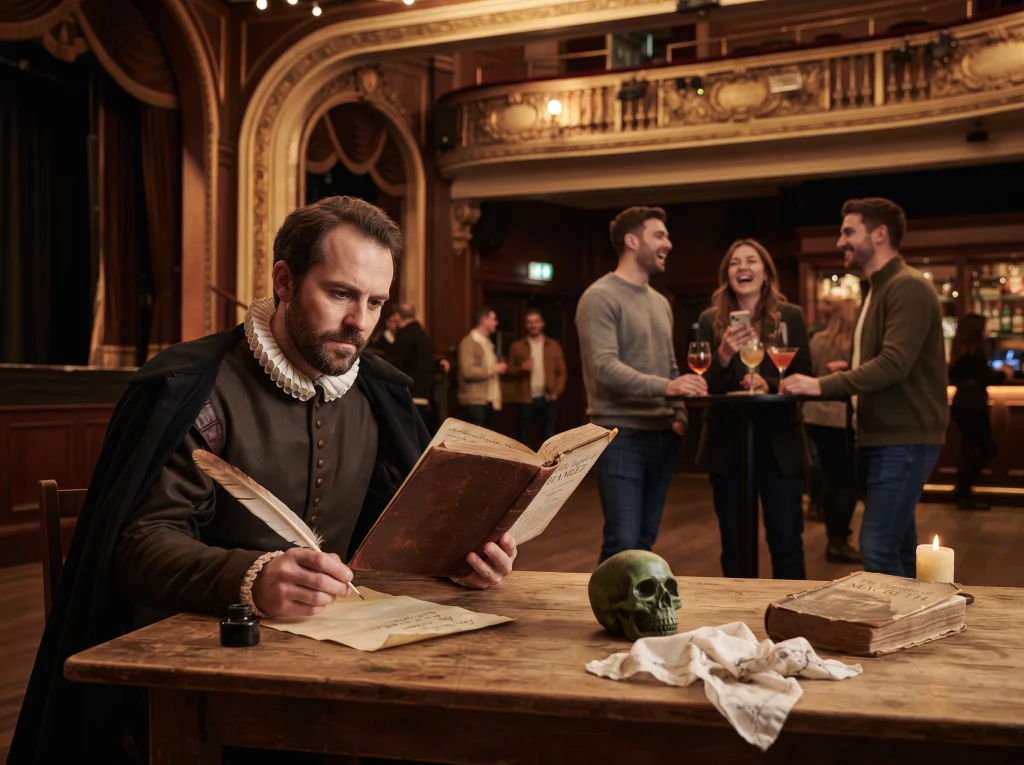
These expressions appear in conversations, books, newspapers, movies, workplaces, classrooms, and online communication. Some are true idioms, while others are famous phrases or expressions whose original wording has become part of modern English.
For English learners, Shakespeare idioms used today are especially interesting because their modern meanings are often much simpler than their original literary contexts. You do not need to read every Shakespeare play to understand them. Learning the expressions individually can help you recognize figurative language in everyday American English.
What Are Shakespeare Idioms?
Shakespeare idioms are idiomatic expressions and familiar phrases that originated in, or were first recorded in, Shakespeare’s plays and poems and that continue to be used in modern English.
It is important to be precise about the word originated. Shakespeare did not necessarily invent every phrase attributed to him. In some cases, he provided the earliest known written record, while in others he popularized an existing expression or used familiar words in a new way.

The Royal Shakespeare Company explains that Shakespeare played a major role in the transformation of English and that many words and phrases were first written down in his works.
Today, expressions such as wild-goose chase, green-eyed monster, foregone conclusion, and the world is my oyster can be understood without knowing their original plays.
40 Shakespeare Idioms and Expressions Used Today
1. Wild-Goose Chase
Meaning: A pointless or difficult search for something that is unlikely to be found.
Example: We spent all afternoon on a wild-goose chase looking for the missing file.
The expression appears in Romeo and Juliet. Its original context referred to a type of horse race, but its meaning later developed into the modern idea of a fruitless search.
2. Green-Eyed Monster
Meaning: Jealousy.
Example: The green-eyed monster appeared when he saw his former partner with someone else.
In Othello, Shakespeare describes jealousy as a “green-eyed monster.” The expression remains common today.
3. The World Is My Oyster
Meaning: I have many opportunities available to me.
Example: After graduating from college, she felt that the world was her oyster.
The phrase comes from The Merry Wives of Windsor. Its modern meaning emphasizes opportunity and possibility.
4. Foregone Conclusion
Meaning: An outcome that seems certain before the final result occurs.
Example: Given the team’s performance all season, the championship seemed like a foregone conclusion.
Shakespeare uses the phrase in Othello. Today it is common in general English and does not require any knowledge of the play.
5. Heart of Gold
Meaning: A very kind, generous, and caring nature.
Example: My neighbor has a heart of gold and always helps people in need.
The expression appears in Henry V.
6. Break the Ice
Meaning: Make people feel more comfortable when they first meet or when a situation feels awkward.
Example: The teacher told a joke to break the ice on the first day of class.
The expression is associated with Shakespeare’s The Taming of the Shrew and has become one of the most common everyday expressions in English.
7. Wear Your Heart on Your Sleeve
Meaning: Show your emotions openly.
Example: She wears her heart on her sleeve and never hides her feelings.
The phrase comes from Othello, where the wording refers to displaying one’s feelings openly.
8. Love Is Blind
Meaning: People in love may fail to see another person’s faults clearly.
Example: He ignored all the warning signs because love is blind.
The phrase is associated with The Merchant of Venice.
9. In a Pickle
Meaning: In a difficult or troublesome situation.
Example: I was in a pickle after I accidentally deleted the presentation.
The expression appears in The Tempest.
10. Knock, Knock, Who’s There?
Meaning: The familiar opening of a knock-knock joke.
Example: The children started a knock-knock joke at the dinner table.
The Porter scene in Macbeth contains an early literary example of this joke structure. The Royal Shakespeare Company notes that Shakespeare may have originated the familiar form.
11. Bated Breath
Meaning: Holding your breath because you are excited, nervous, or waiting for something.
Example: We waited with bated breath for the final announcement.
The phrase appears in The Merchant of Venice. Shakespeare’s wording uses bated, a shortened form of abated.
12. Wild-Goose Chase
Meaning: A search or pursuit that leads nowhere.
Example: The detective worried that the new clue would send them on another wild-goose chase.
This expression is so established that many speakers use it without any connection to Shakespeare.
13. Send Someone Packing
Meaning: Make someone leave, often because they are unwanted.
Example: The manager sent the dishonest salesman packing.
The phrase appears in Henry IV, Part 1 and is used there in essentially the same general sense it has today.
14. More Fool You
Meaning: You are foolish for making a particular choice.
Example: If you refuse the opportunity, more fool you.
The Royal Shakespeare Company identifies an early appearance of the expression in The Taming of the Shrew.
15. Forever and a Day
Meaning: A very long time or seemingly forever.
Example: I could listen to that story forever and a day.
Shakespeare used the phrase in The Taming of the Shrew and later in As You Like It.
16. Short Shrift
Meaning: Little attention, consideration, or sympathy.
Example: The proposal received short shrift from the committee.
The phrase appears in Richard III. Its historical meaning was connected with a rushed religious confession before execution, while its modern meaning focuses on dismissive treatment.
17. High Time
Meaning: The appropriate or overdue time for something to happen.
Example: It is high time we repaired the roof.
The phrase appears in The Comedy of Errors.
18. Be Cruel to Be Kind
Meaning: Do something unpleasant now because you believe it will ultimately help someone.
Example: I had to be cruel to be kind and tell him the truth about his performance.
The expression comes from Hamlet.
19. As Pure as the Driven Snow
Meaning: Completely innocent or morally pure.
Example: The character presents herself as being as pure as the driven snow.
A closely related version appears in The Winter’s Tale.
20. Keep Your Distance
Meaning: Stay physically or socially separate from someone.
Example: The aggressive dog made us keep our distance.
The Royal Shakespeare Company identifies Shakespeare’s All’s Well That Ends Well as an early written source for the expression.
Shakespeare Idioms About Love and Relationships
Shakespeare wrote extensively about romance, jealousy, marriage, friendship, betrayal, and human relationships. As a result, many expressions connected with emotions and relationships remain familiar today.
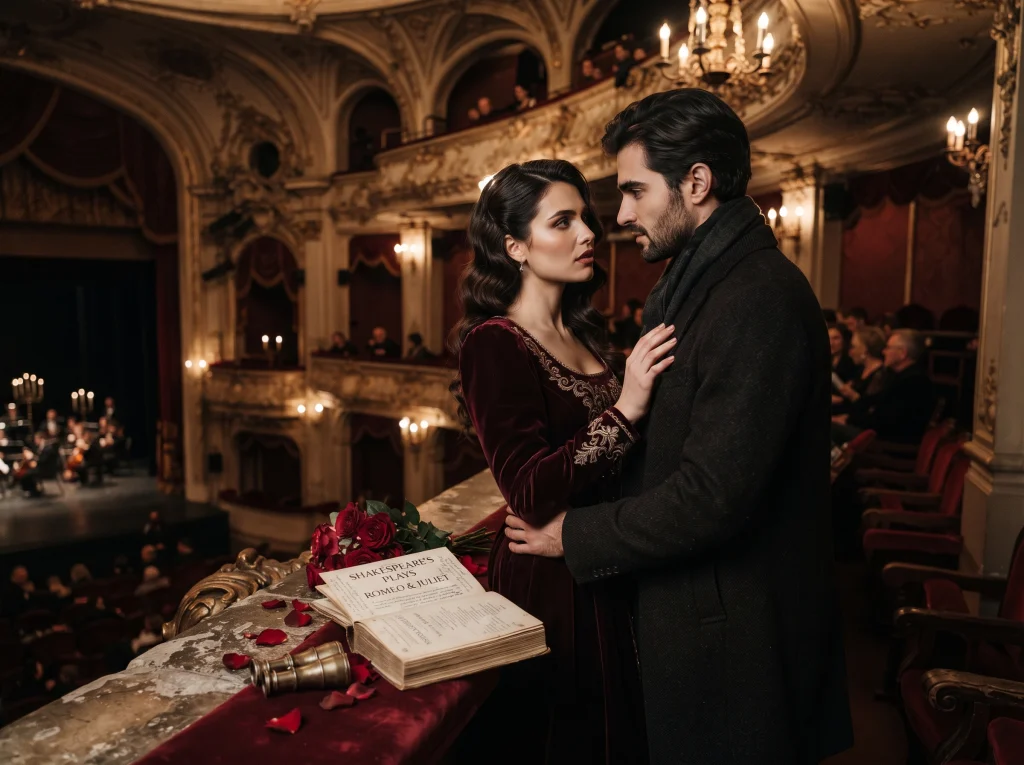
21. Love Is Blind
Meaning: Love can prevent people from seeing another person’s faults clearly.
Example: Love is blind sometimes, especially when someone is deeply attached to another person.
22. Wear Your Heart on Your Sleeve
Meaning: Make your emotions obvious to others.
Example: He wears his heart on his sleeve, so everyone knows when he is upset.
23. Heart of Gold
Meaning: A kind and generous personality.
Example: Despite his serious appearance, he has a heart of gold.
24. Green-Eyed Monster
Meaning: Jealousy or envy.
Example: The green-eyed monster can damage even a strong relationship.
25. Love-Letter Language
Shakespeare’s works also helped popularize memorable ways of discussing romance and affection. However, not every romantic quotation from Shakespeare is an idiom. A famous quotation should not automatically be described as an idiom simply because people still recognize it.
This distinction matters when studying Shakespeare idioms used today. Love is blind and wear your heart on your sleeve function naturally as expressions, while many famous Shakespeare quotations remain quotations rather than everyday idioms.
Shakespeare Expressions About Life and Human Nature
Some Shakespeare expressions have survived because they describe situations people still encounter.
26. The World Is My Oyster
Meaning: Life offers many opportunities.
Example: After finishing school, she felt that the world was her oyster.
27. All That Glisters Is Not Gold
Meaning: Attractive appearances do not always reveal true value.
Example: The expensive offer looked impressive, but all that glisters is not gold.
The expression appears in The Merchant of Venice.
28. In Stitches
Meaning: Laughing very hard.
Example: The comedian had the entire audience in stitches.
The Royal Shakespeare Company identifies Twelfth Night as an early written source for the expression.
29. Night Owl
Meaning: A person who prefers staying awake and active late at night.
Example: I am a night owl, so I usually do my best work after dinner.
The RSC identifies Shakespeare’s The Rape of Lucrece as an early written use of night owl for a person who stays active at night.
30. Tower of Strength
Meaning: A person who provides strong emotional or practical support.
Example: Her older sister was a tower of strength during the difficult period.
The phrase appears in Richard III.
31. Elbow Room
Meaning: Enough physical or personal space.
Example: We need more elbow room in the office.
The Royal Shakespeare Company identifies elbow room as one of the well-known phrases associated with Shakespeare’s language.
32. The Game Is Afoot
Meaning: An activity, investigation, or pursuit has begun.
Example: We have our first clue, so the game is afoot.
The expression appears in Henry V.
Shakespeare Idioms About Conflict and Problems
Shakespeare’s plays contain plenty of conflict, deception, rivalry, and difficult decisions. Some expressions from these contexts continue to describe modern problems.

33. At One Fell Swoop
Meaning: All at once or in a single action.
Example: The company solved three major problems at one fell swoop.
The expression is associated with Macbeth and remains recognizable in modern English.
34. A Foregone Conclusion
Meaning: A result that appears certain in advance.
Example: Everyone expected the vote to pass, so the result seemed like a foregone conclusion.
35. The Game Is Up
Meaning: A secret or deception has been discovered and the situation is finished.
Example: Once the police found the evidence, the game was up.
The expression appears in Cymbeline.
36. Send Him Packing
Meaning: Force or tell someone to leave.
Example: The company sent him packing after discovering the misconduct.
The expression appears in Henry IV, Part 1.
37. Off With His Head
Meaning: A humorous or dramatic way of demanding punishment or removal.
Example: When the computer crashed for the third time, he jokingly shouted, “Off with its head!”
The expression appears in Henry VI, Part 3 and Richard III.
38. Harp on That String
Meaning: Keep talking repeatedly about the same subject, especially something unpleasant.
Example: I know you are disappointed, but there is no need to harp on that string.
The expression appears in Richard III.
39. The Game’s Afoot
Meaning: The action or investigation has begun.
Example: We have found the missing document. The game’s afoot.
Shakespeare uses the expression in Henry V.
40. All’s Well That Ends Well
Meaning: A difficult situation is acceptable if it ultimately has a good outcome.
Example: We had several problems during the trip, but we arrived safely. All’s well that ends well.
The expression also became the title of one of Shakespeare’s plays.
Shakespeare Expressions Still Common in American English
Many Shakespearean expressions do not sound old-fashioned to modern American speakers. Break the ice, night owl, heart of gold, wild-goose chase, high time, and foregone conclusion can all appear naturally in everyday conversation.
For example, an American might say:
Let’s play a quick game to break the ice.
Or:
I’m a night owl, so I don’t mind working late.
Or:
Looking for that old receipt turned into a wild-goose chase.
None of these sentences requires literary knowledge. The expressions function as ordinary parts of modern English.
At the same time, some Shakespeare phrases are strongly literary. The game is afoot can sound more dramatic than simply saying “the investigation has started.” Choosing the right expression depends on context, audience, and tone.

Common Mistakes About Shakespeare Idioms
Calling every Shakespeare quote an idiom
This is one of the most common mistakes. Shakespeare wrote thousands of memorable lines, but not every famous quotation is an idiom.
An idiom is generally an established expression whose meaning is understood beyond the literal meanings of its individual words. A famous quotation can remain a quotation without functioning as an idiom.
Assuming Shakespeare invented every expression attributed to him
The phrase coined by Shakespeare can be misleading. In some cases, he may have been the first known writer to record a phrase rather than the person who originally created it.
The Royal Shakespeare Company specifically explains that Shakespeare’s role in English included both creating new words and using existing words in inventive ways.
Using Shakespearean wording in every situation
Modern English does not require you to speak like a Shakespeare character. Expressions such as wild-goose chase and heart of gold sound natural, but more theatrical phrases may sound unusual in casual conversation.
Confusing the original meaning with the modern meaning
Some expressions have changed slightly over time. Wild-goose chase, for example, had a different historical context in Shakespeare’s period, while its modern meaning refers to a pointless search.

How Shakespeare Influenced Modern English
Shakespeare’s influence on English extends beyond famous quotations. His plays contain unusual combinations of words, inventive uses of language, memorable metaphors, and expressions that later became established parts of English.
The Royal Shakespeare Company notes that many words and phrases were first written down in Shakespeare’s works and that his language helped transform English.
His influence is particularly noticeable because his plays have remained widely performed and studied for centuries. Expressions that might otherwise have disappeared continued to be repeated through theater, education, literature, and popular culture.
For modern English learners, this creates an interesting connection between literature and everyday communication. A phrase such as green-eyed monster can move from a Shakespearean tragedy into an ordinary conversation about jealousy.
Frequently Asked Questions
Conclusion
Shakespeare’s influence on modern English can be heard in everyday expressions that may seem completely ordinary. Break the ice, wild-goose chase, green-eyed monster, heart of gold, night owl, elbow room, and the world is my oyster are examples of language connected with Shakespeare that continues to be understood today.