
Studying or Studing? Which Spelling Is Correct in American English?
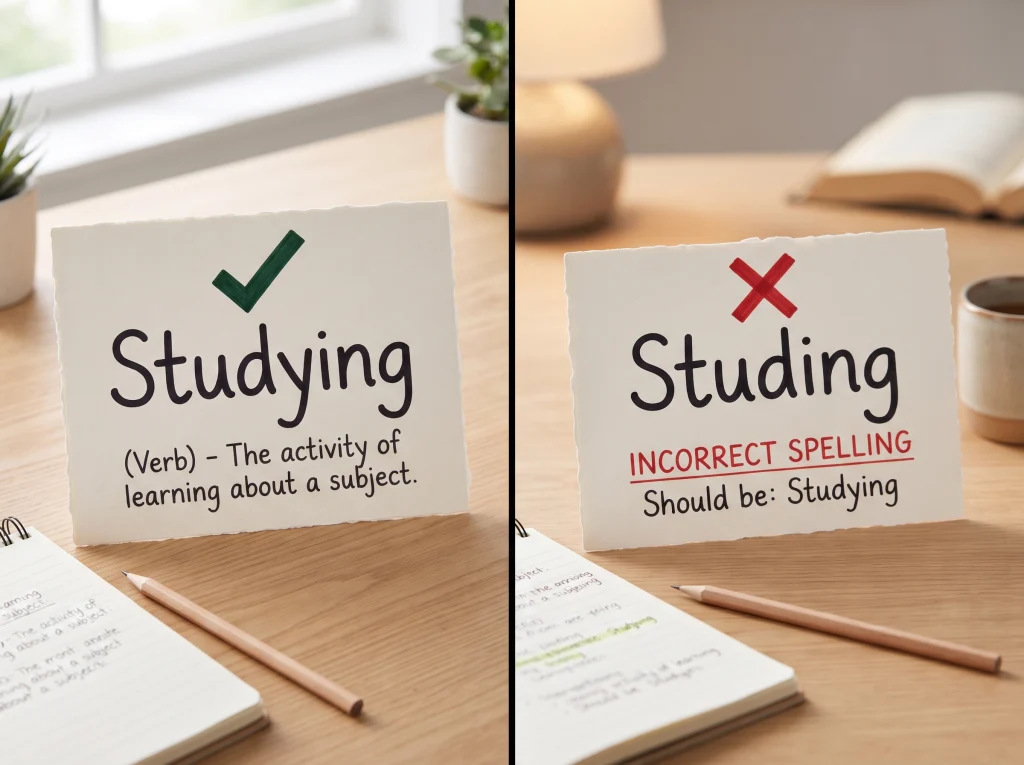
Studying is the correct spelling. Studing is incorrect in standard English.
The word studying is the present participle of study. It is used when someone is learning, examining, or giving careful attention to a subject. Cambridge Dictionary lists studying as the present participle of study.

The spelling can seem confusing because some English words change their spelling when -ing is added. However, study keeps its final y:
study + ing = studying
Not:
stud + ing = studing
For American English, the correct form is always studying.
What Does Studying Mean?
Studying means spending time learning about a subject, usually by reading, practicing, attending classes, researching, or reviewing information. It can also mean examining something carefully. Cambridge gives both learning and careful examination as meanings of the verb study.
For example:
I am studying for my English exam.
Here, studying means preparing for the exam by learning and reviewing material.
You can study many different things, including:
- A school subject
- A college course
- A language
- A professional subject
- A textbook
- A research topic
- A particular problem or situation
The word is not limited to formal education.
For example:
She is studying the company’s financial records.
In this sentence, studying means examining the records carefully.
Simular or Similar: https://learnidioms.com/simular-or-similar/
Why Is Studying Spelled With a Y?
The easiest way to understand the spelling is to start with the base verb:
study
Then add -ing:
study + ing = studying
The letter y remains part of the word.
This is important because English spelling rules do not generally remove the final y before adding -ing.
Compare these examples:
| Base Verb | Correct -ing Form |
|---|---|
| study | studying |
| play | playing |
| enjoy | enjoying |
| carry | carrying |
| worry | worrying |
The spelling of study therefore remains recognizable when -ing is added.
The incorrect form studing results from removing the y before adding -ing. That spelling does not represent the standard English form of the verb.
Studying vs. Studing Comparison
| Spelling | Correct? | Explanation | Example |
|---|---|---|---|
| Studying | Yes | Present participle or gerund of study | I am studying English. |
| Studing | No | Incorrect spelling | I am studing English. |
The difference is only one letter, but that letter matters.
The correct spelling is:
Studying
The incorrect spelling is:
Studing
If you are writing an email, school assignment, article, résumé, or social media post, use studying.

Studying in the Present Continuous Tense
Studying is commonly used in the present continuous tense to describe an activity happening now or around the present time.
The basic structure is:
Subject + am/is/are + studying
Examples:
I am studying for my exam.
She is studying biology.
They are studying together.
We are studying English this semester.
He is studying at the library.
Cambridge’s American English dictionary gives studying as the present participle of study.
The same form can be used for an activity that is temporary or currently in progress:
I’m studying for my final exam this week.
Here, studying describes an activity taking place during the current period.
Studying as a Gerund
The word studying can also function as a gerund. A gerund is an -ing form that functions as a noun.
For example:
Studying requires concentration.
In this sentence, studying is the subject of the sentence.
Another example is:
I enjoy studying in the morning.
Here, studying follows the verb enjoy and refers to the activity of learning.
More examples include:
Studying English can improve your communication skills.
Studying regularly can make exam preparation easier.
She enjoys studying history.
So, studying can describe an action in progress or refer to the activity of learning itself.
Common Mistakes With Studying
Writing “Studing”
The most common mistake is leaving out the y:
❌ I am studing for my test.
The correct version is:
✅ I am studying for my test.
The base word is study, so keep the y when adding -ing.
Confusing Study and Studying
Study and studying are both correct, but they serve different grammatical purposes.
I study every evening.
I am studying right now.
The first sentence uses the base verb study. The second uses studying as part of the present continuous construction.
Confusing Studying and Studied
Studying refers to an -ing form, while studied is the simple past and past participle of study.
Compare:
I am studying biology.
I studied biology yesterday.
The first describes an activity in progress. The second describes an activity that happened in the past.
Assuming the Y Should Be Removed
Some spelling patterns involve changing letters before adding a suffix, which can make studying seem unusual. However, the standard form keeps the y.
Remember:
study → studying
Not:
study → studing

How to Remember the Spelling
The simplest memory trick is to keep the original word visible:
STUDY + ING = STUDYING
Do not remove the y.
You can also remember it by comparing these words:
- Study → studying
- Play → playing
- Enjoy → enjoying
- Stay → staying
The y remains before -ing.
A useful sentence to remember is:
I am studying because I want to learn.
Both studying and learning are common words, so the sentence can help reinforce the correct spelling.

Studying in Common American English Sentences
Here are natural examples using studying in everyday American English.
Studying for an Exam
I am studying for my final exam tonight.
She has been studying for the test all week.
Studying a Subject
He is studying chemistry in college.
My sister is studying psychology.
Studying a Language
I’m studying Spanish this semester.
They are studying English together.
Studying at School or College
She is studying at a university in California.
He spent the afternoon studying at the library.
Studying Carefully
The scientist is studying the effects of the new treatment.
The researcher is studying how children learn language.
Studying as an Activity
Studying every day can help you remember information.
I enjoy studying early in the morning.
These examples show that studying can be used for academic preparation, learning a subject, language study, research, and careful examination.

Is Studying Spelled the Same in American and British English?
Yes. Studying has the same spelling in standard American and British English.
The base verb is study, and its present participle is studying. Cambridge lists the same form in its English and American English dictionary resources.
Therefore, you should use studying whether you are writing for readers in the United States, the United Kingdom, Canada, Australia, or another English speaking audience.
FAQs:
Conclusion
When choosing between studying or studing, the correct answer is studying.
The spelling comes directly from the base verb study plus -ing:
study + ing = studying
The y stays in the word. Studying can describe learning a subject, preparing for an exam, researching a topic, or examining something carefully.
So whether you write “I am studying for my exam,” “She is studying biology,” or “They are studying English,” always use studying, not studing.





5 Comments