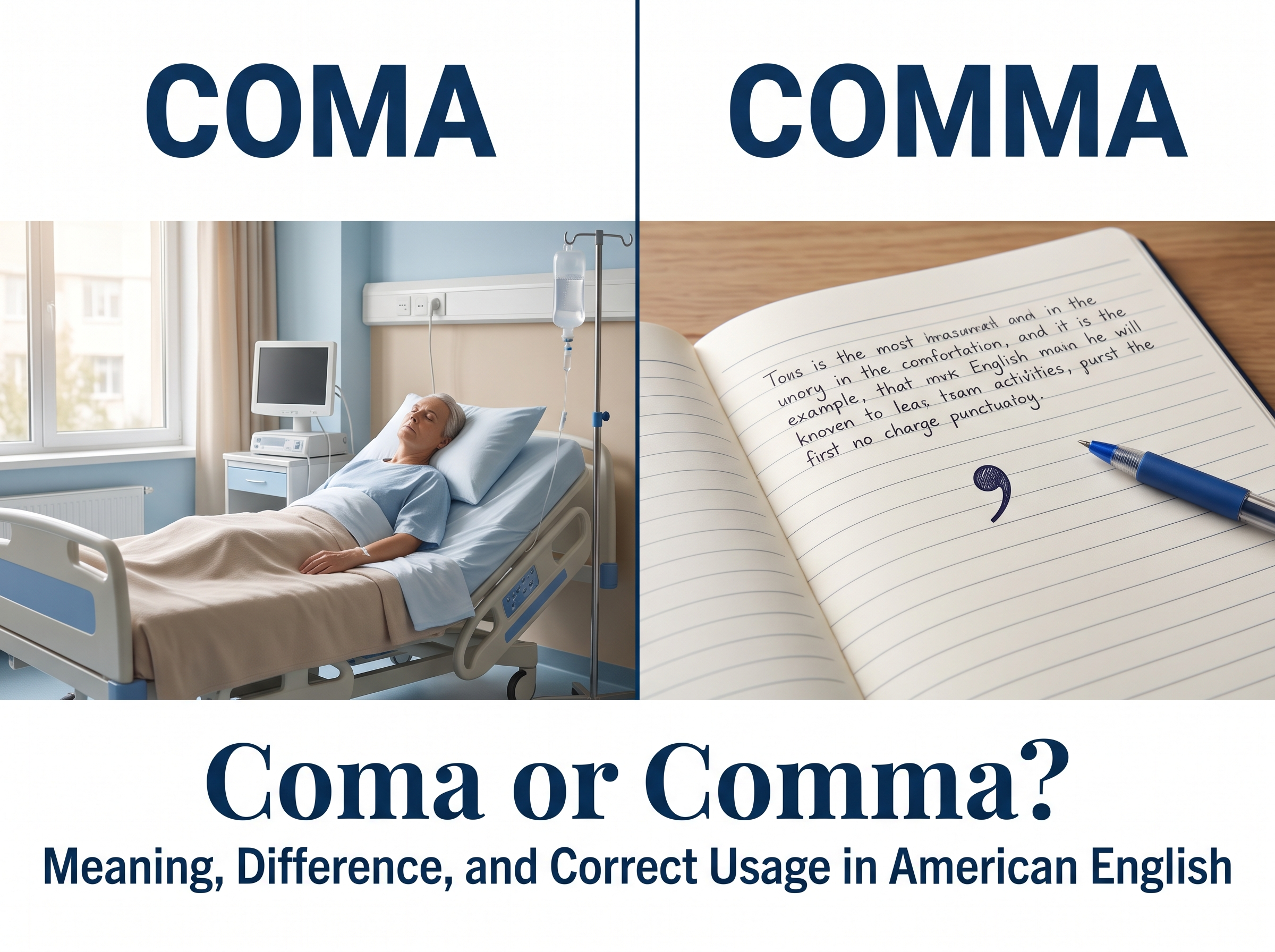
Coma or Comma? Meaning, Difference, and Correct Usage in American English
Have you ever wondered whether to write coma or comma? These two words look almost identical, but they have completely different meanings. One refers to a serious medical condition, while the other is a punctuation mark used in everyday writing. Adding or removing a single letter changes the meaning of the word.
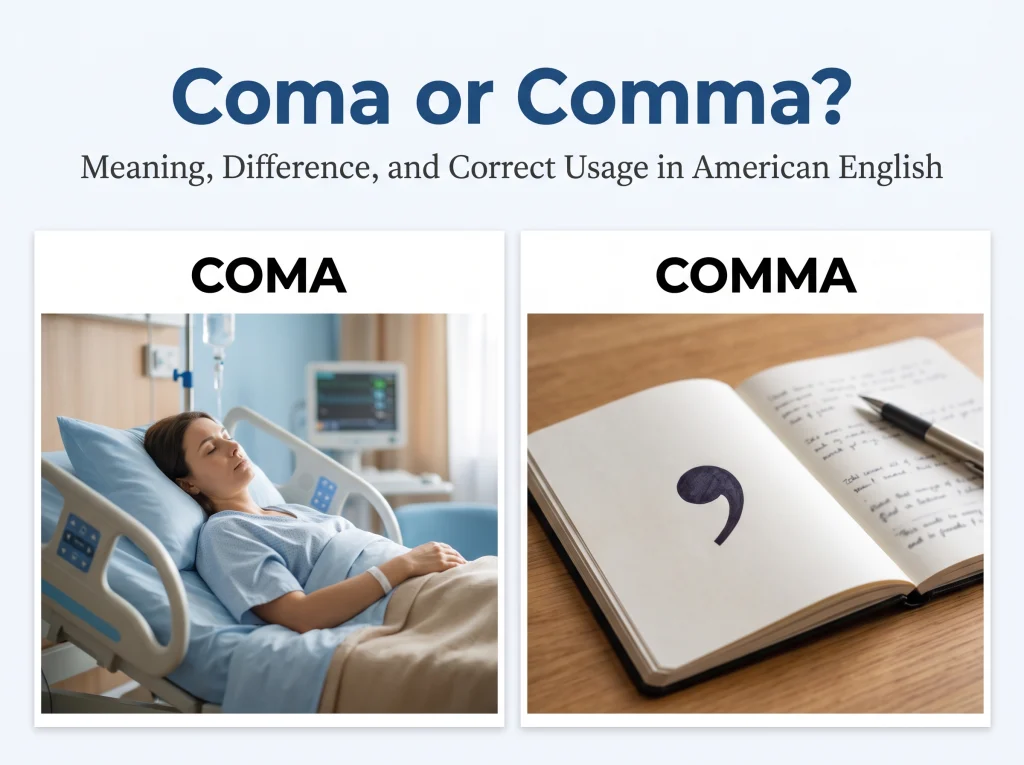
The correct choice depends on what you want to communicate. If you are writing about a patient who cannot be awakened, use coma. If you are writing an email, preparing a school assignment, editing a document, or separating items in a sentence, use comma. Understanding the difference will help you avoid spelling mistakes and communicate clearly in American English.
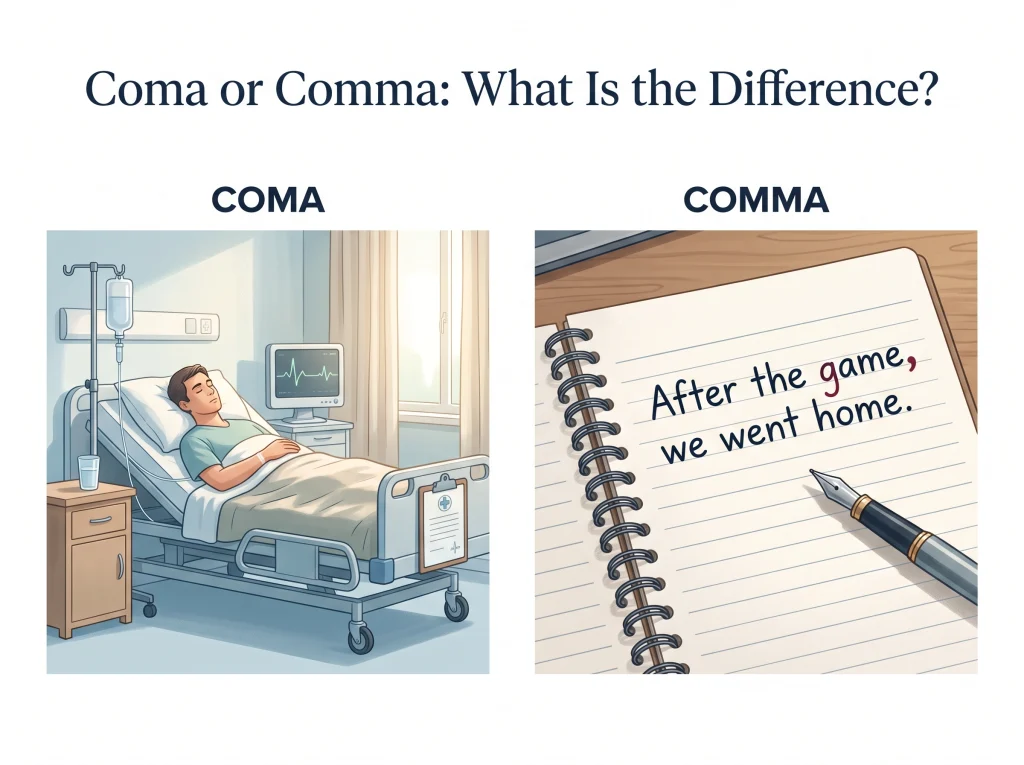
Coma or Comma: What Is the Difference?
Coma refers primarily to a prolonged state of unconsciousness in which a person cannot be awakened normally. Comma is a punctuation mark (,) used to separate words, phrases, clauses, and items in a list.
Both words are nouns, but they belong to different contexts. Coma is commonly used in medical discussions, while comma appears in grammar lessons, professional writing, emails, books, and everyday communication.
| Feature | Coma | Comma |
|---|---|---|
| Meaning | A state of prolonged unconsciousness | A punctuation mark |
| Part of speech | Noun | Noun |
| Main context | Medicine and health | Grammar and writing |
| Spelling | One m | Two m’s |
| Plural form | Comas | Commas |
| Example | The patient remained in a coma. | Add a comma after the introduction. |
Quick rule: Use coma when discussing unconsciousness and comma when discussing punctuation.
What Does Coma Mean?
A coma is a serious medical condition in which a person remains deeply unconscious and cannot be awakened or respond normally to the surrounding environment. It can result from severe brain injury, certain illnesses, poisoning, or other medical emergencies. A person in a coma requires medical evaluation and appropriate care.
NCI
+1
The word is used in medical reports, hospital updates, news stories, and conversations about a person’s health. It is also found in common expressions such as fall into a coma, remain in a coma, and recover from a coma.
Examples of Coma in Sentences
Here are examples showing how to use coma correctly:
- After the accident, the injured driver fell into a coma.
- The doctors monitored the patient while she was in a coma.
- His family waited for news about his condition.
- The patient remained in a coma for several days.
- The medical team explained the possible causes of the coma.
- She eventually emerged from the coma and began recovering.
- The news report described the patient’s condition following the injury.
In each sentence, coma refers to a medical state rather than a punctuation mark.
Common Expressions With Coma
Certain expressions make it easier to recognize when coma is the correct word.
| Expression | Meaning | Example |
|---|---|---|
| In a coma | In a state of prolonged unconsciousness | The patient is in a coma. |
| Fall into a coma | Become comatose | He fell into a coma after the injury. |
| Remain in a coma | Continue in that state | She remained in a coma overnight. |
| Emerge from a coma | Regain consciousness after a coma | The patient emerged from a coma. |
| Coma patient | A person who is in a coma | The hospital treated the coma patient. |
Remember that coma has one m. If the sentence concerns a patient, unconsciousness, or medical treatment, this is usually the spelling you need.
What Does Comma Mean?
A comma is a punctuation mark represented by this symbol: ,. Writers use it to separate items in a list, introduce clarity into sentences, set off certain phrases, and separate independent clauses when appropriate.
Commas are common in school assignments, business emails, essays, reports, articles, and personal messages. Using them correctly helps readers understand how different parts of a sentence relate to one another.
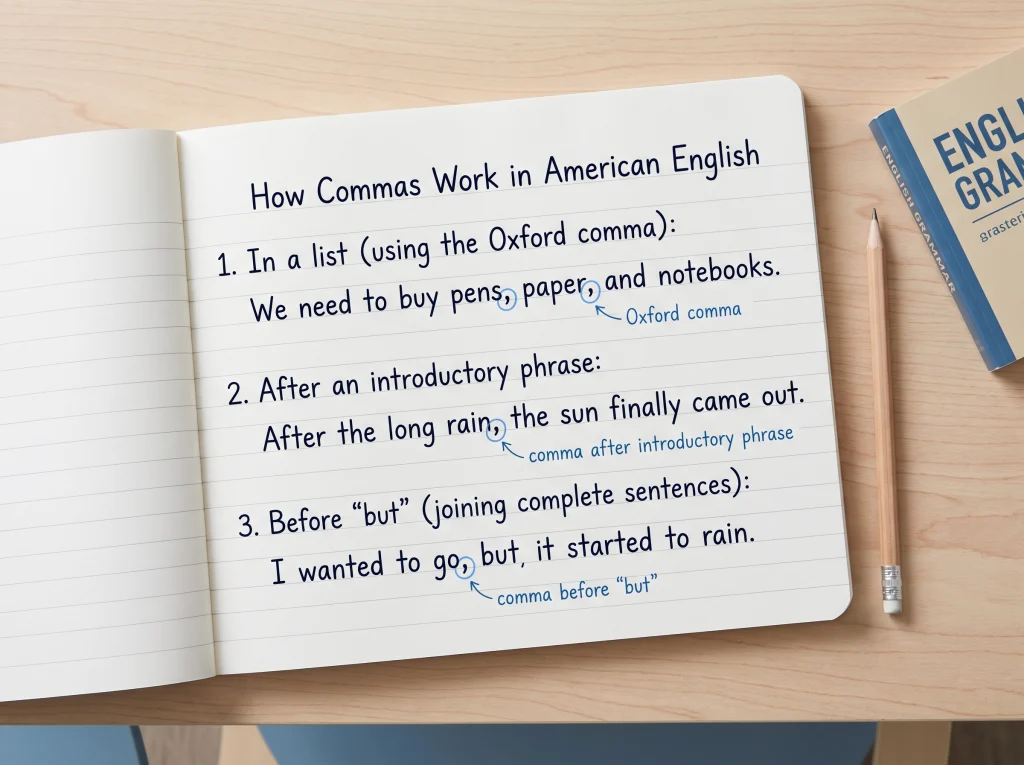
How Commas Work in American English
Here are some common situations in which American English uses commas.
1. Separating items in a list
Use commas to separate three or more items in a series.
Example: I bought apples, oranges, bananas, and grapes.
American English commonly uses the serial comma, also called the Oxford comma, before the final conjunction in a list. For example, the comma before and grapes separates the final item from the preceding items.
2. Following an introductory phrase
A comma often follows an introductory word, phrase, or dependent clause.
Example: After finishing her homework, Mia watched television.
3. Joining independent clauses
Use a comma before a coordinating conjunction such as and, but, or so when it joins two independent clauses.
Example: I wanted to go outside, but it started raining.
4. Setting off nonessential information
Commas can separate information that adds detail but is not essential to identifying the person or thing being discussed.
Example: My brother, who lives in Texas, is visiting next week.
5. Separating a direct address
Use a comma when directly addressing someone.
Example: Thank you, Sarah, for your help.
These examples show how commas organize written information. The exact punctuation depends on the sentence’s structure and intended meaning.
Examples of Comma in Sentences
- Please add a comma after the introductory phrase.
- I need a notebook, a pencil, and an eraser.
- The meeting ended early, so we went home.
- Before you leave, please turn off the lights.
- The editor removed an unnecessary comma.
- Can you check whether this sentence needs a comma?
- Dear Alex, thank you for your email.
Each sentence uses comma to refer to punctuation.
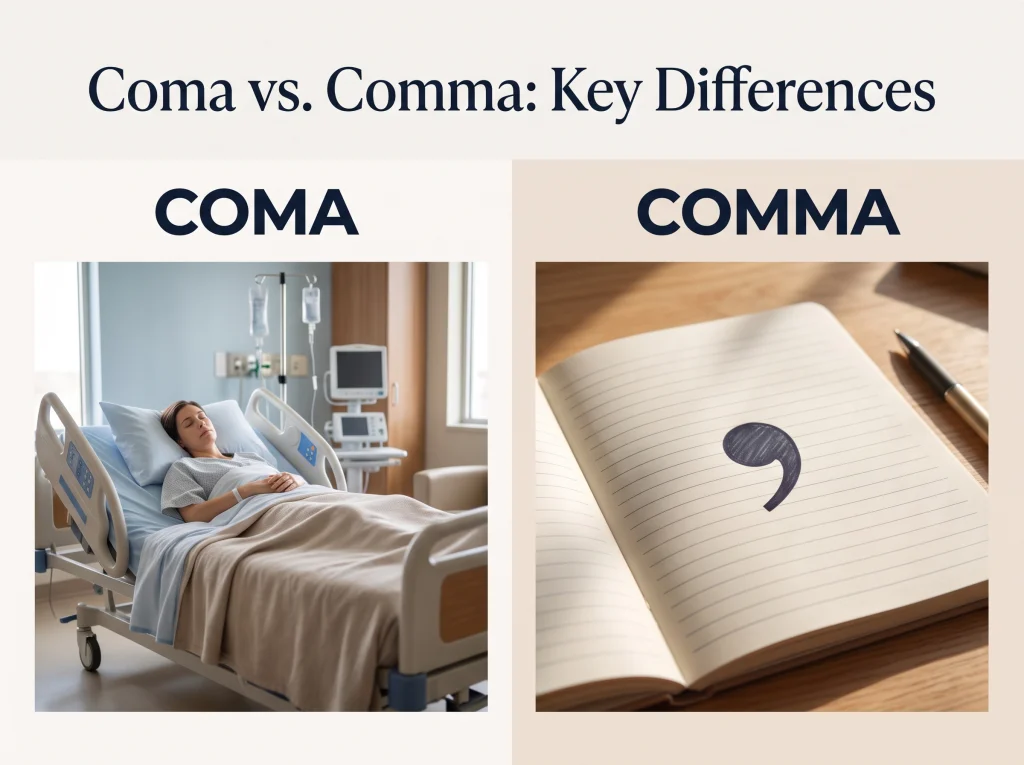
Coma vs. Comma: Key Differences
The main difference between these words is their meaning, not merely their spelling. Although they differ by just one letter, they cannot be used interchangeably in standard English.
Consider the following comparisons:
| Incorrect usage | Correct usage | Why? |
|---|---|---|
| The patient was in a comma. | The patient was in a coma. | A medical condition requires coma. |
| Put a coma after the first phrase. | Put a comma after the first phrase. | A punctuation mark requires comma. |
| He recovered from the comma. | He recovered from the coma. | Recovery refers to the medical condition. |
| The editor added a coma. | The editor added a comma. | An editor adds punctuation. |
The context usually makes the intended meaning clear. However, choosing the correct spelling is important in professional, academic, and personal writing.
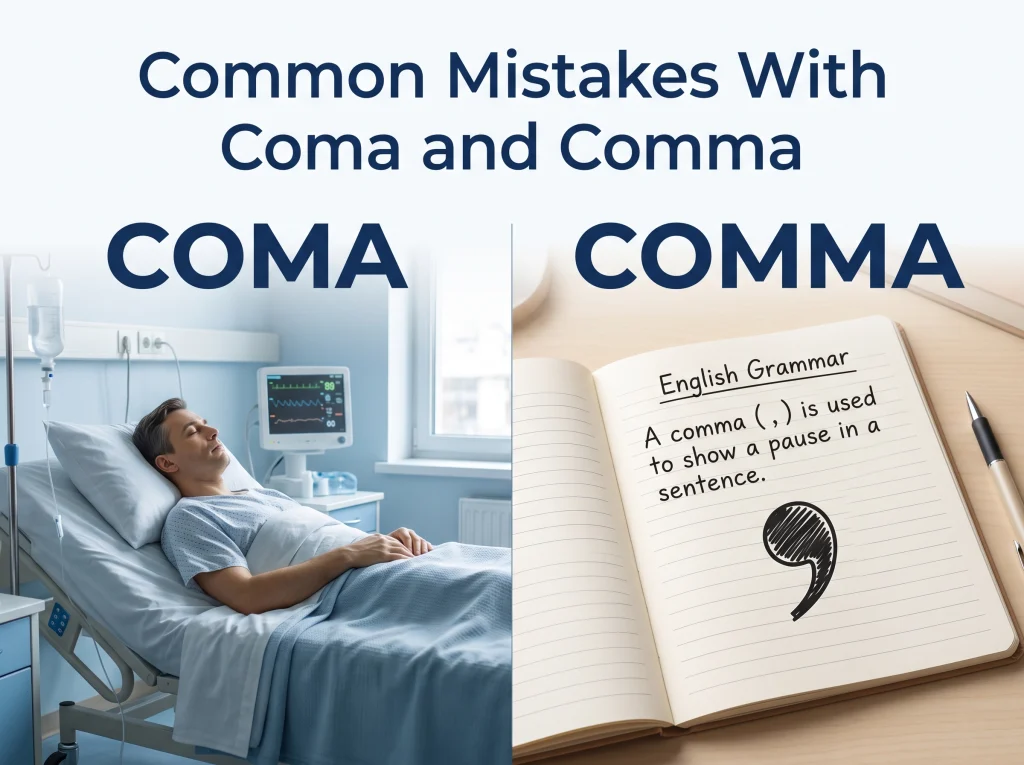
Common Mistakes With Coma and Comma
Writers sometimes confuse these words because their spellings are so similar. Spell-checking tools may not catch the error because both are legitimate English words.
1. Using Coma When You Mean Punctuation
Incorrect: Please place a coma between the two items.
Correct: Please place a comma between the two items.
The sentence concerns punctuation, so comma is the correct spelling.
2. Using Comma When You Mean a Medical Condition
Incorrect: The patient remained in a comma overnight.
Correct: The patient remained in a coma overnight.
The sentence describes a medical condition, so it requires coma.
3. Assuming Both Words Are Alternative Spellings
Coma and comma are not interchangeable versions of the same word. Each has its own meaning and spelling.
For example, add a comma is correct in a grammar lesson, while fall into a coma is correct in a medical context.
4. Relying Only on Spell-Check
A spelling checker may accept both words without recognizing that one does not fit the sentence. Read the entire sentence after proofreading and check whether the chosen word communicates the intended meaning.
How to Remember the Difference Between Coma and Comma
A simple memory trick can help you choose the correct word without consulting a dictionary.
- Coma = medical condition. Remember the single m when thinking about a patient who is unconscious.
- Comma = punctuation mark. Remember the double m in the word used when writing and editing sentences.
You can also use a context test. If the sentence mentions a hospital, a patient, or unconsciousness, coma is likely correct. If it mentions a sentence, a list, grammar, or editing, comma is the appropriate choice.
Try these examples:
- The teacher asked us to add a ___ after the introductory phrase. Answer: comma
- The injured man remained in a ___ after the accident. Answer: coma
- Please remove the unnecessary ___ from this sentence. Answer: comma
- The doctors discussed the patient’s recovery from the ___. Answer: coma
Practicing with complete sentences makes the distinction easier to remember.
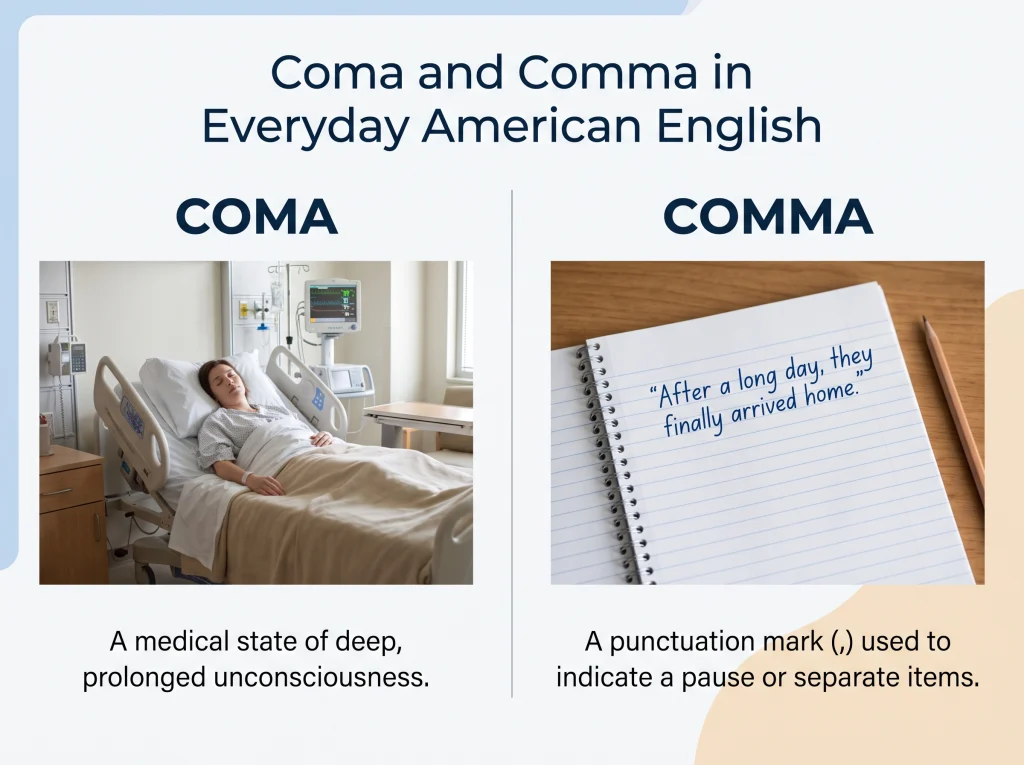
Coma and Comma in Everyday American English
Both words appear in American English, but they are used in very different situations.
In everyday writing, comma frequently appears in conversations about grammar, proofreading, and communication. You might hear a teacher explain comma placement, see an editor request a missing comma, or read instructions asking you to separate items with commas.
The word coma is more likely to appear in medical conversations, hospital reports, and news coverage of serious injuries or illnesses. It may also appear in informal expressions such as food coma, which describes feeling sleepy or sluggish after eating a large meal. This informal expression is not the same as a medical coma.
Understanding the context is therefore more useful than focusing only on how the words look. When you identify whether the sentence concerns health or punctuation, the correct spelling becomes much easier to select.
FAQs:
Conclusion
The difference between coma and comma is simple once you understand their meanings. A coma is a serious state of prolonged unconsciousness, while a comma is a punctuation mark used to organize written language.
Remember that coma has one m and belongs primarily to medical contexts. Comma has two m’s and belongs to grammar and writing. By checking the context and proofreading your sentences carefully, you can use both words correctly in American English.