Noun or Pronoun? Meaning, Differences, and Examples in American English
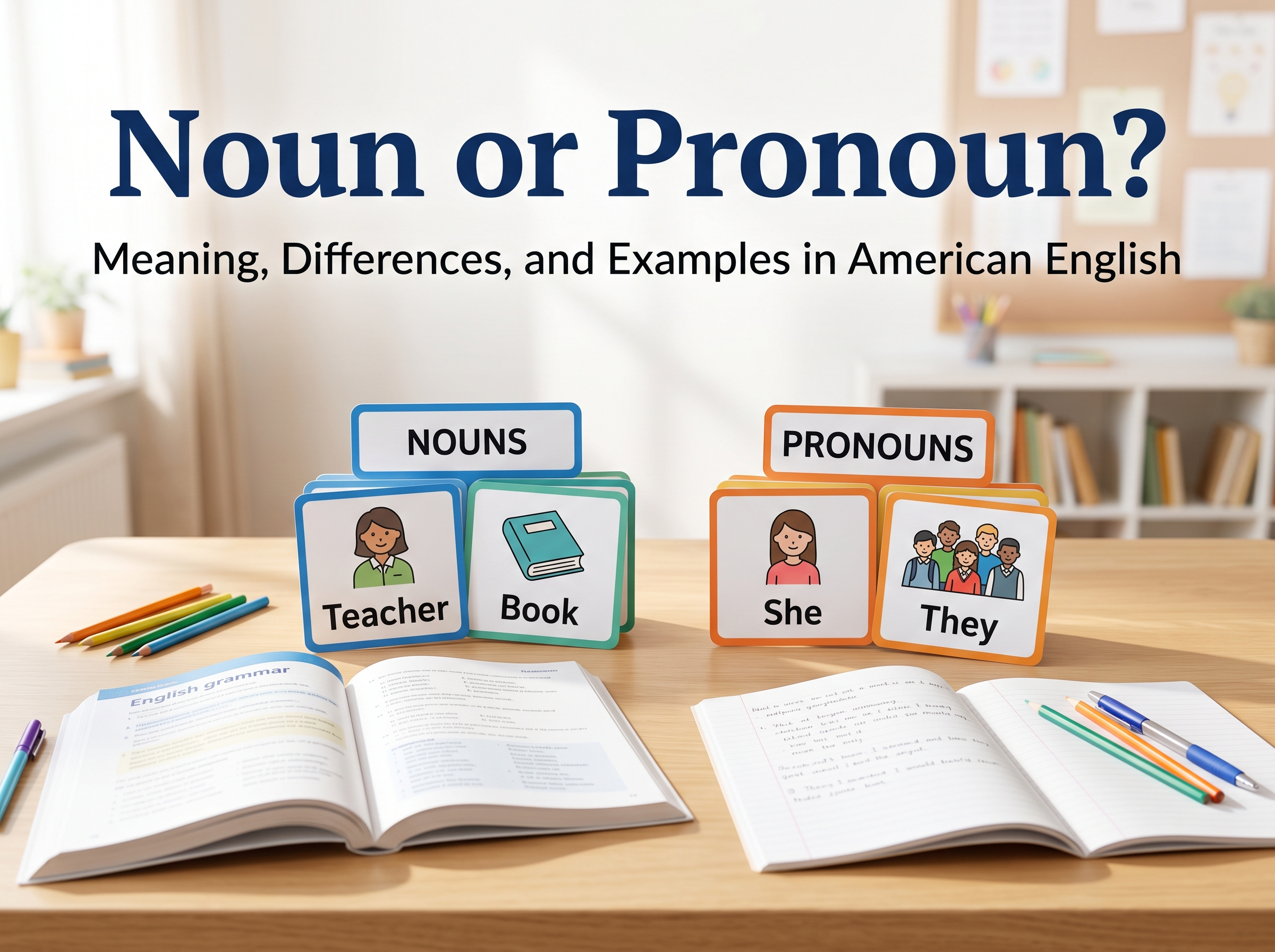
Understanding the difference between a noun and a pronoun is an important part of learning English grammar. Both help us talk about people, places, things, and ideas, but they serve different purposes in a sentence. A noun names someone or something, while a pronoun usually replaces a noun or refers to someone or something already mentioned.
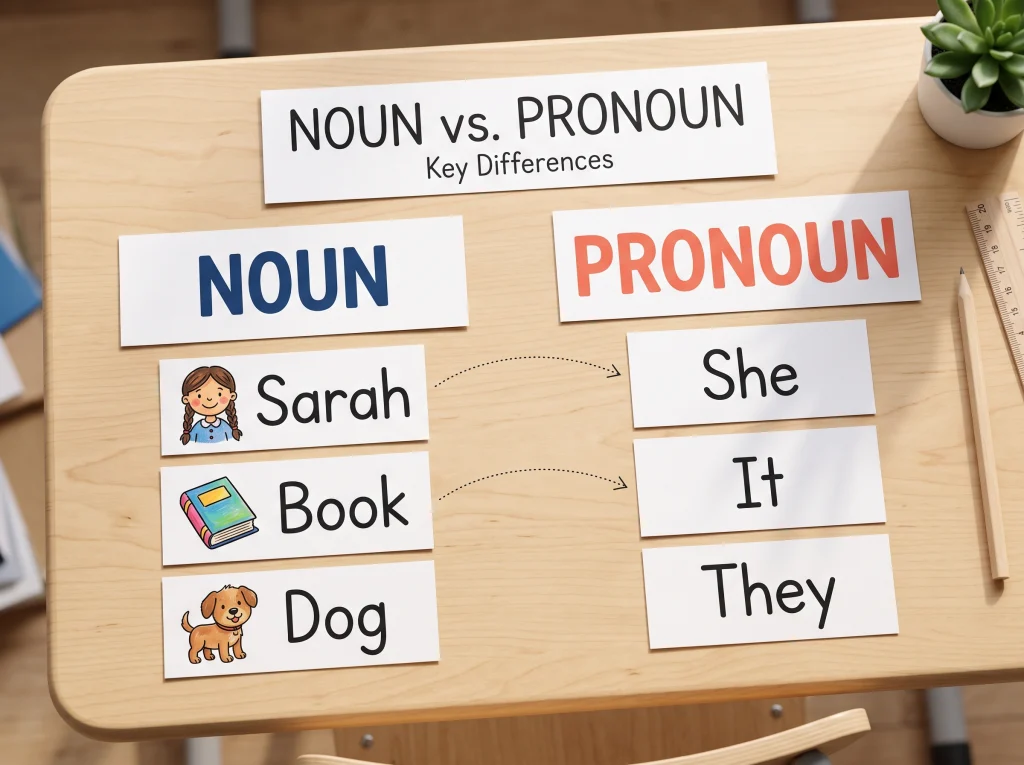
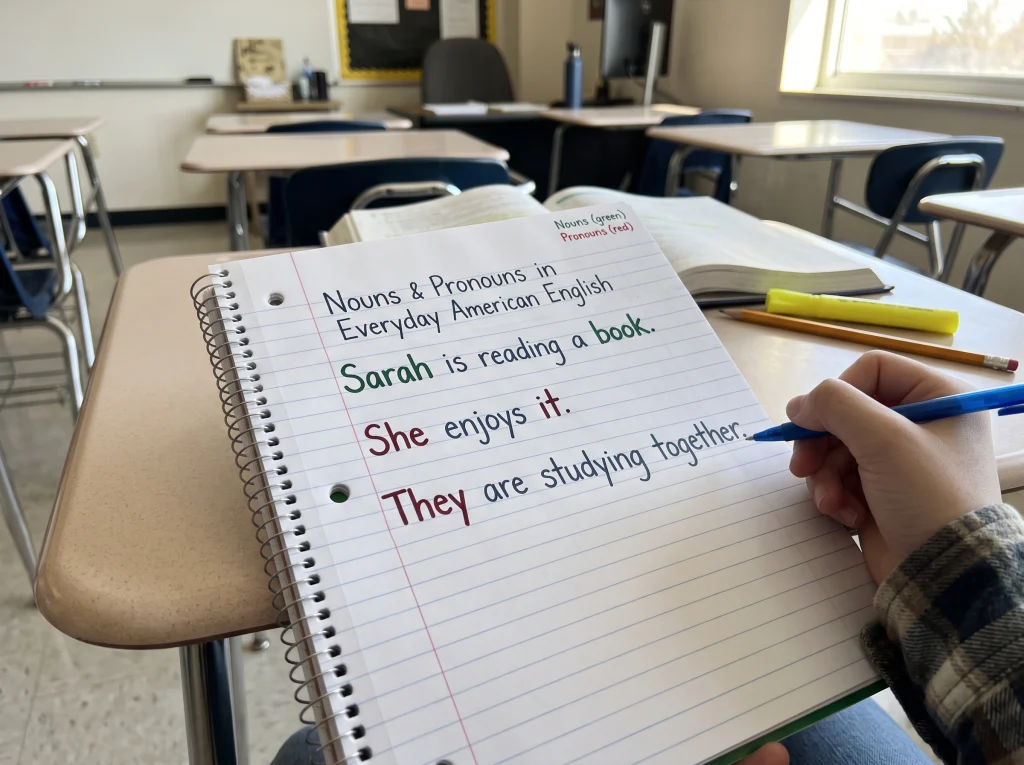
For example, consider these two sentences: “Sarah is reading a book” and “She is reading a book.” In the first sentence, Sarah is a noun that names a person. In the second sentence, she is a pronoun that replaces Sarah’s name. Learning how these words work makes it easier to write clear sentences, avoid repetition, and communicate naturally in American English.
What Is a Noun?
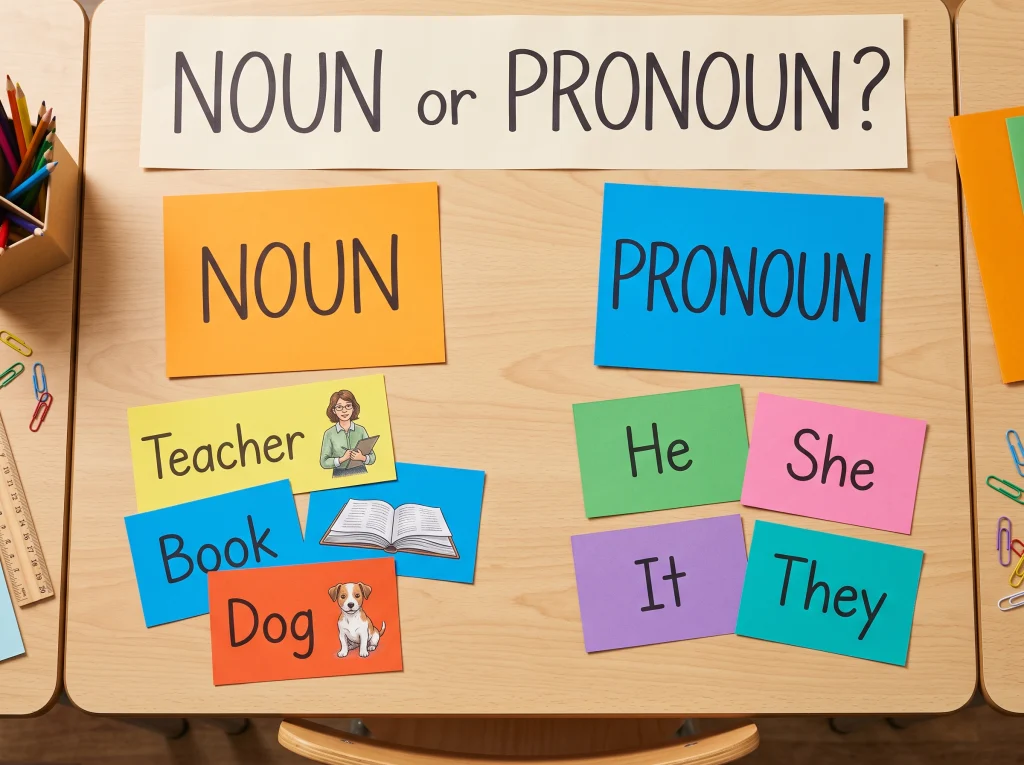
A noun is a word that names a person, place, thing, or idea. Nouns identify who or what a sentence is talking about. They can refer to people, physical objects, locations, feelings, qualities, and activities.
Consider these examples:
- Person: teacher, doctor, student, Maria
- Place: school, city, California, library
- Thing: phone, computer, table, book
- Idea or quality: happiness, freedom, honesty, courage
Nouns can perform different grammatical roles in sentences. A noun may act as the subject, the object of a verb, or the object of a preposition.
For example, in the sentence “The student opened the door,” student is the subject, while door is the object of the verb opened. In “The keys are on the table,” keys is the subject, and table is the object of the preposition on.
Examples of Nouns in Sentences
Here are several examples that show how nouns work in everyday American English.
- My brother works at a hospital.
Brother and hospital are nouns. - The dog chased a ball.
Dog and ball are nouns. - Honesty is important in every relationship.
Honesty is an abstract noun. - Chicago is a large American city.
Chicago and city are nouns. - The teacher explained the lesson to the class.
Teacher, lesson, and class are nouns.
Nouns do not always refer to physical objects. Words such as love, patience, knowledge, and confidence are nouns even though you cannot touch them.
What Is a Pronoun?
A pronoun is a word that takes the place of a noun or refers to a person, thing, or idea. Pronouns help speakers and writers avoid repeating the same names or nouns unnecessarily.
For example:
Without a pronoun: “Michael called Michael’s sister because Michael needed help.”
With pronouns: “Michael called his sister because he needed help.”
The second sentence sounds more natural because his and he refer to Michael without repeating his name. Pronouns can also refer to things, groups, and ideas mentioned earlier in a conversation or passage. Purdue OWL
Common pronouns include:
- Personal pronouns: I, you, he, she, it, we, they
- Object pronouns: me, you, him, her, it, us, them
- Possessive pronouns: mine, yours, his, hers, ours, theirs
- Reflexive pronouns: myself, yourself, himself, herself, itself, ourselves, themselves
- Demonstrative pronouns: this, that, these, those
- Relative pronouns: who, whom, whose, which, that
- Indefinite pronouns: someone, anyone, everybody, nothing, several
The exact pronoun you use depends on its meaning and grammatical role.
Examples of Pronouns in Sentences
The following sentences demonstrate how pronouns are used in everyday English.
- She is studying for her exam.
She is a pronoun referring to a female person. - David invited them to dinner.
Them is an object pronoun. - This jacket is mine.
Mine is a possessive pronoun. - The children prepared the meal themselves.
Themselves is a reflexive pronoun. - Someone left a phone on the desk.
Someone is an indefinite pronoun. - The woman who lives next door is a nurse.
Who is a relative pronoun introducing information about the woman.
Pronouns make sentences more concise, but readers must be able to identify what each pronoun refers to. If the reference is unclear, the sentence may become confusing.
Noun vs. Pronoun: Key Differences
The main difference between a noun and a pronoun is that a noun names a person, place, thing, or idea, while a pronoun usually replaces a noun or refers to something already identified.
| Feature | Noun | Pronoun |
|---|---|---|
| Main purpose | Names a person, place, thing, or idea | Replaces or refers to a noun or other referent |
| Examples | Emma, school, book, happiness | She, they, it, someone |
| Common use | Identifies the person or thing being discussed | Avoids repetition or refers back to something |
| Subject of a sentence | The teacher is speaking. | She is speaking. |
| Object of a verb | I called Emma. | I called her. |
| Possession | Emma’s book is new. | Her book is new. |
| Reference | Can introduce a person or thing by name | Often depends on context to identify its reference |
Compare Nouns and Pronouns in Similar Sentences
Looking at nouns and pronouns side by side makes their differences easier to understand.
Example 1: Talking about a person
- Noun: Jessica is my friend.
- Pronoun: She is my friend.
Jessica names the person, while she refers to Jessica.
Example 2: Talking about an object
- Noun: The computer needs an update.
- Pronoun: It needs an update.
Computer names the object, while it refers to the computer.
Example 3: Talking about a group
- Noun: The students finished the assignment.
- Pronoun: They finished the assignment.
Students identifies the group, while they refers to that group.
Example 4: Showing ownership
- Noun: Daniel’s backpack is in the car.
- Pronoun: His backpack is in the car.
Daniel’s identifies the owner by name, while his indicates ownership without repeating Daniel’s name.
These examples show that nouns and pronouns can serve similar grammatical roles, but they are not interchangeable in every situation.
Types of Nouns and Pronouns
Nouns and pronouns belong to different grammatical categories. Understanding their main types helps you identify them accurately.
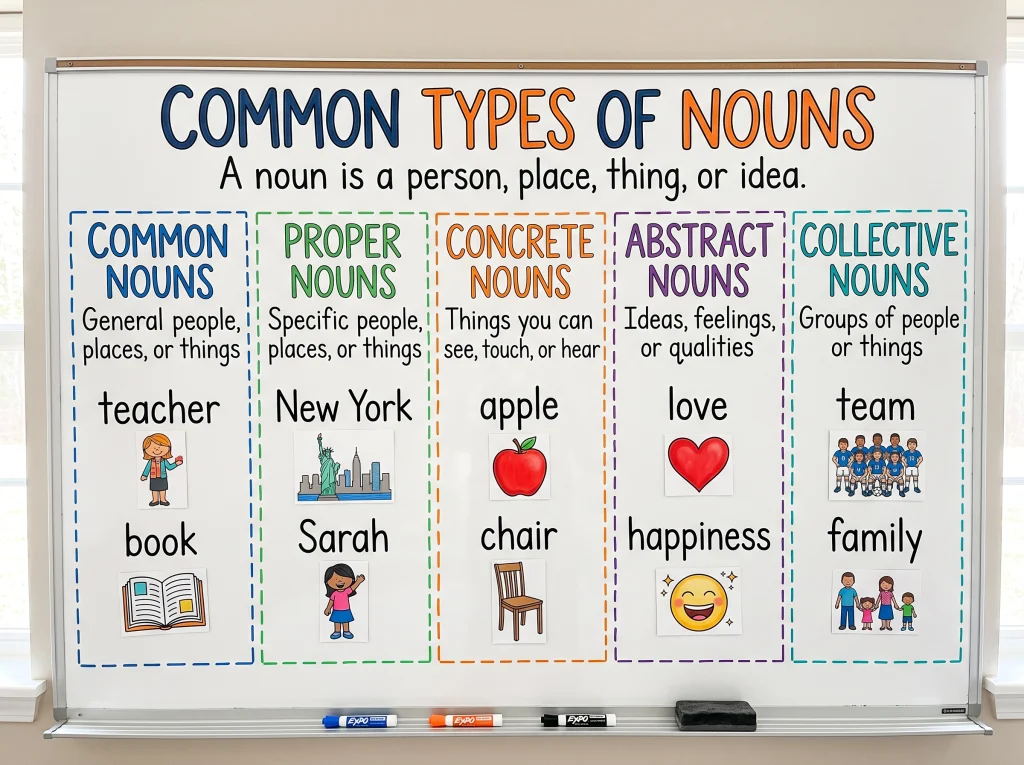
Common Types of Nouns
1. Common nouns
Common nouns refer to general people, places, things, or ideas rather than specific names.
Examples include teacher, restaurant, country, river, and book.
Sentence: “The teacher entered the classroom.”
2. Proper nouns
Proper nouns identify specific people, places, organizations, or other named entities. In English, they generally begin with capital letters.
Examples include Emily, New York, Texas, and the United States.
Sentence: “Emily moved to Texas last year.”
3. Concrete nouns
Concrete nouns refer to things that can be experienced through the senses.
Examples include apple, chair, music, and flower.
Sentence: “The flower smells wonderful.”
4. Abstract nouns
Abstract nouns name ideas, emotions, qualities, or conditions that cannot usually be touched or physically observed.
Examples include kindness, fear, freedom, and patience.
Sentence: “Patience helps people handle difficult situations.”
5. Collective nouns
Collective nouns refer to groups considered as a unit.
Examples include team, family, audience, and committee.
Sentence: “The team won the championship.”
6. Countable and uncountable nouns
Countable nouns can be counted individually, such as book, chair, and student. Uncountable nouns usually refer to substances, concepts, or categories that are not normally counted individually, such as water, information, and furniture.
Sentence: “She bought three books and some furniture.”
Common Types of Pronouns
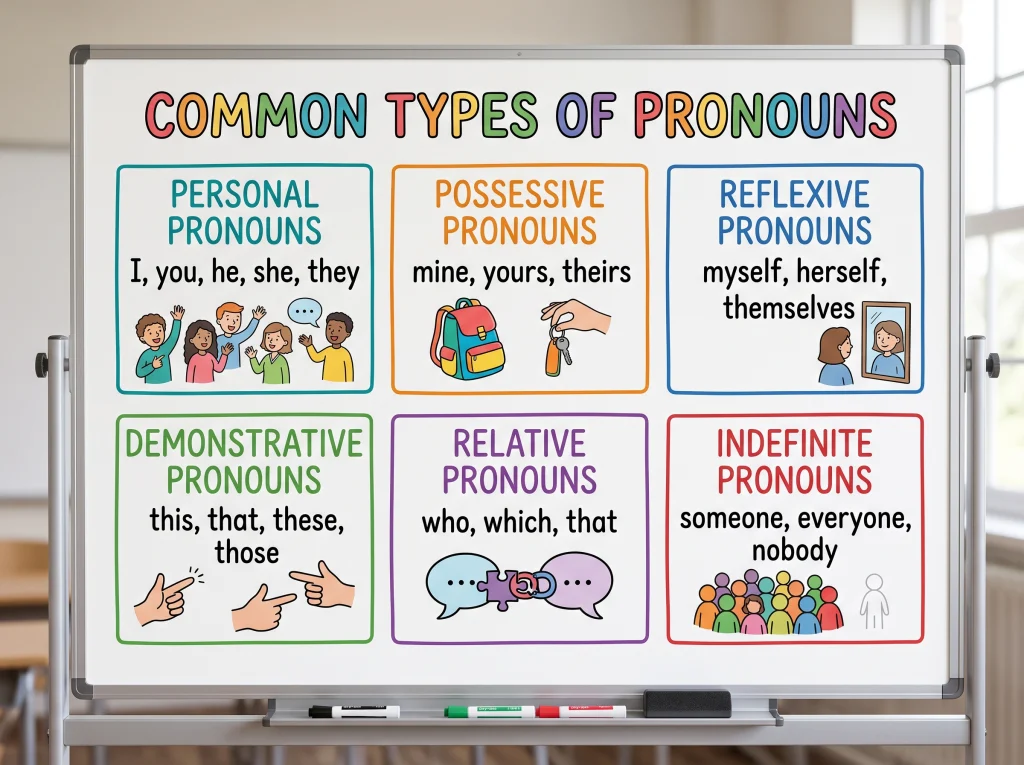
1. Personal pronouns
Personal pronouns refer to people or things.
Examples: I, you, he, she, it, we, they, me, him, her, us, them.
Sentence: “They are waiting outside.”
2. Possessive pronouns
Possessive pronouns indicate ownership and can stand independently rather than directly modifying a noun.
Examples: mine, yours, his, hers, ours, theirs.
Sentence: “That seat is ours.”
Compare this with “That is our seat.” In the second sentence, our is a possessive determiner because it appears before the noun seat.
3. Reflexive pronouns
Reflexive pronouns refer back to the subject of a sentence.
Examples: myself, yourself, himself, herself, itself, ourselves, yourselves, themselves.
Sentence: “She taught herself to play the piano.”
4. Demonstrative pronouns
Demonstrative pronouns point to particular people or things.
Examples: this, that, these, those.
Sentence: “These are the documents I need.”
5. Relative pronouns
Relative pronouns introduce clauses that provide additional information about a noun or pronoun.
Examples: who, whom, whose, which, and that.
Sentence: “The student who won the award is my cousin.”
6. Indefinite pronouns
Indefinite pronouns refer to people or things without identifying them precisely.
Examples: somebody, anybody, everyone, nobody, something, and several.
Sentence: “Everyone enjoyed the picnic.”
7. Interrogative pronouns
Interrogative pronouns are used to ask questions.
Examples: who, whom, whose, what, and which.
Sentence: “Who left the door open?”
Some words can function as pronouns in one sentence and as determiners in another. For example, these is a pronoun in “These are expensive,” but it is a determiner in “These shoes are expensive.” Its grammatical function depends on how it is used.
Examples of Nouns and Pronouns in Sentences
Nouns and pronouns often appear together in the same sentence. The noun identifies a person or thing, while the pronoun can refer back to it. The following examples show how they work in different situations.
| Sentence | Noun | Pronoun |
|---|---|---|
| Olivia said she was tired. | Olivia | she |
| The dog wagged its tail. | dog, tail | its |
| My parents said they would visit. | parents | they |
| James gave her a present. | James, present | her |
| The students said they understood the lesson. | students, lesson | they |
| The phone is new, but it is expensive. | phone | it |
| Sarah and I went shopping because we needed clothes. | Sarah, clothes | I, we |
| Someone left a wallet on the counter. | wallet, counter | someone |
How Nouns and Pronouns Work Together
Consider the following short paragraph:
“Michael bought a new bicycle last weekend. He took it to the park on Sunday. His sister joined him, and they rode around the lake.”
In this paragraph, Michael, bicycle, weekend, park, Sunday, sister, and lake are nouns. He, it, his, him, and they are pronouns.
Each pronoun refers to a person or thing identified by the surrounding context. He and his refer to Michael, it refers to the bicycle, him refers to Michael, and they refers to Michael and his sister.
Using pronouns makes the paragraph easier to read. Without them, the writer would need to repeat names and nouns in nearly every sentence.
How to Identify a Noun or Pronoun
You can identify nouns and pronouns by examining what a word does in a sentence. Rather than relying only on memorized word lists, pay attention to the word’s meaning, position, and grammatical function.
Step 1: Ask What the Word Names
If a word names a person, place, thing, or idea, it is likely a noun.
For example, in “The teacher explained the problem,” teacher and problem are nouns. They identify the person speaking and the subject being explained.
Remember that abstract concepts, such as honesty and happiness, are also nouns.
Step 2: Check Whether the Word Refers to Something
If a word refers to a person or thing without naming it directly, it may be a pronoun.
For example, in “The teacher explained the problem, and she answered questions,” she is a pronoun referring to the teacher.
Pronouns do not always have an explicit noun immediately before them. In a sentence such as “Someone is waiting outside,” someone is an indefinite pronoun even though the person has not been identified.
Step 3: Look at the Word’s Role in the Sentence
A word’s grammatical role can help you identify its category.
Consider these sentences:
- The book is interesting. In this sentence, book is a noun.
- It is interesting. In this sentence, it is a pronoun.
- Those books are interesting. Here, books is a noun, and those is a determiner.
- Those are interesting. Here, those functions as a demonstrative pronoun.
The last two examples are especially useful because the same word can have different grammatical functions depending on the sentence.
Step 4: Check the Context
Pronouns must refer clearly to the people or things being discussed.
For example:
“Maria spoke to Jennifer after she finished work.”
The pronoun she could refer to Maria or Jennifer. Without more context, the reader cannot be certain who finished work.
A clearer version might be:
“After Maria finished work, she spoke to Jennifer.”
Clear references help prevent misunderstandings in school assignments, emails, workplace documents, and everyday conversations. Purdue OWL
Common Mistakes When Using Nouns and Pronouns
Learning the definitions is only the beginning. Writers also need to understand how to use nouns and pronouns correctly in sentences.
1. Repeating Nouns Too Often
Repeating a noun unnecessarily can make writing sound awkward.
Incorrect: “Jessica said Jessica would bring Jessica’s laptop.”
Better: “Jessica said she would bring her laptop.”
The second sentence uses pronouns naturally while keeping the meaning clear.
However, repetition is not always wrong. Sometimes repeating a noun is helpful when several people or objects are being discussed and a pronoun could cause confusion.
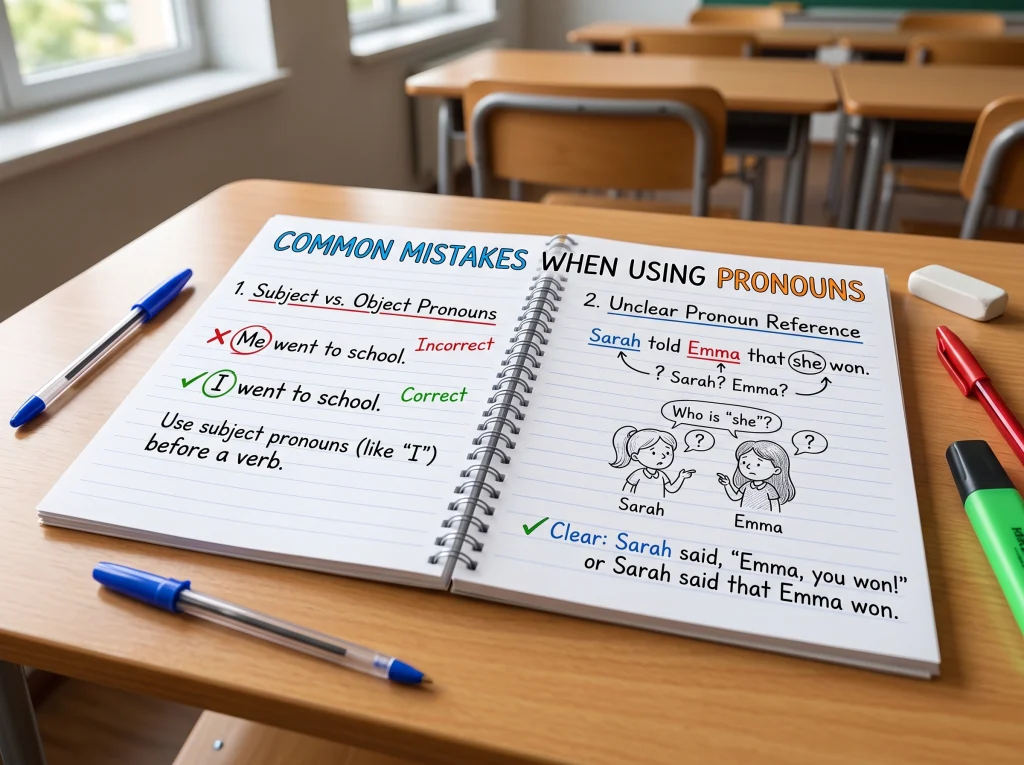
2. Using the Wrong Pronoun Form
Pronouns have different forms depending on their grammatical role.
Incorrect: “Me went to the store.”
Correct: “I went to the store.”
In the correct sentence, I is the subject of the verb went.
Consider another example:
Incorrect: “The teacher gave the assignment to Sarah and I.”
Correct: “The teacher gave the assignment to Sarah and me.”
Me is correct because it is the object of the preposition to. A useful trick is to remove the other person’s name and check the sentence: “The teacher gave the assignment to me.”
3. Using Unclear Pronoun References
A pronoun should clearly identify the person or thing it refers to.
Unclear: “When Alex called Jordan, he was driving.”
The reader cannot tell whether Alex or Jordan was driving.
Clearer: “Alex was driving when he called Jordan.”
The revised sentence identifies the driver directly.
4. Confusing Possessive Determiners With Possessive Pronouns
Words that indicate ownership do not all function in the same way.
Compare these examples:
- “That is my notebook.” My is a possessive determiner because it comes before the noun notebook.
- “That notebook is mine.” Mine is a possessive pronoun because it stands independently.
- “Their car is parked outside.” Their is a possessive determiner.
- “The car parked outside is theirs.” Theirs is a possessive pronoun.
Understanding this distinction can improve both grammar knowledge and sentence construction.
5. Making Pronouns Agree With Their Referents
Pronouns should generally agree with the nouns or other referents they represent in number and person.
Incorrect: “The students finished his assignment.”
Correct: “The students finished their assignments.”
The plural pronoun their agrees with the plural noun students.
In American English, singular they is also widely used when referring to a person whose gender is unknown or when that person uses they/them pronouns.
For example: “Someone left their jacket in the classroom.”
Here, their refers to the singular indefinite pronoun someone. This is an accepted construction in contemporary English. Purdue OWL
Nouns and Pronouns in Everyday American English
Nouns and pronouns appear in nearly every type of communication, from casual conversations to formal writing. Understanding their differences helps you speak naturally and write sentences that are easy to follow.
In Everyday Conversations
People commonly use nouns to introduce people, places, and things before using pronouns to refer to them again.
For example:
“Did you see my neighbor? She just moved to Chicago.”
Neighbor and Chicago are nouns, while she refers to the neighbor.
Another example is:
“I bought a new phone yesterday. It has a great camera.”
Phone and camera are nouns, while it refers to the phone.
In School and Academic Writing
Students use nouns to identify topics, concepts, people, and evidence. Pronouns help connect ideas and reduce repetition.
For example:
“Climate change affects many communities. It can influence weather patterns and local ecosystems.”
Climate change, communities, weather patterns, and ecosystems are nouns or noun phrases. It refers to climate change.
When writing essays or answering exam questions, students should make sure pronouns have clear references. A reader should not have to guess what a word such as it, they, or this means.
In Workplace Communication
Professional emails and reports often use nouns to identify departments, employees, projects, and responsibilities. Pronouns then help keep the writing concise.
For example:
“The marketing team completed the report. They sent it to the manager on Friday.”
Marketing team, report, manager, and Friday are nouns or noun phrases. They refers to the marketing team, and it refers to the report.
Using nouns and pronouns correctly makes professional communication clearer and more efficient.
Frequently Asked Questions:
Conclusion
Nouns and pronouns are essential parts of English grammar, but they have different functions. A noun names a person, place, thing, or idea, while a pronoun usually replaces a noun or refers to something already mentioned. Recognizing this distinction helps you build clear sentences, avoid repetition, and communicate more effectively.