Temporarily or Temporary? Meaning, Difference, and Correct Usage
Choosing between temporarily and temporary can be confusing because both words describe something that lasts for a limited time. However, they serve different grammatical purposes in a sentence. Temporary is an adjective, while temporarily is an adverb. Knowing this difference helps you write clearer sentences in emails, school assignments, workplace messages, and everyday American English.
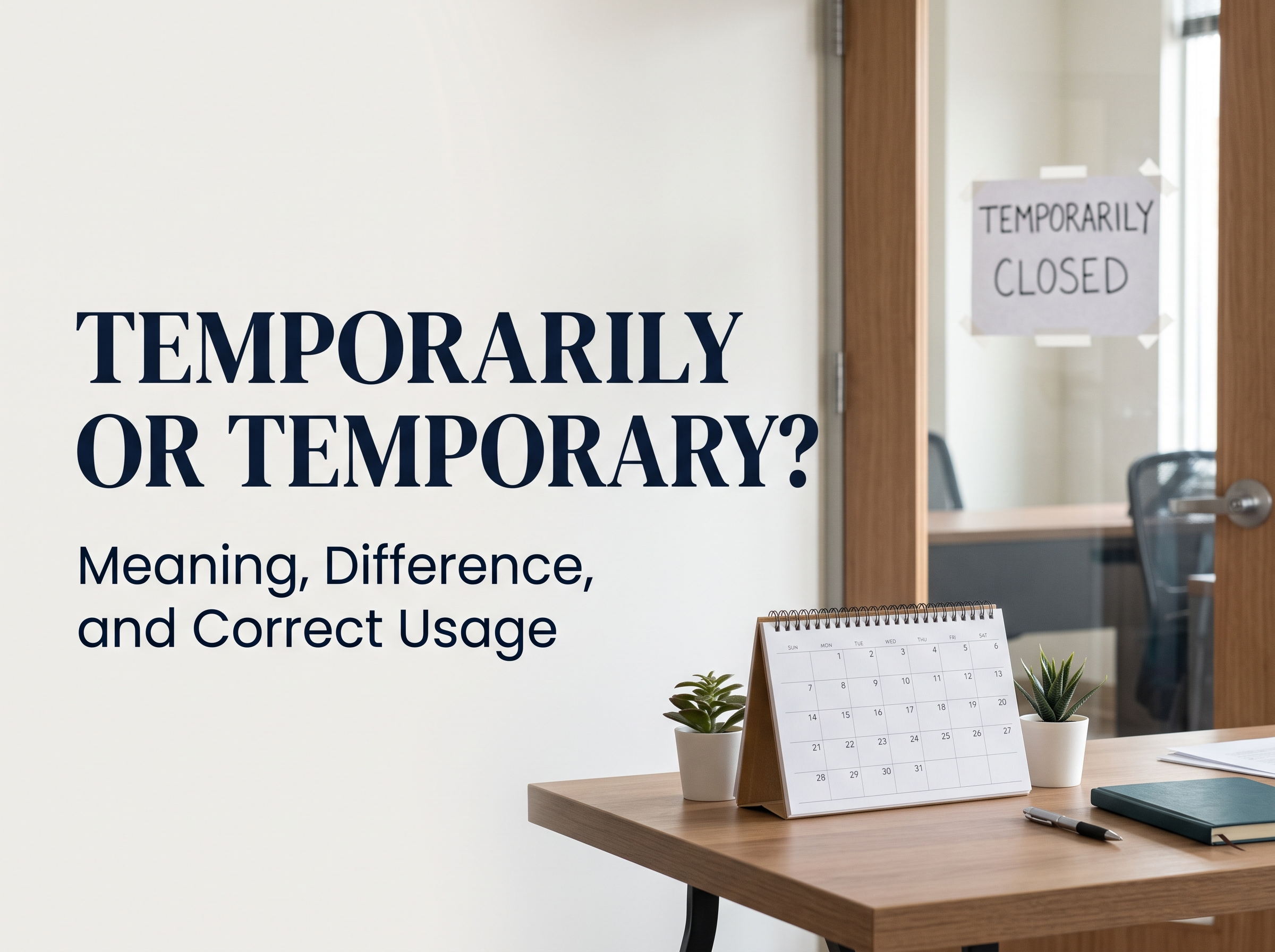
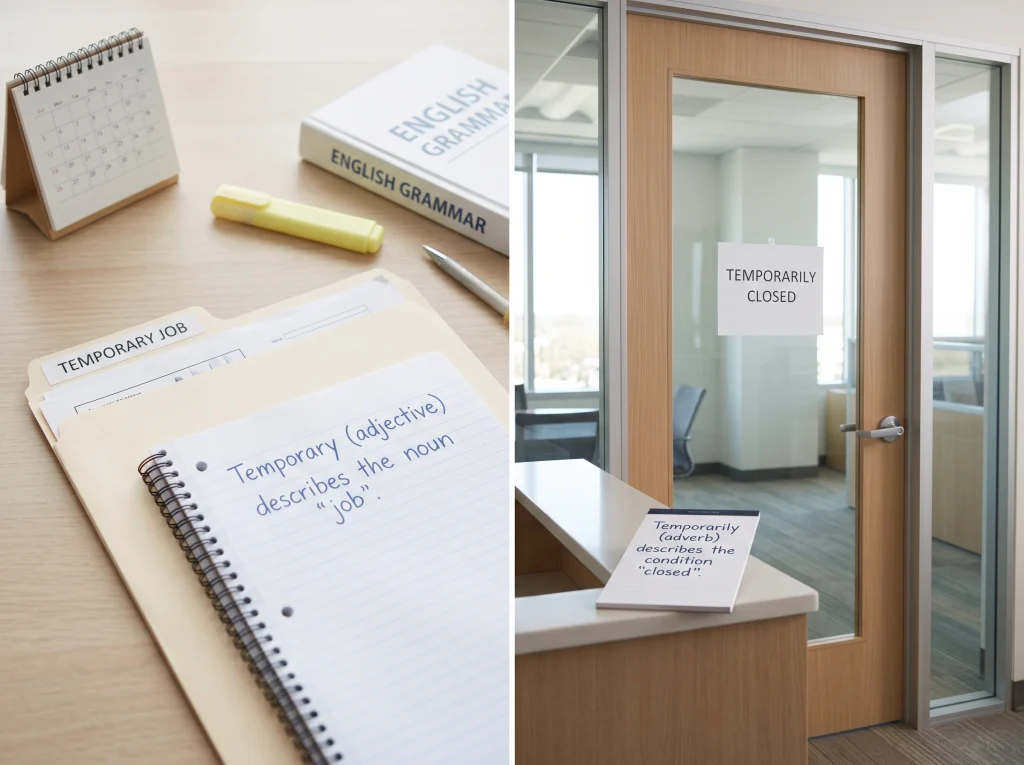
For example, you would say, “The office is in a temporary location,” because temporary describes the noun location. However, you would say, “The office is temporarily closed,” because temporarily describes the condition of being closed.

Both words are correct, but they cannot always replace each other. The right choice depends on the word you want to describe and the role it plays in your sentence.
Temporarily or Temporary: What Is the Difference?
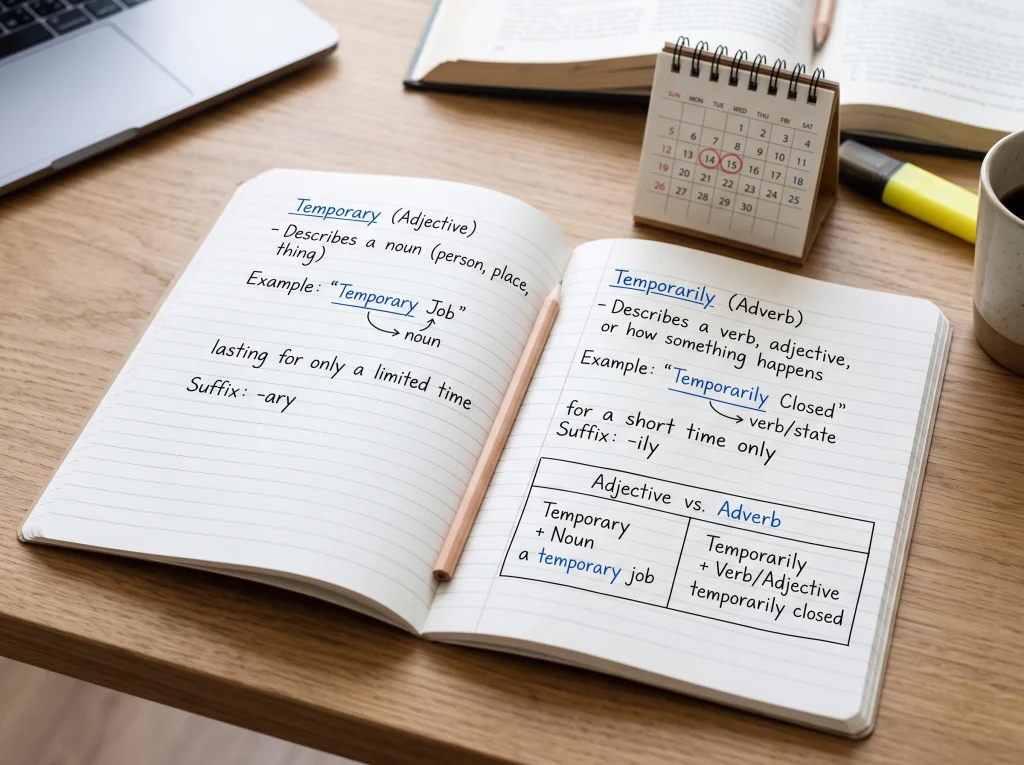
The main difference between temporary and temporarily is their part of speech. Temporary describes a noun, while temporarily describes an action, condition, or situation.
| Word | Part of speech | Meaning | Example |
|---|---|---|---|
| Temporary | Adjective | Lasting for a limited time | She found a temporary job. |
| Temporarily | Adverb | For a limited time | She is temporarily working from home. |
Use temporary when describing a person, place, position, arrangement, or condition that will not last permanently. Use temporarily when explaining how long an action or condition lasts.
Consider these examples:
- Temporary: The school hired a temporary teacher.
- Temporarily: The regular teacher is temporarily absent.
In the first sentence, temporary describes the teacher’s position. In the second, temporarily explains the duration of the teacher’s absence.
A simple way to remember the distinction is to ask yourself what the word describes. If it describes a noun, use temporary. If it modifies a verb, adjective, or another adverb, temporarily is usually the correct choice.
What Does Temporary Mean?
Temporary is an adjective that describes something that exists, happens, or is intended to last for a limited period rather than indefinitely. It often refers to jobs, housing, solutions, arrangements, changes, and physical conditions.
The word does not specify exactly how long something will last. A temporary arrangement might last a few hours, several weeks, or even a few years, depending on the situation.
Examples of Temporary in Sentences
- I accepted a temporary position at a local company.
- The family moved into temporary housing while their home was repaired.
- We need a temporary solution to the problem.
- The store has a temporary entrance during construction.
- She received a temporary parking permit.
- The manager made a temporary change to the work schedule.
- The patient experienced temporary discomfort after the procedure.
- They installed a temporary sign outside the building.
In each example, temporary describes a noun, such as position, housing, solution, or sign.
Common Phrases With Temporary
Several everyday expressions use temporary to describe arrangements or conditions that are not permanent.
Temporary job: A position intended to last for a limited period.
Example: He took a temporary job while looking for a permanent position.
Temporary housing: A place to live for a limited time.
Example: The family stayed in temporary housing after the apartment building was damaged.
Temporary solution: A short-term way to address a problem.
Example: This repair is only a temporary solution until we replace the equipment.
Temporary closure: A situation in which a business, facility, or service is closed for a limited period.
Example: The library announced a temporary closure for renovations.
Temporary change: An adjustment that is not expected to remain in place permanently.
Example: The company introduced a temporary change to its office hours.
These expressions appear frequently in American workplaces, schools, businesses, and public announcements.
What Does Temporarily Mean?
Temporarily is an adverb that means for a limited time or during a period that is not permanent. It commonly modifies verbs and explains how an action happens or how long a particular condition continues.
For example, in the sentence “The website is temporarily unavailable,” the word temporarily explains that the website’s unavailability is limited in duration.
Unlike temporary, which describes a noun, temporarily often appears near a verb or after a linking verb followed by an adjective.
Examples of Temporarily in Sentences
- The restaurant is temporarily closed for repairs.
- I am temporarily staying with my relatives.
- The company temporarily suspended its services.
- She temporarily moved to another department.
- The road was temporarily blocked because of construction.
- The school temporarily switched to online classes.
- He temporarily lost access to his account.
- The store is temporarily out of stock.
In these examples, temporarily describes an action or condition, including staying, suspending, moving, blocking, switching, and being unavailable.
Common Phrases With Temporarily
Temporarily closed: Closed for a limited period.
Example: The coffee shop is temporarily closed while the kitchen is renovated.
Temporarily unavailable: Not accessible or ready for use for a limited time.
Example: Online registration is temporarily unavailable due to maintenance.
Temporarily suspended: Paused or stopped for a limited period.
Example: The service was temporarily suspended because of a technical issue.
Temporarily relocated: Moved to another place for a limited time.
Example: The customer service team has been temporarily relocated to another office.
Temporarily disabled: Made inactive or unavailable for a limited period.
Example: The administrator temporarily disabled the feature during testing.
These phrases are especially common in customer service notices, workplace communications, websites, and public information messages.
Temporary vs. Temporarily: Key Differences
Although the two words share the same root and a similar meaning, their grammatical functions are different. Understanding how each word fits into a sentence makes it easier to choose correctly.
| Feature | Temporary | Temporarily |
|---|---|---|
| Part of speech | Adjective | Adverb |
| Main function | Describes a noun | Modifies a verb, adjective, or adverb |
| Meaning | Lasting for a limited time | For a limited time |
| Common placement | Before a noun or after a linking verb | Near the verb or before an adjective |
| Example | We need a temporary replacement. | We temporarily replaced the manager. |
Notice how the words work in these paired examples.
- Temporary: The system has a temporary problem.
- Temporarily: The system is temporarily unavailable.
The first sentence describes the problem itself. The second explains that the system’s unavailable status will not last indefinitely.
Another comparison makes the distinction clear:
- Temporary: She has a temporary assignment.
- Temporarily: She is temporarily assigned to another team.
Both sentences describe a limited arrangement, but the first word modifies the noun assignment, while the second modifies the verb phrase is assigned.
Can Temporary and Temporarily Be Used Interchangeably?
No. Although their meanings are related, they are not interchangeable in standard English because they perform different grammatical functions.
For example, “The office is temporary closed” is incorrect because temporary cannot normally modify the adjective closed in this sentence. The correct version is “The office is temporarily closed.”
Likewise, “I accepted a temporarily job” is incorrect because job is a noun that needs an adjective. The correct sentence is “I accepted a temporary job.”
The key is to choose the form that fits the sentence structure, not simply the word that conveys the general idea of something lasting for a limited time.
How to Use Temporary in Sentences
Use temporary when you need an adjective to describe a person, object, place, position, arrangement, or condition. It frequently appears immediately before a noun, although it can also follow linking verbs such as be and seem.
Here are several examples from everyday American English.
At work:
- The company offered me a temporary contract.
- We hired a temporary assistant for the summer.
- This is a temporary change to our regular schedule.
At school:
- The school assigned a temporary classroom while the main building was repaired.
- He received a temporary student ID.
- The principal appointed a temporary substitute for the position.
At home:
- We need a temporary place to stay.
- The broken window has a temporary covering.
- This arrangement is temporary, so we will look for a permanent home soon.
In technology and business:
- The website displays a temporary error message.
- Customers received temporary access to the new feature.
- The company introduced a temporary price reduction.
Can Temporary Come After a Verb?
Yes. Although temporary often comes before a noun, it can also appear after a linking verb when it describes the subject.
For example:
- The arrangement is temporary.
- Her position seems temporary.
- The change was temporary.
In these sentences, temporary describes the subject rather than the action of the verb. The verb connects the subject to the description.
This is why “The office is temporary closed” is incorrect, but “The office closure is temporary” is correct. In the second sentence, temporary describes the noun phrase office closure.
How to Use Temporarily in Sentences
Use temporarily when you want to explain that an action or condition lasts for a limited period. It can modify an action verb, a verb phrase, or an adjective.
For example:
- The manager temporarily changed the schedule.
- We temporarily moved our operations to another building.
- The service is temporarily unavailable.
- She temporarily stopped attending the evening class.
- The road was temporarily closed to traffic.
The word can appear in different positions depending on the sentence.
Before the main verb:
The company temporarily reduced its operating hours.
After the verb or verb phrase:
The company has suspended the service temporarily.
Before an adjective:
The application is temporarily inactive.
All three patterns are grammatically correct. The most natural position depends on the sentence’s structure and emphasis.
Is Temporarily Always About Time?
Yes, temporarily indicates that something applies for a limited period, but it does not tell readers exactly when the situation will end.
For example, “The account is temporarily locked” indicates that the locked status is not intended to be permanent. It does not tell the reader whether access will return in minutes, hours, or days.
If the duration matters, include additional information.
- The office is temporarily closed until Monday.
- The service will be temporarily unavailable for two hours.
- She will temporarily work from home for the next three weeks.
These examples communicate the temporary nature of the situation and provide a more specific timeframe.
Common Mistakes When Using Temporary and Temporarily
Many mistakes happen when writers confuse adjectives with adverbs or choose a word based only on its meaning. The following examples show how to correct common errors.
| Incorrect sentence | Correct sentence | Explanation |
|---|---|---|
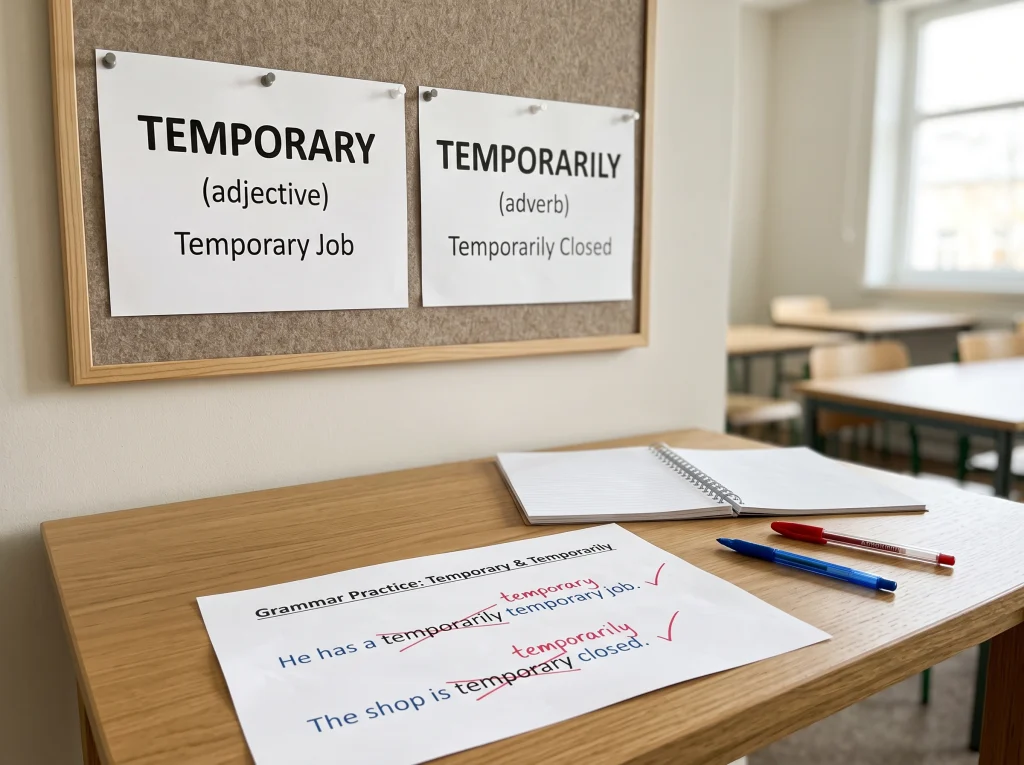
| The store is temporary closed. | The store is temporarily closed. | The adverb modifies closed. |
| I need a temporarily job. | I need a temporary job. | The adjective describes job. |
| We temporary moved offices. | We temporarily moved offices. | The adverb modifies moved. |
| The solution is temporarily. | The solution is temporary. | The adjective describes the solution. |
| She has a temporary relocated team. | She has a temporarily relocated team. | The adverb modifies relocated. |
One additional mistake is assuming that every sentence containing a form of be requires an adverb. That is not true. In “The arrangement is temporary,” the word temporary describes the arrangement, so an adjective is needed.
Another common error is adding the -ly ending automatically whenever a sentence contains an action. Some verbs connect a subject to a description rather than express an action that the adverb should modify. Always check the grammatical role of the word before choosing its form.
Tips for Remembering the Difference Between Temporary and Temporarily
A simple grammar check can help you select the right word quickly.
1. Look for the noun. If the word describes a noun, use temporary. For example, “a temporary solution” and “a temporary position” are correct because the adjective describes a solution and a position.
2. Look at the action or condition. If the word explains how long an action or condition lasts, use temporarily. For example, “The company temporarily closed the office” uses the adverb to modify closed.
3. Remember the common -ly pattern. Many adverbs end in -ly. In this pair, temporarily is the adverb form of the adjective temporary. However, do not rely on spelling alone because not every word ending in -ly is an adverb.
4. Try replacing the word with a similar expression. If you can replace the word with “for a limited time” and the sentence still makes sense, temporarily is likely correct. If the word describes a noun, temporary is usually the better choice.
5. Practice with paired sentences. Compare “We need a temporary office” with “We are temporarily working elsewhere.” The first describes a place, while the second describes an activity.
With regular practice, you can recognize the difference without having to stop and think about the grammar rule every time.
Temporary and Temporarily in Everyday American English
Both words are widely used in American English, particularly in workplaces, businesses, schools, customer service messages, and conversations about short-term arrangements.
In professional communication, temporary often describes positions, contracts, staffing arrangements, and solutions. For example, a company might advertise a temporary position or explain that a temporary employee will cover a staff member’s absence.
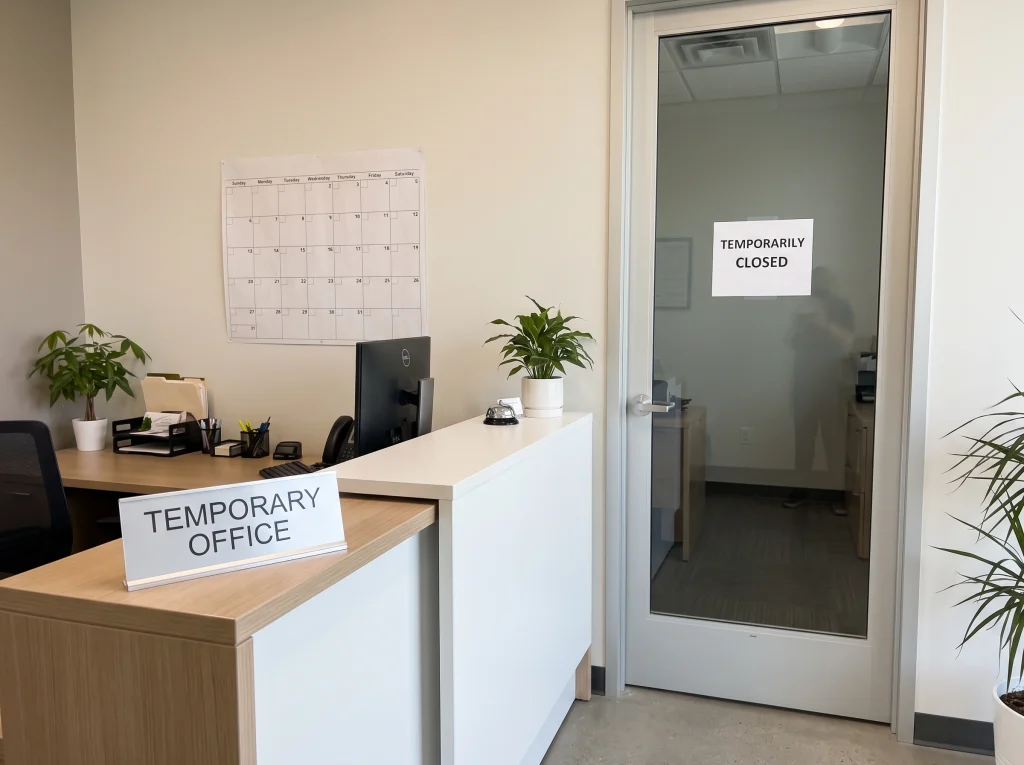
In public announcements and customer service messages, temporarily commonly describes closures, interruptions, and changes in availability. A business might display a sign stating that its entrance is temporarily closed or explain that online services are temporarily unavailable.
The distinction also matters in academic and personal writing. A student might write, “I found a temporary place to study,” while another sentence might read, “I temporarily moved my study sessions to the library.”
Choosing the correct word makes writing more precise and natural. It also helps readers understand whether you are describing something that is limited in duration or explaining that an action or condition will last only for a while.
FAQs:
Conclusion
The difference between temporary and temporarily comes down to grammar. Temporary is an adjective that describes a noun, while temporarily is an adverb that explains that an action or condition lasts for a limited time.
Use temporary job, temporary solution, and temporary arrangement when describing nouns. Use temporarily closed, temporarily unavailable, and temporarily relocated when modifying actions or conditions.