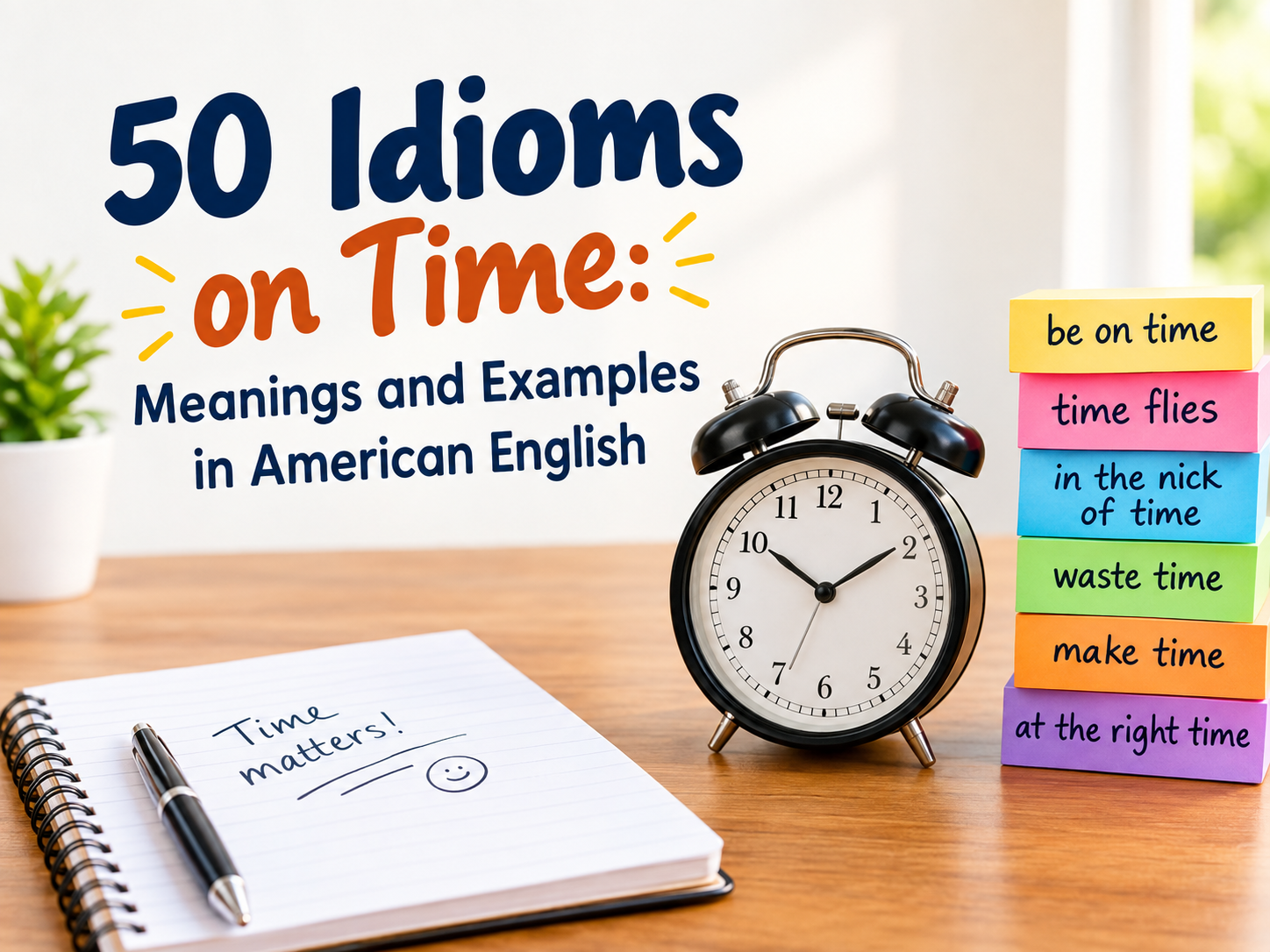
50 Idioms on Time: Meanings and Examples in American English
Idioms on time are expressions that help people talk about punctuality, deadlines, timing, schedules, opportunities, and the passing of time. Some of these expressions include the word time, while others describe the idea of being early, late, punctual, or prepared without using the word directly.
Time related idioms are common in everyday American English. You may hear them at work, school, home, and in casual conversations. For example, someone who arrives exactly when expected is “right on time,” while someone who waits until the last possible moment may be described as doing something “at the eleventh hour.”
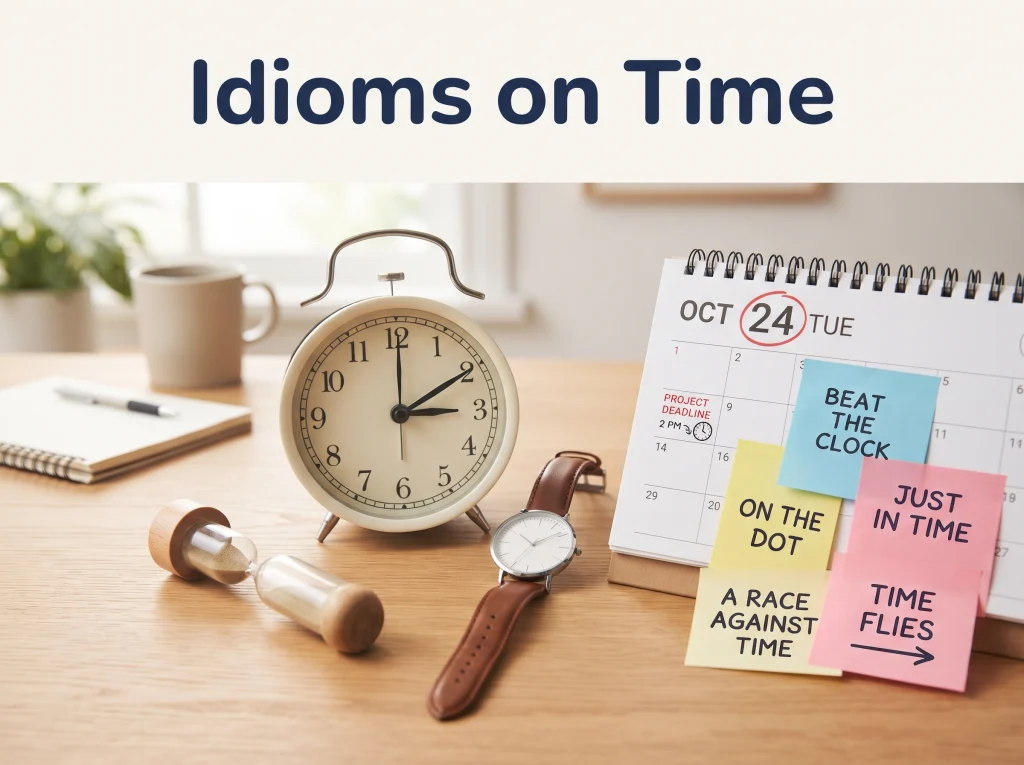
Learning these expressions can make conversations easier to understand and help English learners sound more natural when talking about schedules, deadlines, and everyday situations.
50 Common Idioms on Time
Idioms About Being On Time
1. Right on Time
Meaning: Arriving or happening exactly at the expected time.
Example:
The bus arrived right on time at 8:30.
2. Just in Time
Meaning: Arriving or doing something shortly before it becomes too late.
Example:
We got to the theater just in time for the movie.
3. On the Dot
Meaning: Exactly at a particular time.
Example:
The meeting starts at 9:00 on the dot.
4. On Schedule
Meaning: Happening at the planned or expected time.
Example:
The construction project is on schedule.
5. Ahead of Schedule
Meaning: Happening earlier than planned.
Example:
The team finished the project ahead of schedule.
6. Ahead of Time
Meaning: Earlier than the expected or required time.
Example:
I finished my report ahead of time.
7. In Good Time
Meaning: Early enough to have enough time for something.
Example:
We arrived in good time to find our seats.
8. Time Is of the Essence
Meaning: It is extremely important to act quickly because there is little time available.
Example:
Time is of the essence, so we need to make a decision today.
9. Beat the Clock
Meaning: Finish something before the available time runs out.
Example:
We worked quickly to beat the clock and submit the application before midnight.
10. Against the Clock
Meaning: Working under pressure because there is a limited amount of time.
Example:
The rescue team was working against the clock.
Idioms About Being Early or Late

11. Early Bird
Meaning: A person who gets up early or arrives early.
Example:
I’m an early bird, so I usually start work before everyone else.
12. The Early Bird Catches the Worm
Meaning: People who act early often have an advantage.
Example:
She applied for the scholarship immediately because the early bird catches the worm.
13. Better Late Than Never
Meaning: Doing something late is better than not doing it at all.
Example:
I finally started exercising at 40. Better late than never.
14. Fashionably Late
Meaning: Arriving late, often intentionally, especially to a social event.
Example:
He showed up fashionably late to the party.
15. Run Late
Meaning: To be delayed and likely arrive later than planned.
Example:
I’m running late, so I’ll be there in about fifteen minutes.
16. Running Behind
Meaning: Being late or not progressing as quickly as planned.
Example:
We’re running behind, so let’s skip the break.
17. At the Last Minute
Meaning: Just before something needs to happen.
Example:
She changed her presentation at the last minute.
18. At the Eleventh Hour
Meaning: At the latest possible moment.
Example:
They reached an agreement at the eleventh hour.
19. In the Nick of Time
Meaning: Just before it becomes too late.
Example:
The firefighters arrived in the nick of time.
20. Time to Spare
Meaning: Having more time than necessary.
Example:
We arrived at the airport with time to spare.
Idioms About Deadlines and Timing

21. Beat the Deadline
Meaning: Finish something before the deadline.
Example:
The writer worked all weekend to beat the deadline.
22. Meet a Deadline
Meaning: Finish something by the required time.
Example:
We need to meet the deadline by Friday afternoon.
23. Miss the Boat
Meaning: Miss an opportunity because you acted too late.
Example:
If you don’t apply today, you may miss the boat.
24. Strike While the Iron Is Hot
Meaning: Take action while an opportunity is available.
Example:
The customer is interested, so we should strike while the iron is hot.
25. Now or Never
Meaning: It is the last opportunity to do something.
Example:
If you want to buy the house, it’s now or never.
26. While You Still Can
Meaning: Before the opportunity or ability to do something disappears.
Example:
Visit your grandparents while you still can.
27. Make Up for Lost Time
Meaning: Work faster or spend extra time doing something because time was previously wasted or lost.
Example:
After recovering from illness, she worked hard to make up for lost time.
28. Buy Time
Meaning: Delay something so that you have more time to prepare or decide.
Example:
He asked several questions to buy time while he considered his answer.
29. In the Meantime
Meaning: During the period before something else happens.
Example:
The repairs will take two days. In the meantime, we’ll stay at a hotel.
30. Time Is Running Out
Meaning: There is very little time remaining.
Example:
Time is running out, so we need to finish the project today.
Idioms About Time Passing

31. Time Flies
Meaning: Time seems to pass very quickly.
Example:
Time flies when you’re having fun.
32. In No Time
Meaning: Very soon or very quickly.
Example:
You’ll feel better in no time.
33. In the Blink of an Eye
Meaning: Extremely quickly.
Example:
The summer vacation ended in the blink of an eye.
34. Before You Know It
Meaning: Something will happen sooner than you expect.
Example:
You’ll be graduating before you know it.
35. In a New York Minute
Meaning: Extremely quickly.
Example:
She would accept that job in a New York minute.
This informal American expression emphasizes speed rather than literal time.
36. Once in a Blue Moon
Meaning: Very rarely.
Example:
We eat at expensive restaurants once in a blue moon.
37. Every Now and Then
Meaning: Occasionally.
Example:
I still call my old college friends every now and then.
38. From Time to Time
Meaning: Occasionally.
Example:
I still visit that neighborhood from time to time.
39. Day in and Day Out
Meaning: Every day, repeatedly, often without change.
Example:
She works day in and day out to support her family.
40. Day by Day
Meaning: Gradually as each day passes.
Example:
His English is improving day by day.
Idioms About Using Time Wisely

41. Make the Most of Your Time
Meaning: Use your available time as effectively as possible.
Example:
Try to make the most of your time while you’re in college.
42. Waste Time
Meaning: Spend time without accomplishing anything useful.
Example:
Don’t waste time worrying about things you cannot change.
43. Kill Time
Meaning: Spend time doing something while waiting.
Example:
I read a magazine to kill time at the airport.
44. Pass the Time
Meaning: Do something to make a period of waiting feel shorter.
Example:
We played cards to pass the time.
45. Have Time on Your Hands
Meaning: Have free time available.
Example:
I have some time on my hands this weekend, so I’ll clean the garage.
46. Take Your Time
Meaning: Do something without rushing.
Example:
Take your time and make sure you complete the form correctly.
47. Time on Your Side
Meaning: Having enough time available to achieve something.
Example:
We have time on our side, so we don’t need to make a rushed decision.
48. Give Someone a Hard Time
Meaning: Tease, criticize, or make something difficult for someone.
Example:
My brothers always give me a hard time about my cooking.
49. In Due Time
Meaning: At the appropriate or expected time.
Example:
You’ll receive the results in due time.
50. A Matter of Time
Meaning: Something will eventually happen because it is only a question of when.
Example:
With enough practice, becoming fluent is a matter of time.
How to Use Time Idioms Naturally in American English
Time idioms are especially useful in conversations about work, school, appointments, travel, deadlines, and everyday plans. The key is to understand the difference between expressions that describe punctuality and those that describe general timing.
For example, use “right on time” when something happens exactly when expected:
“The doctor called me right on time.”
Use “just in time” when something happens shortly before it would have been too late:
“We arrived just in time to catch the train.”
These expressions have similar meanings, but they are not always interchangeable.
For deadlines, expressions such as “against the clock,” “beat the deadline,” “at the last minute,” and “time is running out” are useful.
For everyday conversations about passing time, Americans commonly use expressions such as “time flies,” “in no time,” “every now and then,” and “before you know it.”
It is also important to consider formality. Expressions such as “take your time” and “in the meantime” work in many situations, including professional conversations. Expressions such as “in a New York minute” and “kill time” are more informal.

Common Mistakes With Time Idioms
One common mistake is confusing “on time” with “in time.” On time means at the scheduled or expected time. In time means early enough to prevent a problem or catch an event.
For example:
“The train arrived on time.”
This means the train followed its schedule.
“We arrived in time for the train.”
This means we arrived early enough to catch it.
Another common mistake is confusing “ahead of time” with “ahead of schedule.” Ahead of time usually means earlier than necessary or expected, while ahead of schedule often describes progress that is faster than a planned schedule.
English learners should also avoid translating time idioms literally from their native language. Idioms have established meanings, and their natural usage depends on context.
Finally, remember that some expressions are informal. “Kill time,” “fashionably late,” and “in a New York minute” are appropriate for casual conversations but may not be ideal for formal academic or professional writing.

Frequently Asked Questions:
Conclusion
Idioms on time are useful expressions for talking about punctuality, deadlines, opportunities, schedules, and the passing of time. Expressions such as “right on time,” “on the dot,” and “ahead of schedule” are useful when discussing punctuality and progress.
When something happens just before it becomes too late, expressions such as “just in time” and “in the nick of time” are natural choices. When talking about deadlines, “beat the clock,” “against the clock,” and “at the eleventh hour” can make everyday American English more expressive.