130+ Idioms in Russian: Meanings, English Translations, and Examples
Russian idioms make everyday conversations more expressive, memorable, and sometimes surprisingly funny. A short phrase about a cat, a fly, a wolf, or even a person’s ears can communicate an idea that would take several ordinary sentences to explain in English.
For English speakers learning Russian, understanding these expressions is an important step toward following natural conversations, reading Russian stories, and recognizing the humor behind familiar phrases. Many Russian idioms have English equivalents, while others use completely different images to express similar ideas.
This guide explains 30 common idioms in Russian, including their original Cyrillic forms, approximate pronunciations, literal translations, figurative meanings, and practical examples. The examples include Russian sentences with English translations so you can understand how each expression works in context.
What Are Idioms in Russian?
Russian idioms, known as фразеологизмы (frazeologizmy), are established expressions whose intended meanings often differ from the literal meanings of their individual words.
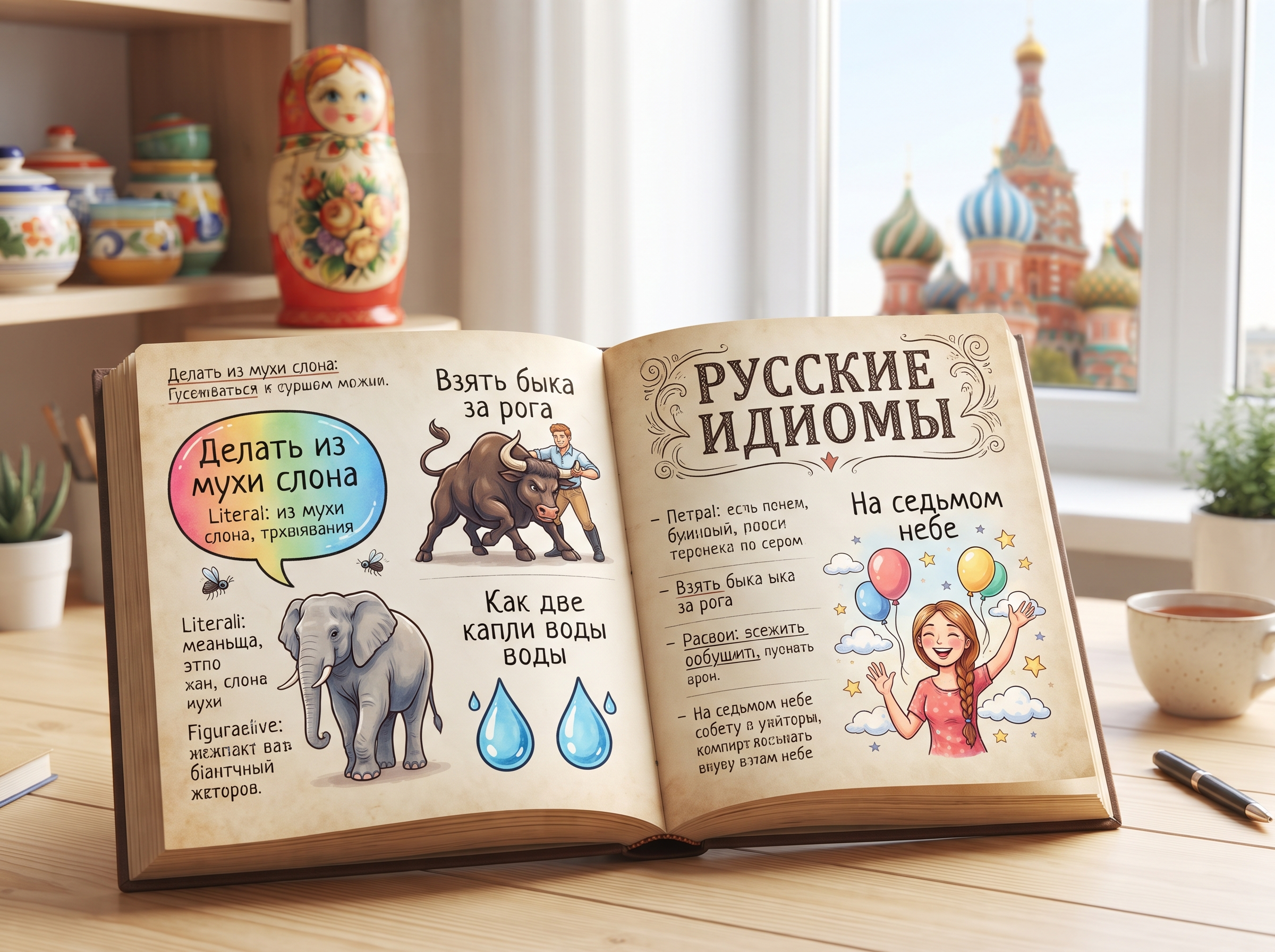
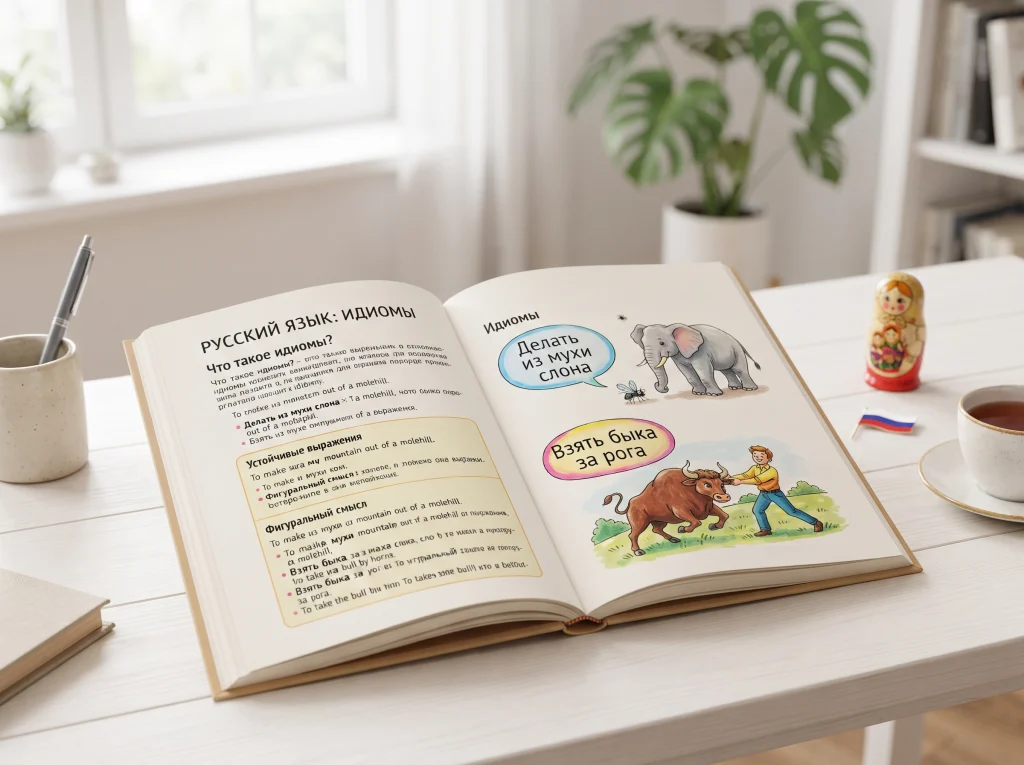
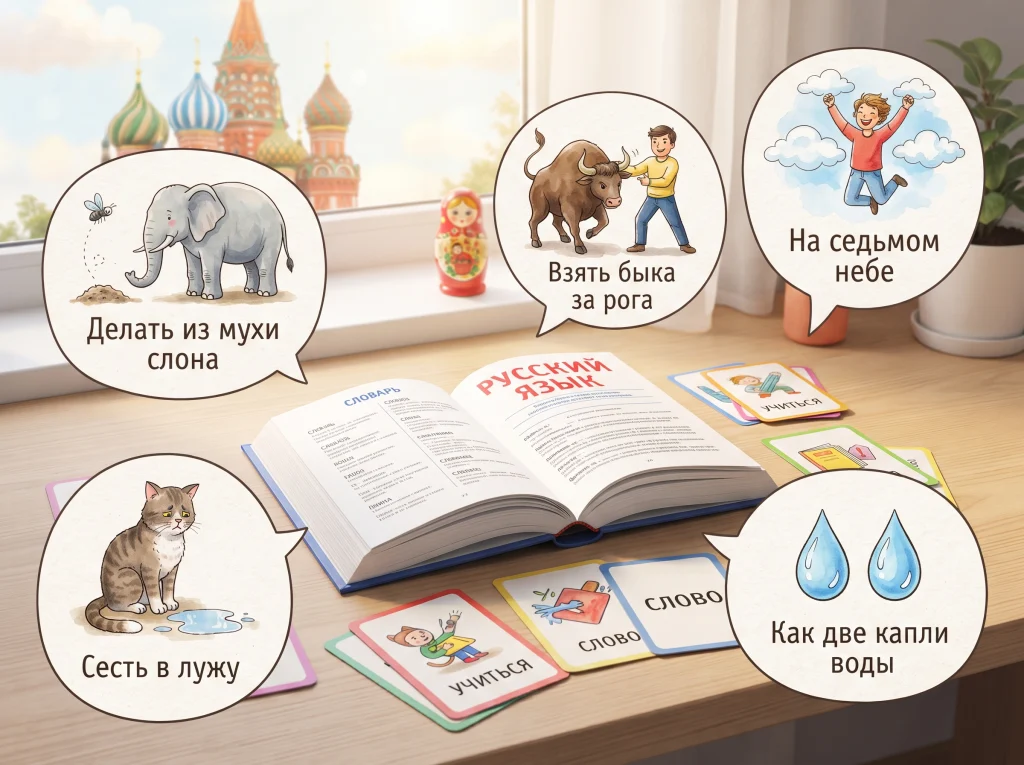
For example, the expression делать из мухи слона literally means “to make an elephant out of a fly.” Figuratively, it means to exaggerate a small problem or make something seem much more serious than it really is.
Idioms are different from ordinary vocabulary because translating each word separately may not communicate the intended message. Learning the complete expression, its tone, and the situation in which it is used helps you understand Russian more naturally.
Some expressions are close equivalents of English idioms. Others reflect distinctive Russian wording, imagery, humor, or cultural traditions. Proverbs and fixed sayings are also often included in beginner-friendly idiom collections because they serve a similar purpose in conversation.
Idioms for Teens: https://learnidioms.com/idioms-for-cars/
30 Common Idioms in Russian With Meanings and Examples
The following expressions cover everyday situations, emotions, relationships, work, and humorous descriptions. Pronunciations are approximate guides for English speakers rather than formal phonetic transcriptions.
1. Делать из мухи слона
Pronunciation: DYEL-at iz MOO-khee slo-NA
Literal meaning: To make an elephant out of a fly.
Figurative meaning: To exaggerate a small problem or make a minor issue seem enormous.
English equivalent: To make a mountain out of a molehill.
Example:
Не делай из мухи слона!
Translation: Don’t make a mountain out of a molehill!
This expression is useful when someone is overreacting to a small mistake, inconvenience, or misunderstanding.
2. Взять быка за рога
Pronunciation: vzyat’ by-KA za ro-GA
Literal meaning: To take the bull by the horns.
Figurative meaning: To confront a problem directly and take decisive action.
English equivalent: To take the bull by the horns.
Example:
Пора взять быка за рога и закончить этот проект.
Translation: It’s time to take the bull by the horns and finish this project.
Use this expression when someone stops delaying and begins dealing with a difficult task.
3. Держать язык за зубами
Pronunciation: der-ZHAT’ ya-ZYK za zu-BA-mee
Literal meaning: To keep the tongue behind the teeth.
Figurative meaning: To remain silent, avoid revealing information, or keep a secret.
English equivalent: To keep one’s mouth shut.
Example:
Обещай держать язык за зубами.
Translation: Promise to keep your mouth shut.
This phrase can sound firm or blunt, depending on the relationship between the speakers.
4. Как две капли воды
Pronunciation: kak dve ka-PLI vo-DY
Literal meaning: Like two drops of water.
Figurative meaning: Almost exactly alike or extremely similar.
English equivalent: Like two peas in a pod, or like two drops of water.
Example:
Эти сестры похожи как две капли воды.
Translation: These sisters look as alike as two drops of water.
It is commonly used to describe people who look remarkably similar, although it can also describe other things.

5. Зарубить себе на носу
Pronunciation: za-ru-BEET’ se-BYE na na-SOO
Literal meaning: To make a notch on one’s nose.
Figurative meaning: To remember something firmly and not forget it.
English equivalent: To take something to heart or remember it well.
Example:
Заруби себе на носу: всегда проверяй адрес перед отправкой.
Translation: Remember this well: always check the address before sending.
This expression is informal and can sound like a strong warning or instruction.
6. Попасть впросак
Pronunciation: pa-PAST’ fprasak
Literal meaning: The original wording has a historical background and does not translate neatly into a useful modern English phrase.
Figurative meaning: To get into an awkward, embarrassing, or difficult situation.
English equivalent: To get into a pickle or find oneself in a predicament.
Example:
Я попал впросак, когда назвал ее чужим именем.
Translation: I got into an embarrassing situation when I called her by someone else’s name.
Use it when an unexpected mistake leaves someone feeling uncomfortable.
7. Семь пятниц на неделе
Pronunciation: syem’ PYAT-neets na nye-DYE-lye
Literal meaning: Seven Fridays in one week.
Figurative meaning: Someone frequently changes plans, decisions, or promises.
English equivalent: To keep changing one’s mind.
Example:
У него семь пятниц на неделе: каждый день новые планы.
Translation: He keeps changing his mind; every day he has new plans.
The phrase is usually critical and may suggest that a person is unreliable or indecisive.
8. Не в своей тарелке
Pronunciation: nye f sva-YEY ta-REL-kye
Literal meaning: Not in one’s own plate.
Figurative meaning: To feel uncomfortable, awkward, or out of place.
English equivalent: To feel out of one’s element.
Example:
На первой встрече я чувствовал себя не в своей тарелке.
Translation: I felt out of place at the first meeting.
This expression is useful for describing unfamiliar social situations or environments.
9. Ума палата
Pronunciation: u-MA pa-LA-ta
Literal meaning: A chamber of intelligence.
Figurative meaning: A person who is very intelligent or clever. Depending on the context, it can also be sarcastic.
English equivalent: A real brain, or a very clever person.
Example:
У нашей учительницы ума палата.
Translation: Our teacher is exceptionally intelligent.
Tone matters: the expression may be sincere praise or ironic criticism.
10. Бить баклуши
Pronunciation: beet’ bak-LOO-shee
Literal meaning: To beat or split wooden blanks, referring to an old expression associated with making small wooden pieces.
Figurative meaning: To waste time, loaf around, or avoid doing useful work.
English equivalent: To sit around doing nothing.
Example:
Хватит бить баклуши, пора готовиться к экзамену.
Translation: Stop wasting time; it’s time to prepare for the exam.
This informal expression is often used when encouraging someone to become productive.
11. Душа в душу
Pronunciation: du-SHA v du-SHOO
Literal meaning: Soul to soul.
Figurative meaning: To live together in harmony, understanding, and mutual affection.
English equivalent: To get along wonderfully.
Example:
Мои бабушка и дедушка всю жизнь жили душа в душу.
Translation: My grandparents lived together in perfect harmony all their lives.
It is especially useful when describing close relationships and peaceful family life.
12. Душа в пятки ушла
Pronunciation: du-SHA f PYAT-kee ush-LA
Literal meaning: The soul went down into the heels.
Figurative meaning: To become extremely frightened or suddenly feel terrified.
English equivalent: To be scared stiff.
Example:
Когда я услышал громкий звук ночью, душа в пятки ушла.
Translation: When I heard a loud noise at night, I was scared stiff.
The unusual image makes the expression memorable and emphasizes a strong emotional reaction.
13. Ни пуха ни пера
Pronunciation: nee POO-kha nee pee-RA
Literal meaning: Neither down nor feather.
Figurative meaning: A traditional way of wishing someone good luck before an important event.
English equivalent: Break a leg, or good luck.
Example:
Завтра у тебя экзамен? Ни пуха ни пера!
Translation: You have an exam tomorrow? Good luck!
A traditional response is К черту! (k CHYER-too), literally “to the devil.” The exchange is a conventional good-luck ritual, not an actual wish for harm.
14. Без труда не вытащишь и рыбку из пруда
Pronunciation: byez tru-DA nye VY-ta-shish ee RYB-koo iz pru-DA
Literal meaning: Without effort, you cannot even pull a little fish out of a pond.
Figurative meaning: Achievements require effort, patience, and work.
English equivalent: No pain, no gain.
Example:
Если хочешь хорошо говорить по-русски, занимайся каждый день. Без труда не вытащишь и рыбку из пруда.
Translation: If you want to speak Russian well, practice every day. Nothing comes without effort.
This proverb is useful when discussing studying, training, work, and personal goals.
15. Первый блин комом
Pronunciation: PYER-vy blin KO-mom
Literal meaning: The first pancake comes out lumpy or unsuccessful.
Figurative meaning: The first attempt at something may not go well.
English equivalent: The first attempt is often rough.
Example:
Мой первый урок русского языка прошел не очень хорошо, но первый блин комом.
Translation: My first Russian lesson didn’t go very well, but the first attempt is often rough.
It can reassure someone who is disappointed with an initial effort.
16. Яблоко от яблони недалеко падает
Pronunciation: YAB-la-ka at YAB-la-nee nye-da-le-KO PA-da-yet
Literal meaning: An apple does not fall far from the apple tree.
Figurative meaning: Children often resemble their parents in behavior, personality, or habits.
English equivalent: The apple doesn’t fall far from the tree.
Example:
Его сын тоже любит музыку. Яблоко от яблони недалеко падает.
Translation: His son loves music too. The apple doesn’t fall far from the tree.
The expression can be affectionate, neutral, or critical depending on what behavior is being discussed.
17. Нет дыма без огня
Pronunciation: nyet DY-ma byez ag-NYA
Literal meaning: There is no smoke without fire.
Figurative meaning: Rumors or suspicions may have some underlying cause.
English equivalent: There is no smoke without fire.
Example:
Все говорят об этой истории. Нет дыма без огня.
Translation: Everyone is talking about this story. There is no smoke without fire.
Remember that this saying expresses a common belief. It does not prove that a rumor is true.
18. В гостях хорошо, а дома лучше
Pronunciation: v gas-TYAKH kha-ra-SHO, a DO-ma LOOCH-she
Literal meaning: It is nice when visiting others, but home is better.
Figurative meaning: Visiting can be enjoyable, but being at home is often more comfortable.
English equivalent: East or west, home is best.
Example:
Мы отлично провели выходные у друзей, но в гостях хорошо, а дома лучше.
Translation: We had a wonderful weekend at our friends’ place, but home is best.
This saying is often used warmly when returning home after a trip or visit.
19. На вкус и цвет товарищей нет
Pronunciation: na fkoos ee tsvyet ta-va-REE-shchey nyet
Literal meaning: There are no companions for taste and color.
Figurative meaning: People have different preferences, and personal taste varies.
English equivalent: To each their own.
Example:
Мне нравится классическая музыка, а ему рок. На вкус и цвет товарищей нет.
Translation: I like classical music, and he likes rock. To each their own.
It is useful for accepting differences in food, music, clothing, entertainment, and other personal preferences.
20. Запретный плод сладок
Pronunciation: za-PRYET-ny plod SLA-dak
Literal meaning: The forbidden fruit is sweet.
Figurative meaning: Something can become more attractive simply because it is forbidden or restricted.
English equivalent: Forbidden fruit is sweetest.
Example:
Ему особенно хотелось прочитать эту книгу, потому что ее запретили. Запретный плод сладок.
Translation: He especially wanted to read that book because it had been banned. Forbidden fruit is sweetest.
The expression describes the attraction of something unavailable or prohibited.
21. Волков бояться, в лес не ходить
Pronunciation: val-KOF ba-YAT-sya, v les nye kha-DEET’
Literal meaning: If you are afraid of wolves, don’t go into the forest.
Figurative meaning: You cannot accomplish certain goals if you refuse to face every possible risk or difficulty.
English equivalent: Nothing ventured, nothing gained.
Example:
Ты боишься подать заявку на работу? Волков бояться, в лес не ходить.
Translation: Are you afraid to apply for the job? Nothing ventured, nothing gained.
It is commonly used as encouragement, although the tone can be challenging.
22. Когда рак на горе свистнет
Pronunciation: kag-DA rak na ga-RYE svist-NYET
Literal meaning: When a crayfish whistles on the mountain.
Figurative meaning: Something will happen at an extremely unlikely time, or perhaps never.
English equivalent: When pigs fly.
Example:
Он обещает убрать комнату, но сделает это, когда рак на горе свистнет.
Translation: He promises to clean his room, but he’ll do it when pigs fly.
This humorous expression is often used when someone doubts that another person will keep a promise.
23. Водить за нос
Pronunciation: va-DEET’ za nos
Literal meaning: To lead someone by the nose.
Figurative meaning: To deceive, mislead, or manipulate someone.
English equivalent: To lead someone on or pull the wool over someone’s eyes.
Example:
Он месяцами водил нас за нос и скрывал правду.
Translation: He misled us for months and hid the truth.
The expression usually carries a negative meaning because it suggests dishonesty.
24. Кот наплакал
Pronunciation: kot na-PLA-kal
Literal meaning: A cat cried only a tiny amount.
Figurative meaning: There is very little of something.
English equivalent: Hardly any, or next to nothing.
Example:
У нас осталось кот наплакал времени до начала урока.
Translation: We have hardly any time left before the lesson begins.
It is an informal and expressive way to describe a shortage of time, money, food, or another resource.
25. Как снег на голову
Pronunciation: kak snyek na ga-la-VOO
Literal meaning: Like snow falling on someone’s head.
Figurative meaning: Something happens unexpectedly or without warning.
English equivalent: Out of the blue.
Example:
Его неожиданный звонок был как снег на голову.
Translation: His unexpected phone call came completely out of the blue.
This expression can describe surprising news, a sudden visit, or an unforeseen event.
26. Сесть в лужу
Pronunciation: syest’ v LOO-zhoo
Literal meaning: To sit down in a puddle.
Figurative meaning: To embarrass oneself or end up in an awkward situation.
English equivalent: To make a fool of oneself.
Example:
Он хотел показать свои знания, но перепутал все даты и сел в лужу.
Translation: He wanted to show off his knowledge, but he mixed up all the dates and embarrassed himself.
It is often used when someone’s attempt to impress others goes wrong.
27. Работать спустя рукава
Pronunciation: ra-BO-tat’ spus-TYA ru-ka-VA
Literal meaning: To work with one’s sleeves hanging down or loosely.
Figurative meaning: To work carelessly, without enough effort or attention.
English equivalent: To do a halfhearted job.
Example:
Если будешь работать спустя рукава, результат тебя разочарует.
Translation: If you do a halfhearted job, the result will disappoint you.
The phrase is useful for describing poor effort or a lack of care.
28. На седьмом небе
Pronunciation: na syed-MOM NYE-bye
Literal meaning: In the seventh heaven.
Figurative meaning: To feel extremely happy or delighted.
English equivalent: To be on cloud nine.
Example:
Она была на седьмом небе от счастья, когда получила письмо о поступлении.
Translation: She was on cloud nine when she received the acceptance letter.
This expression is appropriate for describing intense happiness after good news or a meaningful achievement.

29. Тянуть кота за хвост
Pronunciation: tya-NOOT’ ka-TA za khvost
Literal meaning: To pull a cat by the tail.
Figurative meaning: To delay something, waste time, or avoid getting to the point.
English equivalent: To drag things out.
Example:
Не тяни кота за хвост, рассказывай, что случилось.
Translation: Stop dragging things out and tell me what happened.
Depending on the context, it can refer to procrastination, slow progress, or unnecessarily delaying a conversation.
30. Время лечит
Pronunciation: VRYE-mya LYE-cheet
Literal meaning: Time heals.
Figurative meaning: Emotional pain often becomes easier to bear as time passes.
English equivalent: Time heals all wounds.
Example:
Я знаю, что тебе сейчас тяжело, но время лечит.
Translation: I know things are difficult for you right now, but time heals.
This familiar saying is often used to comfort someone going through disappointment, sadness, or a difficult change.
Russian Idioms With English Equivalents
Some Russian expressions share almost the same wording and meaning as English idioms. Others express a similar idea through a different image. The following comparison makes these connections easier to remember.
| Russian expression | English equivalent |
|---|---|
| Взять быка за рога | Take the bull by the horns |
| Как две капли воды | Like two drops of water |
| Нет дыма без огня | There is no smoke without fire |
| Яблоко от яблони недалеко падает | The apple doesn’t fall far from the tree |
| Запретный плод сладок | Forbidden fruit is sweetest |
| На седьмом небе | On cloud nine |
| Когда рак на горе свистнет | When pigs fly |
| Делать из мухи слона | Make a mountain out of a molehill |
| Ни пуха ни пера | Break a leg |
| Без труда не вытащишь и рыбку из пруда | No pain, no gain |
These equivalents are useful memory aids, but they are not always exact translations. The surrounding sentence, relationship between speakers, and level of formality can affect how an expression should be translated.
How to Learn and Use Russian Idioms Naturally
Memorizing a list of expressions is a helpful starting point, but using idioms appropriately requires understanding their context. A phrase that sounds friendly among close friends may feel too direct in a formal conversation.

Learn the figurative meaning first
Start by remembering what an expression communicates rather than trying to translate every word. For example, associate когда рак на горе свистнет with an event that is extremely unlikely to happen. The literal image can then serve as a memory aid.
Practice idioms in complete sentences
Learn each expression alongside a realistic example. This helps you recognize its grammatical structure and understand how Russian speakers use it in conversation.
Instead of memorizing only бить баклуши, practice a complete sentence such as:
Хватит бить баклуши!
Translation: Stop wasting time!
Group expressions by situation
Organize idioms into categories such as emotions, work, friendship, surprises, and personal preferences. This makes it easier to retrieve the right expression when you need it.
For example, на седьмом небе describes happiness, while душа в пятки ушла describes fear. Learning them together can help you distinguish between different emotional situations.
Pay attention to tone and formality
Some idioms are appropriate in ordinary conversation, while others can sound sarcastic, blunt, old-fashioned, or overly familiar. Listen to how native speakers use them in conversations, interviews, films, and other Russian-language material.
When speaking with someone you do not know well, a straightforward sentence is often a sensible choice until you understand the expression’s social tone.
Review expressions regularly
Short, repeated practice sessions can help you retain idioms more effectively than trying to memorize a large list all at once. Review a few expressions, write your own examples, and revisit phrases that you find difficult to remember.
You can also keep a vocabulary notebook with four columns: Russian expression, pronunciation, figurative meaning, and your own example sentence.
Idioms for Teens: https://learnidioms.com/idioms-for-teens/
FAQ: Idioms in Russian
Conclusion
Idioms in Russian provide an engaging way to understand how the language communicates humor, emotions, advice, and everyday experiences. Expressions such as делать из мухи слона, взять быка за рога, and на седьмом небе are particularly useful because their meanings connect to familiar situations.
Some Russian idioms closely resemble English expressions, while others use distinctive imagery that becomes easier to understand with practice. Learning their meanings, pronunciation, and conversational tone will help you recognize them when reading or listening to Russian.






One Comment