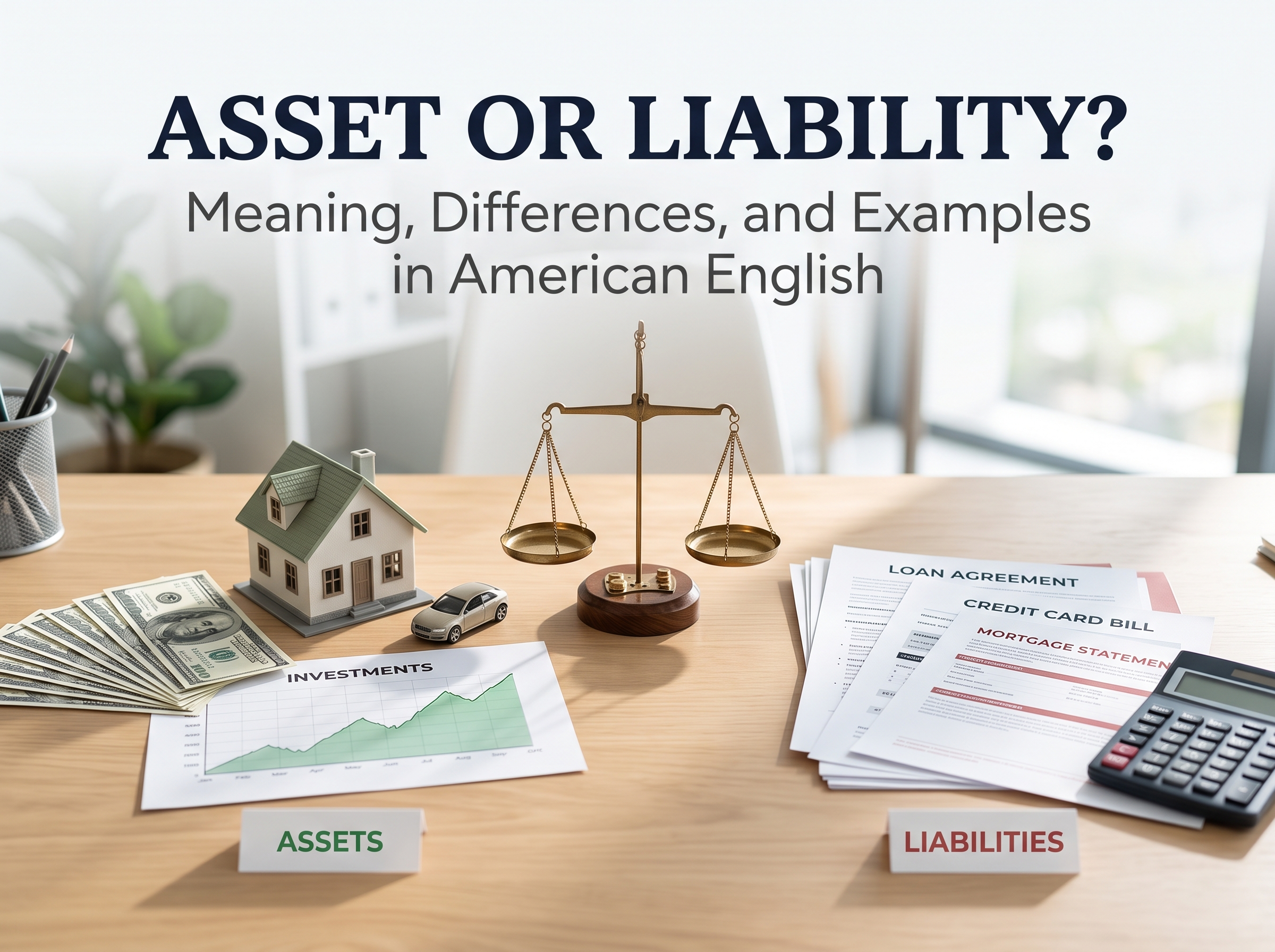
Asset or Liability? Meaning, Differences, and Examples in American English
Understanding the difference between an asset and a liability is important for managing money, making financial decisions, and learning basic accounting. Both terms describe important parts of a person’s or business’s financial situation, but they represent different things.

An asset is something you own or control that has economic value, while a liability is a debt or financial obligation you owe. For example, money in your savings account is an asset, while an unpaid credit card balance is a liability. Knowing how these two concepts work can help you understand your finances, calculate your net worth, and make more informed decisions about spending, saving, and borrowing.
What Is an Asset?
An asset is something a person, business, or organization owns or controls that has economic value. Assets can provide financial benefits now or in the future. They may include cash, investments, real estate, vehicles, equipment, and other valuable resources.
In personal finance, assets represent the things you own that contribute to your financial position. For example, if you have $5,000 in a savings account, that money is an asset because it belongs to you and can be used to meet your financial needs.
Businesses also depend on assets to operate and earn revenue. A company’s assets might include office buildings, computers, inventory, cash, and money customers owe the business.
Common Types of Assets
Assets can be divided into several categories according to their form and purpose.
1. Current assets
Current assets are resources that can generally be converted into cash, sold, or used up within one year or the normal operating cycle of a business.
Examples include:
- Cash in checking and savings accounts
- Accounts receivable, or money customers owe a business
- Inventory held for sale
- Short-term investments
- Supplies used in business operations
2. Noncurrent assets
Noncurrent assets are resources expected to provide benefits beyond the next year or normal operating cycle.
Examples include:
- Real estate
- Buildings and land
- Manufacturing equipment
- Company vehicles
- Long-term investments
3. Tangible assets
Tangible assets have a physical form. You can generally see or touch them.
Examples include houses, cars, furniture, computers, machinery, and jewelry.
4. Intangible assets
Intangible assets have economic value but do not have a physical form.
Examples include patents, trademarks, copyrights, and certain software rights. For businesses, the recognition and measurement of intangible assets depend on applicable accounting rules.
Examples of Assets in Everyday Life
You probably have several assets even if you do not think about your finances regularly.
For example, money in your bank account is an asset because you can use it to pay bills or cover unexpected expenses. A car you own is also an asset because it has resale value, even though its value may decrease over time.
Investments such as stocks, bonds, and mutual funds can also be assets. A home you own may represent a significant portion of your wealth. However, if you have a mortgage on that home, you must account for the outstanding mortgage balance separately as a liability.
The important point is that an asset does not have to generate income to qualify as an asset. It needs to have economic value or provide an economic benefit under the relevant financial or accounting framework.

What Is a Liability?
A liability is a debt, obligation, or amount that a person or business owes to another party. Liabilities commonly require future payments, the delivery of goods, or the performance of services.
In personal finance, liabilities include mortgages, student loans, auto loans, and unpaid credit card balances. For example, if you owe $3,000 on a credit card, that outstanding balance is a liability because you are responsible for repaying it.
Businesses also have liabilities. These can include bank loans, unpaid supplier invoices, wages owed to employees, and taxes payable.
Liabilities are not always a sign of poor financial management. A mortgage may help someone purchase a home, while a business loan may provide funds to expand operations. What matters is whether the obligation is manageable and supports the person’s or business’s financial goals.
Common Types of Liabilities
Liabilities are commonly classified according to when they are expected to be settled.
1. Current liabilities
Current liabilities are generally obligations expected to be settled within one year or the normal operating cycle.
Examples include:
- Credit card balances due
- Accounts payable
- Short-term loans
- Wages payable
- Certain taxes payable
2. Long-term liabilities
Long-term liabilities are obligations that extend beyond one year, although the portion due within the next year may be classified as a current liability.
Examples include:
- Long-term mortgages
- Long-term business loans
- Certain student loans
- Bonds payable
3. Personal liabilities
Personal liabilities are debts and financial obligations owed by an individual or household.
Examples include auto loans, personal loans, medical bills that remain unpaid, and mortgage balances.
4. Business liabilities
Business liabilities are obligations incurred by a company while operating.
Examples include money owed to suppliers, outstanding business loans, certain employee benefit obligations, and taxes payable.
Examples of Liabilities in Everyday Life
Imagine that you purchase a car using an auto loan. The car is an asset because it has economic value, but the unpaid loan is a liability because you must repay the lender.
Similarly, if you use a credit card to buy groceries and have not paid the balance, the outstanding amount is a liability. Once you pay that balance in full, the corresponding debt is settled.
A mortgage works in much the same way. The home is an asset, while the outstanding mortgage is a liability. Looking at both figures together gives you a more accurate picture of your financial position than considering the home’s value alone.
Liabilities can also arise without a traditional loan. For example, a business that receives inventory from a supplier and agrees to pay later may record an accounts payable liability.
Asset vs. Liability: Key Differences
The main difference between an asset and a liability is that an asset represents an economic resource, while a liability represents an obligation.
| Feature | Asset | Liability |
|---|---|---|
| Meaning | A resource with economic value | A debt or financial obligation |
| Financial effect | Contributes to financial resources | Represents an amount owed or an obligation to fulfill |
| Common examples | Cash, investments, property | Loans, mortgages, unpaid bills |
| Ownership or responsibility | A resource you own or control | An obligation you must settle |
| Personal finance role | Helps determine what you own financially | Helps determine what you owe financially |
| Effect on net worth | Generally increases net worth | Generally decreases net worth |
For example, suppose you own a home worth $300,000 and have an outstanding mortgage of $200,000. The home is an asset worth $300,000, while the mortgage is a liability of $200,000.
Ignoring other assets, liabilities, and transaction costs, the difference between the home’s value and its mortgage balance is $100,000 in home equity.
This example shows why assets and liabilities should be considered together when evaluating your financial position.

Is Something an Asset or a Liability?
Some items can be confusing because they involve both ownership and debt. The correct classification depends on what the item represents.
Is a House an Asset or a Liability?
A house you own is generally an asset because it has economic value and may be sold in the future. If you have a mortgage, however, the outstanding mortgage balance is a liability.
Owning a home can also involve property taxes, insurance, repairs, and maintenance expenses. These ongoing costs affect your budget, but they do not automatically make the house itself a liability in accounting terms.
The distinction matters because a home can have substantial value while still creating significant monthly expenses.
Is a Car an Asset or a Liability?
A car you own is generally an asset because it can be sold for money. If you financed the purchase, the remaining auto loan is a liability.
Cars often lose value as they age and accumulate mileage. They also require insurance, fuel, maintenance, and repairs. These costs may make a vehicle expensive to own, but the vehicle remains an asset as long as it has economic value.
If the outstanding loan is greater than the car’s current market value, you have negative equity in the vehicle.
Are Student Loans Assets or Liabilities?
Student loans are liabilities because they represent money borrowed that must be repaid according to the loan terms.
The education funded by a student loan may help someone develop skills and qualify for higher-paying work. However, the loan balance itself remains a liability.
A degree is not automatically recorded as a personal asset in the same way as cash or an investment account. Its potential value may come from future opportunities rather than a directly saleable financial resource.
Are Credit Cards Assets or Liabilities?
An unpaid credit card balance is a liability because it represents money you owe the card issuer.
A credit card itself is not the same as cash in a bank account. Having an available credit limit does not mean you own that amount of money. It means you may borrow up to a specified limit under the card agreement.
For example, a card with a $10,000 credit limit does not give you a $10,000 asset. If you spend $1,000 and have not paid it back, you generally have a $1,000 credit card liability.
Are Investments Assets or Liabilities?
Investments such as stocks, bonds, and mutual funds are generally assets when you own them. They may increase or decrease in value depending on market conditions.
However, borrowing money to purchase investments can create liabilities. If you buy $10,000 worth of investments using $4,000 of your own money and a $6,000 loan, you have investment assets worth $10,000 and a loan liability of $6,000 at the time of purchase, assuming those are the relevant current values.
The investment’s market value can change, but the loan remains an obligation under its terms.
Assets and Liabilities in Personal Finance
Understanding assets and liabilities can help you make better financial decisions. Instead of looking only at your income or the amount of money in your bank account, you can evaluate what you own, what you owe, and how those amounts change over time.
For example, a person may earn $6,000 per month but also have large mortgage, auto loan, and credit card payments. Another person may earn $4,000 per month, have substantial savings, and owe very little. Income alone does not reveal the complete financial picture.
Tracking assets and liabilities can help you identify debt, build savings, and plan for major purchases. It can also help you evaluate whether you are accumulating wealth or relying increasingly on borrowed money.
A practical approach is to list your financial resources and obligations separately. Update their values periodically, especially when you repay loans, make significant purchases, or add to your investments.
The U.S. government’s Investor.gov website also recommends listing what you own and what you owe to calculate your net worth. Investor

How to Calculate Your Net Worth
Your net worth is the difference between the total value of your assets and the total value of your liabilities.
The formula is simple:
Net Worth = Total Assets − Total Liabilities
Consider this example of a household’s finances.
| Financial item | Amount |
|---|---|
| Checking and savings accounts | $12,000 |
| Investments | $18,000 |
| Car’s current market value | $15,000 |
| Home’s current market value | $250,000 |
| Total assets | $295,000 |
| Outstanding mortgage | $190,000 |
| Auto loan | $8,000 |
| Credit card debt | $2,000 |
| Total liabilities | $200,000 |
| Net worth | $95,000 |
In this example, the household has $295,000 in assets and $200,000 in liabilities. Subtracting the liabilities from the assets gives a net worth of $95,000.
A positive net worth means your assets exceed your liabilities. A negative net worth means your liabilities exceed your assets. Neither figure alone tells the whole story, but tracking your net worth over time can help you understand changes in your financial position.
For a useful calculation, estimate the current value of your property and investments rather than relying on their original purchase prices. Also include outstanding debts and avoid counting the same financial item twice.
Common Mistakes When Using Asset and Liability
People sometimes confuse these terms because everyday language and financial terminology do not always use them in exactly the same way.
Mistake 1: Calling every valuable item an income-producing asset.
An asset does not need to generate regular income. Cash, personal property, and a vehicle can be assets even if they do not produce earnings.
Mistake 2: Assuming every debt is a bad financial decision.
A liability is an obligation, not a judgment about whether a purchase was wise. Some loans may help people buy a home, obtain an education, or operate a business. Their value depends on the circumstances, costs, risks, and repayment terms.
Mistake 3: Treating a credit limit as an asset.
Available credit is not the same as money you own. Borrowing creates an obligation to repay the amount used.
Mistake 4: Calling a house with a mortgage a liability.
The house is generally an asset, while the mortgage is a liability. The property’s value and the outstanding loan should be considered separately.
Mistake 5: Confusing liabilities with expenses.
A liability is an obligation, while an expense is a cost incurred during a period. For example, an unpaid utility bill may create a liability, while the electricity used represents an expense. Paying the bill settles the obligation but does not erase the fact that the expense was incurred.
Mistake 6: Ignoring the current value of an asset.
The original purchase price may not reflect what an item is worth today. A car purchased for $30,000 may now be worth $18,000. For a current personal net worth statement, its estimated present value is generally more useful than its original cost.
How to Remember the Difference Between Asset and Liability
A simple way to remember the difference is to ask two questions: What do I own, and what do I owe?
An asset belongs on the side of what you own or control. A liability belongs on the side of what you owe or are obligated to provide.
For example, money in a savings account is an asset, while a personal loan is a liability. A home is an asset, while its outstanding mortgage is a liability.
You can also remember the terms using this simple comparison:
- Asset: Something of economic value that you own or control.
- Liability: Something you owe or are responsible for settling.
When evaluating a financial situation, classify the resource and the obligation separately. This approach works for personal budgets, business accounting, and net worth calculations.
Asset and Liability in Everyday American English
The words asset and liability are used in financial discussions, business conversations, workplaces, and everyday American English. They can also have broader meanings outside accounting.
The word asset can describe a person, quality, or skill that provides value to a group or organization.
For example:
- “Her communication skills are a valuable asset to the company.”
- “The new employee has become an asset to our team.”
- “The property is one of the family’s largest financial assets.”
In these sentences, asset refers to something or someone that provides value or an advantage.
The word liability can refer to a financial obligation or, more generally, a person or thing that creates a disadvantage, risk, or burden.
For example:
- “The company has a significant liability on its balance sheet.”
- “Unpaid credit card debt can become a financial liability.”
- “The outdated equipment became a liability for the business.”

The meaning depends on the context. In accounting, an asset is a resource and a liability is an obligation. In everyday conversation, an asset can be an advantage, while a liability can be a disadvantage.
Frequently Asked Questions:
Conclusion
Understanding the difference between an asset and a liability makes it easier to evaluate personal finances, understand business accounting, and make informed financial decisions. An asset is a resource with economic value, such as cash, investments, a home, or a vehicle. A liability is a debt or obligation, such as a mortgage, auto loan, or unpaid credit card balance.