Become or Became? Meaning, Difference, and Correct Usage in American English
Choosing between become and became depends on the tense of your sentence. Both words describe a change in a person’s condition, role, identity, or situation, but they are not interchangeable.
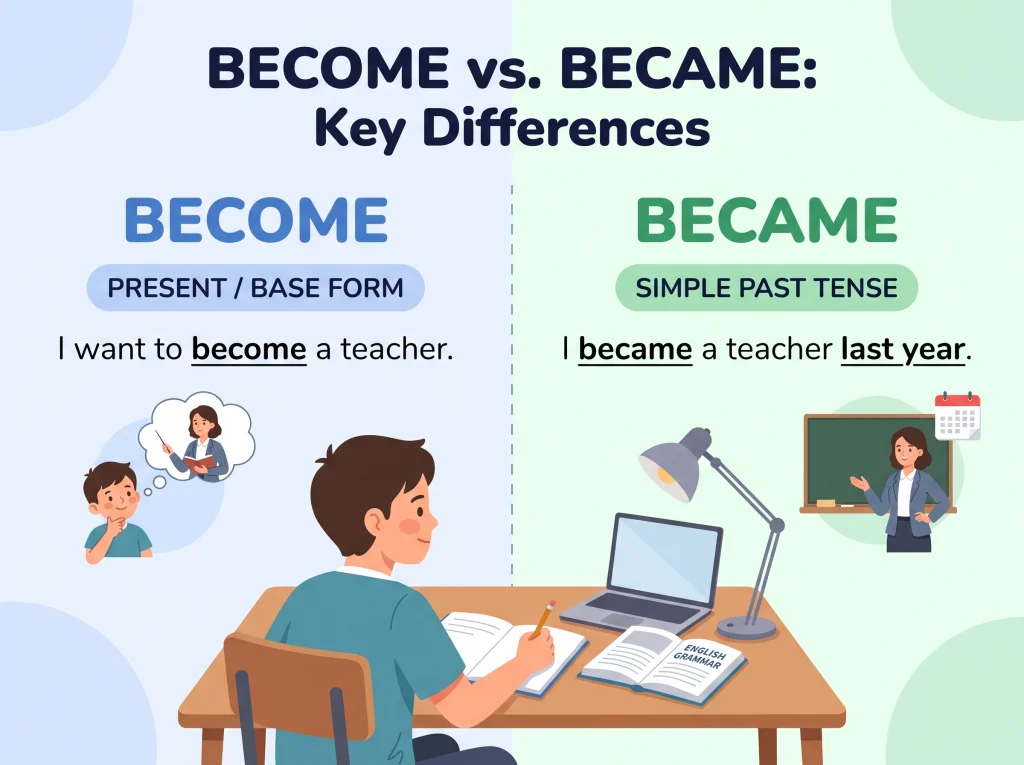
Become is the base form of the verb, while became is its simple past tense. For example, you might say, “I want to become a teacher” when talking about a future goal, but “I became a teacher in 2024” when describing something that happened in the past.

Understanding the difference between become and became helps you write clearer sentences, speak natural American English, and avoid common grammar mistakes. The key is to identify when the change happens and choose the correct verb form for that time.
Become vs. Became: What Is the Difference?
The main difference between become and became is verb tense. Become is used in base-form constructions, including after modal verbs, with the infinitive marker to, and as the present-tense form with plural subjects. Became describes a change that happened in the past.
| Word | Verb form | Example |
|---|---|---|
| Become | Base form and present tense with plural subjects | They become nervous before interviews. |
| Became | Simple past tense | They became nervous before the interview. |
| Become | Past participle, used with helping verbs | She has become more confident. |
These forms belong to the same irregular verb, but each has a different grammatical role. You cannot use became after the word to or after modal verbs such as will, can, and should.
Compare these sentences:
- Correct: She wants to become a doctor.
- Incorrect: She wants to became a doctor.
- Correct: She became a doctor last year.
- Incorrect: She become a doctor last year.
The correct choice depends on the sentence structure and the time being described.
What Does Become Mean?
Become means to begin to be something or to change into a different condition, role, or state. It can describe personal development, career changes, emotions, physical conditions, and changes in circumstances.
Examples include:
- I want to become a better writer.
- People become more confident with practice.
- The weather may become colder tonight.
- She hopes to become a nurse.
- Small problems can become serious if ignored.
In American English, become is especially common when discussing goals, professional ambitions, personal growth, and possible future changes.
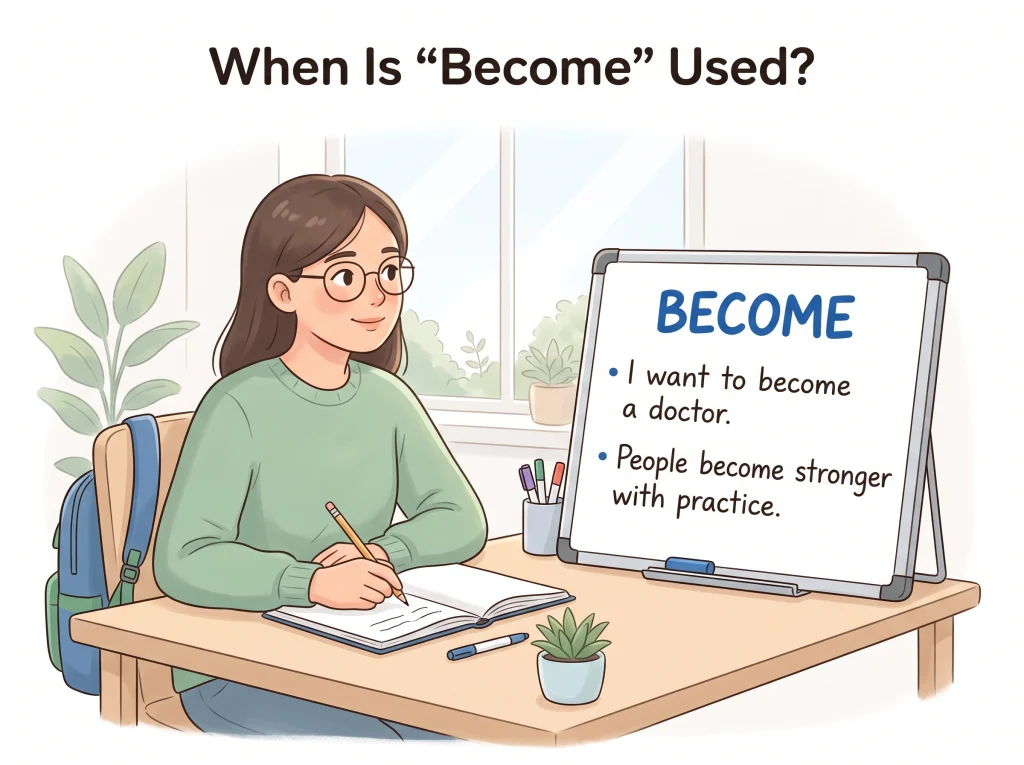
When Is Become Used?
Become appears in several common grammatical structures.
After “to”:
Use become after the infinitive marker to.
- He plans to become a lawyer.
- I would like to become fluent in English.
- She worked hard to become a successful business owner.
After modal verbs:
Use become after modal verbs such as will, can, could, may, might, should, and must.
- You can become a better speaker with practice.
- The situation could become complicated.
- He will become a father next year.
In the present tense with plural subjects:
Use become with plural subjects such as they, we, and students, as well as with the pronoun I.
- They become excited before a big game.
- We become more experienced over time.
- I become anxious when I have too much work.
With a third-person singular subject in the simple present, use becomes instead.
- She becomes nervous before presentations.
- The road becomes slippery when it rains.
What Does Became Mean?
Became is the simple past tense of become. Use it to describe a change, transformation, or new condition that occurred in the past.
Examples include:
- She became a teacher after graduating from college.
- The sky became dark before the storm.
- He became interested in photography during high school.
- Our small business became profitable last year.
- They became close friends after working together.
Each sentence describes a change that took place in the past. The word became can be used with singular and plural subjects, including I, you, he, she, it, we, and they.
When Is Became Used?
Use became when you describe a completed past change without a helping verb such as has or had.
With a specific past time:
- I became a U.S. citizen in 2022.
- She became the team captain last season.
- The restaurant became popular last summer.
With a past event or experience:
- He became nervous when the interviewer asked a difficult question.
- My brother became interested in cooking after taking a class.
- The conversation became uncomfortable after the disagreement.
When describing a change in a past story:
- The room became quiet when the teacher entered.
- The little boy became excited when he saw the presents.
- The weather became warmer as the afternoon progressed.
Remember that a sentence does not need to include a specific date or time expression to use became. The surrounding context can establish that the change happened in the past.
When to Use Become and Became
The easiest way to choose the correct form is to look at the sentence structure and determine whether you are describing a present situation, a possibility, or a completed past event.
Use Become for Infinitives and Future Possibilities
Use become after to and modal verbs such as will, can, could, may, and should.
| Sentence structure | Correct example |
|---|---|
| Want to + verb | I want to become a nurse. |
| Will + verb | She will become a great leader. |
| Can + verb | Anyone can become a better writer. |
| May + verb | The weather may become colder. |
| Should + verb | You should become familiar with the rules. |
These structures require the base form of the verb. Even when the sentence refers to the future, become remains the correct choice.
Use Became for Completed Past Events
Use became when the change happened in the past and the sentence uses the simple past tense.
For example:
- He became a manager three years ago.
- The town became famous for its annual festival.
- She became more confident after practicing her presentation.
- The movie became a major success after its release.
Compare the following sentences:
- Future: He will become a doctor.
- Simple past: He became a doctor.
- Present perfect: He has become a doctor.
All three sentences describe a change in someone’s professional role, but they use different verb structures.
Become vs. Became: Key Differences
The table below summarizes the main differences between the two words.
| Feature | Become | Became |
|---|---|---|
| Verb form | Base form | Simple past |
| Main use | Infinitives, modal constructions, and present tense with certain subjects | Completed past changes |
| After “to” | Correct | Incorrect |
| After “will” | Correct | Incorrect |
| After “did” | Correct | Incorrect |
| After “has,” “have,” or “had” | Correct as a past participle | Incorrect in standard perfect constructions |
| Example | They want to become teachers. | They became teachers last year. |
One important detail is that become does not refer only to the present or future. It is also the past participle of the verb, which is used in perfect tenses.
For example, “She has become more patient” describes a change that began in the past and is relevant to the present.
Become, Became, and Become: Understanding All Three Verb Forms
The verb become is irregular because its simple past and past participle have different forms.
Its three principal forms are:
Become → Became → Become
| Verb form | Name | Example |
|---|---|---|
| Become | Base form | I hope to become a teacher. |
| Became | Simple past | I became a teacher in 2023. |
| Become | Past participle | I have become a better teacher. |
Why Is “Has Become” Correct?
In the present perfect tense, use has or have followed by the past participle. Since become is the past participle, the correct expression is has become or have become.
- Correct: She has become more independent.
- Incorrect: She has became more independent.
- Correct: They have become good friends.
- Incorrect: They have became good friends.
The same rule applies to the past perfect tense, which uses had followed by the past participle.
For example, “He had become tired before the meeting ended” is correct. The change occurred before another event in the past.
What About “Did Become”?
After did, use the base form become rather than became.
- Correct: Did she become upset?
- Incorrect: Did she became upset?
- Correct: He did become more confident after the training.
- Incorrect: He did became more confident after the training.
The helping verb did already marks the past tense, so the main verb stays in its base form.
Common Mistakes When Using Become and Became
Understanding a few common errors can help you choose the right verb form in writing and conversation.
Mistake 1: Using Became After “Has”
Incorrect: She has became a successful business owner.
Correct: She has become a successful business owner.
Use the past participle become after has, have, and had.
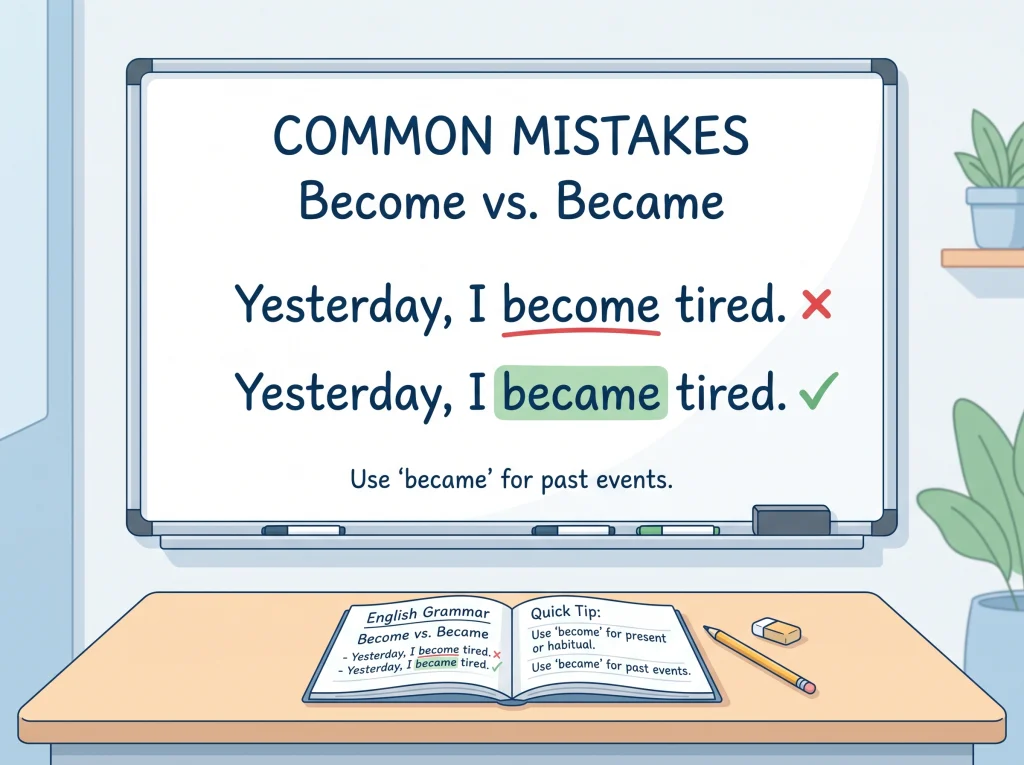
Mistake 2: Using Become for a Simple Past Event
Incorrect: He become a teacher last year.
Correct: He became a teacher last year.
The phrase last year identifies a completed past event, so became is appropriate.
Mistake 3: Using Became After “Will”
Incorrect: They will became parents next month.
Correct: They will become parents next month.
Modal verbs such as will require the base form of the main verb.
Mistake 4: Using Became After “Did”
Incorrect: When did you became interested in music?
Correct: When did you become interested in music?
After did, always use the base form of the main verb in standard English.
Mistake 5: Confusing Became With Becomes
Incorrect: She become upset whenever she feels ignored.
Correct: She becomes upset whenever she feels ignored.
Use becomes with singular third-person subjects such as he, she, and it in the simple present tense.
Become and Became in Everyday American English
Both words appear frequently in American conversations, workplace communication, education, and personal storytelling.
In everyday conversation, become often appears when people discuss goals, possibilities, or general changes.
Examples:
- I want to become a better public speaker.
- You can become more comfortable with practice.
- People become tired after a long workday.
- The traffic can become heavy during rush hour.
Became is more common when people describe past experiences, milestones, or changes.
Examples:
- She became my best friend in middle school.
- He became a supervisor after five years with the company.
- The neighborhood became more expensive over time.
- I became interested in American history during college.
Both forms are standard in American English. The choice depends on the grammatical structure and intended meaning, not on a difference between American and British spelling.
Tips for Remembering the Difference Between Become and Became
Use these simple reminders to choose the correct form.
- Remember the three forms: Become, became, become.
- Look for past-time context: If you are describing a completed change in the simple past, use became.
- Check the word before the verb: After to, will, can, or did, use become.
- Check for have, has, or had: Use become as the past participle in perfect constructions.
- Check the subject: In the simple present, use becomes with he, she, or it, but become with I, you, we, and they.
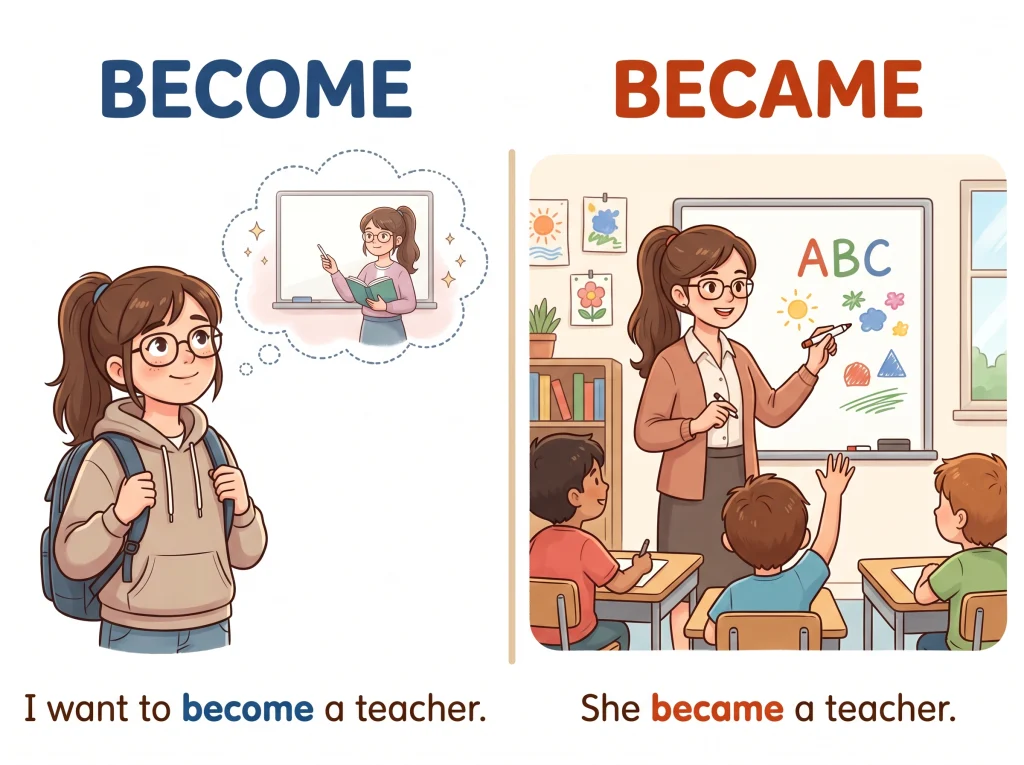
A helpful way to remember the rule is to compare three sentences about the same person:
- I want to become a doctor.
- I became a doctor in 2024.
- I have become a more confident doctor.
Once you recognize these patterns, choosing the right form becomes much easier.
Frequently Asked Questions:
Conclusion
The difference between become and became comes down to verb form and sentence structure. Become is the base form used in infinitives, after modal verbs, and in certain present-tense constructions. Became is the simple past form used to describe changes that happened in the past.