
Faring or Fairing? Meaning, Difference, and Examples
If you are unsure whether to write faring or fairing, the correct spelling depends on what you mean. The two words sound alike in many varieties of English, but they have different meanings and grammatical uses.
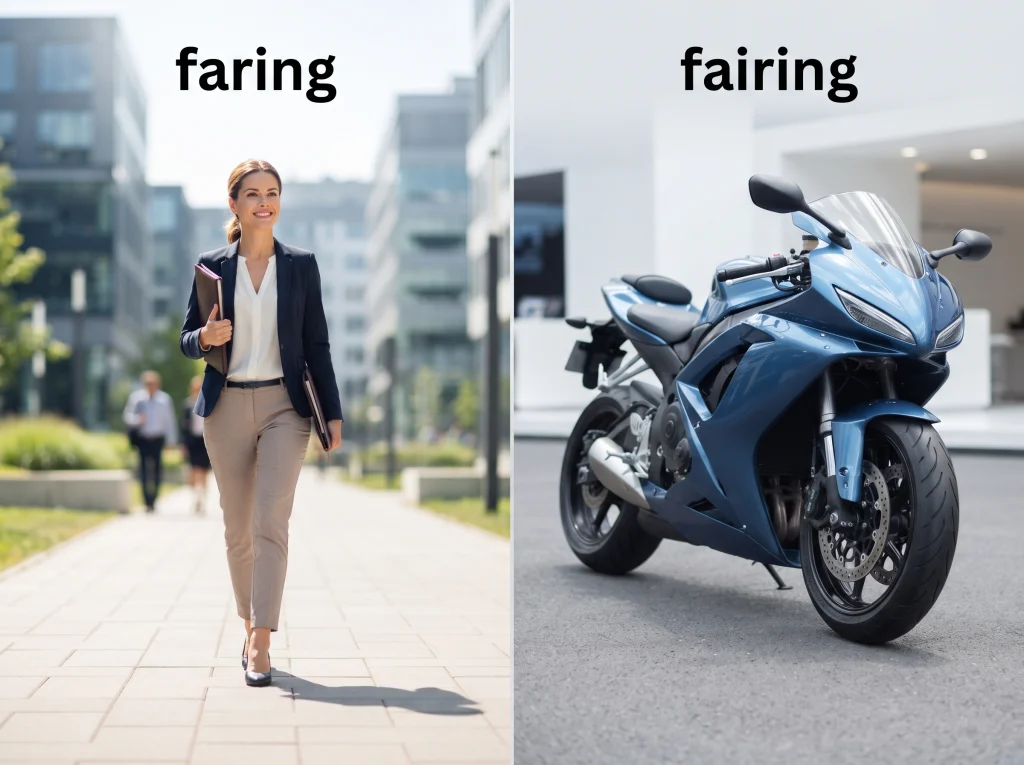
Use faring when you mean doing, progressing, coping, or managing in a particular situation. It comes from the verb fare. For example, “How are you faring in your new job?” means “How are you doing in your new job?”

Use fairing when you are talking about a physical structure or covering, especially one designed to create a smooth shape or reduce drag. It is common in discussions of motorcycles, aircraft, rockets, boats, bicycles, and engineering.
The easiest way to remember the difference is simple: faring describes how someone or something is doing, while fairing usually names a physical structure.
Faring Meaning in American English
Faring is the present participle of the verb fare. In American English, fare can mean to progress or be in a particular condition. Cambridge Dictionary gives examples such as “How did you fare on your finals?” and explains the verb as describing how someone or something progresses or is doing in a situation.
Because faring comes from fare, it is used when talking about progress, performance, circumstances, or how someone is managing.
For example:
- How are you faring in your new position?
- The students are faring well in their classes.
- How is your business faring this year?
- The team is faring better than expected.
- How are things faring after the move?
The word can describe people, groups, businesses, teams, projects, or other things whose progress can be discussed.
Faring and the Verb Fare
The connection between fare and faring is important:
fare → faring
The verb fare can mean to succeed, progress, or be treated in a particular way. Its forms include fared and faring.
Compare these sentences:
- How did you fare on the exam?
- How are you faring in your new class?
- The company fared well last year.
- The company is faring well this year.
In each example, the word relates to performance or progress.
Fairing Meaning in American English
Fairing usually refers to a structure or covering that creates a smoother exterior shape, often to reduce drag or improve airflow. It is especially common in transportation, aviation, aerospace, motorcycles, and engineering.
For example:
- The motorcycle has a damaged fairing.
- The aircraft’s fairing was inspected before the flight.
- The rocket’s payload fairing protects the payload during part of the launch.
- The bicycle has an aerodynamic fairing.
A fairing is generally something physical rather than a description of how a person is doing. Merriam-Webster’s definition, reproduced in reference material, describes a fairing as a member or structure whose main purpose is to produce a smooth outline and reduce drag.
Fairings are therefore associated with concepts such as aerodynamics, airflow, drag, vehicle design, and protective coverings.

Fairing in Transportation and Engineering
You may encounter fairing in several technical contexts.
A motorcycle fairing is an exterior panel or set of panels that can help streamline the motorcycle and manage airflow.
An aircraft fairing is a streamlined structure used as part of an aircraft’s design.
A payload fairing is a protective structure used around a rocket’s payload during launch. Cambridge’s examples include the term “payload fairing” in aerospace contexts.
The meaning remains connected to a physical structure rather than someone’s personal progress.
Faring vs. Fairing Comparison
| Word | Meaning | Part of Speech | Common Context | Example |
|---|---|---|---|---|
| Faring | Doing, progressing, or managing | Verb form | People, businesses, teams, situations | How are you faring? |
| Fairing | A streamlined or protective structure | Usually a noun | Motorcycles, aircraft, rockets, boats, engineering | The motorcycle needs a new fairing. |
The most useful distinction is:
Faring = how something is doing.
Fairing = a physical structure or covering.
Both spellings are legitimate English words. The mistake occurs when one is used in place of the other.

Faring or Fairing in Common American English Sentences
Seeing the words in realistic sentences makes the difference easier to remember.
Examples With Faring
- How are you faring in your new job?
- How are the students faring this semester?
- The company is faring better than expected.
- How is your project faring so far?
- The team is faring well this season.
- How are things faring at the new office?
- The small business is faring better after the changes.
- She is faring well in her new role.
- How are your parents faring after the move?
- The new product is faring well with customers.
In each sentence, faring refers to progress, performance, or circumstances.
Examples With Fairing
- The motorcycle’s fairing was damaged in the accident.
- The mechanic replaced the cracked fairing.
- Engineers redesigned the aircraft fairing.
- The rocket’s payload fairing protects the equipment during launch.
- The racing bicycle has an aerodynamic fairing.
- The technician inspected the aircraft’s fairing.
- The new motorcycle has a lightweight fairing.
- The boat’s design includes a streamlined fairing.
Here, fairing refers to a physical component or structure.
How Are You Faring or Fairing?
The correct sentence is:
How are you faring?
Not:
How are you fairing?
The reason is grammatical as well as semantic. The sentence asks how someone is doing, so it uses the verb fare in its present participle form, faring.
Cambridge defines fare in American English as a verb meaning to progress or be in a particular condition.
Therefore:
How are you faring? = How are you doing?
For example:
How are you faring in your new position?
The question asks about the person’s progress at work, so faring is correct.
By contrast, fairing does not normally describe a person’s condition or progress.

Common Mistakes With Faring and Fairing
Mistake 1: Writing “How Are You Fairing?”
Incorrect:
How are you fairing in your new job?
Correct:
How are you faring in your new job?
The sentence asks about someone’s progress, so the word comes from fare.
Mistake 2: Writing “The Motorcycle Needs a New Faring”
Incorrect:
The motorcycle needs a new faring.
Correct:
The motorcycle needs a new fairing.
Here, the word refers to a motorcycle component, so fairing is correct.
Mistake 3: Connecting Faring With Fair
It is easy to see fair inside fairing and assume that the words are related.
For the meaning of “doing” or “progressing,” however, the useful connection is:
fare → faring
Do not use fairing simply because you mean that something is going well or is “fair.”
Mistake 4: Choosing the Spelling by Sound
Pronunciation can make this pair confusing because faring and fairing can sound the same or very similar.
That means listening alone may not tell you which spelling belongs in a sentence.
Instead, look at the meaning.
Ask yourself:
Am I talking about progress, or am I naming a physical structure?
If you mean progress, use faring.
If you mean a physical aerodynamic structure, use fairing.
Mistake 5: Assuming Fairing Is Always Wrong
Fairing is not an incorrect word. It is completely legitimate when used in its appropriate sense.
For example:
The aircraft fairing was damaged.
That sentence is correct because it refers to a physical structure.
The problem only occurs when fairing is used where faring is required.

How to Remember the Difference
Use this simple memory trick:
Faring = doing.
Fairing = physical structure.
You can also connect faring with fare:
Fare → faring
If you can replace the word with doing, progressing, or managing, you probably need faring.
For example:
How are you faring?
Replace faring with doing:
How are you doing?
The meaning still works, so faring is correct.
Now consider:
The motorcycle’s fairing is damaged.
You cannot replace fairing with doing:
The motorcycle’s doing is damaged.
That makes no sense, so fairing is the appropriate word.
Faring vs. Fairing vs. Fare vs. Fair
These four words can be confusing because their spellings are similar.
| Word | Meaning | Example |
|---|---|---|
| fare | To progress or succeed; also the price paid for transportation | How did you fare on the test? |
| faring | Progressing, doing, or managing | How are you faring? |
| fair | Just, reasonable, or acceptable; also having certain meanings related to appearance or conditions | That seems like a fair decision. |
| fairing | A streamlined structure or covering | The aircraft’s fairing was replaced. |
The key connection is fare → faring, not fair → faring.
Is “Faring” More Formal Than “Doing”?
Faring can sound somewhat more formal than doing in everyday American conversation.
For example, “How are you doing?” is extremely natural in ordinary conversation. “How are you faring?” is also correct, but it can sound more formal or deliberate.
You might see faring more often in writing, reports, professional discussions, news writing, or questions about someone’s progress.
For example:
- How are you doing in your new job?
- How are you faring in your new job?
Both communicate the general idea of asking about someone’s progress, but the second uses the more formal-sounding verb fare.
Are Faring and Fairing Homophones?
They can be homophones, meaning words that sound alike but have different meanings and spellings.
That similarity in pronunciation is one reason the words are frequently confused in writing.
Because both are valid words, spellcheck may not always identify the problem. A sentence containing fairing can be spelled correctly at the word level while still using the wrong word for the intended meaning.
Context is therefore the best way to choose between them.
Final Difference Between Faring and Fairing
The difference between faring and fairing becomes simple once you connect each word to its meaning.
Use faring when you are talking about how someone or something is doing, progressing, coping, or managing. It comes from the verb fare.
Use fairing when you are talking about a streamlined or protective physical structure, especially in transportation, aviation, aerospace, or engineering.
Remember:
Faring = doing or progressing.
Fairing = a physical structure.
So, if you want to ask someone about their progress, write “How are you faring?” If you are talking about a motorcycle or aircraft compo