Python or Java? Differences, Uses, and Which Programming Language Should You Learn?
Choosing between Python and Java is an important decision for anyone starting a programming career. Both are powerful, widely used programming languages, but they have different strengths, learning requirements, and practical applications.
Python is generally the easier choice for beginners, especially those interested in artificial intelligence, data science, automation, and scripting. Java is a strong choice for developers interested in enterprise software, large backend systems, and Android development.

The right option depends on what you want to build, the type of programming work you enjoy, and your long-term career goals. Let’s compare Python and Java in terms of syntax, performance, applications, difficulty, and job opportunities.
What Are Python and Java?
Python and Java are general-purpose programming languages used to create software, applications, websites, and other digital products. Both support object-oriented programming, have extensive libraries, and run on multiple operating systems.
However, their approaches to writing and executing programs are different.
What Is Python?
Python is a high-level programming language known for its readable syntax and flexibility. Created by Guido van Rossum, it is widely used in web development, artificial intelligence, machine learning, data analysis, automation, and scientific computing.
Python uses dynamic typing, meaning developers generally do not need to declare variable types explicitly. Its straightforward syntax makes it easier for beginners to understand programming concepts without dealing with extensive code.
For example, a simple Python program looks like this:
name = "John"print("Hello, " + name)Output:
Hello, JohnPython is particularly useful for projects where developers want to write, test, and modify code quickly. Its extensive standard library and third-party packages also reduce the amount of code needed for many tasks. Python.org+1
What Is Java?
Java is a general-purpose, class-based, object-oriented programming language developed by James Gosling and his team at Sun Microsystems. It was released in 1995 and is now maintained through the Java ecosystem under Oracle and the broader OpenJDK community.
Java is known for its strong type system, portability, security features, and support for large applications. Developers use it for enterprise software, backend services, financial systems, Android applications, and other business solutions.
Unlike Python, Java requires developers to declare variable types. It also uses a compilation process that converts source code into bytecode, which runs on the Java Virtual Machine (JVM).
Here is a simple Java program:
public class Main {
    public static void main(String[] args) {
        String name = "John";
        System.out.println("Hello, " + name);
    }
}
Output:
Hello, JohnJava’s structured programming approach helps developers organize large projects and identify certain errors during compilation. Oracle Documentation+1
Python or Java: Key Differences
Python and Java can solve many of the same programming problems, but they differ in syntax, typing, execution, performance, and development practices.
The following table summarizes their main differences.
| Feature | Python | Java |
|---|---|---|
| Language type | High-level, general-purpose | High-level, general-purpose |
| Typing | Dynamically typed | Statically typed |
| Syntax | Simple and concise | More structured and explicit |
| Learning difficulty | Generally easier | Generally more challenging |
| Execution | Commonly uses an interpreter and bytecode | Compiles to JVM bytecode |
| Runtime | Python interpreter | Java Virtual Machine |
| Performance | Often slower for CPU-intensive pure-language code | Often faster for CPU-intensive workloads |
| Programming style | Multi-paradigm | Primarily object-oriented |
| Memory management | Automatic garbage collection | Automatic garbage collection |
| Popular applications | AI, data science, automation | Enterprise software, backend systems |
| File extension | .py | .java |
| Common frameworks | Django, Flask, FastAPI | Spring Boot, Jakarta EE |
| Beginner suitability | Excellent | Good with structured learning |
Both languages have mature development communities and extensive ecosystems. Your choice should depend on the type of applications you want to develop.
Python vs. Java Syntax and Ease of Learning
One of the biggest differences between Python and Java is how developers write code.
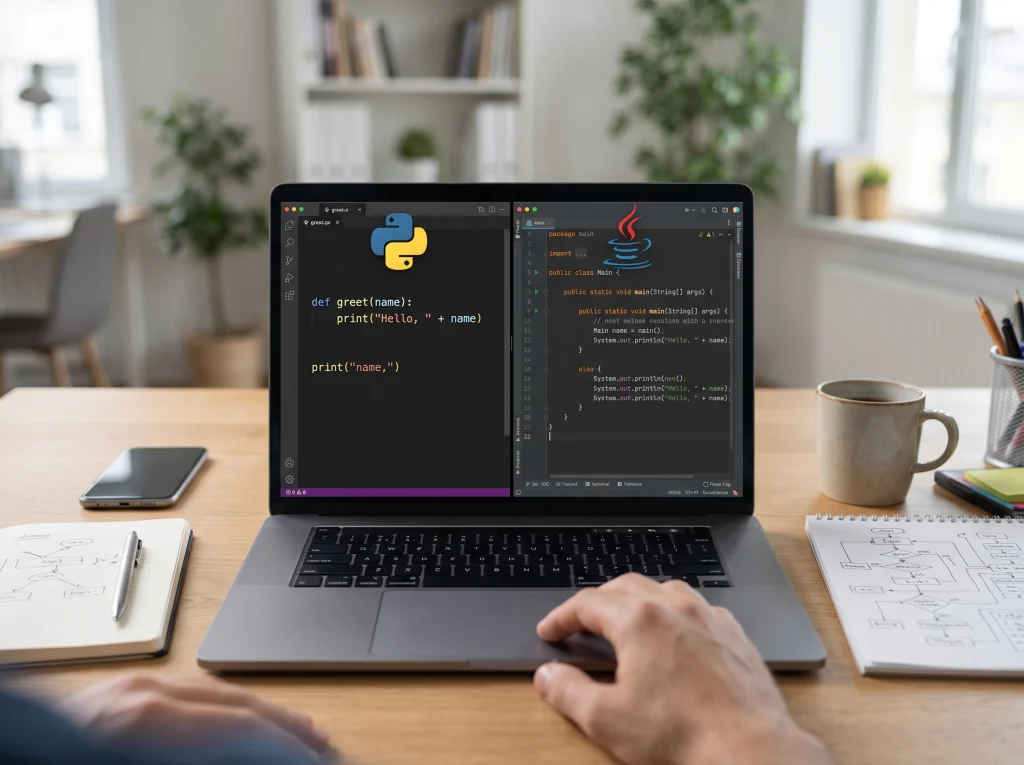
Python uses concise syntax and indentation to organize code blocks. Java uses curly braces, semicolons, and explicit type declarations. These differences can affect how quickly beginners understand their first programs.
Python Syntax
Python is designed to make code readable and relatively easy to write. Developers can perform many basic operations with only a few lines.
For example, a Python program that checks whether a number is positive looks like this:
number = 10if number > 0: print("Positive number")The code is short and does not require a class declaration for this simple example.
Java Syntax
Java generally requires more structure, even for small programs. A similar example looks like this:
public class Main {
    public static void main(String[] args) {
        int number = 10;

        if (number > 0) {
            System.out.println("Positive number");
        }
    }
}
Java requires developers to understand concepts such as classes, methods, data types, and program structure.
Which Is Easier to Learn?
Python is usually easier for beginners because its syntax is closer to everyday language. New programmers can focus on variables, conditions, loops, and problem-solving without immediately learning as much surrounding structure.
Java may take longer initially, but its explicit types and structured approach help learners understand object-oriented programming and software organization.
Winner for beginners: Python.
However, Java is also suitable for beginners who prefer a structured approach and want to build a strong foundation in object-oriented programming.
Performance and Speed Comparison
Java generally has an advantage over standard Python implementations in many CPU-intensive applications. However, actual performance depends on the program, libraries, hardware, and execution environment.
Java uses the JVM, which can apply just-in-time compilation and runtime optimizations. These techniques help Java applications achieve strong performance, particularly in long-running programs.
Python commonly runs through an interpreter implementation such as CPython. Its execution model can introduce additional overhead for CPU-intensive operations.
However, Python can still perform very well when using optimized libraries. Tools such as NumPy and other scientific computing packages rely on optimized native code for many demanding operations.
| Performance factor | Python | Java |
|---|---|---|
| CPU-intensive tasks | Often slower in pure Python | Often faster |
| Development speed | Usually faster to write | Often requires more code |
| Large applications | Suitable with good architecture | Strong enterprise ecosystem |
| Data processing | Excellent library support | Strong capabilities |
| Runtime optimization | Depends on implementation and tools | JVM offers JIT optimization |
Java is often a better choice when raw execution speed and predictable performance are important. Python is attractive when development speed, data processing libraries, and flexibility matter more.
Neither language is automatically faster for every application.

Common Uses of Python and Java
Both languages are used in professional software development, but their ecosystems make them particularly attractive for different projects.
Where Is Python Used?
Python is especially popular in fields involving data, automation, and artificial intelligence.
Common applications include:
- Artificial intelligence: Building AI applications and working with machine learning models.
- Data science: Analyzing datasets, creating visualizations, and identifying patterns.
- Web development: Building websites and backend services using Django, Flask, and FastAPI.
- Automation: Automating repetitive office tasks, file management, and data collection.
- Scientific computing: Supporting research, mathematics, and engineering projects.
- Testing: Writing automated tests and development tools.
Python’s readable syntax and extensive package ecosystem make it useful for both small scripts and sophisticated applications.
Where Is Java Used?
Ingenieria Informatica Online | Estudia 100% A Distancia | UTAMED
Java is widely used in business software and systems that require structured development and long-term maintenance.
Common applications include:
- Enterprise software: Developing large business applications for organizations.
- Backend development: Building server-side applications and APIs with Spring Boot.
- Android development: Developing Android applications alongside Kotlin and other supported technologies.
- Financial systems: Supporting banking, payment processing, and business operations.
- Cloud applications: Creating distributed services and backend systems.
- Big data: Working with technologies such as Apache Hadoop and related data-processing tools.
Java’s mature ecosystem makes it particularly useful for organizations that maintain complex software systems over many years.

Python or Java for Beginners?
If you have never written a program before, Python is generally the better starting point.
Its simple syntax allows beginners to understand programming concepts through practical examples. You can quickly create small projects such as calculators, number-guessing games, file organizers, and basic automation scripts.
Java is also a good learning option, especially if your goal is to understand classes, objects, data types, and structured application development.
Consider these recommendations:
| Your learning goal | Recommended language |
|---|---|
| First programming language | Python |
| Basic programming concepts | Python |
| Artificial intelligence | Python |
| Machine learning | Python |
| Object-oriented programming | Java |
| Enterprise software | Java |
| Android development | Java or Kotlin |
| Data analysis | Python |
| Backend development | Either |
| Automation | Python |
If you are completely new to coding, start with Python and build a few small projects before moving to advanced topics.
Python or Java for Jobs and Career Opportunities?
Both Python and Java offer professional career opportunities in the United States. However, the types of jobs available can differ depending on the industry, employer, and technical requirements.
Python Career Opportunities
Python is useful for people interested in modern data-focused and automation-related careers.
Common job titles include:
- Python Developer
- Data Analyst
- Data Scientist
- Machine Learning Engineer
- AI Engineer
- Automation Engineer
- Backend Developer
Python is particularly relevant to organizations working with artificial intelligence, analytics, scientific research, and software automation.
Java Career Opportunities
Java is a strong option for developers interested in enterprise and backend software development.
Common job titles include:
- Java Developer
- Backend Developer
- Software Engineer
- Enterprise Application Developer
- Android Developer
- Java Full-Stack Developer
- Application Architect
Large companies, financial institutions, technology businesses, and organizations with established software systems continue to use Java.
Which Language Offers Better Career Opportunities?
Neither language guarantees a job or a higher salary. Career opportunities depend on experience, technical skills, location, industry, and the ability to build useful applications.
Python may be more suitable if you want to work in AI, machine learning, or data science. Java may be a better fit if you want to specialize in enterprise development or backend engineering.
For U.S. job seekers, it is also useful to learn related technologies, databases, Git, APIs, testing, and cloud platforms.
Advantages and Disadvantages of Python and Java
Both programming languages have strengths and limitations. Understanding them can help you select the right language for your goals.
Advantages of Python
- Easy to read: Its straightforward syntax makes learning and maintaining code easier.
- Versatile: It supports web development, automation, AI, and data science.
- Large community: Beginners can find tutorials, documentation, and programming support.
- Extensive libraries: Packages reduce the need to write everything from scratch.
- Rapid development: Developers can build and test applications quickly.
Disadvantages of Python
- It can be slower than Java for CPU-intensive operations.
- Dynamic typing can allow certain errors to appear during runtime.
- Some applications require additional optimization for performance.
- Python applications can consume significant memory depending on their design.
Advantages of Java
- Strong type checking: Many programming errors can be identified during compilation.
- Portability: Java applications can run on different platforms with compatible JVM implementations.
- Performance: JVM optimization makes Java suitable for many demanding applications.
- Scalability: Its ecosystem supports large and complex software systems.
- Mature ecosystem: Developers have access to extensive libraries, frameworks, and development tools.
Disadvantages of Java
- Its syntax can be more complicated for beginners.
- Simple programs often require more code than Python.
- JVM applications may require additional memory and runtime resources.
- Understanding classes, objects, and Java development tools takes time.
Can You Learn Python and Java Together?
Yes, you can learn both Python and Java, but beginners usually benefit from studying one language first.
Learning two languages simultaneously may create confusion because they use different syntax, type systems, and development approaches.
A practical learning sequence is:
- Start with Python fundamentals, including variables, data types, loops, conditions, and functions.
- Build small projects such as calculators, games, and automation scripts.
- Learn object-oriented programming, including classes, objects, inheritance, and encapsulation.
- Start Java and compare its syntax with the Python concepts you already understand.
- Build a project using Java to practice structured application development.
Once you understand programming fundamentals, learning another language becomes easier because many concepts are shared.
Which Should You Choose: Python or Java?
The best programming language depends on what you want to accomplish.
Choose Python if you want to:
- Start programming with relatively simple syntax.
- Develop artificial intelligence and machine learning applications.
- Work with data analysis and visualization.
- Automate repetitive tasks.
- Build web applications using Python frameworks.
- Create scripts and prototypes quickly.
Choose Java if you want to:
- Develop large enterprise applications.
- Build backend services using Spring Boot.
- Work with established business software systems.
- Develop Android applications using Java.
- Learn structured object-oriented programming.
- Work on applications that benefit from JVM performance and tooling.
Our recommendation: If you are a complete beginner without a specific career direction, start with Python. It provides an accessible introduction to programming and opens opportunities in several technical fields.
If your primary interest is enterprise software or Java backend development, starting directly with Java is a sensible choice.
You do not need to become an expert in both languages immediately. Focus on one, build real projects, and gradually expand your skills.
Frequently Asked Questions:
Conclusion
Python and Java are both valuable programming languages, but they serve different needs in software development. Python stands out for its readable syntax, flexibility, artificial intelligence tools, and data science applications. Java is a strong choice for enterprise software, backend development, and structured applications.