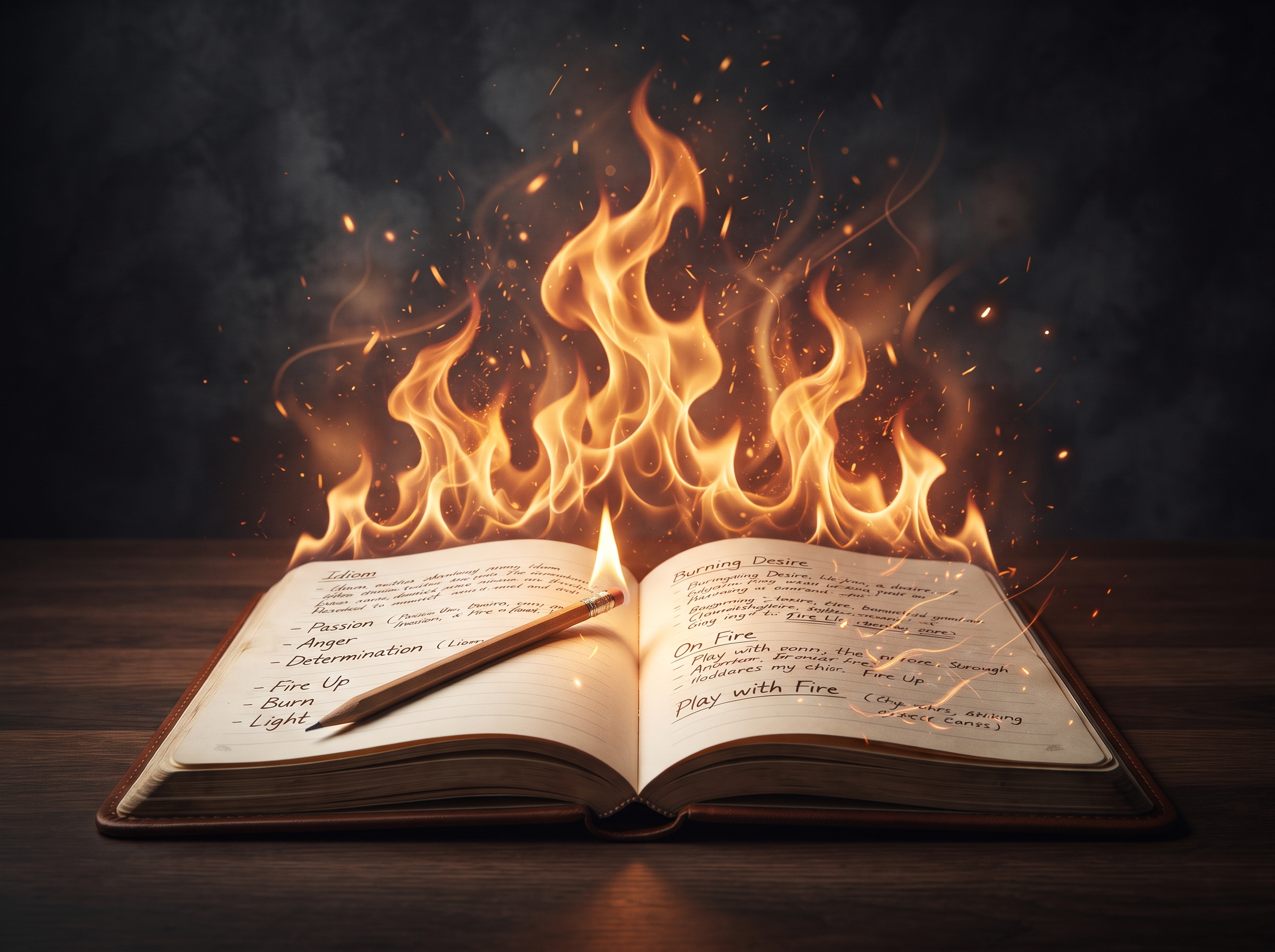
Fire Related Idioms: 50 Common Expressions With Meanings and Examples
Fire can represent warmth, danger, anger, passion, and determination. These different qualities have influenced everyday English, creating expressions that describe everything from heated arguments to outstanding performance. In American English, fire related idioms appear in conversations, movies, books, workplace discussions, and sports commentary.
Learning these expressions helps English learners understand figurative language and communicate ideas more naturally. Some expressions describe taking risks, while others explain how problems grow, how people react under pressure, or how enthusiasm motivates someone to act. The meaning usually depends on the situation rather than the literal image of flames.
Cambridge Dictionary blog
+2
This guide covers 50 useful fire related idioms and expressions, with straightforward definitions and original example sentences to show how they work in context.
What Are Fire Related Idioms?
Fire related idioms are expressions that use the idea of fire, flames, heat, burning, or related actions to communicate a figurative meaning. Instead of describing an actual fire, they often express emotions, risks, conflict, effort, success, or personal experiences.

For example, “playing with fire” means taking a dangerous risk. “On fire” can describe someone performing exceptionally well, and “add fuel to the fire” means making an existing problem worse. These expressions make everyday communication more vivid and concise.
Cambridge Dictionary blog
+1
Not every phrase containing the word fire is an idiom. Some are literal expressions, such as start a fire when talking about a campfire. The examples below focus on figurative meanings, established sayings, and common conversational expressions.
College Idioms: https://learnidioms.com/college-idioms/
Common Fire Related Idioms With Meanings and Examples
Idioms About Anger, Conflict, and Arguments
These expressions help describe disagreements, criticism, and situations in which emotions become intense.
1. Add fuel to the fire
Meaning: To make an already difficult or tense situation worse.
Example: Bringing up the old argument only added fuel to the fire.
2. Fan the flames
Meaning: To encourage or intensify an existing conflict, emotion, or problem.
Example: The manager’s sarcastic response fanned the flames of the disagreement.
3. Come under fire
Meaning: To receive strong criticism or face an attack.
Example: The company came under fire after customers complained about its service.
4. Fight fire with fire
Meaning: To respond to someone’s tactics by using similar tactics.
Example: Instead of ignoring the competitor’s aggressive advertising, the business decided to fight fire with fire.
5. Fire back
Meaning: To respond quickly and forcefully to criticism, an accusation, or an attack.
Example: When the reporter questioned his decision, the coach fired back with a sharp response.
6. A heated argument
Meaning: An argument involving strong emotions, anger, or intense disagreement.
Example: The neighbors had a heated argument about the noise coming from the apartment.
7. A war of words
Meaning: An ongoing exchange of angry, critical, or hostile statements.
Example: The two business owners began a war of words on social media.
8. Get someone’s blood boiling
Meaning: To make someone extremely angry.
Example: Being blamed for a mistake he did not make really got his blood boiling.
9. Have a short fuse
Meaning: To become angry very quickly.
Example: My uncle has a short fuse, so we try to discuss sensitive subjects calmly.
10. Blow your top
Meaning: To suddenly become extremely angry.
Example: Dad blew his top when he discovered that someone had scratched his new car.
Idioms About Problems, Danger, and Urgency
Fire can symbolize danger and situations that need immediate attention. These expressions are useful when describing risks, escalating problems, or difficult circumstances.

11. Play with fire
Meaning: To take a serious or unnecessary risk.
Example: You’re playing with fire by ignoring repeated warnings from your supervisor.
12. Out of the frying pan and into the fire
Meaning: To escape one difficult situation only to enter an even worse one.
Example: She left her stressful job for another position, but the new workplace was even more demanding. She had jumped out of the frying pan and into the fire.
13. Go through fire and water
Meaning: To endure serious difficulties or face great danger for someone or something.
Example: Her closest friends would go through fire and water to help her.
14. Put out fires
Meaning: To deal with urgent problems as they arise, often instead of working on planned tasks.
Example: I spent the entire morning putting out fires instead of finishing my report.
15. Be in the firing line
Meaning: To be in a position where you are likely to face criticism, blame, or attack.
Example: The department director was in the firing line after the project missed its deadline.
16. Hold someone’s feet to the fire
Meaning: To pressure someone to accept responsibility or meet an obligation.
Example: The board held the contractor’s feet to the fire over the unfinished repairs.
17. Have bigger fish to fry
Meaning: To have more important matters to deal with.
Example: I can’t spend all afternoon arguing about office decorations. I have bigger fish to fry.
18. A baptism of fire
Meaning: A difficult or challenging first experience in a job, activity, or new situation.
Example: Her first shift at the busy restaurant was a baptism of fire.
19. Trial by fire
Meaning: A challenging experience that tests someone’s abilities, knowledge, or character.
Example: Leading the project without much support was a trial by fire for the new supervisor.
20. Go up in flames
Meaning: To fail completely or be destroyed, literally or figuratively.
Example: Their plans for a weekend getaway went up in flames when the flight was canceled.
Archery Idioms: https://learnidioms.com/archery-idioms/
Idioms About Passion, Energy, and Enthusiasm
These expressions use fire as a symbol of motivation, strong feelings, excitement, and ambition.
21. Fire in your belly
Meaning: A strong desire, determination, or ambition to succeed.
Example: The young athlete has fire in her belly and trains consistently for every competition.
22. Be fired up
Meaning: To feel excited, enthusiastic, or strongly motivated.
Example: The players were fired up before the championship game.
23. Light a fire under someone
Meaning: To motivate or pressure someone to take action quickly.
Example: The approaching deadline lit a fire under the entire team.
24. Catch fire
Meaning: To become popular, successful, or widely adopted very quickly.
Example: The small clothing brand caught fire after a celebrity wore one of its jackets.
25. Set the world on fire
Meaning: To achieve remarkable success or attract widespread attention.
Example: His first business did not set the world on fire, but it gave him valuable experience.
26. On fire
Meaning: Performing exceptionally well or showing outstanding ability.
Example: Maya was on fire during the spelling competition and answered every question correctly.
27. Fire on all cylinders
Meaning: To operate or perform with maximum energy, efficiency, or effectiveness.
Example: After a good night’s sleep, I felt ready to fire on all cylinders at work.
28. Burn with desire
Meaning: To feel an extremely strong desire or longing for something.
Example: He burned with desire to prove that he could complete the challenging course.
29. Have a spark
Meaning: To show a lively quality, enthusiasm, or a special appeal.
Example: The new singer has a spark that makes her performances memorable.
30. Ignite someone’s passion
Meaning: To awaken or inspire a strong interest or enthusiasm in someone.
Example: Her science teacher ignited her passion for astronomy.
Idioms Green: https://learnidioms.com/idioms-green/
Idioms About Success, Pressure, and Difficult Situations
These expressions are useful for describing hard work, commitment, setbacks, and the pressure of meeting expectations.

31. Burn the midnight oil
Meaning: To work or study late into the night.
Example: I burned the midnight oil to prepare for my final exams.
32. Burn the candle at both ends
Meaning: To exhaust yourself by staying up late and getting up early, or by doing too much without enough rest.
Example: She’s been burning the candle at both ends while balancing her job and college classes.
33. Burn yourself out
Meaning: To become physically or mentally exhausted from prolonged effort or stress.
Example: If you keep working seven days a week, you may burn yourself out.
34. Burn the boats
Meaning: To commit yourself to a course of action by removing the option of turning back.
Example: He quit his old job and moved across the country to launch his business, effectively burning the boats.
35. Burn your bridges
Meaning: To damage relationships or remove the possibility of returning to a previous situation.
Example: She left the company professionally because she did not want to burn her bridges.
36. Get your fingers burned
Meaning: To suffer an unpleasant consequence from a risky decision or experience.
Example: He got his fingers burned after investing in a business without checking its finances.
37. Have too many irons in the fire
Meaning: To be involved in too many activities, projects, or responsibilities at once.
Example: I’m trying to finish three courses and start a new job, so I may have too many irons in the fire.
38. Strike while the iron is hot
Meaning: To take advantage of an opportunity while the conditions are favorable.
Example: The bakery’s video was attracting attention online, so the owners struck while the iron was hot and introduced a new product.
39. Keep the home fires burning
Meaning: To maintain the household, family responsibilities, or familiar routines while someone is away or occupied elsewhere.
Example: While her husband traveled for work, she kept the home fires burning.
40. Hold fire
Meaning: To wait before acting, speaking, or making a decision.
Example: Let’s hold fire until we receive the final figures from the accounting department.
Idioms About Reactions, Relationships, and Everyday Life
These expressions appear in casual conversations and help describe attraction, rumors, quick responses, and everyday experiences.
41. Like a moth to a flame
Meaning: To be strongly attracted to someone or something, even when the attraction may lead to trouble.
Example: He kept returning to the risky investment like a moth to a flame.
42. An old flame
Meaning: A former romantic partner or someone with whom a person once had a romantic relationship.
Example: She ran into an old flame at her college reunion.
43. Get on like a house on fire
Meaning: To become friendly with someone very quickly and enjoy each other’s company.
Example: The new coworkers got on like a house on fire from their first day together.

44. Spread like wildfire
Meaning: To spread very quickly, especially information, news, or rumors.
Example: News of the surprise concert spread like wildfire across the campus.
45. Where there’s smoke, there’s fire
Meaning: The belief that signs of a problem or suspicious activity may indicate that something is wrong.
Example: Some employees suspected that the project was in trouble, saying, “Where there’s smoke, there’s fire.”
This saying expresses a suspicion, not proof. Rumors and allegations still need to be checked before being treated as facts.
Cambridge Dictionary blog
+1
46. Money burning a hole in your pocket
Meaning: To feel eager to spend money as soon as you have it.
Example: That birthday money is burning a hole in his pocket, and he already wants to buy a new game.
47. Fire away
Meaning: An informal way to invite someone to begin asking questions or speaking.
Example: “I have a few questions about the assignment.” “Sure, fire away.”
48. Draw someone’s fire
Meaning: To attract criticism or attack that might otherwise be directed at someone else.
Example: The spokesperson answered the difficult questions to draw the fire away from the junior staff.
49. Go down in flames
Meaning: To fail in a very noticeable or dramatic way.
Example: His attempt to fix the computer without reading the instructions went down in flames.
50. Not set the world on fire
Meaning: To be ordinary or unimpressive rather than remarkably successful or exciting.
Example: The restaurant’s new menu didn’t set the world on fire, but regular customers still enjoyed it.
How to Use Fire Related Idioms Naturally in American English
Understanding an idiom’s definition is only the first step. To use it naturally, pay attention to the situation, the tone, and the people involved.
1. Match the expression to the situation
Some fire idioms describe danger, while others communicate enthusiasm or success. Using the wrong expression can change the meaning of your sentence.
| Situation | Natural expression |
|---|---|
| Someone takes a serious risk | Playing with fire |
| An argument becomes worse | Adding fuel to the fire |
| Someone performs exceptionally well | On fire |
| Someone works late at night | Burning the midnight oil |
| Someone faces strong criticism | Coming under fire |
| A rumor spreads quickly | Spreading like wildfire |
2. Learn idioms in complete sentences
Memorizing an expression alongside a realistic example makes it easier to remember how it works.
- Natural: “You’re playing with fire by ignoring those warnings.”
- Natural: “The team’s performance was incredible. They were on fire tonight.”
- Natural: “I need to hold fire until I have all the information.”
Try creating your own examples about school, work, friendships, sports, and everyday responsibilities.
3. Pay attention to tone and formality
Many fire idioms are informal and work well in casual conversations. Expressions such as fire away, blow your top, and on fire are common in conversational English.
In formal reports or professional emails, a direct explanation may be clearer. For example, instead of writing “The department is putting out fires,” you could write “The department is addressing urgent operational problems.”
4. Notice the difference between similar expressions
Some idioms have related meanings but are not interchangeable.
- Add fuel to the fire: Make a bad situation worse.
- Fan the flames: Intensify an existing conflict, feeling, or problem.
- Play with fire: Take a risk that could cause trouble.
- Hold fire: Delay taking action.
Learning these distinctions helps you choose the expression that communicates your intended meaning.

Common Mistakes to Avoid When Using Fire Idioms
English learners sometimes understand an idiom’s individual words but miss its figurative meaning. These are a few common mistakes to watch for.
Confusing literal and figurative meanings
“Catch fire” can describe something actually beginning to burn, but it can also mean becoming popular or successful.
- Literal: “The dry leaves caught fire.”
- Figurative: “The new dance trend caught fire online.”
Use the surrounding sentence to determine which meaning is intended.
Using a negative idiom in a positive situation
“Add fuel to the fire” generally describes making a difficult situation worse. It is not a suitable way to describe helping someone become more motivated.
For a positive situation, use an expression such as “fire someone up” or “ignite someone’s passion.”
Mixing up similar expressions
“Burn your bridges” and “burn the boats” both suggest commitment, but their emphasis differs. Burning your bridges often involves damaging relationships or eliminating a way back. Burning the boats emphasizes committing yourself to a course of action without an easy retreat.
Assuming every idiom is appropriate in formal writing
Expressions such as “blow your top” and “have bigger fish to fry” are conversational. In a formal business document, direct wording may communicate your point more clearly.
Treating a saying as proof
“Where there’s smoke, there’s fire” expresses a belief that warning signs may point to a real problem. It does not establish that a rumor or accusation is true. Use evidence and reliable information when discussing serious claims.
Why Learning Fire Related Idioms Helps English Learners
Fire related idioms help learners understand how English speakers communicate emotions, urgency, motivation, and conflict without always stating everything literally. Recognizing these expressions can make conversations, entertainment, and written material easier to follow.
They also provide useful alternatives to basic vocabulary. Instead of saying that someone is very angry, you might say that the person “blew their top.” Instead of explaining that a rumor spread quickly, you can say that it “spread like wildfire.”
For learners of American English, the goal is not to insert an idiom into every conversation. It is to recognize familiar expressions, understand their tone, and use them when they fit the situation.
Idioms in Russian: https://learnidioms.com/idioms-in-russian/
FAQS
Conclusion
Fire related idioms add color and emotion to everyday English. Expressions such as “playing with fire,” “adding fuel to the fire,” “on fire,” and “burning the midnight oil” can describe risks, conflicts, achievements, and hard work in a memorable way.
Start by learning a few expressions that match situations you encounter regularly. Practice them in complete sentences, notice how native speakers use them, and pay attention to whether the context is casual, professional, positive, or negative. With regular practice, these idioms can become a natural part of your English vocabulary.






2 Comments