
Shop Idioms: 35 Common Expressions With Meanings and Examples
Shopping is part of everyday life, whether you are buying groceries, comparing prices online, looking for clothes, or visiting a local store. English speakers often use colorful expressions to describe these activities, their spending habits, and the experiences they have while buying or selling things. Many of these expressions have meanings that go beyond the individual words.
Learning shop idioms can help you understand conversations, movies, advertisements, and everyday discussions about money and business. You might hear someone say they are going on a shopping spree, looking for a bargain, or paying through the nose for a new phone. These phrases communicate ideas quickly and naturally.
In American English, shop-related expressions are also used outside stores. People talk shop at work, set up shop when starting a business, and describe an expensive purchase as something that could break the bank. Understanding these expressions makes it easier to follow both casual conversations and professional discussions.
This guide explains 35 useful shop idioms and related expressions, with straightforward meanings and example sentences to show how people use them in context.
What Are Shop Idioms?
Shop idioms are figurative expressions and familiar phrases connected with shopping, stores, spending, saving, business, and buying or selling goods. Some refer directly to shopping, while others use the idea of a shop to describe work, behavior, or everyday situations.
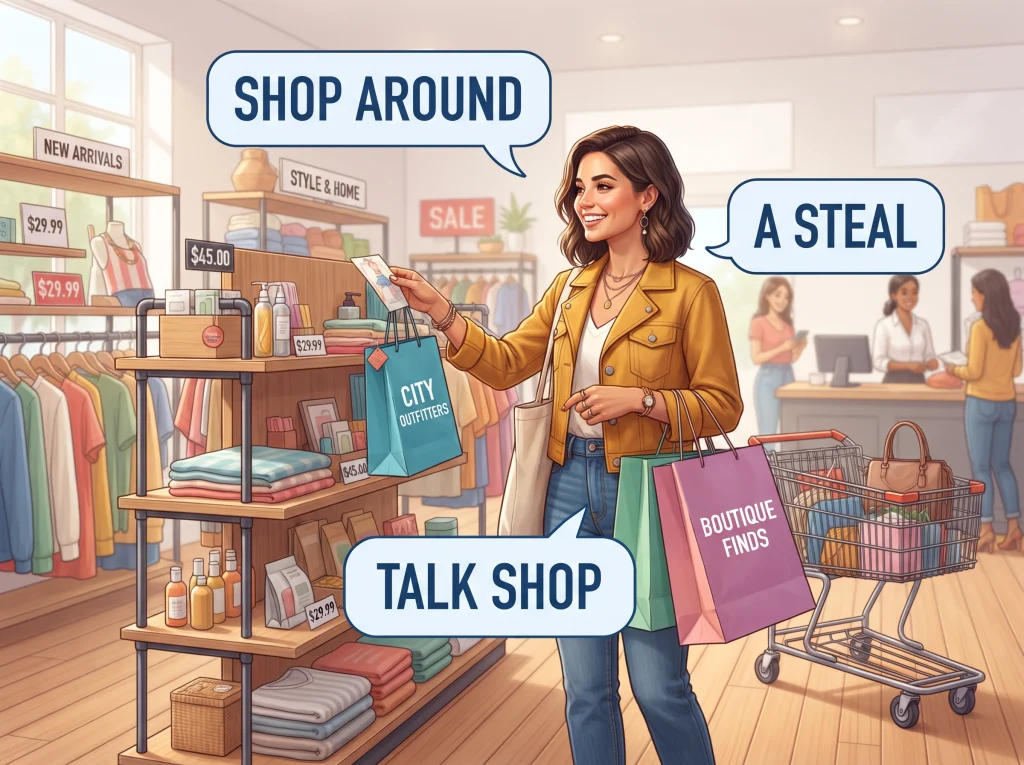
For example, “talk shop” means discussing work-related subjects, not having a conversation inside a store. Similarly, “cost an arm and a leg” means something is extremely expensive, not that someone has literally lost a body part.
Some expressions in this guide are traditional idioms, while others are common idiomatic phrases or shopping-related expressions. Learning them together helps English learners recognize the language people actually use in the United States.
Storytelling Idioms: https://learnidioms.com/storytelling-idioms/
35 Common Shop Idioms With Meanings and Examples
Shop Idioms About Shopping and Spending Money
These expressions describe browsing, buying things, spending money, and deciding what to purchase.
1. Shop Till You Drop
Meaning: To shop for such a long time that you become extremely tired.
Example: We spent all Saturday at the mall and shopped till we dropped.
How to use it: This expression is often used humorously when talking about a long shopping trip.
2. Window Shopping
Meaning: Looking at products in stores without intending to buy them.
Example: We were just window shopping downtown when we saw the new clothing collection.
How to use it: Use this phrase when browsing is the main activity rather than making purchases.
3. Go on a Shopping Spree
Meaning: To buy many things during a short period, often enthusiastically or impulsively.
Example: After receiving her bonus, Mia went on a shopping spree and bought several new outfits.
How to use it: The expression can describe planned shopping or a burst of enthusiastic spending.
4. Shop Around
Meaning: To compare prices, quality, or available options before buying something.
Example: I always shop around before purchasing a new laptop.
How to use it: This is especially useful when discussing expensive purchases, insurance, electronics, or services.
5. Retail Therapy
Meaning: Shopping in an attempt to improve your mood or feel better.
Example: After a stressful week, she went shopping for a little retail therapy.
How to use it: This is an informal expression. It often describes shopping for emotional comfort, sometimes humorously.
6. Be in the Market for Something
Meaning: To be interested in buying something.
Example: We’re in the market for a larger house now that our family is growing.
How to use it: This phrase is common in American conversations about cars, homes, electronics, and other major purchases.
7. Hit the Shops
Meaning: To go shopping.
Example: We decided to hit the shops before meeting our friends for lunch.
How to use it: This expression is widely understood, although American speakers often say “hit the stores” or simply “go shopping.”
8. Shop Like There’s No Tomorrow
Meaning: To spend money shopping very freely, as if there will be no opportunity to shop later.
Example: During the holiday sales, my cousins shopped like there was no tomorrow.
How to use it: This phrase usually suggests excessive or enthusiastic spending.
9. Buy in Bulk
Meaning: To purchase a large quantity of something at one time, often to reduce the cost per item.
Example: We buy paper towels in bulk because we use them every day.
How to use it: This phrase is common when discussing warehouse stores, household supplies, and business purchasing.
10. Pick Up a Bargain
Meaning: To buy something at a particularly good price.
Example: I picked up a bargain at the outlet mall and saved $40 on a jacket.
How to use it: American speakers also commonly say “get a bargain” or “find a great deal.”
Shop Idioms About Bargains, Prices, and Value
These expressions help describe expensive purchases, low prices, good value, and financial decisions.
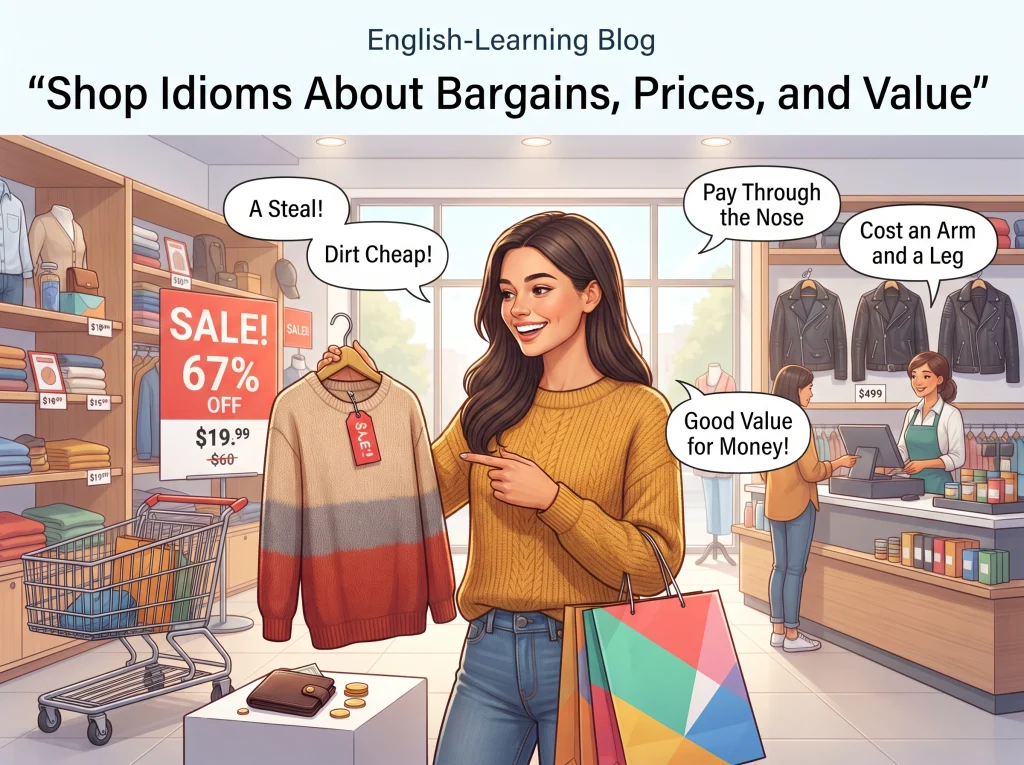
11. Cost an Arm and a Leg
Meaning: To be extremely expensive.
Example: That designer handbag costs an arm and a leg, so I’m waiting for a sale.
How to use it: Use this informal idiom to emphasize that something costs much more than expected.
12. Pay Through the Nose
Meaning: To pay an excessively high price for something.
Example: We paid through the nose for last-minute concert tickets.
How to use it: This expression often suggests that the price was unfairly high or unpleasantly expensive.
13. Break the Bank
Meaning: To cost so much that it uses up too much money or exceeds someone’s budget.
Example: I’d love to take a weekend trip, but I don’t want it to break the bank.
How to use it: This phrase is often used when discussing whether something is affordable.
14. A Steal
Meaning: Something bought at a surprisingly low price or for excellent value.
Example: This winter coat was a steal at just $25.
How to use it: In this expression, “steal” means a bargain, not an act of theft.
15. Dirt Cheap
Meaning: Extremely inexpensive.
Example: We found some dirt-cheap decorations at the clearance sale.
How to use it: This is an informal expression used to emphasize a very low price.
16. For a Song
Meaning: At a very low price.
Example: My uncle bought an antique table for a song at a neighborhood yard sale.
How to use it: This expression is often used when someone gets something valuable for much less than expected.
17. Rip-Off
Meaning: Something that costs far more than it is worth or seems unfairly overpriced.
Example: The souvenir shop charged $30 for a basic T-shirt. What a rip-off!
How to use it: This informal expression communicates dissatisfaction with a price or deal.
18. Good Value for Money
Meaning: Worth the amount of money spent because of its quality, usefulness, or benefits.
Example: This sturdy backpack is good value for money because it should last for years.
How to use it: This phrase is useful when comparing products and explaining why a purchase is worthwhile.
19. Penny-Pincher
Meaning: A person who is very careful about spending money, sometimes excessively so.
Example: My brother is such a penny-pincher that he compares the price of every item before buying it.
How to use it: Depending on the context, the phrase can be playful or critical.
20. Tighten Your Belt
Meaning: To reduce spending and live more carefully because money is limited.
Example: We need to tighten our belts this month after paying for the car repairs.
How to use it: This expression is common when talking about household budgets or financial difficulties.
Shop Idioms About Business, Stores, and Deals
These expressions are useful for conversations about jobs, companies, customers, and business operations.
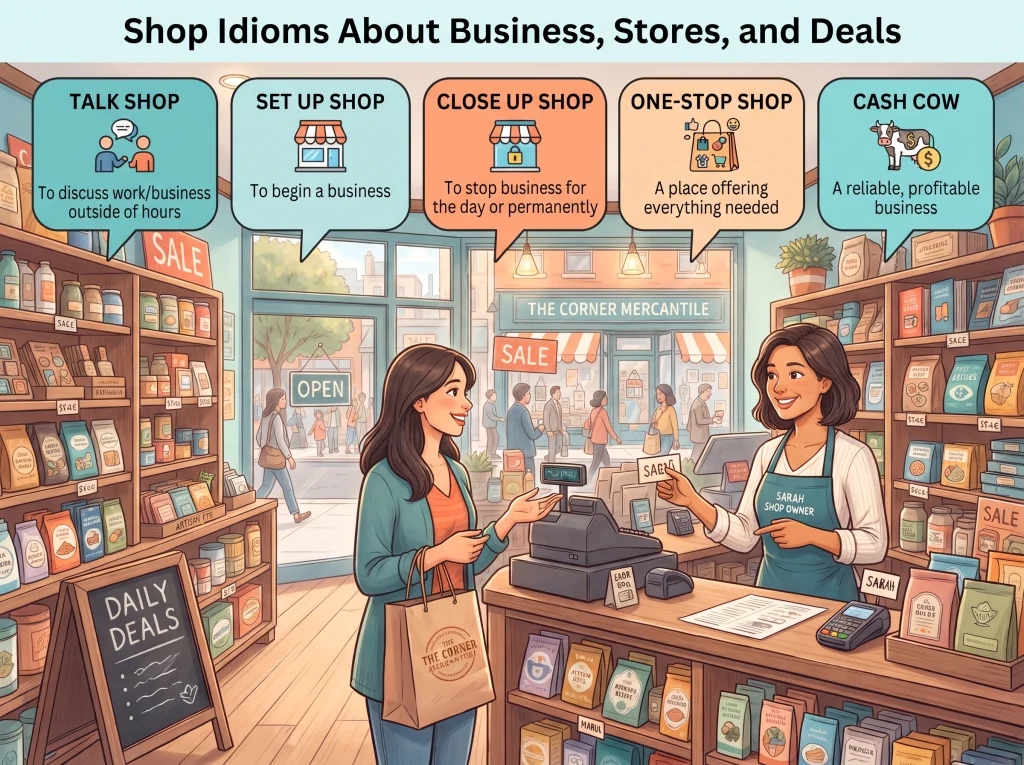
21. Talk Shop
Meaning: To discuss work, professional interests, or business matters.
Example: Even at the family barbecue, my parents kept talking shop about their new project.
How to use it: This phrase is often used when people discuss their jobs outside the workplace.
22. Set Up Shop
Meaning: To establish a business or begin operating in a particular place.
Example: A new coffee shop set up shop across the street from the library.
How to use it: The expression can refer to opening a physical business or beginning operations in a new location.
23. Close Up Shop
Meaning: To stop operating a business, either temporarily at the end of the day or permanently, depending on the context.
Example: The store closes up shop at 9 p.m. every evening.
How to use it: When the context indicates a permanent closure, the phrase means the business is shutting down. It can also be used figuratively for ending an activity.
24. Mind the Store
Meaning: To take responsibility for a business or situation while someone else is away.
Example: Can you mind the store while I run out to pick up lunch?
How to use it: This expression is especially natural in American English when asking someone to supervise a shop or take charge temporarily.
25. Mom-and-Pop Shop
Meaning: A small, independently owned business, often operated by a family or couple.
Example: We prefer buying our bread from the mom-and-pop shop on the corner.
How to use it: This distinctly familiar American expression often highlights a small local business in contrast with a large chain.
26. One-Stop Shop
Meaning: A place or service where people can find many of the things they need in one location.
Example: This home improvement store is a one-stop shop for paint, tools, and gardening supplies.
How to use it: The expression is also used for websites, agencies, and businesses that provide several related services.
27. Cash Cow
Meaning: A product, business, or activity that consistently generates substantial income.
Example: The company’s popular subscription service has become a cash cow.
How to use it: This phrase is common in business conversations about reliable sources of revenue.
28. In the Bag
Meaning: Almost certain to be achieved or successfully completed.
Example: Once the client approved the proposal, we thought the deal was in the bag.
How to use it: This informal expression applies to deals, victories, and other expected successes. It does not specifically mean that a purchase has been placed in a shopping bag.
Shop Idioms About Problems, Choices, and Everyday Situations
These expressions extend beyond shopping and help describe mistakes, behavior, and ordinary decisions.
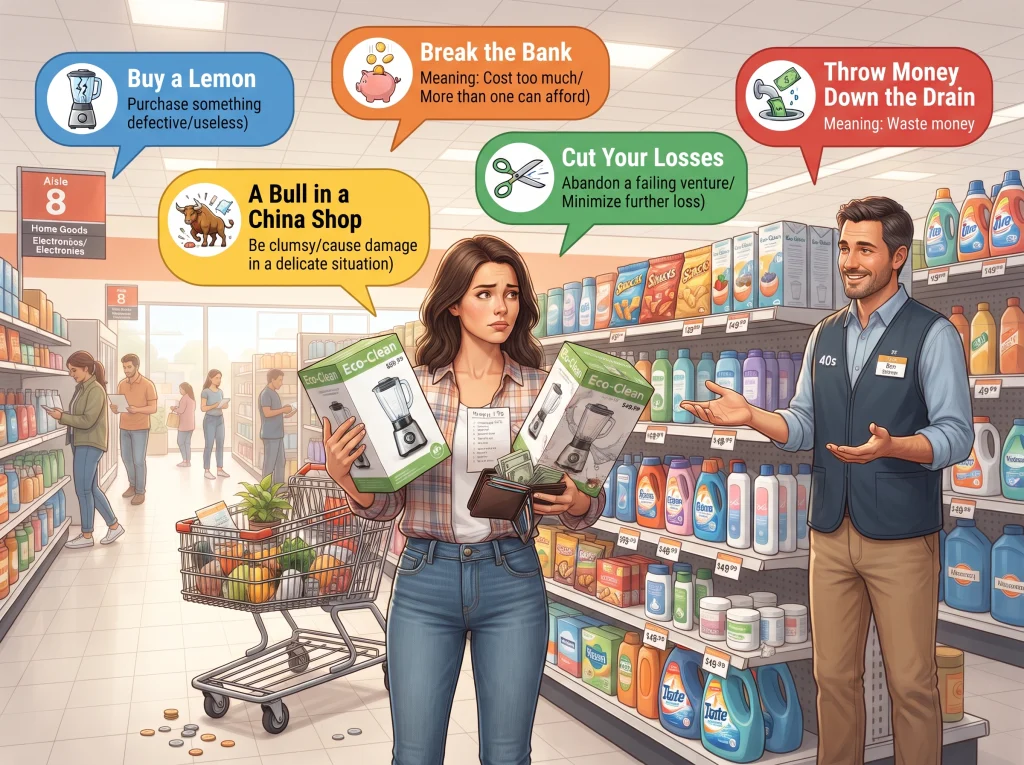
29. A Bull in a China Shop
Meaning: Someone who behaves clumsily, carelessly, or insensitively in a delicate situation.
Example: He acted like a bull in a china shop when he criticized everyone’s work during the meeting.
How to use it: Use this expression when someone’s lack of care creates awkwardness or damage.
30. Buy a Lemon
Meaning: To buy something defective or unreliable, especially a vehicle.
Example: We bought a used car last year, but it turned out to be a lemon.
How to use it: In American English, this expression is especially common when discussing cars that repeatedly develop problems.
31. Throw Money Down the Drain
Meaning: To waste money on something useless, unsuccessful, or not worth the cost.
Example: Buying that broken appliance without checking it first was like throwing money down the drain.
How to use it: This expression emphasizes that money has been spent without receiving worthwhile benefits.
32. Burn a Hole in Your Pocket
Meaning: To feel a strong urge to spend money as soon as you have it.
Example: That birthday money is burning a hole in his pocket because he wants a new video game.
How to use it: This informal phrase often describes someone who finds it difficult to save money.
33. Cut Your Losses
Meaning: To stop investing time, money, or effort in something that is unlikely to succeed, in order to avoid further losses.
Example: After months of struggling to sell the product, the company decided to cut its losses.
How to use it: This expression is common in business, investing, and everyday decisions.
34. Splash Out
Meaning: To spend a relatively large amount of money on something special or enjoyable.
Example: We decided to splash out on a nice hotel for our anniversary.
How to use it: American speakers may also say “splurge” or “splurge on something.” “Splash out” is understood but is more associated with British English.
35. The Customer Is Always Right
Meaning: A traditional business saying that encourages companies to take customer concerns seriously and provide good service.
Example: The manager listened carefully to the complaint because she believed the customer was always right.
How to use it: This is a business saying rather than a strict rule. In practice, businesses can treat customers respectfully while still correcting misunderstandings and enforcing reasonable policies.
How to Use Shop Idioms Naturally in American English
Using idioms naturally means choosing expressions that fit the situation, the relationship between speakers, and the tone of the conversation. Some shop idioms are casual and humorous, while others are suitable for professional discussions.
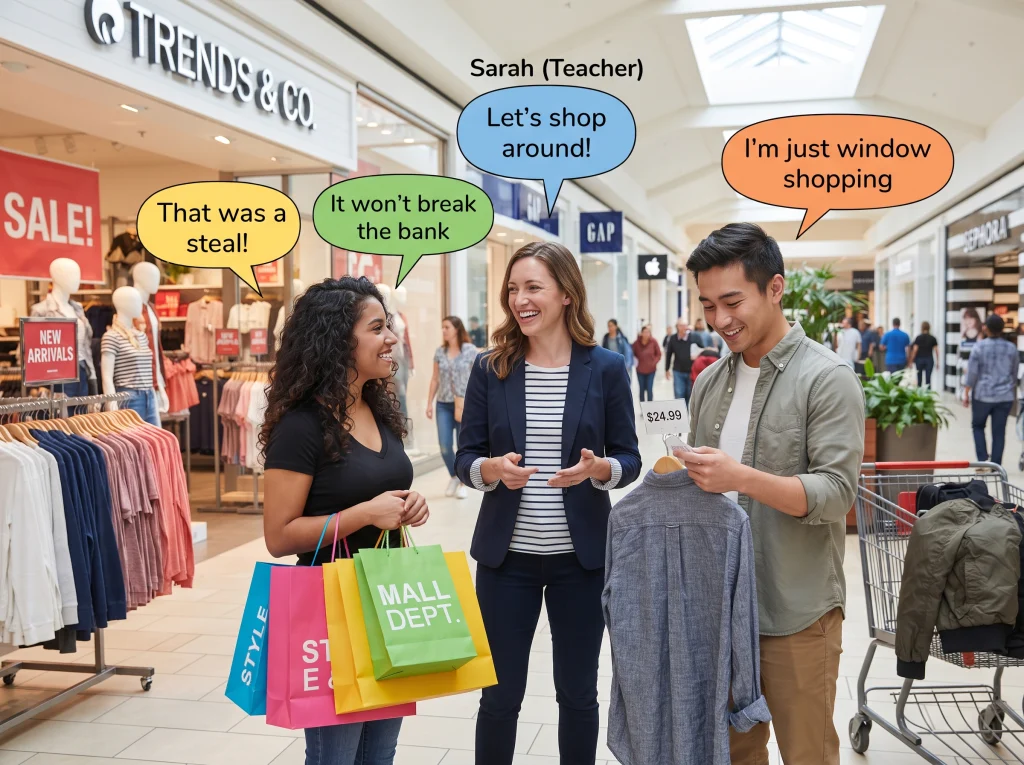
Here are a few examples of how they can appear in everyday American conversations.
At a Store or Mall
- “I’m just window shopping today.”
- “I found this jacket for a steal.”
- “Let’s shop around before we buy the television.”
- “That designer bag costs an arm and a leg.”
These expressions are useful when browsing, comparing prices, or discussing purchases with friends and family.
When Talking About Money
- “We need to tighten our belts until payday.”
- “I don’t want this vacation to break the bank.”
- “That expensive membership feels like a rip-off.”
- “His bonus is burning a hole in his pocket.”
These phrases help communicate financial decisions and spending habits without lengthy explanations.
At Work or in Business
- “I’ll mind the store while you’re at lunch.”
- “The new location set up shop last month.”
- “Let’s not talk shop during dinner.”
- “Our most popular product is a real cash cow.”
These expressions can make workplace conversations sound more natural, although professional writing may call for more literal language.
Fire Related Idioms: https://learnidioms.com/fire-related-idioms/
Common Mistakes to Avoid When Using Shop Idioms
Learning an idiom’s meaning is only the first step. It is also important to understand how it works in a sentence and when it sounds appropriate.
| Common mistake | Correct usage |
|---|---|
| Saying “I did window shopping” in every context | “I went window shopping.” |
| Using “a steal” to mean something was stolen | “The jacket was a steal” means it was a bargain. |
| Saying “talk shop” means shopping together | “Talk shop” means discussing work or professional matters. |
| Using “break the bank” only for literal bank problems | “The new phone won’t break the bank” means it is affordable enough for the speaker’s budget. |
| Treating “the customer is always right” as a legal requirement | It is a traditional business saying, not a universal legal rule. |
A useful learning habit is to remember each idiom with a complete example sentence. This helps you understand its grammar, tone, and typical context instead of memorizing a definition alone.
Why Learn Shop Idioms?
Shop idioms are useful because shopping and money come up frequently in everyday conversations. Understanding expressions such as “shop around,” “a steal,” and “break the bank” can help you follow discussions about prices, budgets, and purchases.
They can also improve listening comprehension. American speakers often use familiar expressions casually, and understanding the figurative meaning helps prevent confusion when the literal words seem unusual.
For English learners, the best approach is to start with a few common expressions, practice them in realistic sentences, and pay attention to how native speakers use them. You do not need to use an idiom in every conversation. Clear, natural communication matters more than using as many expressions as possible.
Idioms for Teens: https://learnidioms.com/idioms-for-teens/
Frequently Asked Questions
Conclusion
Shop idioms add color and personality to conversations about shopping, spending, business, and everyday decisions. Expressions such as “window shopping,” “talk shop,” “cost an arm and a leg,” and “set up shop” are useful examples of how English speakers communicate ideas beyond literal meanings.




2 Comments