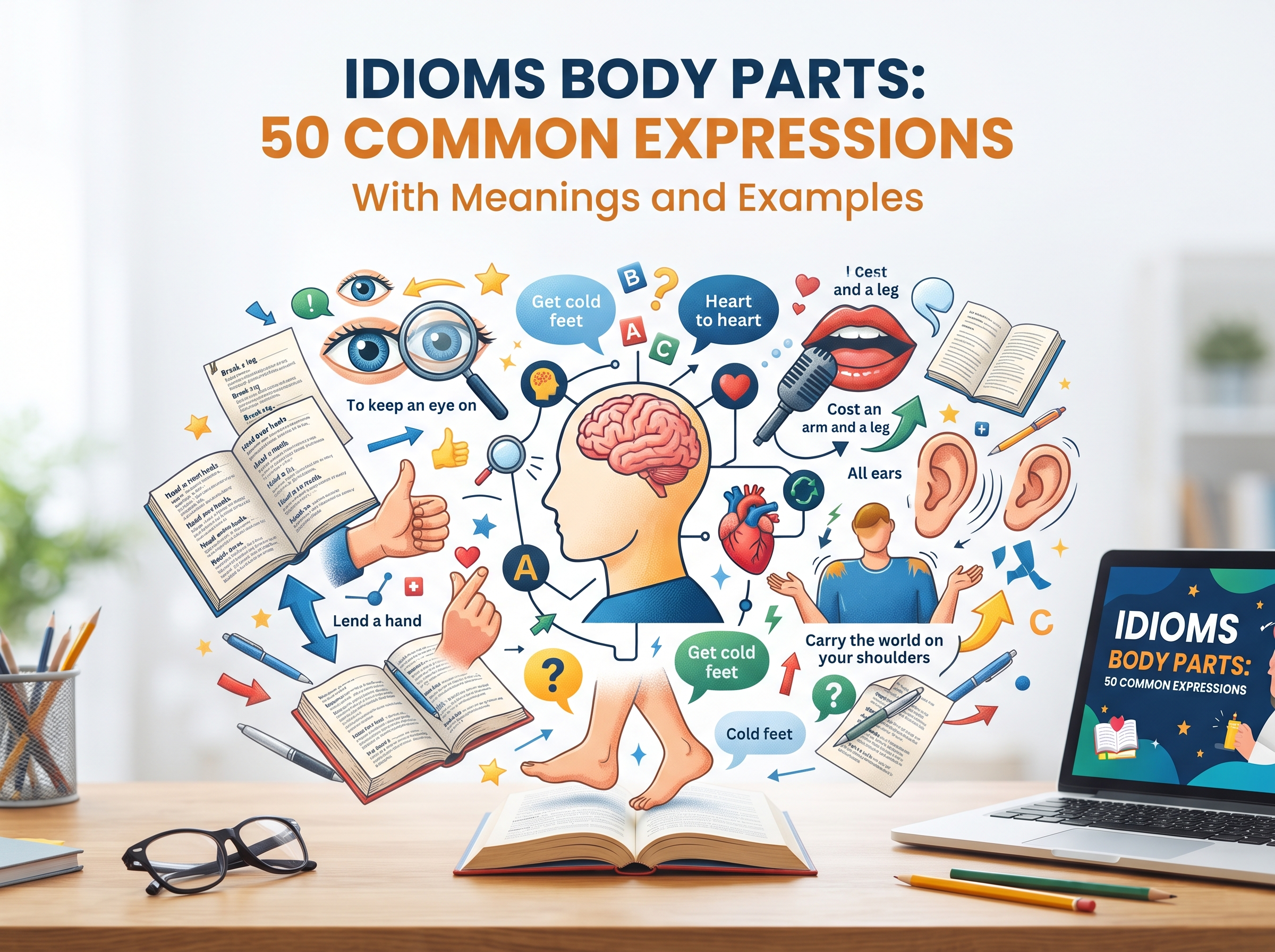
Idioms Body Parts: 50 Common Expressions With Meanings and Examples
English uses body parts in many expressions that have meanings far beyond the literal words. A person can have “cold feet” without actually feeling cold, “lend a hand” without giving away a hand, or “keep an eye on” something without staring at it constantly.
These expressions are called body part idioms. They are common in everyday American English and appear in conversations, movies, books, workplace communication, and informal writing. Learning them by body part can make their meanings easier to remember and help English learners recognize them when native speakers use them.
What Are Body Part Idioms?
Body part idioms are fixed or familiar expressions that contain words such as head, eye, hand, foot, heart, mouth, or shoulder but usually have a figurative meaning.
For example, “hit the nail on the head” does not mean physically hitting a nail. It means to identify something exactly or describe a situation correctly. Similarly, “cost an arm and a leg” means something is very expensive.

Because the literal image is often memorable, body part idioms can be useful for English learners. The key is to learn the entire expression rather than translating each word separately.
50 Idioms Body Parts With Meanings and Examples
Head and Face Idioms
1. Off the top of your head
Meaning: To give an answer from memory without checking the information.
Example: Off the top of my head, I think the store closes at 9 p.m.
2. Keep your head
Meaning: Stay calm in a difficult or stressful situation.
Example: Try to keep your head when everyone around you is panicking.
3. Have your head in the clouds
Meaning: To be unrealistic, distracted, or lost in your thoughts.
Example: He’s got his head in the clouds and rarely pays attention during meetings.
4. In over your head
Meaning: In a situation that is more difficult than you can handle.
Example: I was in over my head when I agreed to manage the entire project alone.
5. Use your head
Meaning: Think carefully or use common sense.
Example: Use your head and check the instructions before you start.
6. Head over heels
Meaning: Completely or deeply, especially in love.
Example: She fell head over heels in love with him.
7. Put your heads together
Meaning: Work together to solve a problem or make a decision.
Example: Let’s put our heads together and figure out how to fix this.
8. Keep your chin up
Meaning: Remain positive during a difficult time.
Example: Keep your chin up. Things will get better.
Eye and Ear Idioms
9. Keep an eye on
Meaning: Watch or monitor someone or something carefully.
Example: Can you keep an eye on my bag while I order coffee?
10. See eye to eye
Meaning: Agree with someone.
Example: My brother and I don’t always see eye to eye, but we respect each other.
11. Have an eye for something
Meaning: Have a natural ability to notice or recognize something attractive or valuable.
Example: She has an eye for interior design.
12. Catch someone’s eye
Meaning: Attract someone’s attention.
Example: The bright sign caught my eye as I walked past the store.
13. Keep your eyes peeled
Meaning: Watch carefully and stay alert.
Example: Keep your eyes peeled for the blue mailbox.
14. In the blink of an eye
Meaning: Very quickly.
Example: The summer seemed to disappear in the blink of an eye.
15. All ears
Meaning: Ready and willing to listen.
Example: Tell me what happened. I’m all ears.
16. Lend an ear
Meaning: Listen carefully or sympathetically.
Example: Thanks for lending me an ear when I needed to talk.
17. Play it by ear
Meaning: Decide what to do as a situation develops instead of making a fixed plan.
Example: We don’t know how busy the restaurant will be, so let’s play it by ear.
18. Turn a deaf ear
Meaning: Refuse to listen or ignore something.
Example: The manager turned a deaf ear to the employees’ complaints.

Mouth, Tongue, and Tooth Idioms
19. Put your foot in your mouth
Meaning: Say something embarrassing or inappropriate, usually by accident.
Example: I really put my foot in my mouth when I asked about her old job.
20. Bite your tongue
Meaning: Stop yourself from saying something.
Example: I wanted to argue, but I bit my tongue.
21. Slip of the tongue
Meaning: A small speaking mistake in which you say something you did not intend to say.
Example: It was just a slip of the tongue. I didn’t mean to mention the surprise party.
22. Keep something under your hat
Meaning: Keep information secret.
Example: Keep this under your hat until the company makes the announcement.
23. Have a big mouth
Meaning: Be unable or unwilling to keep secrets.
Example: Don’t tell Jake about the surprise because he has a big mouth.
24. On the tip of your tongue
Meaning: Almost able to remember or say something.
Example: Her name is on the tip of my tongue, but I can’t remember it.
25. Bite off more than you can chew
Meaning: Take on more work or responsibility than you can handle.
Example: I bit off more than I could chew when I accepted three major assignments.
Hand, Arm, and Finger Idioms
26. Give someone a hand
Meaning: Help someone.
Example: Can you give me a hand with these boxes?
27. Lend someone a hand
Meaning: Help someone with a task.
Example: My neighbors lent me a hand when I moved into my new apartment.
28. Have your hands full
Meaning: Be very busy or have a lot to deal with.
Example: I have my hands full with work and two young children.
29. Wash your hands of something
Meaning: Stop taking responsibility for or involvement in something.
Example: After repeated problems, she decided to wash her hands of the whole situation.
30. Get your hands on something
Meaning: Obtain, find, or acquire something.
Example: I need to get my hands on a copy of that report.
31. At hand
Meaning: Nearby or available; it can also refer to something currently being considered.
Example: We have all the information at hand, so we can make a decision.
32. Out of hand
Meaning: Immediately or without further consideration; it can also mean out of control depending on context.
Example: The committee rejected the proposal out of hand.
33. Cost an arm and a leg
Meaning: Be extremely expensive.
Example: That new car costs an arm and a leg.
34. Twist someone’s arm
Meaning: Persuade someone to do something they were initially reluctant to do.
Example: You don’t have to twist my arm. I’d love to go with you.
35. Keep someone at arm’s length
Meaning: Avoid becoming too close to someone.
Example: He tends to keep new coworkers at arm’s length.

Leg and Foot Idioms
36. Get cold feet
Meaning: Become nervous or afraid about doing something you had planned to do.
Example: She got cold feet before giving her presentation.
37. Break a leg
Meaning: A traditional way of wishing someone good luck, especially before a performance.
Example: You have your audition tonight. Break a leg!
38. Put your best foot forward
Meaning: Make a strong effort to create a good impression.
Example: Put your best foot forward during the interview.
39. Get off on the wrong foot
Meaning: Begin a relationship or situation badly.
Example: We got off on the wrong foot, but we’re good friends now.
40. Drag your feet
Meaning: Delay doing something or act very slowly because you do not want to do it.
Example: He’s been dragging his feet about signing the contract.
41. Foot the bill
Meaning: Pay for something, especially a bill or expense.
Example: The company will foot the bill for the business trip.
42. Have one foot in the door
Meaning: Have an initial opportunity that could lead to something better.
Example: Getting an internship gave her one foot in the door at the company.

Heart, Mind, and Stomach Idioms
43. Have a heart of gold
Meaning: Be very kind and generous.
Example: My grandmother has a heart of gold and always helps people in need.
44. Learn something by heart
Meaning: Memorize something completely.
Example: We had to learn the poem by heart for class.
45. Cross your heart
Meaning: Used to emphasize that you are telling the truth or making a sincere promise.
Example: Cross your heart that you won’t tell anyone.
46. Change your mind
Meaning: Decide differently from what you previously decided.
Example: I was going to order pizza, but I changed my mind.
47. Make up your mind
Meaning: Make a decision.
Example: You need to make up your mind before the tickets sell out.
48. Have butterflies in your stomach
Meaning: Feel nervous or excited, especially before an important event.
Example: I always get butterflies in my stomach before a job interview.
49. Have a gut feeling
Meaning: Have a strong feeling about something without knowing exactly why.
Example: I had a gut feeling that something was wrong.
50. Can’t stomach something
Meaning: Be unable to tolerate or accept something.
Example: I can’t stomach the idea of treating people that way.
How to Use Body Part Idioms Naturally
The best way to learn body part idioms is to connect each expression with a realistic situation. For example, use “give someone a hand” when talking about helping, “get cold feet” when discussing nervousness, and “keep an eye on” when someone needs to watch something.
Pay attention to the level of formality, too. Many body part idioms are natural in everyday conversation and informal writing. Some can also appear in professional communication when the tone is relaxed, while formal reports may be clearer when they use direct language instead.
It also helps to learn the complete phrase. Do not memorize only “cold feet” or “arm and a leg.” Learn the expression as it normally appears in a sentence, such as “get cold feet” or “cost an arm and a leg.” This makes it easier to remember the correct grammar and use the expression naturally.

Common Mistakes With Body Part Idioms
One common mistake is interpreting an idiom literally. If someone says, “Keep an eye on the kids,” they are asking you to watch the children, not to physically keep an eye somewhere.
Another mistake is changing the wording too much. Idioms often have established forms, so replacing one body part or changing the structure can make the expression sound unnatural.
English learners should also remember that not every expression containing a body part is necessarily an idiom. Some phrases are literal, while others are ordinary collocations or phrasal expressions. Context helps determine whether the words are being used literally or figuratively.
Why Body Part Idioms Matter in American English
Body part idioms are useful because they appear in ordinary conversations and help speakers express ideas vividly and efficiently. Expressions such as “keep an eye on,” “give me a hand,” “cold feet,” and “see eye to eye” can communicate familiar ideas without lengthy explanations.
For English learners, these expressions are especially valuable for listening comprehension. A speaker may use an idiom casually without explaining it, so recognizing the figurative meaning can make conversations, television shows, podcasts, and informal writing easier to understand.
The easiest approach is to learn a small group at a time. Start with common expressions, practice them in your own sentences, and pay attention to how native speakers use them in context.

Frequently Asked Questions:
Conclusion
Idioms with body parts are an important part of everyday English. They turn familiar words such as head, eye, hand, foot, heart, and mouth into expressions for emotions, decisions, relationships, problems, costs, and everyday actions.
Learning 50 idioms at once can seem like a lot, so begin with the expressions you are most likely to use. Once phrases such as “keep an eye on,” “give someone a hand,” “get cold feet,” and “put your foot in your mouth” become familiar, you can gradually add less common expressions to your vocabulary.