Seat or Sit? Meaning, Difference, and Correct Usage in American English
If you are unsure whether to use seat or sit, you are dealing with two related words that have different grammatical jobs. Both words can describe being in a chair or another place for sitting, but they are not normally interchangeable.
The simplest rule is this: sit usually means to be in a seated position, while seat usually means to give someone a place to sit or to provide enough space for people. Seat is also a very common noun for the place where a person sits.
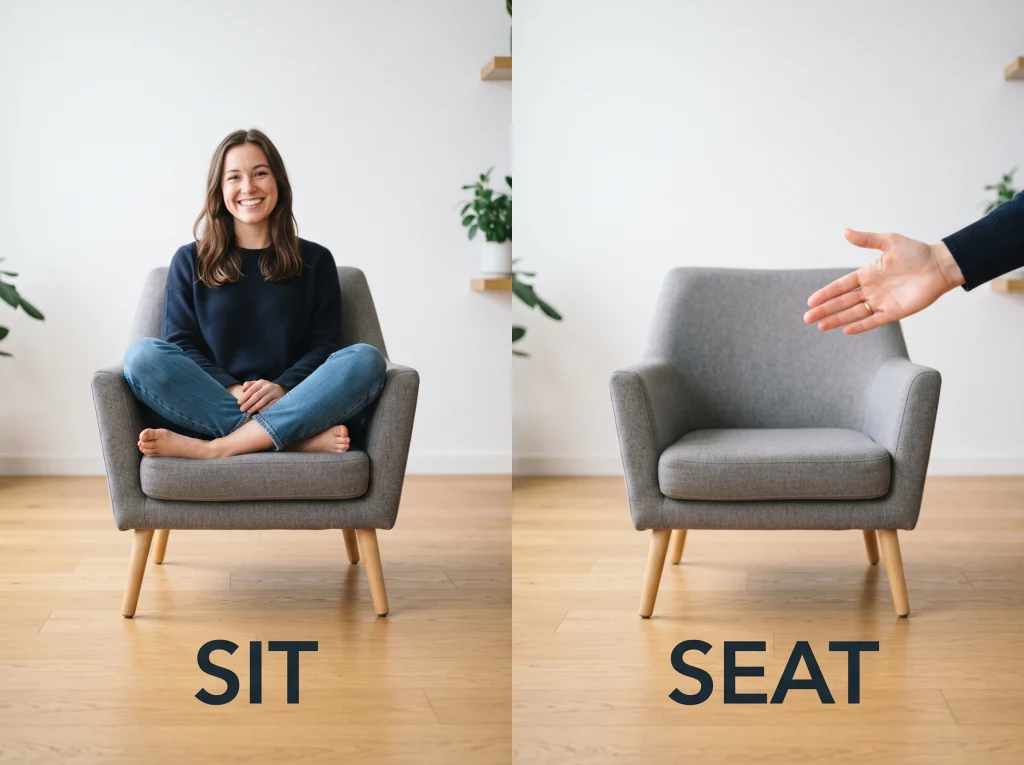
For example, you can say, “Please sit here,” when asking someone to sit down. You can say, “The hostess will seat you,” when someone is being shown to a table. You can also say, “My seat is near the window,” when talking about the actual place where you will sit.
Understanding this small difference will help you use these words naturally in American English.
Seat or Sit: Quick Answer
Sit is primarily a verb meaning to rest your body in a seated position.
Please sit in this chair.
Seat can be a noun meaning a place designed for sitting, or a verb meaning to give someone a place to sit.
Please take your seat.
The hostess will seat us at our table.
As verbs, the main difference is that sit focuses on the person being in a seated position, while seat often focuses on putting or placing someone in a particular place to sit. Oxford describes sit as resting your weight on your bottom with your back upright, while seat can mean giving someone a place to sit.
What Does Sit Mean?
Sit is a verb that means to rest your body in a position where your weight is supported by a chair, couch, floor, or another surface.
It is commonly used when the person performs the action or remains in the seated position.
Examples:
- Please sit here.
- I like to sit by the window.
- She sat on the couch.
- We were sitting at the kitchen table.
- The children sat quietly during the movie.
- He asked me to sit beside him.
The basic verb forms are:
| Form | Example |
|---|---|
| Present | sit |
| Third person | sits |
| Past | sat |
| Past participle | sat |
| -ing form | sitting |
The past tense of sit is sat, not sitted. The past participle is also sat, as in “She has sat here before.”
Sit Down
Sit down means to move from a standing position into a seated position.
Please sit down.
We sat down at the table.
He told the children to sit down.
You can also use sit yourself down, which is an informal way to tell someone to sit.
Come in and sit yourself down.
What Does Seat Mean?
Seat can be either a noun or a verb.
As a noun, a seat is a place where someone can sit.
Is this seat taken?
I saved a seat for you.
My seat is in the front row.
We found two empty seats.
As a verb, seat means to give someone a place to sit or put someone in a seated position.
The hostess seated us near the window.
The teacher seated the students in alphabetical order.
Please wait to be seated.
Oxford lists seat somebody as giving someone a place to sit and also notes the common phrase please wait to be seated.
Seat can also describe how many people a building, vehicle, or room can accommodate.
The theater seats 2,000 people.
This car seats five adults.
The restaurant can seat 100 guests.
Seat vs. Sit Comparison
The easiest way to understand the difference is to look at what each word does in a sentence.
| Word | Part of Speech | Main Meaning | Example |
|---|---|---|---|
| sit | Verb | Be in a seated position | Please sit here. |
| seat | Noun | A place for sitting | My seat is over there. |
| seat | Verb | Give or put someone in a place to sit | The host will seat us. |
Compare these sentences:
Please sit here.
The person is being asked to move into a seated position.
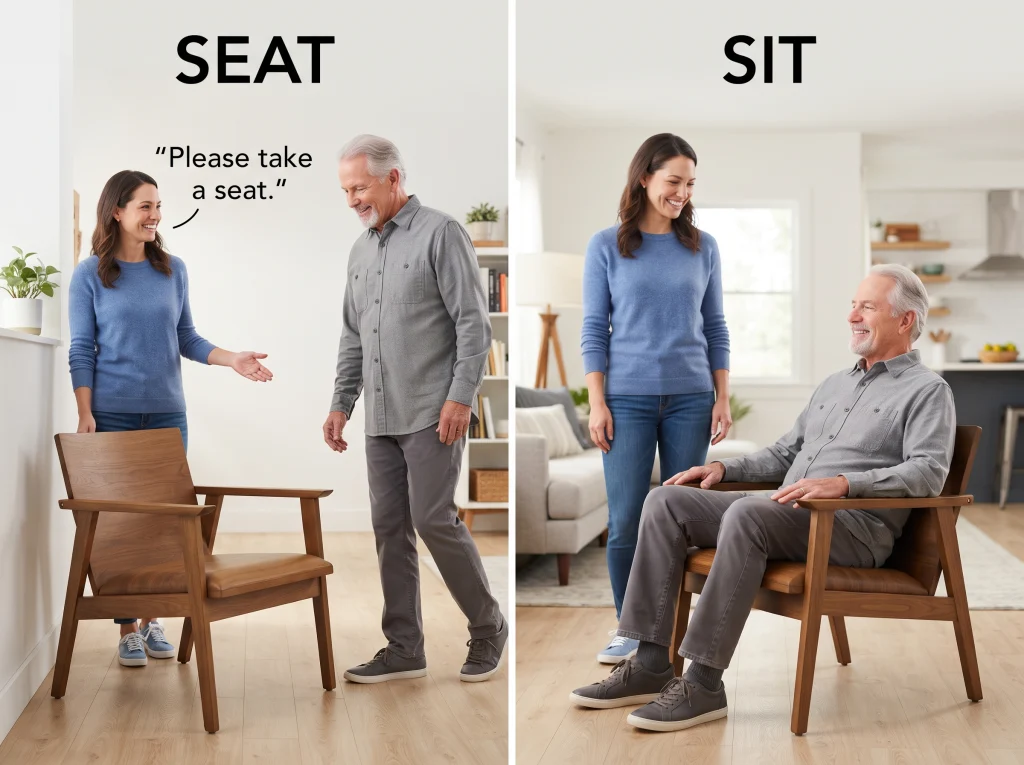
Please take your seat.
The person is being asked to use a particular place for sitting.
The waiter will seat us.
The waiter will show or place us at a table.
Our seats are near the stage.
The sentence refers to the physical places where people will sit.
This distinction is consistent with standard American English usage. Sit describes the seated position, while seat as a verb commonly has someone else as its object.
Seat and Sit in Common American English Sentences
Here are some everyday examples that show how Americans commonly use these words.
Using Sit
Can I sit next to you?
We usually sit at the same table.
Please sit still while I take your picture.
She sat in the back of the classroom.
I was sitting on the couch when you called.
The dog knows how to sit on command.
Using Seat as a Noun
Is anyone sitting in this seat?
I need an aisle seat for the flight.
We reserved our seats online.
Her seat was next to the window.
Please keep your seat until the bus stops.
Using Seat as a Verb
The hostess will seat you shortly.
They seated us at a table near the entrance.
The teacher seated the students in groups.
The restaurant can seat 80 people.
Please wait to be seated.
Sit, Sit Down, Take a Seat, and Be Seated
Several expressions related to sit and seat are common in American English, but they have slightly different uses.
Sit
Sit is the basic verb.
You can sit here.
Sit Down
Sit down emphasizes the movement from standing to sitting.
Please sit down and make yourself comfortable.
Take a Seat
Take a seat means sit down and is often used as a polite invitation.
Please take a seat while you wait.
Have a Seat
Have a seat is another common American English expression meaning sit down. It can sound friendly and conversational.
Come in and have a seat.
Be Seated
Be seated is more formal.
Please be seated.
It is common in formal announcements, ceremonies, restaurants, courtrooms, and other situations where a polite or official tone is appropriate. Oxford also identifies be seated as a formal way of inviting someone to sit down.
Common Mistakes With Seat and Sit
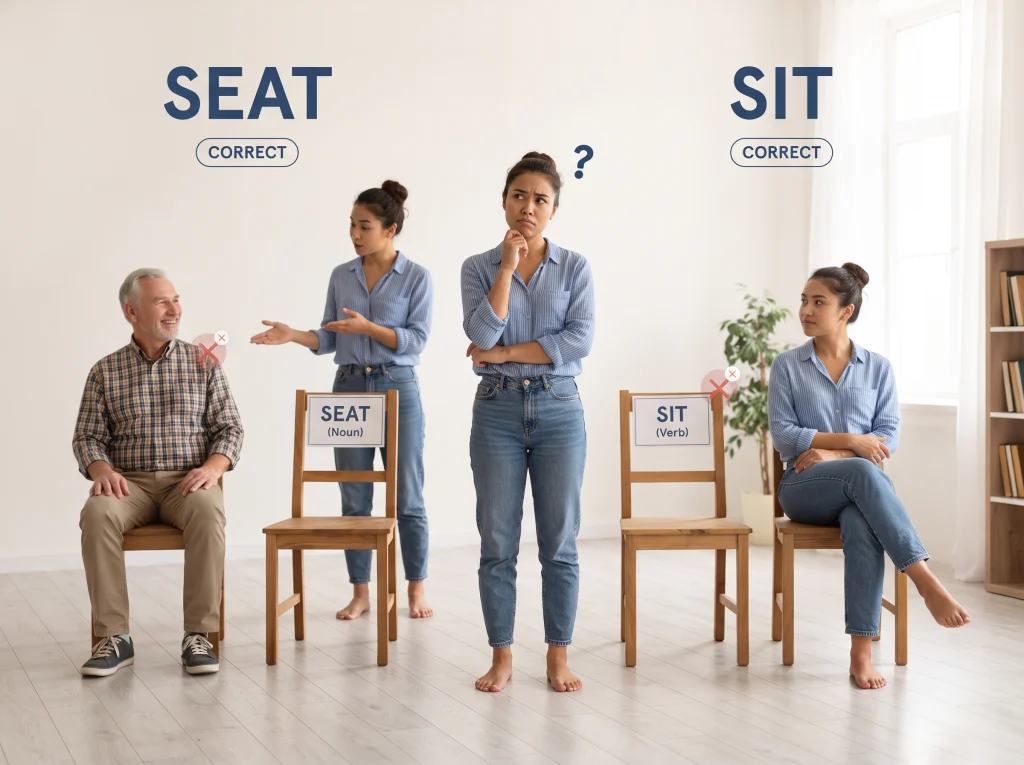
Mistake 1: Using “seat” when you mean “sit”
Incorrect in standard everyday usage:
Please seat here.
Better:
Please sit here.
When you are telling someone to move into a seated position, sit is normally the right word.
Mistake 2: Saying “sit” when you mean a physical place
If you are talking about the actual place where someone sits, use the noun seat.
I need a seat.
Not:
I need a sit.
You can say I need to sit, but seat is the noun for the place.
Mistake 3: Saying “sitted”
The past tense of sit is sat.
Incorrect:
I sitted in the chair.
Correct:
I sat in the chair.
The standard forms are sit, sat, sat, sitting.
Mistake 4: Confusing “seat” with “sit down”
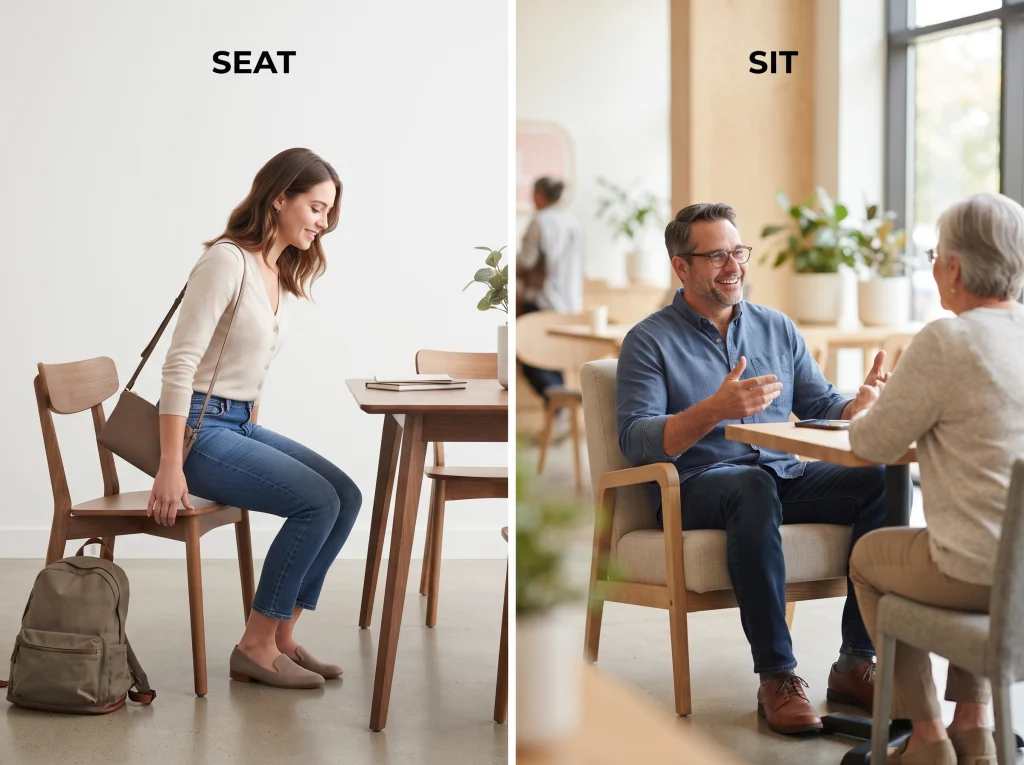
Seat as a verb can mean to put someone in a place to sit, while sit down describes the person’s movement into a seated position.
Compare:
The host seated the guests.
The guests sat down.
The host places or directs the guests to their seats. The guests perform the action of sitting.
Mistake 5: Confusing “seat” with “sit” in restaurants
Restaurants provide especially clear examples of the difference.
The hostess will seat you.
This means the hostess will give you a table or show you where to sit.
You can sit here.
This means you can take a seated position in that place.
How to Remember the Difference Between Seat and Sit
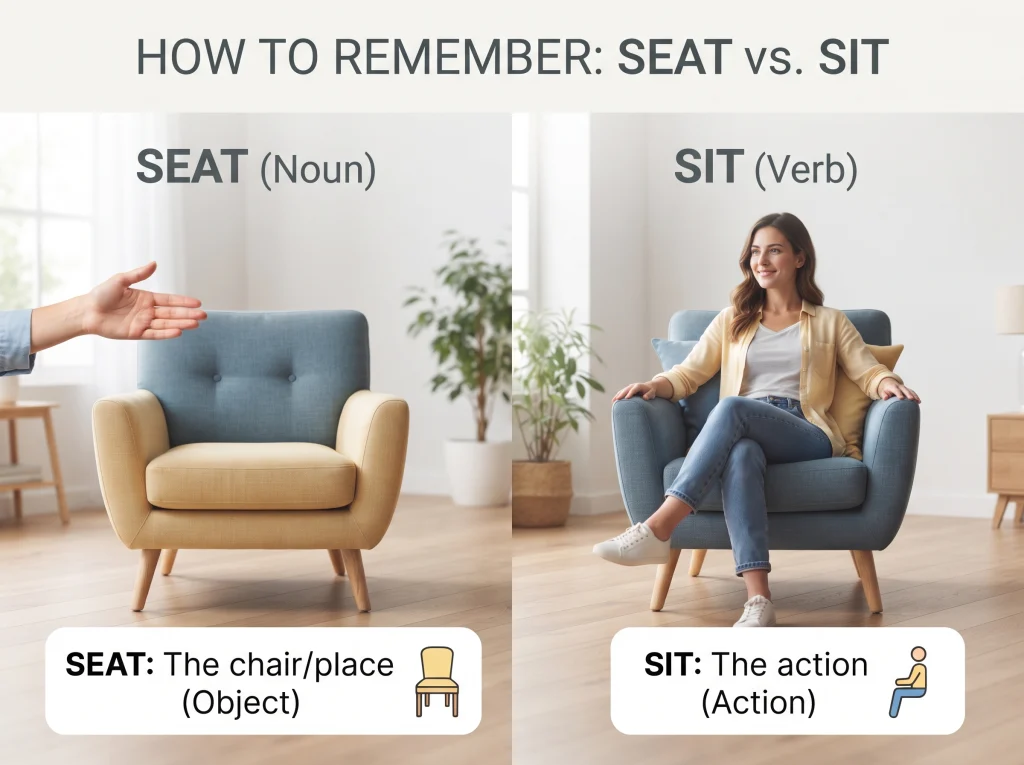
A simple memory trick can make the difference easier.
Think:
Sit = the action or position.
Seat = the place or putting someone in that place.
For example:
I sit in my seat.
Here, sit is the action and seat is the place.
You can also remember this pattern:
Person → sit
Place → seat
Put someone in a place → seat
For example:
I sit in my seat.
The airline assigned me a seat.
The flight attendant seated the passengers.
There are additional uses of both words, but this basic distinction handles most everyday situations in American English.
Why Seat and Sit Are Easy to Confuse
The confusion exists because both words are closely connected. A person sits in a seat, and the verb seat can describe putting that person in the seat.
The words also appear in many of the same situations, including restaurants, classrooms, theaters, offices, cars, airplanes, and public transportation.
The important point is to look at the role the word plays in the sentence. If you are describing what a person does, sit is usually appropriate. If you are naming the place where someone sits, use seat. If you mean giving or assigning someone a place to sit, seat can be used as a verb.
Once you recognize these patterns, choosing between seat and sit becomes much easier.
FAQs:
Conclusion
Seat and sit are related words, but they are not interchangeable in most everyday sentences. Sit is primarily a verb that means to be or move into a seated position. Seat is commonly a noun meaning a place for sitting, and it can also be a verb meaning to give or put someone in a place to sit.
Remember the simple pattern: you sit in a seat. You might also seat someone at a table or take a seat when someone invites you to sit down.