Whichever or Whatever? Meaning, Difference, and Correct Usage in American English
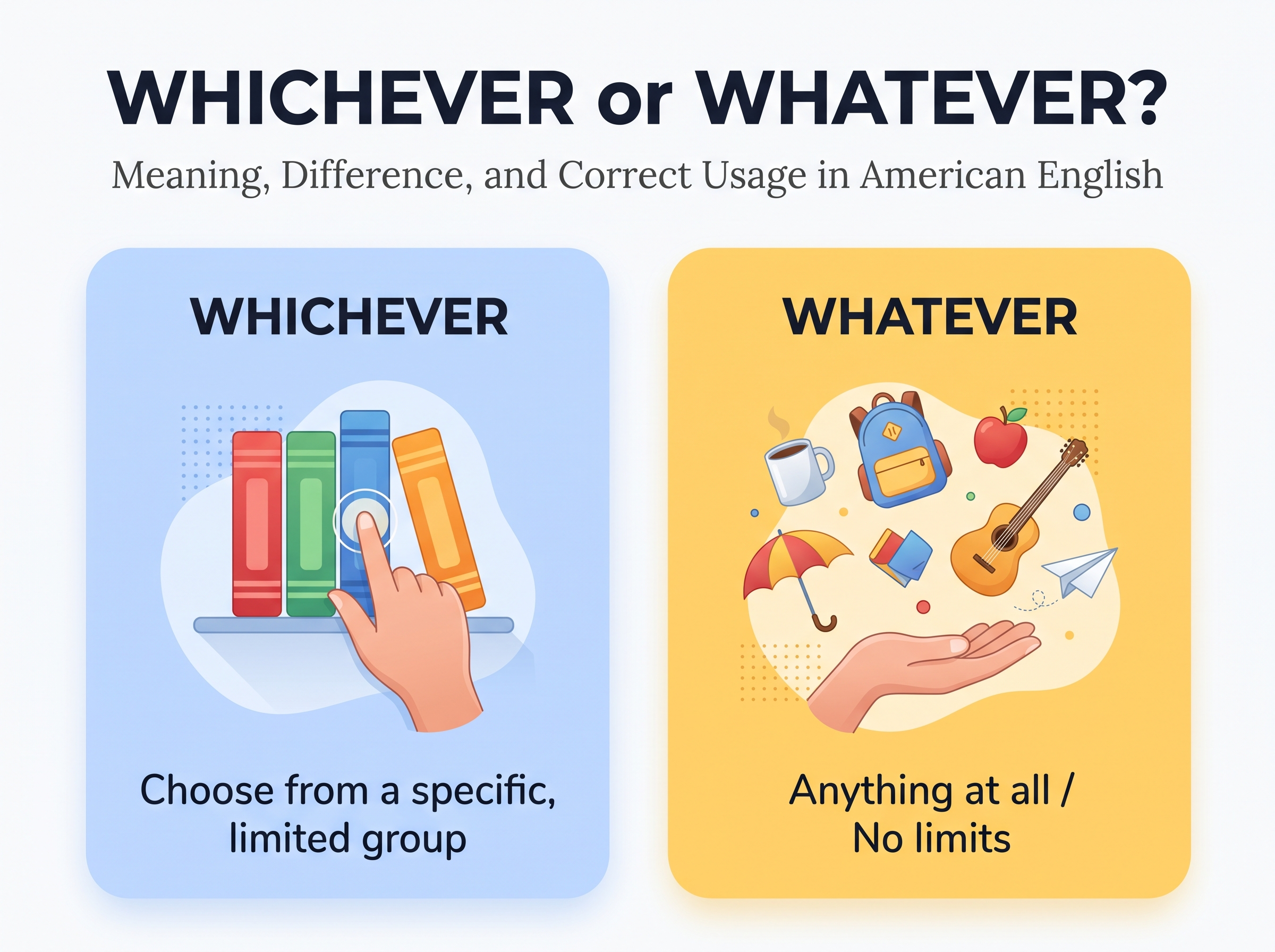
Whichever and whatever are both correct English words, but they are not always interchangeable. Use whichever when referring to a choice among available options. Use whatever when referring to anything that fits a situation, any possible thing, or something that does not need to be specified.
For example, “Choose whichever shirt you prefer” usually refers to shirts available for selection. “Choose whatever you want” gives a broader freedom of choice.
definition in the Cambridge English Dictionary
+1
Understanding this distinction will help you choose the right word in everyday conversations, school assignments, professional emails, and other forms of American English writing. Both words can introduce clauses, appear before nouns, or function as pronouns, but the meaning of the sentence determines which one fits best.
What Does Whichever Mean?
Whichever means any one or any ones from a group of possibilities. It is useful when the available choices are known, limited, or understood from the context. It can also mean that the choice does not matter because the result will be the same.

Examples:
- Choose whichever seat is available.
- You can take whichever route is faster.
- Whichever candidate wins will represent the organization.
- Pick whichever color looks best with your outfit.
- We can meet on Tuesday or Wednesday, whichever works for you.
In these sentences, the speaker is referring to specific options, such as available seats, routes, candidates, colors, or days.
When to Use Whichever
Use whichever when someone is selecting from a group or when the identity of the selected option is less important than the choice itself.
For example, if a restaurant offers chicken, fish, and pasta, you might say, “Order whichever meal you prefer.” The available meals form the group from which the person can choose.
Whichever can also introduce a clause:
“Whichever option you select, please confirm your choice by Friday.”
This means that the person may select any available option, but the instruction to confirm the selection applies regardless of which option is chosen.
What Does Whatever Mean?
Whatever means anything that, no matter what, or any thing or situation that meets the context. It generally allows a broader or less specifically defined range of possibilities than whichever.
definition in the Cambridge English Dictionary
+1
Examples:
- Eat whatever you like.
- Whatever happens, stay calm.
- You can wear whatever makes you comfortable.
- Whatever she decides, I will support her.
- Bring whatever you need for the meeting.
In these sentences, the choices are not restricted to a clearly identified list. The speaker is allowing a broad range of possibilities or referring to any situation that may occur.
When to Use Whatever
Use whatever when you mean any thing, any action, or any possible circumstance that fits the sentence.
For example:
“Whatever you write, make sure your name is on the page.”
The instruction applies to anything the person writes. The sentence does not limit the person to a particular selection of words or topics.
Whatever also appears in expressions that acknowledge uncertainty or indifference:
- Whatever the reason, we need to solve the problem.
- Whatever happens next, we will be prepared.
- “What would you like for lunch?” “Whatever is fine with me.”
Be careful with the last example. When used alone as a response, whatever can sometimes sound dismissive or rude, depending on the speaker’s tone. If you genuinely mean that you have no preference, “Anything is fine with me” is often more polite.
Whichever vs. Whatever: Key Differences
The main difference between whichever and whatever is the type of choice or possibility being discussed. Whichever focuses on selecting from a group, while whatever often refers to anything without a specific limit.
| Feature | Whichever | Whatever |
|---|---|---|
| Main meaning | Any one from a group | Anything or no matter what |
| Typical use | Choosing among options | Referring to things or situations broadly |
| Example | Choose whichever book you like. | Read whatever interests you. |
| Before a noun | Whichever route works | Whatever route you prefer |
| In a general condition | Whichever option wins | Whatever happens |
| Tone | Usually neutral | Neutral, but can sound dismissive when used alone |
Compare These Sentences
Example 1: Choosing a movie
- Whichever: “Choose whichever movie you prefer from these five.”
- Whatever: “Choose whatever movie you want to watch.”
The first sentence identifies a group of five movies. The second allows a broader choice without specifying a list.
Example 2: Selecting a route
- Whichever: “Take whichever road is shorter.”
- Whatever: “Whatever route you take, allow enough time for traffic.”
The first focuses on selecting the road that meets a particular condition. The second means that the instruction applies regardless of the route chosen.
Example 3: Making a decision
- Whichever: “Whichever option you choose, let me know.”
- Whatever: “Whatever you decide, I will respect your decision.”
The first refers to an option within a group. The second focuses on the decision itself, without restricting what it might be.

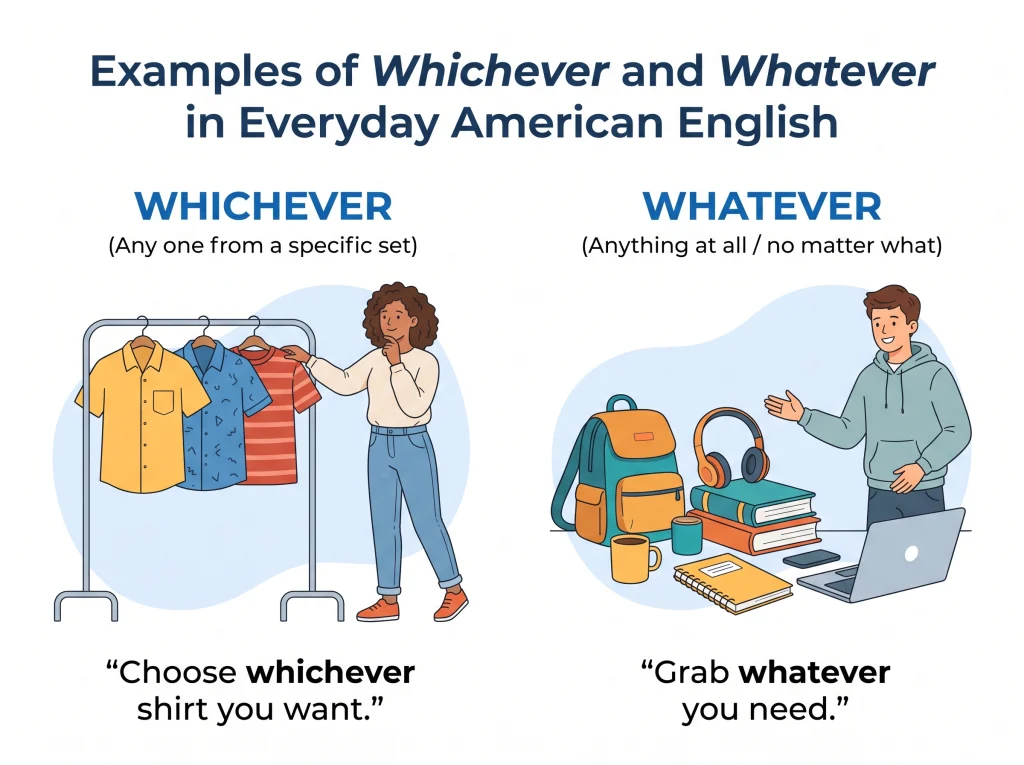
Examples of Whichever and Whatever in Everyday American English
These examples show how the words appear in common situations.
At Home
- Use whichever towel is clean.
- Eat whatever is left in the refrigerator.
- You can sit in whichever chair you prefer.
- Put whatever you do not need in the storage box.
- Whichever room you choose, please turn off the lights when you leave.
At School or College
- Choose whichever topic interests you most.
- Write whatever you learned during the lecture.
- Whichever student finishes first should check the answers.
- Whatever questions you have, ask your instructor.
- You may select whichever assignment topic best suits your interests.
At Work
- Use whichever template matches the project.
- Bring whatever documents are required for the meeting.
- Whichever applicant meets the qualifications will be considered.
- Whatever the client requests, record the details accurately.
- Choose whichever software works best for the team’s needs.
In Shopping and Everyday Decisions
- Buy whichever phone fits your budget.
- You can choose whatever snack you want.
- Take whichever checkout line moves faster.
- Whatever you purchase, keep the receipt.
- Select whichever size fits you comfortably.
How to Use Whichever and Whatever Correctly
Both words can function as pronouns or determiners. A determiner comes before a noun, while a pronoun can stand in for a noun or noun phrase.
1. Use Whichever Before a Noun
When whichever comes directly before a noun, it identifies a choice from available possibilities.
Examples:
- Choose whichever jacket fits you.
- Take whichever bus arrives first.
- Select whichever answer you believe is correct.
Here, jacket, bus, and answer are nouns. Whichever specifies the choice being made.
2. Use Whatever Before a Noun
Whatever can also come before a noun when the meaning is broad or not restricted to a specific selection.
Examples:
- Bring whatever equipment you need.
- Whatever decision you make, think carefully.
- Whatever problems arise, remain professional.
The noun following whatever identifies the general category of thing or situation being discussed.
3. Use Whichever as a Pronoun
Whichever can stand alone when the available choices are clear from the conversation.
Examples:
- “Which of these two shirts should I buy?” “Choose whichever you prefer.”
- “Should we meet Tuesday or Thursday?” “Whichever works better for you.”
- “Which route should we take?” “Whichever is faster.”
The word replaces a noun phrase because the options have already been identified.
4. Use Whatever as a Pronoun
Whatever can stand alone or introduce a clause referring to anything that fits the situation.
Examples:
- Take whatever you need.
- Whatever you say is fine with me.
- I will support whatever you decide.
The meaning is broader than choosing one item from a known list. It refers to anything that fits the context or to the content of a statement or decision.
5. Understand the Difference in Conditional Statements
Both words can introduce clauses, but they emphasize different things.
- “Whichever team wins, we will congratulate the players.” This refers to the possible teams competing.
- “Whatever happens during the game, we will remain supportive.” This refers to any possible event or situation.
The distinction becomes easier when you ask yourself whether you are talking about which option or what might happen.

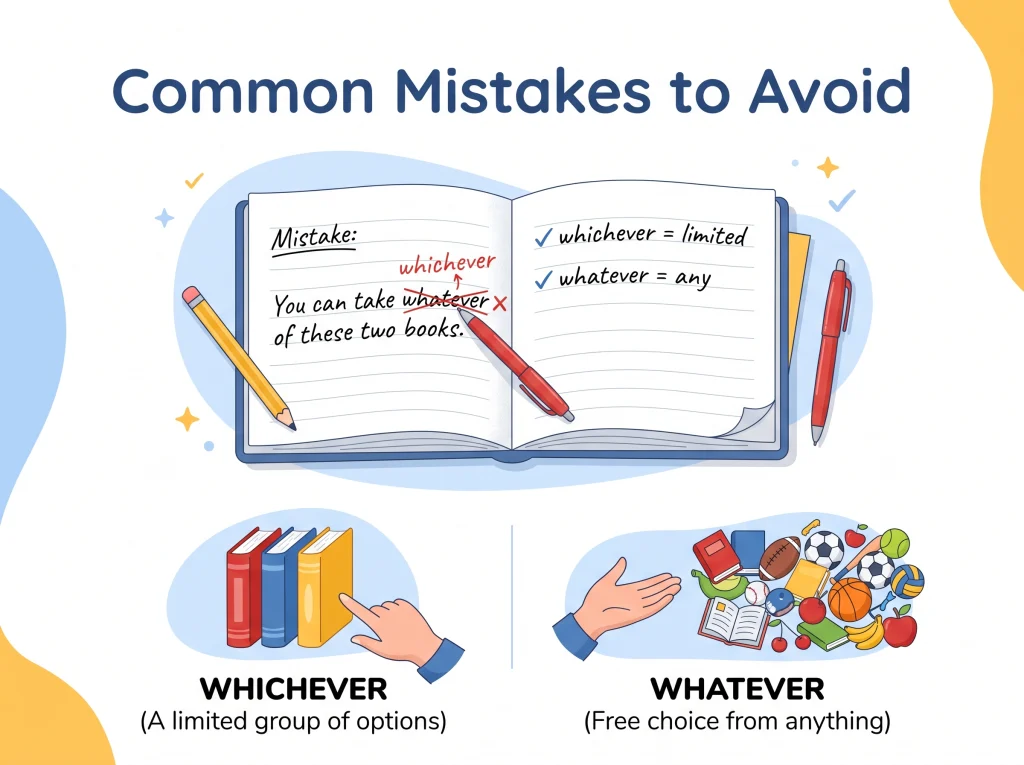
Common Mistakes to Avoid
Mistake 1: Using Whichever When the Choice Is Completely Open
Less natural: “Whichever you want to eat, order it.”
More natural: “Whatever you want to eat, order it.”
The second sentence is better when the speaker means any food the person wants, without limiting the choice to a known group.
However, whichever is correct when the available choices are understood from the context.
Mistake 2: Using Whatever for a Clearly Identified Choice
Suppose someone asks, “Would you prefer the blue shirt or the black shirt?”
A natural answer is: “Whichever is cheaper.”
This answer focuses on selecting one of the two shirts according to price. Whatever would be less precise if the intended meaning is specifically to choose between those two options.
Mistake 3: Confusing Whatever With a Dismissive Response
In casual American English, saying “Whatever” by itself can communicate annoyance, indifference, or disrespect.
For example:
“Do you agree with my suggestion?”
“Whatever.”
Depending on the tone, the response may sound as though the speaker does not care about the discussion.
If you want to sound polite, try:
- “Either option is fine with me.”
- “I do not have a preference.”
- “I’m happy with whichever option you choose.”
Mistake 4: Adding Unnecessary Words
Incorrect or awkward: “Choose whichever option that you like.”
Better: “Choose whichever option you like.”
In standard formal writing, avoid adding that unnecessarily after whichever or whatever when it introduces the relevant clause directly.
Mistake 5: Assuming the Words Are Always Interchangeable
Whichever and whatever sometimes overlap, but they do not always express the same meaning.
“Choose whichever book you prefer” emphasizes selecting from available books.
“Read whatever you prefer” allows a broader choice of reading material.
Choose the word that accurately communicates the intended meaning rather than treating both as exact substitutes in every situation.
Which Word Should You Use?
The easiest way to choose between whichever and whatever is to consider the context.
- Use whichever when the focus is on selecting from available choices.
- Use whatever when the focus is on anything that fits, an unrestricted choice, or any possible situation.
- Use either when referring to one of two options and the context calls for that specific meaning.
- Use anything when you want a straightforward, conversational alternative to whatever.
For example, if a friend offers you two desserts, you might say, “I’ll take whichever you recommend.” If the friend asks what you want to eat without limiting the choices, “I’ll eat whatever you make” is more natural.
Both words are standard in American English and work in formal and informal writing. The correct choice depends on what you want your sentence to mean.
Frequently Asked Questions:
Conclusion
Whichever and whatever may look similar, but they serve different purposes. Whichever usually refers to a choice among available options, while whatever refers to anything that fits the situation or to any possible circumstance. Both can appear before nouns or introduce clauses, so the surrounding sentence helps determine which word is appropriate.