Parenting Idioms: 40 Common Expressions With Meanings and Examples
Parenting comes with its own vocabulary. In everyday American English, people often use idioms and familiar expressions to talk about raising children, family relationships, discipline, growing up, and the challenges parents face. These expressions can make conversations sound more natural because they communicate an idea without stating everything literally.
Some parenting idioms focus directly on children and parents, while others are broader family expressions that are commonly used when discussing parenting. For example, “it takes a village to raise a child” emphasizes the importance of support from a wider community. “Like father, like son” describes similarities between generations. The meaning of each expression depends on its context.
Here are 40 common parenting idioms and family expressions, with simple meanings and examples in natural American English.
What Are Parenting Idioms?
Parenting idioms are expressions used to describe raising children, family life, children’s behavior, parental guidance, and the experiences that come with being a parent.
Not every expression in this list is technically an idiom. Some are proverbs, sayings, or fixed expressions. However, they are all useful when talking about parenting and family life in everyday English.
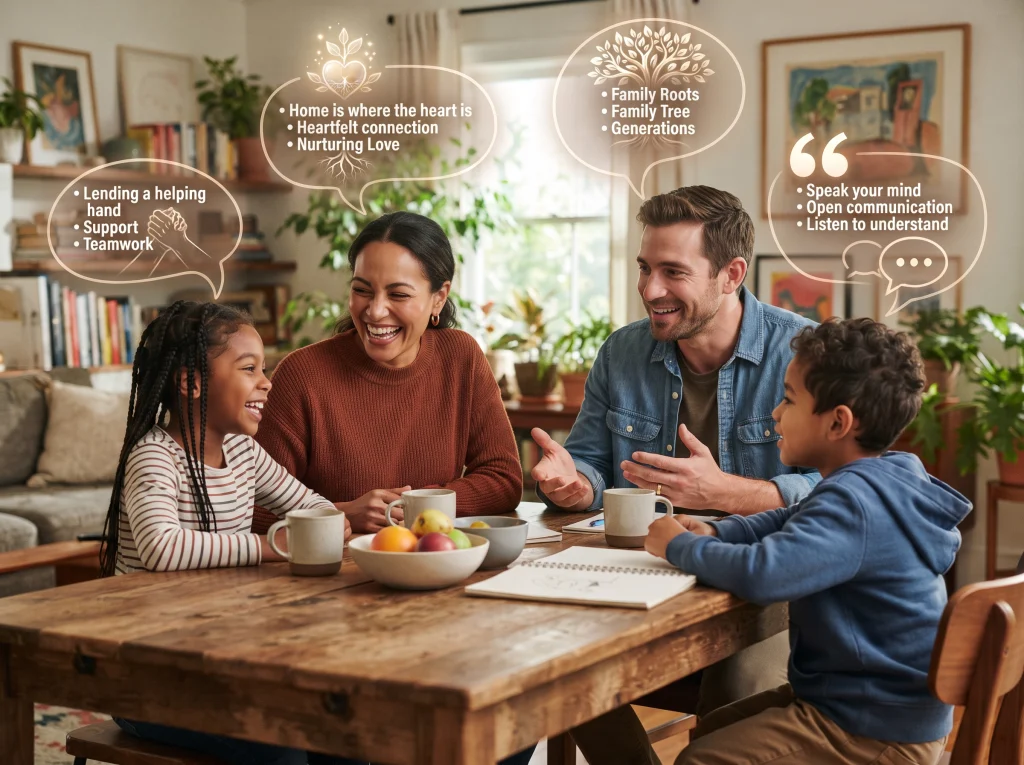
For example, “it takes a village to raise a child” means that raising a child can involve support from many people, including family members, teachers, neighbors, and others in the community.
1. It Takes a Village to Raise a Child
Meaning: Raising a child requires help and support from many people.
Example:
“We have grandparents, teachers, and close friends who help us with the kids. It really takes a village to raise a child.”
This expression is often used when parents recognize that raising children is not always a task they handle completely alone.
2. Like Father, Like Son
Meaning: A son has qualities, habits, or behaviors similar to his father.
Example:
“Jake loves fixing cars just like his dad. Like father, like son.”
The expression can describe positive or negative similarities.
3. Like Mother, Like Daughter
Meaning: A daughter resembles her mother in behavior, personality, interests, or other characteristics.
Example:
“Both of them love gardening. Like mother, like daughter.”
4. The Apple Doesn’t Fall Far From the Tree
Meaning: Children often resemble their parents in personality, behavior, talents, or habits.
Example:
“Her daughter is just as creative as she is. The apple doesn’t fall far from the tree.”
This expression can refer to both positive and negative characteristics.
5. A Chip Off the Old Block
Meaning: A child is very similar to a parent, especially in personality, skills, or behavior.
Example:
“His son is already helping him build furniture. He’s a chip off the old block.”
6. Take After Someone
Meaning: To resemble a parent or another relative in appearance, personality, or behavior.
Example:
“Maria takes after her mother. They’re both incredibly patient.”
Unlike some fixed proverbs, “take after” is commonly used as part of an ordinary sentence.
7. Bring Up
Meaning: To raise and care for a child until adulthood.
Example:
“She was brought up by her grandparents.”
“Bring up” is a common phrasal verb in English and can refer to the way someone was raised.
8. Raise a Child
Meaning: To care for, teach, guide, and support a child while they grow up.
Example:
“Raising three children requires patience and flexibility.”
In American English, raise is the usual verb for talking about caring for children as they grow.
9. Child’s Play
Meaning: Something that is very easy to do.
Example:
“Fixing that simple problem was child’s play for my dad.”
Although the expression contains the word “child,” it usually does not refer literally to parenting.
10. Spare the Rod and Spoil the Child
Meaning: An old saying expressing the idea that children need strict discipline.
Example:
“‘Spare the rod and spoil the child’ is an old saying, but many modern parents have different views about discipline.”
This expression reflects an older approach to child discipline and should not automatically be treated as modern parenting advice.
Parenting Idioms About Guidance and Discipline
Parents often use expressions to describe teaching children right from wrong, setting boundaries, and helping them develop good habits.
11. Lay Down the Law
Meaning: To establish strict rules or make clear what behavior is acceptable.
Example:
“After the kids kept staying up late, their parents had to lay down the law.”
12. Set the Record Straight
Meaning: To correct a misunderstanding or explain the truth.
Example:
“I had to set the record straight when my son told his friends that he never had homework.”
13. Show Someone the Ropes
Meaning: To teach someone how to do something or how something works.
Example:
“My older daughter showed her little brother the ropes when he joined the soccer team.”
14. Lead by Example
Meaning: To teach others through your own behavior rather than only through instructions.
Example:
“Parents can lead by example by showing children how to treat other people with respect.”
15. Practice What You Preach
Meaning: To behave according to the advice or rules you give other people.
Example:
“I tell my children to put their phones away during dinner, so I have to practice what I preach.”
16. Keep Someone in Line
Meaning: To make sure someone follows rules or behaves appropriately.
Example:
“The teacher does a good job of keeping the students in line.”
The expression can be used for children, students, employees, or other groups.
17. Learn the Hard Way
Meaning: To learn something through an unpleasant or difficult experience.
Example:
“My teenager learned the hard way that leaving his homework until midnight was a bad idea.”
18. Learn the Ropes
Meaning: To learn how to do something properly.
Example:
“New parents often need time to learn the ropes.”
Parenting Expressions About Children Growing Up
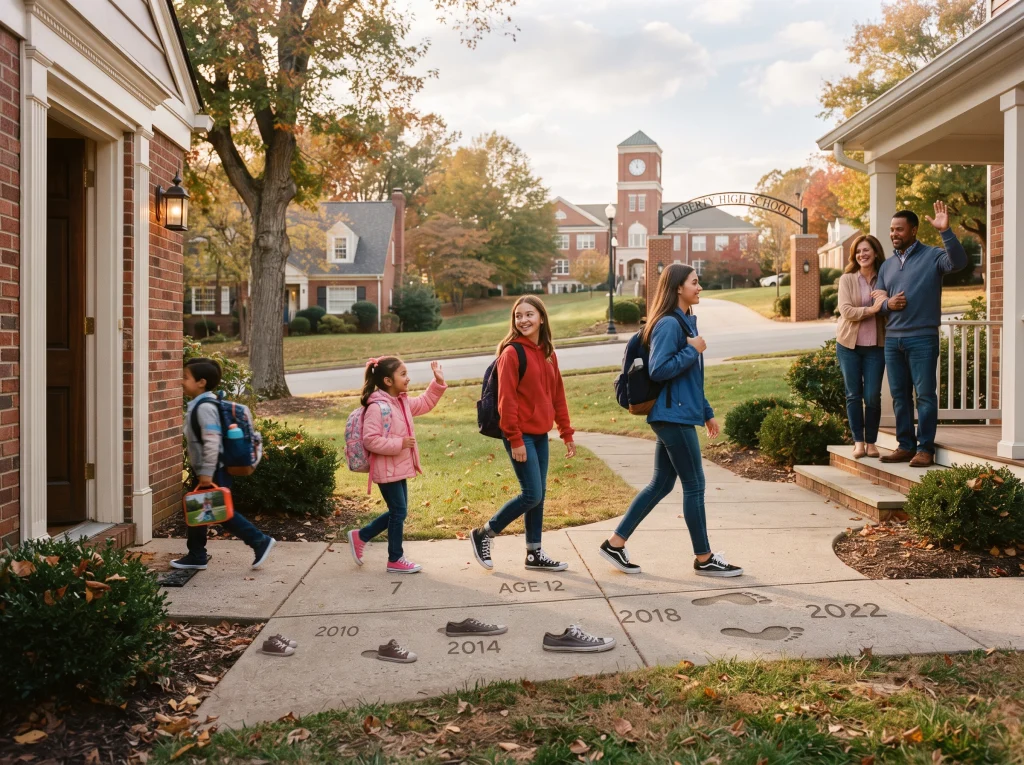
Children change quickly, and English has several expressions for describing different stages of growing up.
19. Grow Up
Meaning: To develop from childhood into adulthood.
Example:
“It seems like yesterday that my daughter was a baby, and now she’s almost grown up.”
20. Come of Age
Meaning: To reach the age or stage when a person becomes an adult.
Example:
“His parents supported him as he came of age and started making his own decisions.”
21. Spread Your Wings
Meaning: To become more independent and try new things.
Example:
“College gave our daughter a chance to spread her wings.”
22. Find Your Feet
Meaning: To become comfortable and confident in a new situation.
Example:
“It took our son a few months to find his feet after starting high school.”
23. Stand on Your Own Two Feet
Meaning: To become independent and take responsibility for yourself.
Example:
“We want our children to learn how to stand on their own two feet.”
24. Leave the Nest
Meaning: To leave the family home and begin an independent life.
Example:
“Our youngest finally left the nest when she moved to Chicago for college.”
25. Spread Your Wings and Fly
Meaning: To become independent and pursue your own goals.
Example:
“It’s hard for parents to let go, but eventually their children need to spread their wings and fly.”
Parenting Idioms About Family Resemblance
Family resemblance is a common theme in English expressions. These phrases can describe physical appearance, personality, habits, interests, and talents.
26. Run in the Family
Meaning: A characteristic, talent, habit, or condition is common among several members of a family.
Example:
“Musical talent runs in their family.”
27. In the Blood
Meaning: To have a natural tendency or strong connection to something, often because it is common in one’s family.
Example:
“Teaching seems to be in her blood. Her mother and grandmother were both teachers.”
28. A Family Trait
Meaning: A characteristic shared by several members of a family.
Example:
“Being good with numbers seems to be a family trait.”
This expression is more literal than an idiom, but it is useful when discussing family similarities.
29. Cut From the Same Cloth
Meaning: Two people have very similar personalities, attitudes, or characteristics.
Example:
“My two sons are cut from the same cloth. They both love sports and competition.”
30. Birds of a Feather
Meaning: People with similar interests, personalities, or characteristics tend to spend time together.
Example:
“Those two dads became friends immediately because they’re birds of a feather.”
The expression is not limited to parents or families.
Parenting Idioms About Challenges
Parenting can involve stressful, unpredictable, and difficult situations. These expressions can help describe those experiences naturally.
31. It Never Rains but It Pours
Meaning: Several problems or events often seem to happen at the same time.
Example:
“First the baby got sick, then the car broke down. It never rains but it pours.”
32. Keep Your Head Above Water
Meaning: To manage a difficult or busy situation without becoming overwhelmed.
Example:
“Between work, school activities, and two young children, we’re just trying to keep our heads above water.”

33. Go Through a Rough Patch
Meaning: To experience a difficult period.
Example:
“My teenager and I went through a rough patch, but our relationship is much better now.”
34. Hang in There
Meaning: To remain patient and continue despite difficulties.
Example:
“Parenting a toddler can be exhausting, but hang in there. Things will get easier.”
35. Take It One Day at a Time
Meaning: To deal with problems or responsibilities one day at a time instead of worrying about everything at once.
Example:
“With a newborn at home, we’re taking it one day at a time.”
36. When the Going Gets Tough, the Tough Get Going
Meaning: Strong and determined people continue working when circumstances become difficult.
Example:
“Parenting can be challenging, but when the going gets tough, the tough get going.”
37. Wear Many Hats
Meaning: To have many different roles or responsibilities.
Example:
“As a single parent, she wears many hats. She’s a caregiver, cook, teacher, driver, and more.”
38. Have Your Hands Full
Meaning: To be very busy because you have many responsibilities.
Example:
“With three young children, they certainly have their hands full.”
39. Sleep Like a Baby
Meaning: To sleep very well and peacefully.
Example:
“I finally slept like a baby after the kids stayed with their grandparents.”
Interestingly, the expression is often used humorously because babies do not always sleep peacefully through the night.
40. The Years Fly By
Meaning: Time seems to pass very quickly.
Example:
“Enjoy these years while you can. The years fly by.”
Parents often use this expression when talking about how quickly children grow.
How to Use Parenting Idioms Naturally in American English
The best way to use parenting idioms is to match the expression to the situation rather than trying to include an idiom in every conversation.
For example, if you are talking about a child who resembles a parent, you might say, “The apple doesn’t fall far from the tree.” If you are describing the support parents receive from relatives, teachers, and friends, “It takes a village to raise a child” may fit naturally.
Some expressions are informal and conversational, such as “have your hands full,” “leave the nest,” and “hang in there.” Others, such as “come of age,” can sound more formal or literary.
It is also important to remember that an idiom may have a broader meaning than its connection to parenting. “Child’s play,” for example, usually means that something is easy. “Wear many hats” can describe anyone who has several responsibilities, not only a parent.
Common Mistakes With Parenting Idioms
One common mistake is treating every family expression as completely interchangeable. For example, “take after someone” focuses on resemblance, while “run in the family” generally suggests that a characteristic occurs among several family members.
Another mistake is using an expression without considering its tone. Some traditional sayings about discipline can sound old-fashioned or judgmental in modern American conversations. The surrounding context matters.
It is also important to remember that idioms should sound natural. Instead of forcing an expression into a sentence, use it when it communicates the idea more effectively than a literal statement.
Why Parenting Idioms Matter
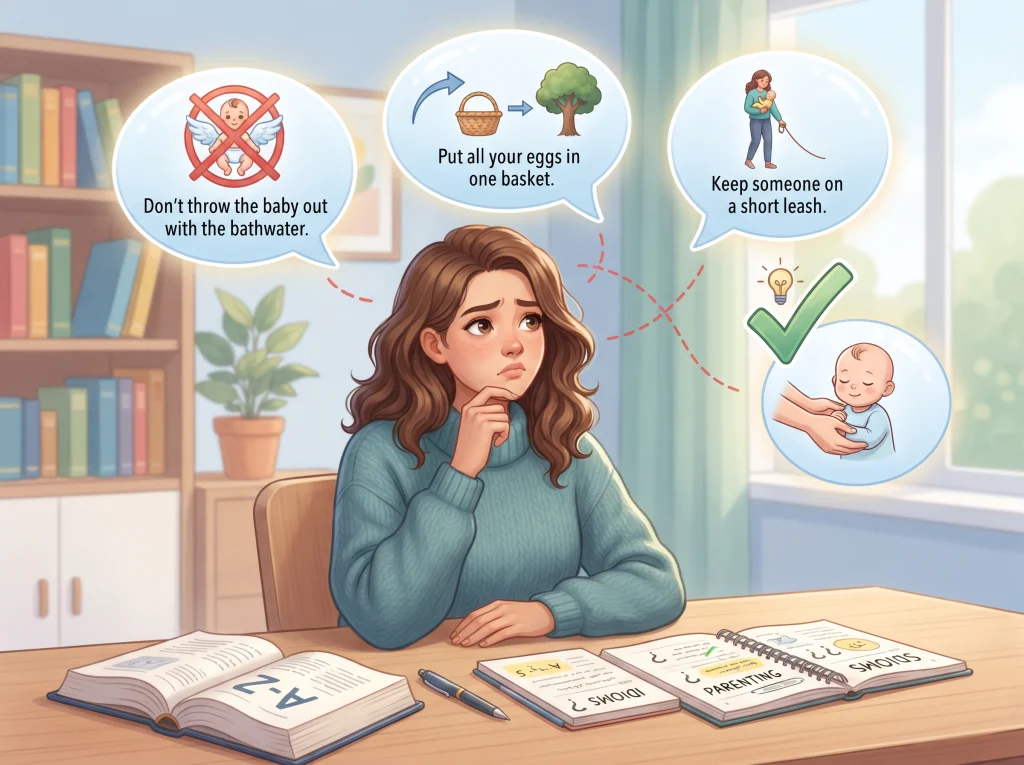
Parenting idioms help English learners understand conversations about family life, children, relationships, and growing up. They also make everyday speech easier to understand because native speakers frequently use fixed expressions without explaining their meanings.
Learning these expressions as complete phrases is often more useful than memorizing individual words. When you understand both the literal words and the intended meaning, you can recognize parenting idioms more easily in conversations, books, movies, podcasts, and social media.
FAQs:
Conclusion
Parenting idioms make it easier to talk about raising children, family relationships, discipline, growing up, and the everyday challenges parents face. Expressions such as “it takes a village to raise a child,” “the apple doesn’t fall far from the tree,” and “have your hands full” can add natural, familiar language to conversations about family life.