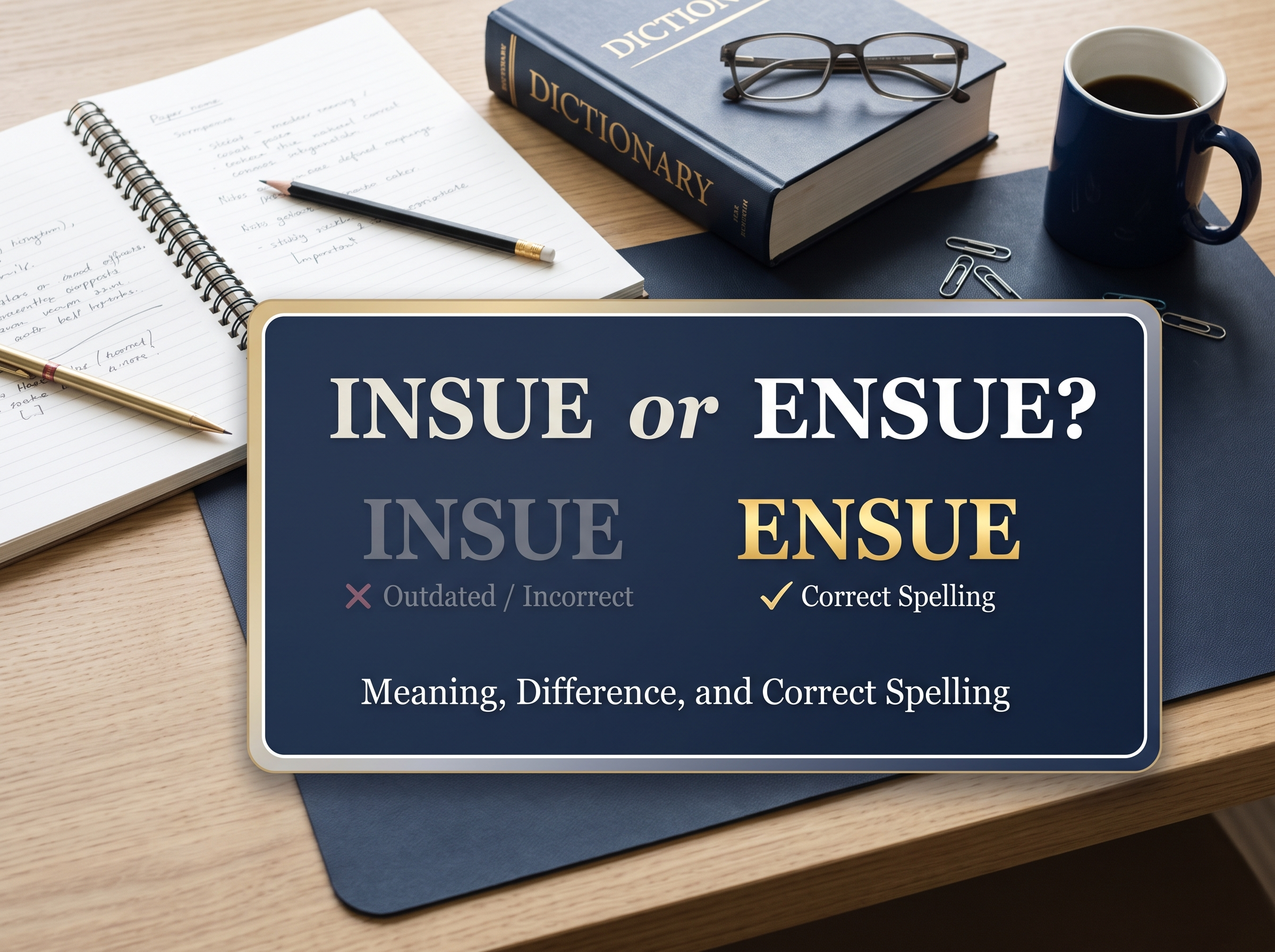
Insue or Ensue? Meaning, Difference, and Correct Spelling
Have you ever wondered whether to write insue or ensue when describing something that happens after an event? The correct choice in modern American English is ensue. It is a verb that means to happen afterward, particularly as a result of something that occurred earlier. For example, “A heated argument ensued after the meeting” means that the argument followed the meeting.
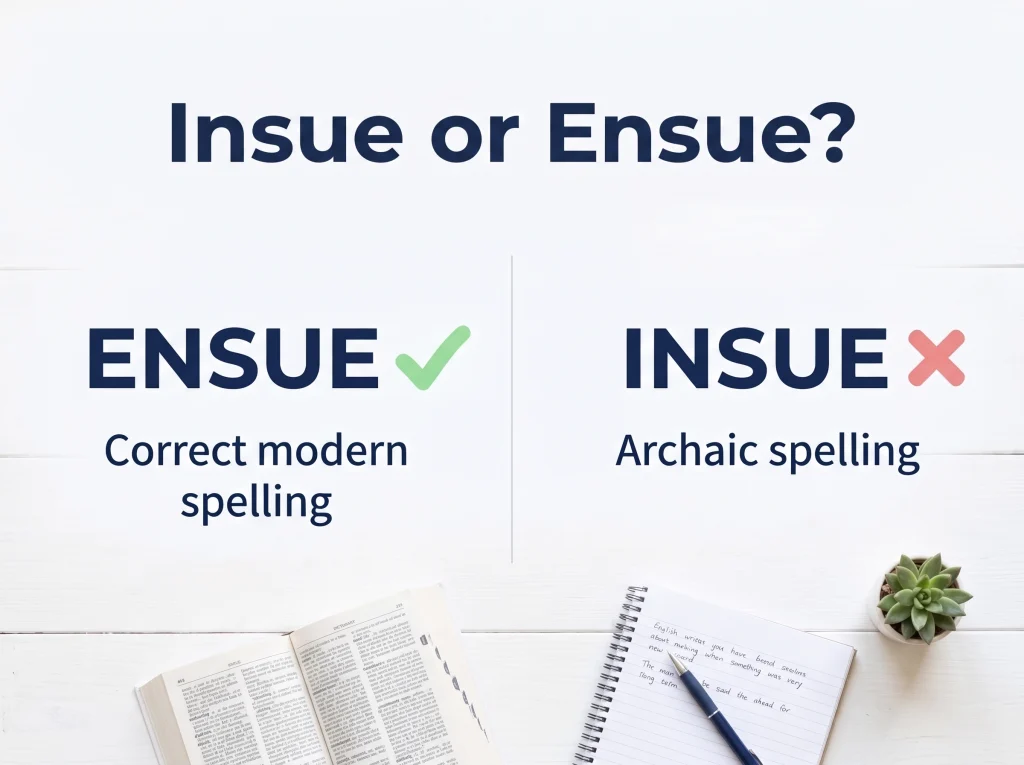
The confusion often comes from pronunciation. In American English, ensue is pronounced approximately as “in-SOO,” so the first sound may lead people to spell it with an i. However, the standard spelling begins with en, not in. Learning its meaning, verb forms, and common sentence patterns can help you use it accurately in school assignments, workplace communication, and everyday writing.
definition in the Cambridge English Dictionary
+1
What Is the Correct Spelling: Insue or Ensue?
Ensue is the correct modern spelling when you mean to happen afterward or follow as a result. Insue is an archaic spelling found in older English texts, but it is not the standard form used in contemporary American English.
Oxford Learner’s Dictionaries
+1
| Word | Status | Meaning |
|---|---|---|
| Ensue | Correct modern spelling | To happen afterward or as a result |
| Insue | Archaic spelling | An older form of ensue |
Here are two examples that demonstrate the difference:
- Correct: Confusion ensued after the announcement.
- Incorrect in modern writing: Confusion insued after the announcement.
In the first sentence, ensued explains that confusion followed the announcement. The second sentence uses an outdated spelling and should be corrected in ordinary modern writing.
Whether you are writing a school essay, a business email, a news report, or a social media post, choose ensue when you want to describe a subsequent event or consequence.
What Does Ensue Mean?
The verb ensue means to happen after something else, often because of it. It connects two events by showing that one follows another. The relationship may involve a direct consequence, a reaction, or simply the next event in a sequence.
definition in the Cambridge English Dictionary
+1
For example:
- A long discussion ensued after the presentation.
- Panic ensued when the fire alarm sounded.
- Several complications ensued after the system update.
- Laughter ensued when the comedian told the joke.
In each example, the event described by ensue follows something that happened first. The word is particularly useful when you want to express this relationship concisely.
How to Pronounce Ensue
In American English, ensue is pronounced /ɪnˈsuː/, which sounds approximately like “in-SOO.” The stress falls on the second syllable.
The pronunciation explains why some writers mistakenly use insue. Because the first syllable sounds like “in,” the incorrect spelling can seem reasonable. However, spelling is not always a direct reflection of pronunciation, so it helps to remember the standard written form.
Forms of the Verb Ensue
Like other English verbs, ensue changes form depending on the sentence’s tense and grammatical structure.
| Verb form | Example |
|---|---|
| Base form: ensue | More problems may ensue. |
| Third-person singular: ensues | Confusion ensues when instructions are unclear. |
| Past tense: ensued | A debate ensued after the vote. |
| Past participle: ensued | Several changes have ensued since the decision. |
| Present participle: ensuing | The ensuing discussion lasted an hour. |
The word ensuing is especially common before nouns. For example, “the ensuing debate” refers to the debate that followed an earlier event. These forms retain the central idea of something occurring afterward.
How to Use Ensue in a Sentence
Use ensue when you want to explain that an event follows another event. It often appears in descriptions of arguments, confusion, reactions, discussions, consequences, and unexpected developments.
In Everyday American English
- A disagreement ensued when the friends could not agree on a restaurant.
- Chaos ensued after the children opened their birthday presents.
- A funny conversation ensued after someone misunderstood the question.
- Silence ensued when the teacher announced the test results.
These examples show how ensue works in everyday situations. Although the word is somewhat formal, it can also describe humorous or ordinary events.

In Academic Writing
In academic writing, ensue can help explain relationships between events without repeating phrases such as “happened afterward.”
For example:
- A detailed discussion ensued after the research findings were presented.
- Several questions ensued following the professor’s explanation.
- Further analysis ensued after researchers identified unexpected results.
Use the verb when the sequence of events matters to your explanation. If a simpler word such as followed communicates the idea more naturally, there is no need to choose a more formal alternative.
In News and Storytelling
Writers frequently use ensue to describe what happens after a significant incident, announcement, or confrontation.
Examples include:
- Protests ensued after officials announced the decision.
- A struggle ensued when the suspect attempted to escape.
- An intense debate ensued during the public meeting.
- A series of unexpected events ensued after the storm.
The verb allows writers to move from the initial event to its aftermath without lengthy explanations. However, it does not automatically establish that the first event directly caused the second. The surrounding context should make the relationship clear.
Ensue vs. Insue: Key Differences
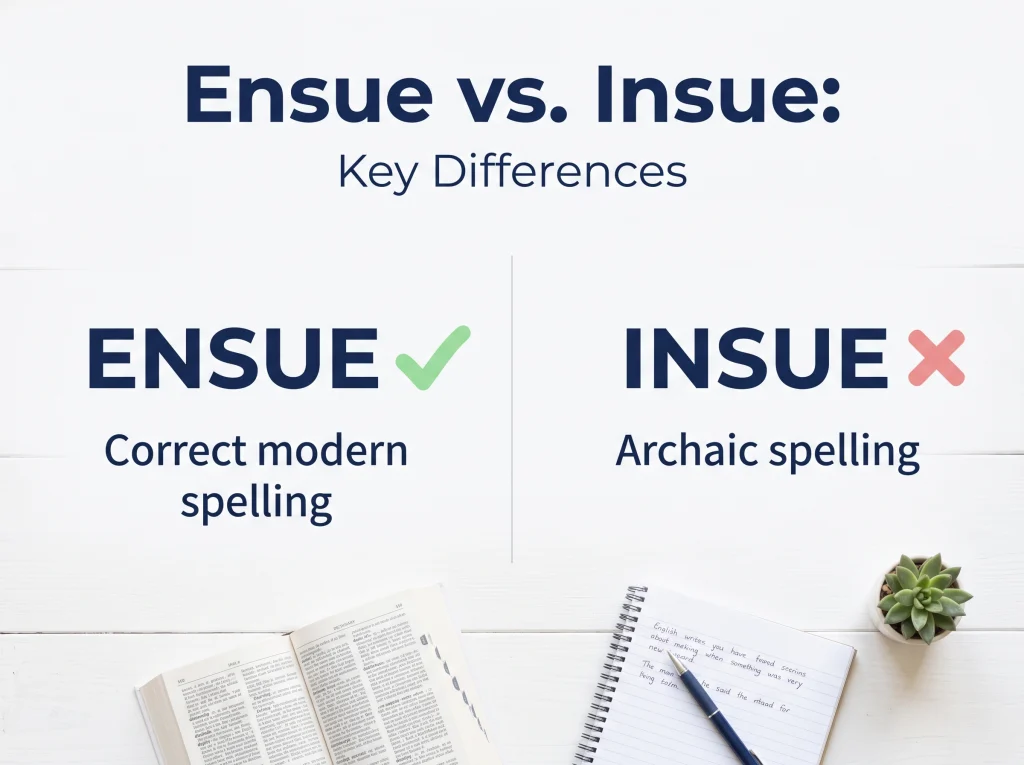
The main difference between ensue and insue is their status in modern English. Ensue is the standard spelling of the verb, while insue is an archaic variant that should generally be avoided in contemporary writing.
Oxford Learner’s Dictionaries
+1
| Feature | Ensue | Insue |
|---|---|---|
| Modern standard spelling | Yes | No |
| Accepted in ordinary contemporary writing | Yes | No |
| Meaning in historical usage | To follow or happen afterward | Older spelling of ensue |
| Suitable for modern professional writing | Yes | No |
The distinction is important because this is not a case in which both spellings are interchangeable in current American English.
Consider these examples:
Correct: An argument ensued after the manager rejected the proposal.
Incorrect for modern standard usage: An argument insued after the manager rejected the proposal.
The intended meaning is clear in both sentences, but only the first uses the standard modern spelling.
Why Do People Confuse Insue and Ensue?
The most common reason is pronunciation. Since ensue begins with a sound similar to the word in, writers may choose the wrong initial vowel when spelling it from memory.
Another reason is that English contains words beginning with both en- and in-. For example, ensure and insure are both standard words, although their usual meanings differ. Seeing these familiar pairs may lead someone to assume that insue is an equally acceptable alternative.
The historical spelling adds another layer to the confusion. Older texts may contain insue, but that does not make it appropriate for present-day essays, emails, or reports.
The easiest solution is to memorize the modern spelling: ensue.
Common Mistakes With Ensue and Insue
Understanding the correct spelling is only the first step. Using ensue naturally also requires knowing its grammar and meaning.
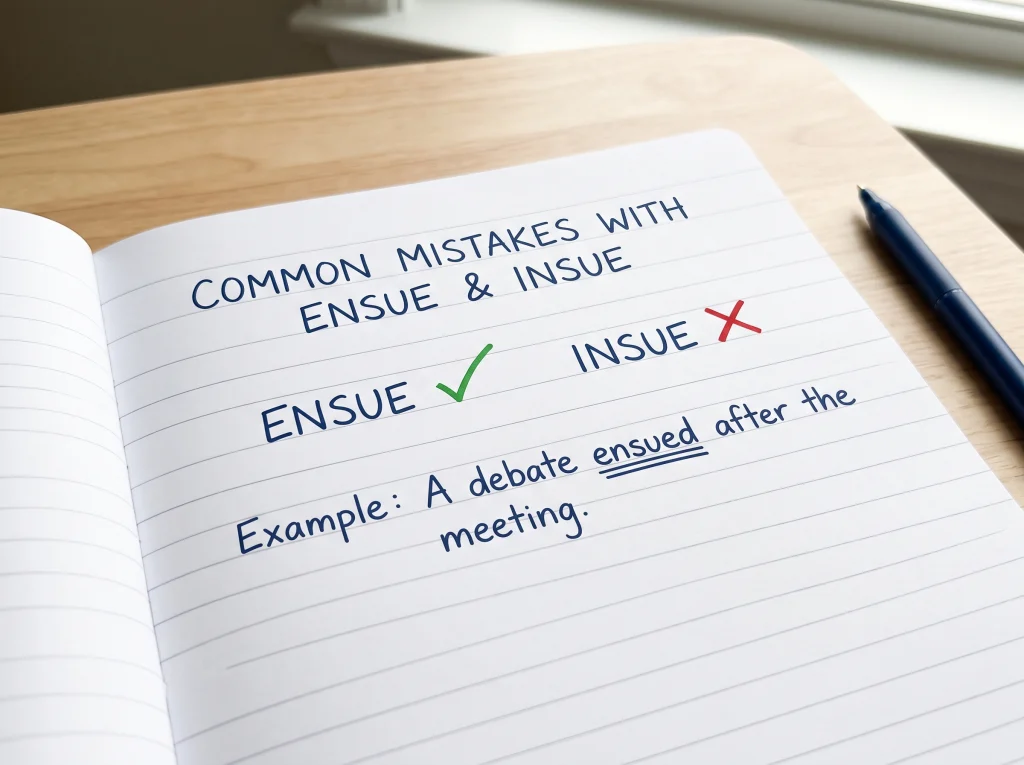
Mistake 1: Writing Insue Instead of Ensue
Incorrect: More problems will insue if we ignore the warning.
Correct: More problems will ensue if we ignore the warning.
The correction changes the initial letter while preserving the intended meaning.
Mistake 2: Using Ensue When You Mean Ensure
Although ensue and ensure look similar, they have different meanings.
- Ensue: To happen afterward or follow as a result.
- Ensure: To make certain that something happens or is true.
Examples:
- Correct: Confusion may ensue if the instructions are unclear.
- Correct: Please ensure that all instructions are clear.
The first sentence describes a possible result. The second asks someone to make sure something is done properly.
Mistake 3: Using Ensue as a Direct Replacement for Every Form of Happen
Ensue usually emphasizes that an event follows another event. It is not always the most natural substitute for happen.
For example, “What will ensue tomorrow?” may sound awkward if you simply want to ask what will happen tomorrow without referring to a preceding event.
A more natural sentence might be, “What will happen tomorrow?” Use ensue when the connection to an earlier event is important.
Mistake 4: Using the Wrong Verb Form
The verb form should agree with the sentence.
- Correct: A debate ensues whenever the topic comes up.
- Correct: A debate ensued yesterday.
- Correct: A debate may ensue tomorrow.
Remember that ensues is the present-tense form used with a singular third-person subject, while ensued is the past-tense form.
Synonyms and Related Words for Ensue
Several words can replace ensue, depending on the context. Choosing the right synonym helps you keep your writing clear and avoid unnecessary repetition.
| Word | Meaning | Example |
|---|---|---|
| Follow | To come after something | A discussion followed the announcement. |
| Result | To occur as an outcome | Further delays resulted from the storm. |
| Occur | To happen | Several problems occurred during testing. |
| Arise | To emerge or begin | New concerns arose after the meeting. |
| Develop | To begin or progress over time | A disagreement developed during negotiations. |
| Emerge | To become apparent or come into existence | New questions emerged after the review. |
These words are related but not always interchangeable. For example, arise often emphasizes the appearance of a problem or situation, while follow emphasizes sequence. Ensue is particularly suitable when one event comes after another, often as a consequence.
Ensue vs. Follow
Follow is generally more common in everyday conversation, while ensue can sound more formal.
- Everyday: An argument followed the announcement.
- More formal: An argument ensued after the announcement.
Both sentences describe an argument that came afterward. The best choice depends on your audience and the tone you want to establish.
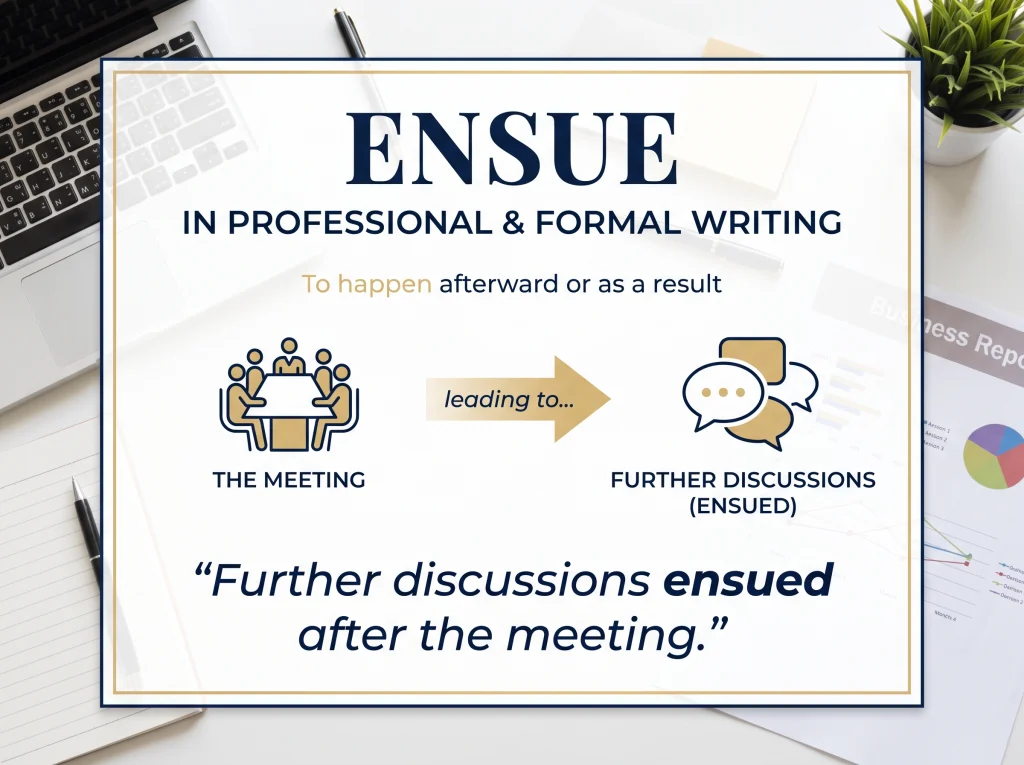
Ensue in Professional and Formal Writing
Ensue works well in business reports, academic essays, news articles, legal discussions, and formal explanations when the sequence of events is relevant.
Consider these examples:
- A review of the proposal ensued after the board meeting.
- Further negotiations ensued following the initial disagreement.
- Additional questions ensued after the company released its report.
- A formal investigation ensued after the incident was reported.
In professional writing, make sure the surrounding sentence explains what happened first. This allows readers to understand why the subsequent event matters.
Avoid using ensue simply to make a sentence sound sophisticated. In many situations, followed, happened, or resulted may be clearer and more natural.
When editing a document, check both spelling and meaning. Replace insue with ensue when describing an event that follows another, but use ensure when you mean to make certain that something happens.