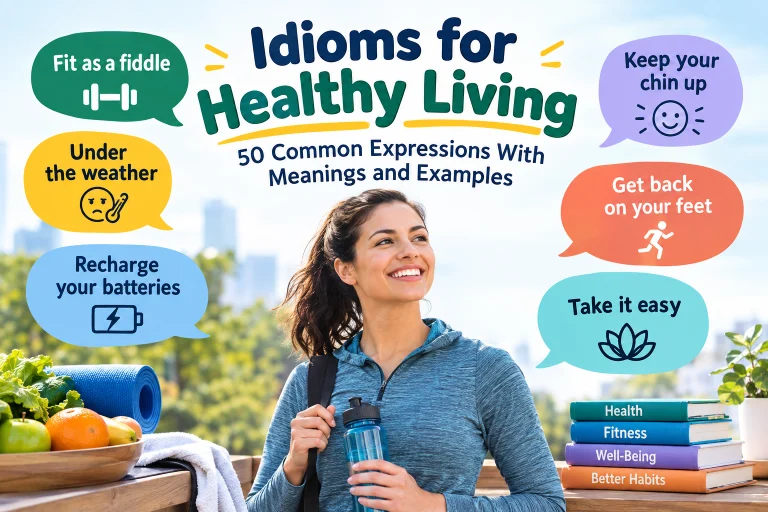
50 Idioms About Health: Meanings and Examples in American English
Talking about health does not always require medical vocabulary. In everyday American English, people often use idioms and familiar expressions to describe feeling healthy, getting sick, recovering, feeling tired, or having plenty of energy. Phrases such as under the weather, fit as a fiddle, and on the mend can make ordinary conversations sound more natural.
Some expressions are specifically about health, while others are broader phrases that are commonly used when discussing physical condition, illness, recovery, or energy. Understanding both types can help English learners recognize what native speakers mean without taking every phrase literally.

For example, if someone says, “I’m feeling under the weather,” they usually mean they are feeling somewhat sick or unwell. If someone says, “She’s fit as a fiddle,” they mean she is in excellent physical condition. These meanings are quite different from the literal meanings of the individual words.
What Are Idioms About Health?
Idioms about health are common expressions used to talk about physical condition, illness, fitness, energy, recovery, and general well-being. They often communicate an idea indirectly instead of using a literal description.
For example:
- Under the weather means feeling somewhat sick.
- Fit as a fiddle means very healthy and physically fit.
- On the mend means recovering from an illness or injury.
- A clean bill of health means that a doctor has determined that someone is healthy.
- Back on your feet means recovered enough to return to normal activity.
Some health-related expressions are technically proverbs or fixed expressions rather than strict idioms. An apple a day keeps the doctor away, for example, is a traditional proverb. Still, it is commonly grouped with health expressions because it communicates a familiar idea about staying healthy.
50 Common Idioms About Health
Idioms About Good Health and Fitness
- Fit as a fiddle
Meaning: Very healthy and physically fit.
Example: My grandfather is 78, but he is still fit as a fiddle. - In good shape
Meaning: Physically fit or healthy.
Example: She exercises regularly and is in good shape. - In the pink
Meaning: In very good health.
Example: After a few weeks of rest, he was back in the pink. - The picture of health
Meaning: Someone who looks extremely healthy.
Example: After changing his lifestyle, he became the picture of health. - Fighting fit
Meaning: Very healthy, strong, and ready for physical activity.
Example: After months of training, the athletes were fighting fit. - Alive and kicking
Meaning: Healthy, active, and full of life.
Example: My grandmother is 90 and still alive and kicking. - Full of beans
Meaning: Very energetic and lively.
Example: The kids were full of beans after breakfast. - Have a spring in your step
Meaning: To appear happy, energetic, and lively.
Example: She had a spring in her step after hearing the good news. - Feel like a million bucks
Meaning: Feel extremely good, healthy, or energetic.
Example: After a good night’s sleep, I feel like a million bucks. - As right as rain
Meaning: Completely well or back to normal after feeling sick.
Example: Give him another day of rest, and he’ll be as right as rain. - In good health
Meaning: Healthy and well.
Example: Her doctor confirmed that she is in good health. - In shape
Meaning: Physically fit or in good physical condition.
Example: I’m trying to get in shape before the hiking trip. - In tip-top shape
Meaning: In excellent condition.
Example: The athlete was in tip-top shape before the competition. - Clean bill of health
Meaning: A doctor’s confirmation that someone is healthy.
Example: After several tests, he received a clean bill of health from his doctor. - Keep in shape
Meaning: Maintain good physical fitness.
Example: Walking every day helps me keep in shape.

Idioms About Feeling Sick or Unwell
- Under the weather
Meaning: Feeling somewhat sick or unwell.
Example: I’m feeling under the weather today, so I’m staying home. - Come down with something
Meaning: Become sick with an illness.
Example: I think I’m coming down with something. - Run down
Meaning: Extremely tired or lacking energy, sometimes because of stress or illness.
Example: I’ve been working long hours, and I’m feeling run down. - Out of sorts
Meaning: Feeling unwell, uncomfortable, or not like yourself.
Example: I have been feeling out of sorts all morning. - Off color
Meaning: Looking or feeling slightly ill.
Example: You look a little off color today. - Sick as a dog
Meaning: Very sick or feeling extremely ill.
Example: After eating the spoiled food, he was sick as a dog. - At death’s door
Meaning: Extremely ill or in a very serious condition.
Example: The old expression describes someone who appears to be at death’s door. - Look like death warmed over
Meaning: Look extremely tired, sick, or exhausted.
Example: After staying awake all night, I looked like death warmed over. - Down with something
Meaning: Sick with an illness.
Example: She’s down with the flu and won’t be at work today. - Not feel like yourself
Meaning: Feel physically or emotionally different from normal.
Example: I’ve been tired all week and just don’t feel like myself. - Have a frog in your throat
Meaning: Have difficulty speaking because your throat is dry, hoarse, or irritated.
Example: Sorry, I have a frog in my throat this morning. - Have a cold
Meaning: Be suffering from a common cold.
Example: I have a cold, so I’m going to rest tonight. - Catch a cold
Meaning: Become sick with a cold.
Example: I caught a cold after traveling last weekend. - Feel lousy
Meaning: Feel very sick, tired, or generally bad.
Example: I felt lousy yesterday, but I’m doing better today. - Feel rough
Meaning: Feel sick, tired, or physically uncomfortable.
Example: I felt rough after getting almost no sleep.

Idioms About Recovery and Getting Better
- On the mend
Meaning: Getting better after an illness or injury. Cambridge Dictionary defines it as becoming healthy after an illness.
Example: She had surgery last month and is now on the mend. - Back on your feet
Meaning: Recovered enough to return to normal activities.
Example: I hope you’re back on your feet soon. - Pull through
Meaning: Survive a serious illness, injury, or difficult situation.
Example: The doctors were hopeful that he would pull through. - Back to normal
Meaning: Returned to the usual physical condition or routine.
Example: After two weeks of rest, she was finally back to normal. - Get back on your feet
Meaning: Recover and regain your normal strength or independence.
Example: It took him several weeks to get back on his feet after the accident. - Turn the corner
Meaning: Begin to improve after a difficult period of illness or trouble.
Example: The patient seems to have turned the corner and is getting stronger. - On the road to recovery
Meaning: Gradually getting better after illness or injury.
Example: She’s on the road to recovery after her operation. - Get back in the saddle
Meaning: Return to an activity after a break, setback, or period of difficulty.
Example: After recovering from his injury, he was eager to get back in the saddle. - Just what the doctor ordered
Meaning: Exactly what is needed to make someone feel better or solve a problem.
Example: A quiet weekend at home was just what the doctor ordered. - Nursing someone back to health
Meaning: Caring for someone while they recover from illness.
Example: Her family spent weeks nursing her back to health.

Idioms About Health, Energy, and Well Being
- An apple a day keeps the doctor away
Meaning: A traditional saying suggesting that healthy habits can help maintain good health.
Example: My grandmother always said, “An apple a day keeps the doctor away.” - Take care of yourself
Meaning: Look after your health and well-being.
Example: You’re working too hard, so take care of yourself. - Keep your chin up
Meaning: Stay positive during a difficult situation.
Example: Keep your chin up while you’re recovering. - Get a clean bill of health
Meaning: Be officially told by a doctor that you are healthy.
Example: He got a clean bill of health after his medical examination. - Have an iron constitution
Meaning: Have unusually strong health or the ability to resist illness.
Example: She seems to have an iron constitution because she rarely gets sick. - A new lease on life
Meaning: A renewed sense of energy, purpose, or opportunity after a major change or recovery.
Example: After recovering from his illness, he felt he had a new lease on life. - Put some color back in your cheeks
Meaning: Help someone look healthier after illness or weakness.
Example: A few days of rest put some color back in her cheeks. - Breathe easy
Meaning: Relax because a worry or danger has passed.
Example: Once the test results came back normal, the family could breathe easy. - Weather the storm
Meaning: Successfully get through a difficult period.
Example: With good support from her family, she was able to weather the storm during her recovery. - Keep the doctor away
Meaning: A humorous reference to maintaining habits that may help support good health.
Example: He jokes that his daily walk helps keep the doctor away.

Health Expressions Used in Everyday American English
Some health idioms are especially useful in casual American conversations. Under the weather is one of the most natural ways to say that you are not feeling well without describing specific symptoms. For example, “I’m a little under the weather today” sounds casual and conversational.
When someone is recovering, on the mend and back on your feet are useful choices. “She’s on the mend” emphasizes that recovery is still happening, while “She’s back on her feet” suggests that she has recovered enough to return to normal activities.
For positive health, expressions such as fit as a fiddle, in good shape, in the pink, and the picture of health can describe someone who appears healthy and energetic. Fit as a fiddle, in particular, means being in excellent health or physically fit.
Common Mistakes With Health Idioms
Health idioms are easy to misunderstand because their literal meanings are often unrelated to their figurative meanings.
Saying “below the weather” instead of “under the weather”
The standard expression is under the weather, not “below the weather.”
Correct:
I’m feeling under the weather today.
Incorrect:
I’m feeling below the weather today.
Confusing “on the mend” with “fully recovered”
On the mend means that someone is improving or recovering. It does not necessarily mean that the person has completely recovered.
Example:
She’s still tired, but she’s on the mend.
Using “fit as a fiddle” for every kind of health
Fit as a fiddle generally emphasizes excellent physical health or fitness. It is not normally used to describe every aspect of mental or emotional well-being.
Natural:
My uncle is fit as a fiddle.
Taking “clean bill of health” too literally
A clean bill of health usually refers to a doctor’s determination that someone is healthy. It can also be used more broadly for something that has been found to be in good condition.
Using very dramatic idioms for minor problems
Expressions such as at death’s door are very strong. They should not normally be used for an ordinary headache, mild cold, or minor tiredness.
For a mild illness, under the weather is much more appropriate.
How to Use Health Idioms Naturally in American English
The easiest way to use health idioms naturally is to match the expression to the situation.
If you have a mild illness, say:
“I’m feeling a little under the weather.”
If you are recovering:
“I’m finally on the mend.”
If you have recovered enough to return to normal activities:
“I’m back on my feet.”
If you are talking about someone’s excellent physical condition:
“She’s fit as a fiddle.”
If a doctor confirms that everything looks healthy:
“He got a clean bill of health.”
It is also important to consider the level of formality. Health idioms are common in conversations with friends, family members, coworkers, and other people you know. In a formal medical setting, however, clear and literal language is often more appropriate when describing symptoms, diagnoses, medications, or treatment.

Why Learning Health Idioms Helps English Learners
Health is a common topic in everyday conversation, so English learners are likely to encounter these expressions in conversations, movies, television, books, podcasts, and online content.
Knowing the idiomatic meaning helps you understand a sentence quickly. If a coworker says, “I’m under the weather today,” you do not need to interpret the phrase literally. You can understand that the person is saying they do not feel well.
Health idioms also help learners choose more natural conversational English. Instead of repeatedly saying “I am sick” or “I am feeling good,” you can use expressions such as under the weather, on the mend, back on your feet, and fit as a fiddle when the context is appropriate.
FAQs:
Conclusion
Idioms about health give English speakers simple and memorable ways to talk about wellness, illness, energy, fitness, and recovery. Some are extremely common, such as under the weather, fit as a fiddle, on the mend, and back on your feet, while others are more colorful or traditional.
The key is to learn each expression together with its meaning and a natural example. Once you understand when an idiom fits the situation, you can use it more confidently in everyday American English.