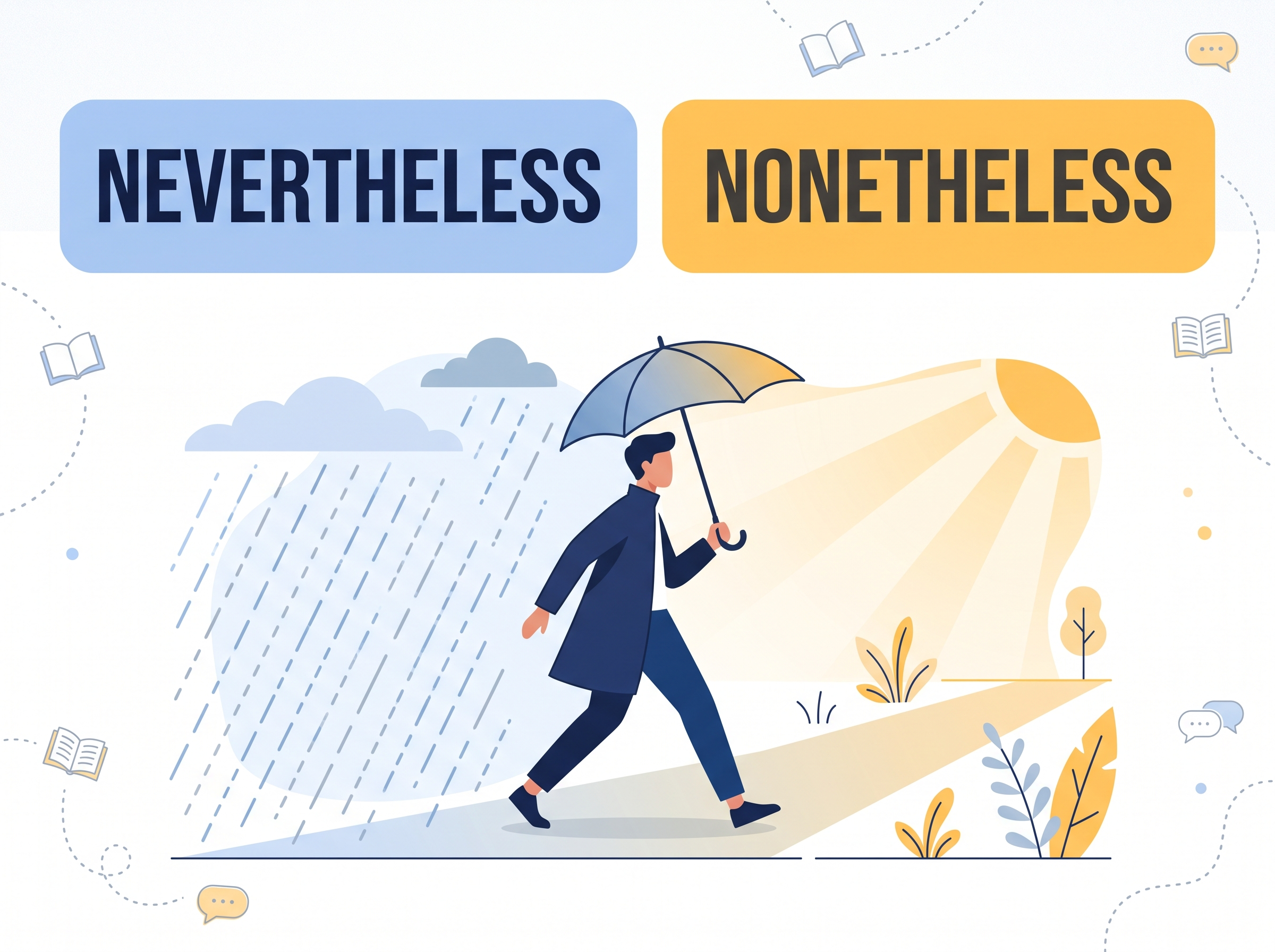
Nevertheless or Nonetheless? Meaning, Difference, and Correct Usage
Nevertheless and nonetheless are both correct English words. They have nearly the same meaning and are used to show that something remains true despite a fact, problem, difficulty, or contrasting situation. In most sentences, you can use either word without changing the overall meaning.
For example, you can write, “It was raining; nevertheless, we went for a walk,” or “It was raining; nonetheless, we went for a walk.” Both sentences are grammatically correct and communicate the same idea.
The main difference is not meaning but word choice and style. Both words appear in formal writing, academic work, professional communication, and everyday American English. Understanding how to use them, punctuate them, and distinguish them from similar transition words will help you write more clearly and confidently.
Nevertheless or Nonetheless: Which Is Correct?
Both nevertheless and nonetheless are correct spellings in American English. Neither is a misspelling of the other, and neither is universally considered more correct.
Use either word when you want to introduce a statement that contrasts with what came before it or shows that a previous obstacle does not change the outcome.
Examples:
- The assignment was difficult; nevertheless, she completed it on time.
- The assignment was difficult; nonetheless, she completed it on time.
- He had very little experience. Nevertheless, he performed well.
- The store was crowded. Nonetheless, we found what we needed.
All four sentences are correct. The choice depends on your personal writing style, the rhythm of the sentence, and your preference.
If you are writing an essay, business report, email, or academic paper, either word is appropriate. The most important thing is to use it where a contrast or unexpected result makes sense.
What Does Nevertheless Mean?
Nevertheless is an adverb meaning in spite of that, even so, or despite what has just been mentioned. It connects an earlier fact or situation with a statement that remains true despite it.
The word often appears when the second statement is unexpected because of the information provided in the first statement.
Examples:
- The weather was cold; nevertheless, the children played outside.
- She was nervous about the interview. Nevertheless, she answered every question confidently.
- The project faced several delays; nevertheless, the team finished it.
- The restaurant was expensive. Nevertheless, the food was worth the price.
In each example, the second statement contrasts with the first. Cold weather might discourage children from playing outside, nervousness might affect an interview, and delays might prevent a project from being completed on time. Nevertheless introduces an outcome that occurs despite those circumstances.
When to Use Nevertheless
Use nevertheless when you want to emphasize that a fact, obstacle, or difficulty does not prevent something else from happening.
It is particularly useful in formal and professional writing because it creates a clear connection between contrasting ideas.
For example:
“Customer demand decreased during the first quarter. Nevertheless, the company maintained its service quality.”
The first sentence describes a challenge, while the second explains what remained true despite that challenge.
Nevertheless also works in ordinary conversation, although some speakers may prefer simpler expressions such as “still” or “even so.”
What Does Nonetheless Mean?
Nonetheless is an adverb that means despite that, even so, or in spite of what has just been said or done. It introduces a statement that remains valid despite a difficulty, limitation, or contrasting fact. Major dictionaries, including Cambridge and Oxford, recognize nonetheless as a synonym of nevertheless.
definition in the Cambridge English Dictionary
+1
Examples:
- The apartment was small; nonetheless, it felt comfortable.
- He made several mistakes. Nonetheless, his presentation was effective.
- The instructions were confusing; nonetheless, we completed the task.
- The gift was inexpensive, but it was meaningful nonetheless.
In the final example, nonetheless appears at the end of the sentence. This placement emphasizes that the gift remained meaningful despite its low cost.
When to Use Nonetheless
Use nonetheless when you want to acknowledge a limitation or contrasting fact while emphasizing that it does not change the main point.
The word works well in essays, reports, business communication, and everyday writing.
For example:
“The proposal exceeded our original budget. Nonetheless, the team approved it because the expected benefits justified the cost.”
The sentence acknowledges the financial concern but makes it clear that the concern did not prevent approval.
Nonetheless can also appear later in a sentence when it sounds more natural:
“The proposal was expensive but worthwhile nonetheless.”
Both positions are grammatically acceptable. Choose the placement that makes your sentence easiest to understand.
Nevertheless vs. Nonetheless: Key Differences
Nevertheless and nonetheless have essentially the same meaning. Both express contrast and show that a previous fact does not change the following statement or outcome.
| Feature | Nevertheless | Nonetheless |
|---|---|---|
| Meaning | Despite that; even so | Despite that; even so |
| Part of speech | Adverb | Adverb |
| Correct spelling | Nevertheless | Nonetheless |
| Formal writing | Appropriate | Appropriate |
| Academic writing | Appropriate | Appropriate |
| American English | Correct | Correct |
| Sentence position | Beginning, middle, or end | Beginning, middle, or end |
There is no strict grammatical rule requiring one word in a particular situation. Both can introduce a contrasting statement, appear within a sentence, or emphasize that something remains true despite an obstacle.

Cambridge English Dictionary
+2
Are There Any Differences in Tone?
Some writers may prefer nevertheless when introducing a counterpoint and nonetheless when emphasizing that something remains true despite a limitation. However, this is a stylistic preference rather than a dependable grammatical distinction.
Compare these examples:
- “The deadline was approaching. Nevertheless, the team continued testing the software.”
- “The deadline was approaching. Nonetheless, the team continued testing the software.”
Both sentences communicate the same idea. The deadline created pressure, but the team continued its work.
In American English, either word is suitable for formal and professional contexts. Consistency and clarity matter more than choosing one over the other.
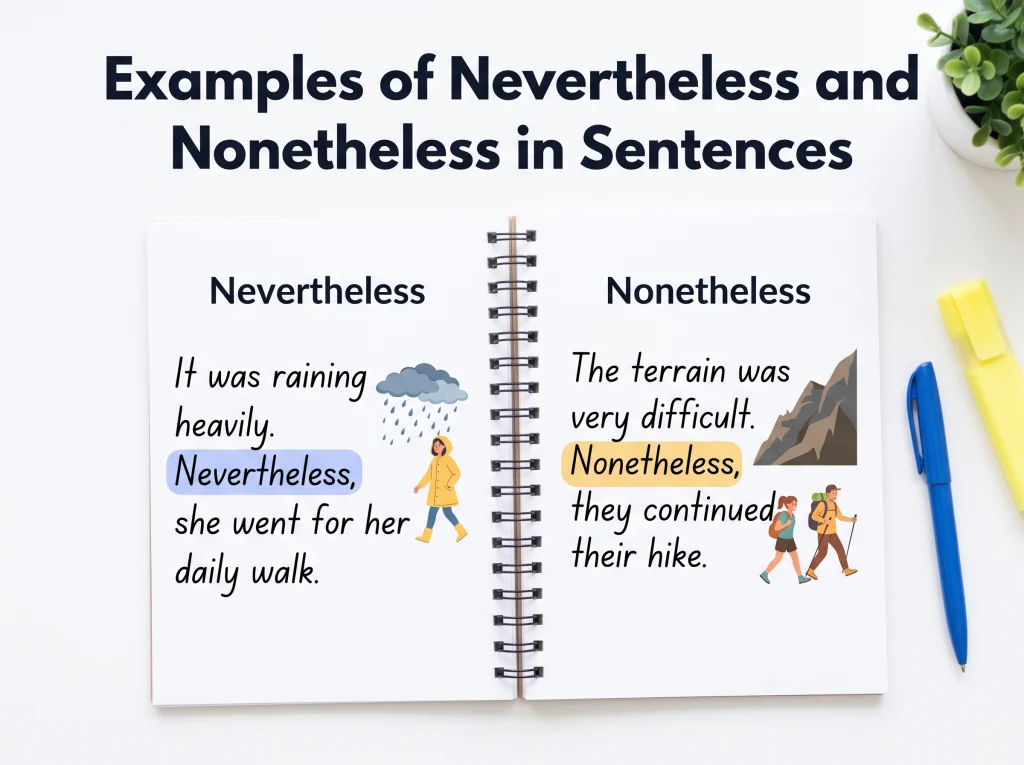
Examples of Nevertheless and Nonetheless in Sentences
The following examples show how both words work in different situations. In most cases, you can replace one with the other without changing the central meaning.
Everyday American English
- It was getting late; nevertheless, we stopped for dinner.
- The coffee was cold. Nonetheless, I drank it.
- She was tired but continued working nevertheless.
- The road was busy. Nonetheless, we crossed safely at the intersection.
- He disagreed with my opinion. Nevertheless, we remained friends.
Academic and Educational Writing
- The study had a small sample size; nevertheless, its findings were useful.
- The exam was challenging. Nonetheless, most students completed it.
- The theory has limitations but remains relevant nevertheless.
- The research was preliminary. Nonetheless, it provided a useful starting point.
- The assignment required additional research; nevertheless, the student submitted it on time.
Business and Professional Writing
- Sales declined in March. Nevertheless, the company met its annual target.
- The client requested several revisions; nonetheless, the project stayed on schedule.
- The software had a few minor issues but was effective nevertheless.
- The proposal involved financial risks. Nonetheless, management approved further evaluation.
- The meeting was brief but productive nevertheless.
Writing With Numbers, Costs, and Limitations
- The discount was small; nevertheless, customers appreciated it.
- The room measured only 120 square feet. Nonetheless, it accommodated the necessary furniture.
- The company had limited resources but delivered a useful product nevertheless.
- The initial payment was modest. Nonetheless, it helped cover essential expenses.
- The trip was short but enjoyable nonetheless.
These examples demonstrate that neither word is restricted to a particular topic or type of writing.
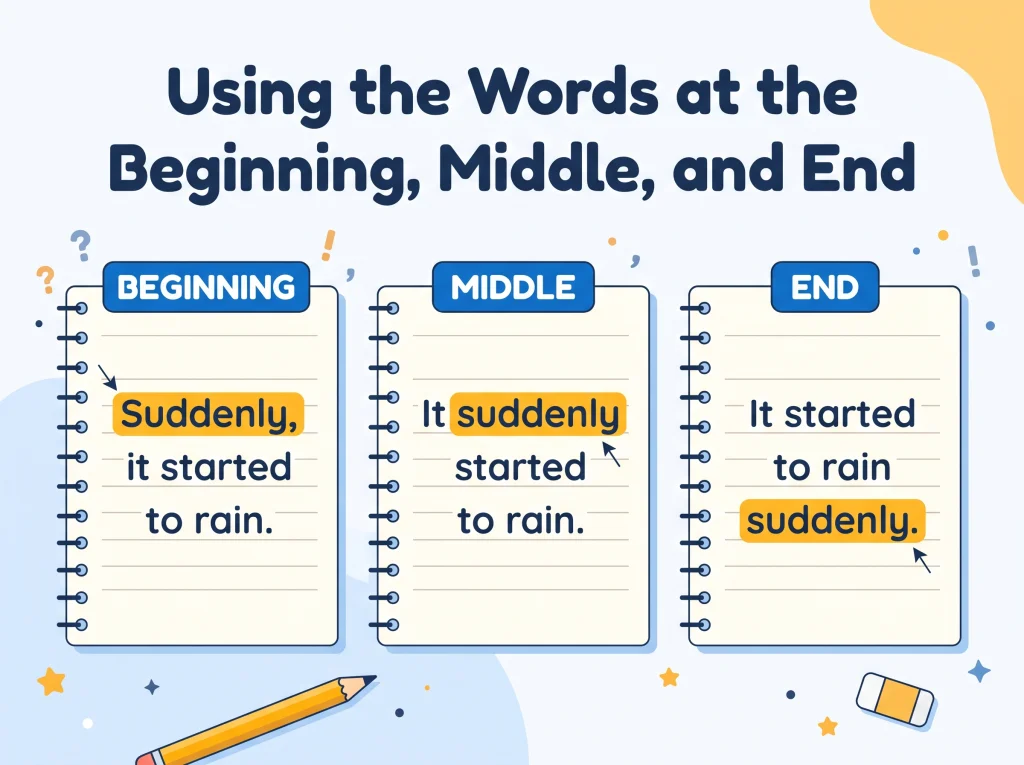
Using the Words at the Beginning, Middle, and End
Both words can appear in different parts of a sentence, depending on the intended emphasis.
At the beginning
Nevertheless, the team completed the project.
Nonetheless, the team completed the project.
In the middle
The team, nevertheless, completed the project.
The team, nonetheless, completed the project.
At the end
The team completed the project nevertheless.
The team completed the project nonetheless.
At the beginning of a sentence, either word is commonly followed by a comma. When inserted parenthetically in the middle, commas can set it off from the surrounding sentence. At the end, a comma is generally unnecessary.
How to Use Nevertheless and Nonetheless Correctly
Both words function as adverbs, often as conjunctive adverbs that connect ideas. Correct punctuation depends on how the surrounding clauses are structured.
1. Use a Semicolon Between Two Independent Clauses
When two complete sentences are closely connected, you can join them with a semicolon followed by nevertheless or nonetheless.
Correct:
“The weather was unpleasant; nevertheless, we went hiking.”
“The weather was unpleasant; nonetheless, we went hiking.”
The first clause is complete, and the second clause is also complete. The semicolon connects them, while the comma after the transition marks the relationship between the ideas.
2. Use a Period When Starting a New Sentence
You can also separate the ideas into two sentences.
Correct:
“The weather was unpleasant. Nevertheless, we went hiking.”
“The weather was unpleasant. Nonetheless, we went hiking.”
This structure works particularly well in essays, reports, and articles because it clearly separates the contrasting ideas.
3. Use a Comma With a Conjunctive Adverb Between Clauses
A comma alone should not join two independent clauses when nevertheless or nonetheless connects them.
Incorrect: “The weather was unpleasant, nevertheless, we went hiking.”
Correct: “The weather was unpleasant; nevertheless, we went hiking.”
Correct: “The weather was unpleasant. Nevertheless, we went hiking.”
This error is known as a comma splice. Use a semicolon or a period to separate the complete clauses.
4. Place the Word Naturally Within the Sentence
Both words can appear in the middle or at the end when the sentence structure supports that placement.
Examples:
- “The plan was, nevertheless, worth considering.”
- “The plan was, nonetheless, worth considering.”
- “The plan was worth considering nevertheless.”
- “The plan was worth considering nonetheless.”
The middle position often creates a more formal or deliberate tone. The final position can sound natural when the word reinforces a point that has already been made.
5. Avoid Unnecessary Repetition
Using both words together is usually unnecessary because they serve the same function.
Wordy: “Nevertheless, we continued; nonetheless, we finished the project.”
Clearer: “Nevertheless, we continued and finished the project.”
You can use both words in the same paragraph when each introduces a separate, meaningful contrast. Avoid repeating them simply to make writing sound more formal.
Common Mistakes to Avoid
Although nevertheless and nonetheless are easy to use once you understand their meaning, several mistakes can make your writing less clear.
Mistake 1: Treating One Word as Incorrect
Incorrect assumption: “Nonetheless is not correct American English.”
Correct understanding: Both words are standard English and are accepted in American writing.
For example, “The task was difficult; nevertheless, we finished it” and “The task was difficult; nonetheless, we finished it” are both correct.
Mistake 2: Using a Comma Splice
Incorrect: “The restaurant was crowded, nevertheless, we found a table.”
Correct: “The restaurant was crowded; nevertheless, we found a table.”
You can also write, “The restaurant was crowded. Nonetheless, we found a table.”
Mistake 3: Confusing Contrast With Addition
Nevertheless and nonetheless express contrast. They are not simply alternatives to words such as also, furthermore, or in addition.
Incorrect for a simple addition: “The report contains sales figures; nevertheless, it includes customer feedback.”
If customer feedback is simply additional information rather than a contrasting point, write:
“The report contains sales figures; in addition, it includes customer feedback.”
Use nevertheless or nonetheless when the second idea contrasts with, or remains true despite, the first.
Mistake 4: Using Them When No Contrast Exists
Consider this sentence:
“The meeting started at 10 a.m. Nevertheless, the conference room had 12 chairs.”
The two facts do not establish a meaningful contrast. A more natural version would be:
“The meeting started at 10 a.m., and the conference room had 12 chairs.”
A transition word should clarify the relationship between ideas rather than make a sentence sound unnecessarily complicated.
Mistake 5: Confusing Nonetheless With “None the Less”
Nonetheless is normally written as one word. The expression none the less can appear as three words in certain constructions, but it is not the standard spelling of the adverb in the examples discussed in this article.
For ordinary American English writing, use nonetheless when you mean “despite that” or “even so.”
Which Word Is Better in American English?
Neither word is universally better. Both are correct, and the best choice depends on your sentence, audience, and preferred writing style.
Use nevertheless if it feels more natural when introducing a counterpoint or contrasting conclusion. Use nonetheless if you prefer its sound or if it fits the rhythm of your sentence. These are stylistic choices, not strict rules.
For school assignments, professional emails, business reports, and academic papers, you can confidently use either word. If you are editing a document, consistency in tone and clear punctuation are more important than replacing every instance of one word with the other.
If your writing is intended for a broad American audience, simpler alternatives may sometimes be more conversational. Words such as still, yet, and even so can express similar ideas, depending on context. Nevertheless and nonetheless remain useful when you want to establish a clear, polished contrast.
Frequently Asked Questions:
Conclusion
Nevertheless and nonetheless are both correct spellings with nearly identical meanings. Each expresses the idea that something remains true despite a difficulty, limitation, or contrasting fact. Neither word is inherently more correct in American English, and both are suitable for formal, academic, professional, and everyday writing.