Drily or Dryly? Correct Spelling, Meaning, and Usage in American English
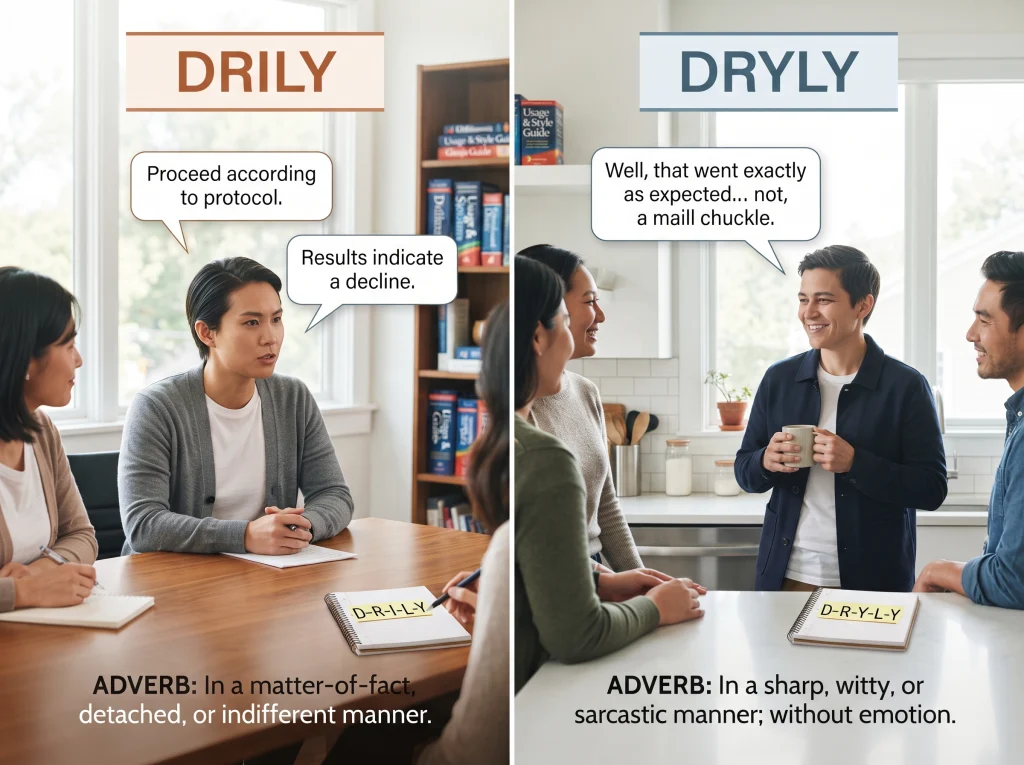
Drily and dryly are both correct spellings. They are adverbs formed from the adjective dry, and both can describe speaking or writing in a serious, restrained, or subtly humorous way.

In American English, dryly is the spelling many readers will recognize most readily, while drily is also a standard dictionary spelling. Cambridge lists drily and dryly as alternative spellings and gives the same pronunciation for both.
For example:
“That went well,” she said dryly.
You could also write:
“That went well,” she said drily.
Both sentences are grammatically correct and have the same basic meaning.
What Does Drily Mean?
Drily is an adverb meaning in a dry, restrained, or subtly humorous manner. It often describes a comment that is funny without sounding openly humorous.
Cambridge defines drily as being funny in a way that is not obvious. Its American English dictionary entry also identifies dryly as an alternative spelling.
For example:
“I’m sure that will go perfectly,” he said drily.
The speaker probably does not genuinely expect everything to go perfectly. The humor comes from the restrained way the comment is delivered.
Examples of Drily
- She drily commented that the meeting had been unusually short.
- “What could possibly go wrong?” he asked drily.
- He smiled drily at the suggestion.
- “That’s exactly what we needed,” she said drily.
- The reporter drily noted the obvious problem.
- He drily observed that nobody had remembered the instructions.
In these examples, drily describes the manner in which someone speaks, writes, observes, or comments.
What Does Dryly Mean?
Dryly has the same basic meaning as drily. It can describe something said in a serious or restrained manner while still being humorous or ironic.
Cambridge lists dryly as an adverb and gives drily as an alternative spelling.
For example:
“Well, that was helpful,” she said dryly.
The sentence suggests that the speaker does not really think the situation was helpful. The humor is understated rather than openly expressed.
Examples of Dryly
- “I hadn’t noticed,” he replied dryly.
- She dryly pointed out that the plan had one small problem.
- “That’s certainly one way to solve it,” he said dryly.
- He dryly remarked that everyone had arrived late.
- “What a surprise,” she said dryly.
- The manager dryly noted that the report was already overdue.
Dryly can also describe writing, analysis, or a manner of presentation that is plain, restrained, or lacking in emotional expression. The exact meaning depends on context.
Drily vs. Dryly Comparison
| Word | Correct? | Meaning | Example |
|---|---|---|---|
| Drily | Yes | In a dry, restrained, or subtly humorous manner | He replied drily. |
| Dryly | Yes | In a dry, restrained, or subtly humorous manner | He replied dryly. |
The important point is that drily and dryly are spelling variants, not two words with different meanings.
You do not need to change the meaning of your sentence when choosing between them.
Is Drily or Dryly Preferred in American English?
Both spellings are recognized in American English. Cambridge’s U.S. dictionary entries list drily and dryly as alternative forms.
For general American English writing, dryly may feel more immediately familiar because it preserves the full spelling of dry before adding -ly.
However, drily is not an incorrect British-only spelling or a misspelling. It is a legitimate variant.
If you are writing for a broad American audience, dryly is a straightforward choice when you want the spelling to be immediately recognizable. If you encounter drily in published English, it should not automatically be treated as an error.
Why Are There Two Spellings?
The difference comes from how the suffix -ly interacts with the adjective dry.
The adjective is:
dry
When an adverb is formed, English uses:
dry + ly
This produces dryly.
English also has the established variant drily, which removes the y before adding the ending.
Both forms are used in standard English, and major dictionaries recognize both. Cambridge specifically identifies drily as another spelling of dryly.
The same general spelling question appears with other words ending in -y, although English does not apply one single rule to every word. That is why checking the dictionary can sometimes be more reliable than trying to apply a spelling rule mechanically.

How to Use Drily and Dryly in Sentences
Both words usually describe how someone says or writes something.
With Speech
“I’m thrilled,” he said dryly.
The speaker’s words may sound positive, but the dry manner suggests the opposite or adds understated humor.
With a Comment
She drily commented that the weather was perfect for a picnic.
The word drily tells the reader that the comment has a restrained or possibly ironic tone.
With an Observation
He dryly observed that nobody had followed the instructions.
Here, dryly describes the manner of the observation.
With Writing
The report dryly explained the consequences of the decision.
In this context, dryly can describe a restrained or matter-of-fact style rather than necessarily describing spoken humor.
Common Mistakes With Drily and Dryly
Mistake 1: Assuming One Spelling Is Incorrect
It is incorrect to assume that drily is always wrong because dryly looks more familiar.
Both are recognized spellings. Cambridge lists them as alternatives.
Mistake 2: Thinking They Have Different Meanings
Drily and dryly do not normally represent different meanings.
Compare:
She answered drily.
and:
She answered dryly.
Both sentences describe the same basic manner of answering.
Mistake 3: Confusing Dryly With Dry
Dry is usually an adjective, while dryly and drily are adverbs.
For example:
He has a dry sense of humor.
Here, dry describes the noun phrase “sense of humor.”
He responded dryly.
Here, dryly describes how he responded.
Mistake 4: Using Dryly Only for Humor
Although dryly is frequently associated with dry humor, it can also describe a restrained, matter-of-fact, or unemotional manner. Context determines the precise shade of meaning. Cambridge’s examples include both humorous and more matter-of-fact uses.

How to Remember the Spelling
A simple way to remember the two forms is:
Dryly = dry + ly
This version keeps the original spelling of dry and adds -ly.
Then remember that drily is an accepted alternative spelling.
If you are unsure which one to use, dryly is a clear and familiar choice for general American English writing. However, seeing drily in a sentence does not mean the writer has made a spelling error.
You can also remember the meaning by connecting both words with dry humor.
He answered dryly.
means he answered in a dry or restrained manner.
She replied drily.
means essentially the same thing.
Drily and Dryly in Common American English
Here are natural examples of both spellings:
Examples With Dryly
- “That sounds like a great idea,” she said dryly.
- He dryly pointed out that nobody had brought the required documents.
- “I’m sure this will be easy,” he replied dryly.
- She smiled dryly at the unexpected question.
- The manager dryly noted that the deadline had already passed.
- “What a wonderful surprise,” he said dryly.
- She dryly observed that the room was not exactly clean.
- He responded dryly to the criticism.
Examples With Drily
- “That’s exactly what we needed,” she said drily.
- He drily remarked that the meeting had lasted only three hours.
- She smiled drily at his explanation.
- “I’m sure everyone will be thrilled,” he said drily.
- The writer drily described the unusual situation.
- He drily pointed out the obvious mistake.
- She replied drily to the unexpected comment.
- The reporter drily noted the contradiction.
The two sets communicate the same basic idea. The spelling changes, but the meaning does not.

Is “Dryly” More Common Than “Drily”?
Both forms are established, but usage can vary by publication, writer, and regional preference. The important point for American English readers is that both are legitimate spellings.
Cambridge’s American dictionary entries explicitly recognize the relationship between the two forms.
If consistency matters in a document, choose one spelling and use it consistently throughout that document.
Drily or Dryly: Final Answer
Drily and dryly are both correct.
They have the same basic meaning and are pronounced the same way in American English. Both can describe speaking or writing in a dry, restrained, or subtly humorous manner. Cambridge lists drily and dryly as alternative spellings.
For general American English writing, dryly is a clear and familiar choice:
“That’s exactly what I expected,” she said dryly.
But drily is also correct:
“That’s exactly what I expected,” she said drily.
The key is not to treat one as the correct spelling and the other as a mistake. They are accepted spelling variants.
FAQs:
Conclusion
Drily or dryly is not a case where one spelling is correct and the other is wrong. Both are accepted spellings of the same adverb.
Use dryly or drily when describing something said or written in a dry, restrained, or subtly humorous way. For American English, dryly is a familiar choice, but drily is also a valid spelling.
If you remember that both forms come from dry, it becomes easier to recognize and use them correctly.