20 Spanish Idioms: Meanings and Examples in English
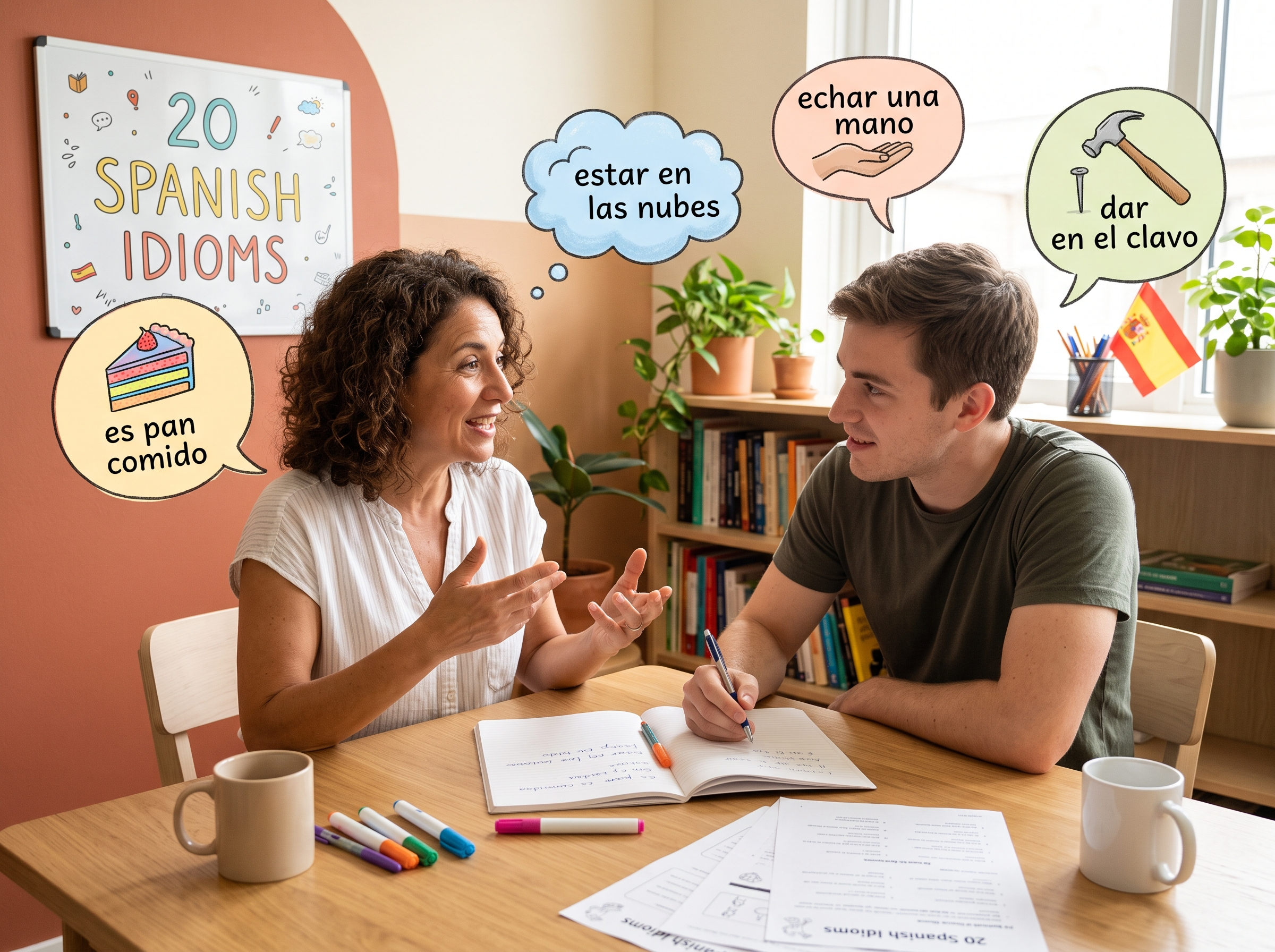
Spanish idioms, known as modismos or expresiones idiomáticas, are phrases whose intended meanings often differ from their literal translations. They help speakers express feelings, describe situations, and communicate ideas in a more natural way. For English speakers learning Spanish, these expressions are especially useful because they appear in everyday conversations, movies, music, and informal writing. SpanishDictionary.com
For example, the Spanish expression ser pan comido literally means “to be eaten bread,” but its actual meaning is “to be a piece of cake.” Similarly, meter la pata literally refers to putting a foot or paw in something, but it means to make a mistake or say something embarrassing. Understanding the intended meaning makes Spanish conversations easier to follow.
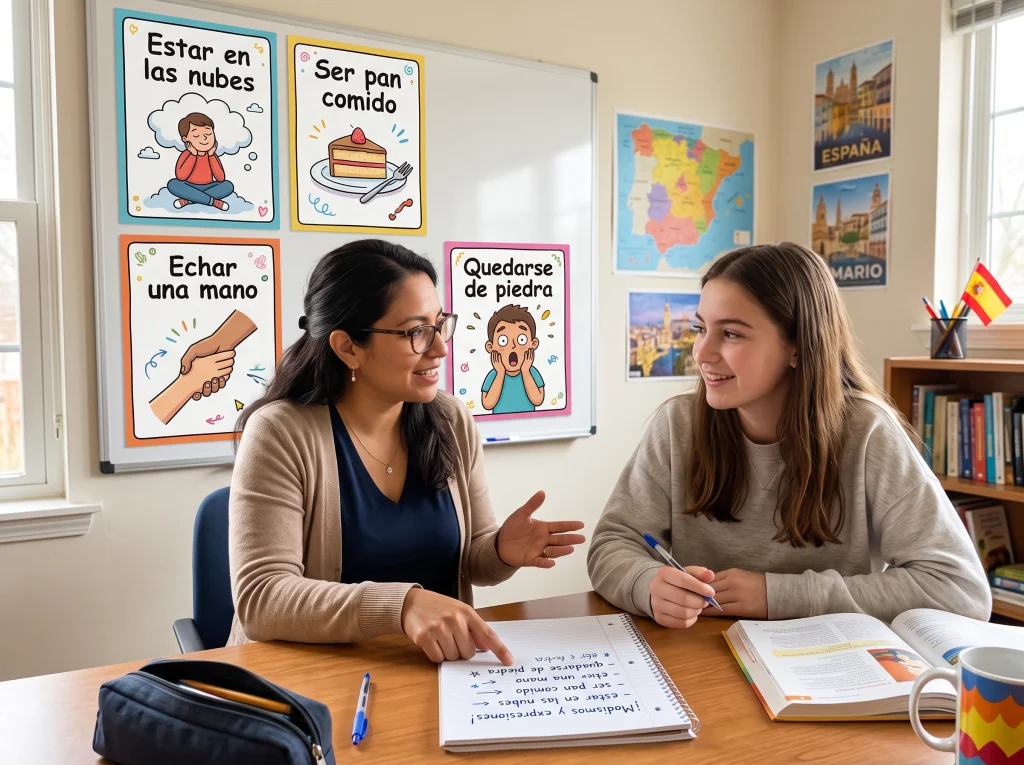
The following 20 Spanish idioms include their literal translations, English meanings, and practical examples. They are useful for beginners, intermediate learners, students, and anyone interested in everyday Spanish spoken across Spain and Latin America.
20 Common Spanish Idioms and Their Meanings
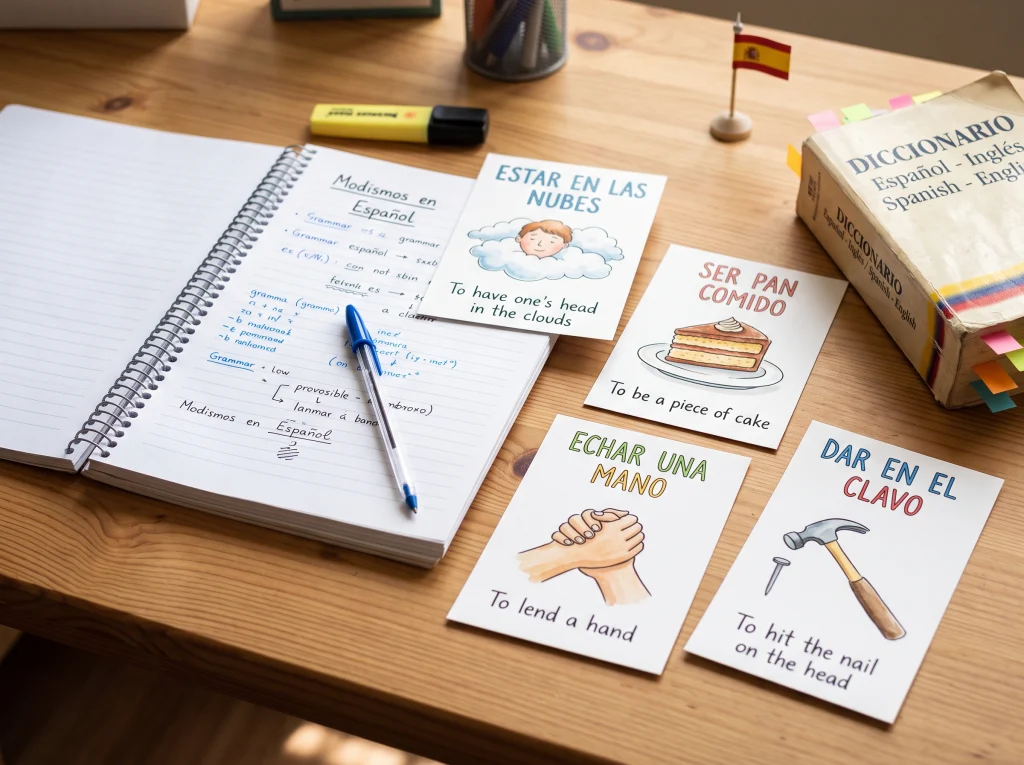
1. Estar en las nubes
Literal translation: To be in the clouds.
Meaning in English: To daydream, be distracted, or have your head in the clouds.
This expression describes someone who is thinking about something else instead of paying attention to what is happening around them. It can be used at school, at work, or during a conversation.
Example in Spanish: María siempre está en las nubes durante las reuniones.
English translation: María is always daydreaming during meetings.
2. Meter la pata
Literal translation: To put the foot or paw in.
Meaning in English: To make a mistake or put your foot in your mouth.
Use this idiom when someone makes an embarrassing mistake, says something inappropriate, or handles a situation poorly. It is a common expression in informal Spanish.
Example in Spanish: Metí la pata cuando mencioné su sorpresa.
English translation: I put my foot in my mouth when I mentioned his surprise.
3. Costar un ojo de la cara
Literal translation: To cost an eye from the face.
Meaning in English: To cost an arm and a leg or be extremely expensive.
This expression emphasizes that something costs much more than expected. It is useful when talking about expensive clothes, electronics, cars, vacations, or housing.
Example in Spanish: Ese apartamento cuesta un ojo de la cara.
English translation: That apartment costs an arm and a leg.
4. Ser pan comido
Literal translation: To be eaten bread.
Meaning in English: To be a piece of cake or be very easy.
Spanish speakers use this idiom to describe a task that requires little effort or seems straightforward. It works well when discussing school assignments, household chores, and everyday challenges.
Example in Spanish: El examen de matemáticas fue pan comido.
English translation: The math test was a piece of cake.
5. Tomar el pelo
Literal translation: To take someone’s hair.
Meaning in English: To pull someone’s leg, tease someone, or make someone believe something that is not true as a joke.
The expression is often used when a person is joking with a friend or playfully misleading someone. The context and tone help distinguish friendly teasing from an attempt to deceive.
Example in Spanish: ¿Me estás tomando el pelo?
English translation: Are you pulling my leg?
6. Echar una mano
Literal translation: To throw a hand.
Meaning in English: To lend a hand or help someone.
This is a practical expression for asking for or offering assistance. It is suitable for many everyday situations, including helping someone move, complete a project, or prepare a meal.
Example in Spanish: ¿Puedes echarme una mano con estas cajas?
English translation: Can you give me a hand with these boxes?
7. Ponerse las pilas
Literal translation: To put in one’s batteries.
Meaning in English: To get moving, become more focused, or get one’s act together.
This idiom encourages someone to stop wasting time and start making an effort. Depending on the situation, it can express friendly encouragement or frustration with someone who is not doing enough.
Example in Spanish: Tenemos que ponernos las pilas para terminar el proyecto.
English translation: We need to get our act together to finish the project.
8. Dar en el clavo
Literal translation: To hit the nail.
Meaning in English: To hit the nail on the head or get something exactly right.
Use this expression when someone gives an accurate answer, identifies the main problem, or makes a particularly good observation.
Example in Spanish: Diste en el clavo con tu respuesta.
English translation: You hit the nail on the head with your answer.
9. Hablar por los codos
Literal translation: To talk through the elbows.
Meaning in English: To talk a lot or talk nonstop.
This idiom describes someone who is very talkative. It is commonly used in casual conversations and can sound affectionate, humorous, or mildly critical depending on the context.
Example in Spanish: Mi hermano habla por los codos cuando está emocionado.
English translation: My brother talks nonstop when he is excited.
10. Tirar la toalla
Literal translation: To throw in the towel.
Meaning in English: To give up or stop trying.
This expression is associated with boxing, where a towel thrown into the ring signals that a fighter’s corner is ending the contest. In everyday Spanish, it describes giving up on a difficult task, goal, or challenge.
Example in Spanish: Aunque el trabajo sea difícil, no voy a tirar la toalla.
English translation: Even though the work is difficult, I’m not going to throw in the towel.
11. Irse por las ramas
Literal translation: To go off through the branches.
Meaning in English: To go off on a tangent or get sidetracked.
Use this idiom when someone moves away from the main subject and starts talking about unrelated details. It is useful in meetings, classroom discussions, and everyday conversations.
Example in Spanish: No te vayas por las ramas y responde a la pregunta.
English translation: Don’t go off on a tangent; answer the question.
12. Estar como una cabra
Literal translation: To be like a goat.
Meaning in English: To be crazy, eccentric, or a little wild.
This informal expression often describes someone who behaves unusually or does unpredictable things. Depending on the relationship and tone, it can be playful or mildly insulting, so use it thoughtfully.
Example in Spanish: Mi primo está como una cabra; siempre inventa juegos extraños.
English translation: My cousin is crazy; he is always inventing strange games.
13. Dormirse en los laureles
Literal translation: To fall asleep on one’s laurels.
Meaning in English: To rest on one’s laurels or stop making an effort after achieving success.
The expression warns against becoming complacent after a victory or accomplishment. It is useful when discussing sports, school performance, careers, and personal goals.
Example in Spanish: Después de ganar el campeonato, el equipo no puede dormirse en los laureles.
English translation: After winning the championship, the team cannot rest on its laurels.
14. No tener pelos en la lengua
Literal translation: To have no hairs on one’s tongue.
Meaning in English: To speak one’s mind openly or not mince words.
This idiom describes someone who speaks directly without hiding their opinions. It can be a compliment when honesty is appreciated, but it can also suggest that someone is too blunt.
Example in Spanish: Mi profesora no tiene pelos en la lengua cuando habla de los errores.
English translation: My teacher doesn’t mince words when talking about mistakes.
15. Llover a cántaros
Literal translation: To rain in pitchers or large containers.
Meaning in English: To rain cats and dogs or rain very heavily.
This colorful expression describes heavy rainfall. It is particularly useful when discussing bad weather or explaining why outdoor plans need to change.
Example in Spanish: No podemos salir ahora porque está lloviendo a cántaros.
English translation: We can’t go outside right now because it’s raining cats and dogs.
16. Quedarse de piedra
Literal translation: To remain like stone.
Meaning in English: To be stunned, shocked, or completely astonished.
Use this expression when something unexpected leaves a person speechless or unable to react immediately. It can describe reactions to surprising news, sudden revelations, or unbelievable events.
Example in Spanish: Me quedé de piedra cuando escuché la noticia.
English translation: I was stunned when I heard the news.
17. Estar hasta las narices
Literal translation: To be up to one’s nose.
Meaning in English: To be fed up or have had enough.
This informal idiom communicates frustration or irritation with a repeated problem. It is stronger than simply saying that something is annoying, so it is best suited to casual situations.
Example in Spanish: Estoy hasta las narices de esperar el autobús.
English translation: I’m fed up with waiting for the bus.
18. Ser uña y carne
Literal translation: To be fingernail and flesh.
Meaning in English: To be inseparable or extremely close.
This expression describes two people who share a strong friendship and spend a great deal of time together. It can be used for close friends, siblings, or other people with a strong personal bond.
Example in Spanish: Ana y Laura son uña y carne desde la escuela.
English translation: Ana and Laura have been inseparable since school.
19. No pegar ojo
Literal translation: Not to hit an eye.
Meaning in English: Not to sleep a wink.
Use this expression when someone cannot sleep at all, often because of stress, excitement, noise, or worry. It is a natural way to describe a sleepless night.
Example in Spanish: No pegué ojo anoche porque estaba preocupado por el examen.
English translation: I didn’t sleep a wink last night because I was worried about the exam.
20. Más vale tarde que nunca
Literal translation: Better late than never.
Meaning in English: It is better to do something late than not do it at all.
This familiar Spanish saying encourages people to complete something even when they have missed the ideal time. It can apply to apologizing, starting a new skill, finishing a task, or reconnecting with an old friend.
Example in Spanish: Finalmente empezó a estudiar español. Más vale tarde que nunca.
English translation: He finally started studying Spanish. Better late than never.
How to Use Spanish Idioms in Everyday Conversations
Learning Spanish idioms is easier when you understand the situations in which people use them. Some expressions are suitable for casual conversations with friends, while others work well in professional or educational settings. Paying attention to tone, context, and the relationship between speakers helps you choose the right phrase.
For example, echar una mano is a friendly way to ask someone for help. You might say it to a classmate, coworker, or neighbor. In contrast, estar hasta las narices expresses stronger frustration and may not be appropriate in a formal conversation with a customer or supervisor.

Spanish idioms also appear in films, television shows, podcasts, songs, and social media posts. When you hear an unfamiliar expression, try to understand its meaning from the surrounding conversation rather than translating each word separately.
Here are three practical ways to use idioms naturally:
- Learn complete sentences: Remembering an idiom in context makes it easier to use correctly.
- Practice with everyday situations: Imagine how you would use an expression at school, at work, or with friends.
- Pay attention to regional differences: An expression may be familiar throughout the Spanish-speaking world, while another may be more common in a particular country or region.
Tips for Learning and Remembering Spanish Idioms
Spanish idioms can seem confusing at first because their literal meanings do not always explain what speakers intend. A few simple learning techniques can make them easier to remember and use.
Connect the Literal Meaning to the Figurative Meaning
Many idioms create a memorable mental picture. For example, estar en las nubes means to be distracted, so you can imagine someone whose thoughts are floating among the clouds. Similarly, tirar la toalla means to give up, making it easy to associate the phrase with the idea of ending a difficult contest.
Understanding the image behind an expression can help you recall its figurative meaning during a conversation.
Group Idioms by Topic
Instead of memorizing a long list of unrelated expressions, organize idioms into categories. For example, costar un ojo de la cara relates to money, quedarse de piedra describes a reaction, and echar una mano relates to helping someone.
Topic-based learning makes it easier to remember expressions when you need them. It also helps you build vocabulary around situations you encounter frequently.

Practice With Spanish and English Examples
Write each idiom in Spanish, followed by its English meaning and a sentence showing how it works. Read the Spanish sentence aloud and then explain the same idea in English.
For instance:
- Spanish: El examen fue pan comido.
- English: The exam was a piece of cake.
- Situation: You use this expression when an exam is much easier than expected.
Repeat the exercise with a few expressions each day. Once you feel comfortable understanding them, try using them in your own sentences.
Learn Which Expressions Are Informal
Not every idiom is appropriate for every situation. Expressions such as estar hasta las narices are informal and communicate frustration, while dar en el clavo can be used in many everyday discussions without sounding rude.
If you are unsure whether an idiom is appropriate, listen to how fluent speakers use it. Resources such as SpanishDict can help you check meanings, translations, and examples of common expressions. SpanishDict Spanish Idioms Guide
Frequently Asked Questions:
Conclusion
Spanish idioms add color and personality to everyday communication. Expressions such as meter la pata, echar una mano, dar en el clavo, and tirar la toalla help speakers describe mistakes, offer assistance, recognize success, and talk about challenges in memorable ways.