
Went or Gone? Meaning, Difference, and Correct Usage in American English
Have you ever wondered whether to say “I went to the store” or “I have gone to the store”? Both words come from the verb “go,” but they serve different grammatical purposes. Understanding when to use went and gone will help you speak and write more naturally in American English.
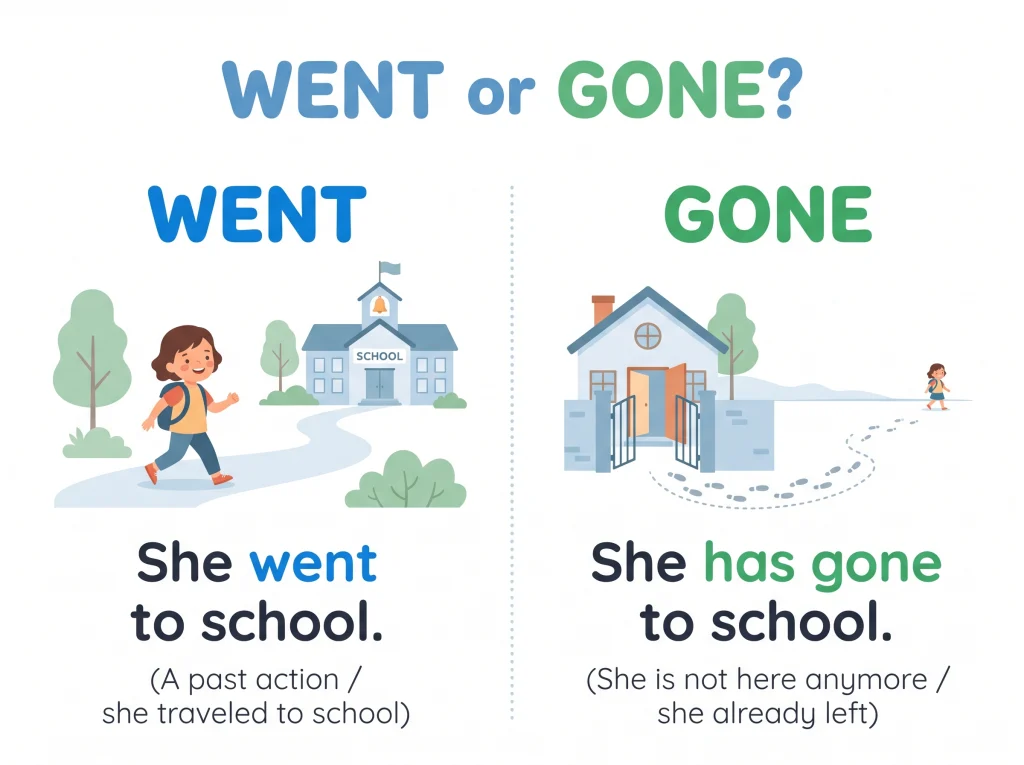
Went is the simple past tense of go, while gone is the past participle. Use went to describe an action that happened in the past, such as “She went to work yesterday.” Use gone with a helping verb to form expressions such as “She has gone to work.” Although these words are related, they cannot be used interchangeably in standard English.
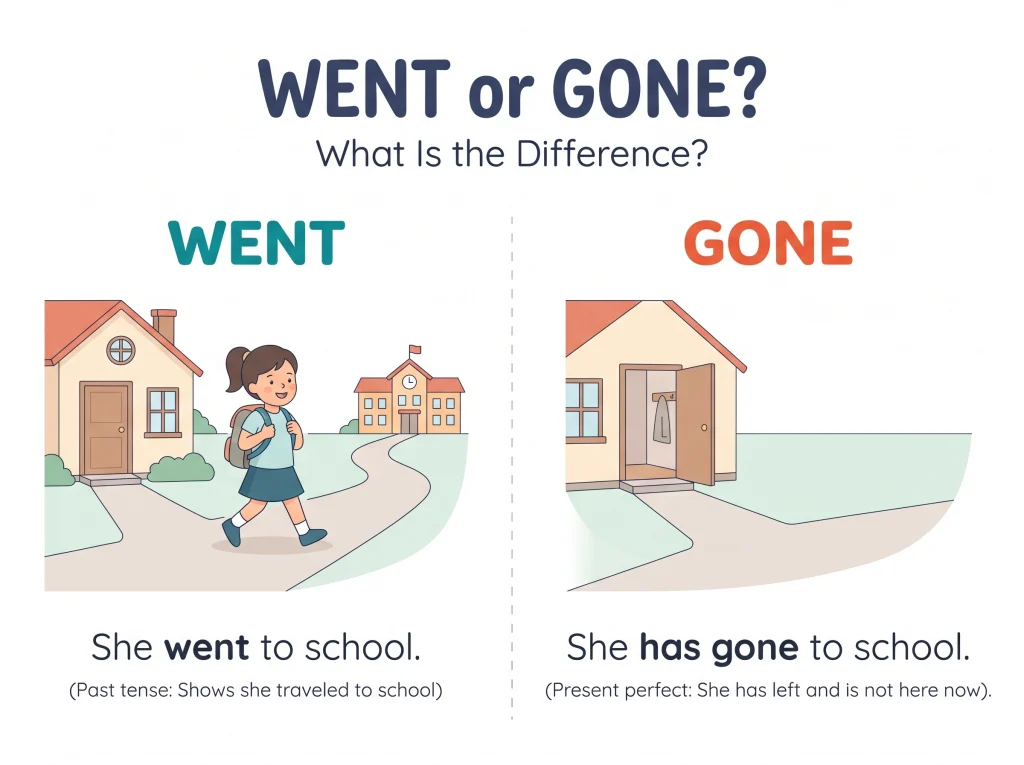
Went or Gone: What Is the Difference?
The main difference between went and gone is their grammatical function. Went describes a past action without requiring a helping verb. Gone usually appears with a helping verb such as has, have, or had to form a perfect tense.
Consider these examples:
- Went: We went to the beach last Saturday.
- Gone: We have gone to the beach several times this summer.
- Went: Daniel went home after work.
- Gone: Daniel had gone home before the storm started.
In the first and third examples, went describes an action that happened in the past. In the second and fourth examples, gone appears with have or had to express the relationship between one event and another time.
Here is a quick comparison:
| Feature | Went | Gone |
|---|---|---|
| Verb form | Simple past tense | Past participle |
| Basic function | Describes a past action | Forms perfect tenses and other grammatical constructions |
| Common structure | Subject + went | Subject + has, have, or had + gone |
| Example | I went to the library. | I have gone to the library. |
| Correct after “did” | No, use the base form go | No, use go after did |
| Correct after “have” | No | Yes |
Remembering this distinction will help you avoid one of the most common mistakes involving the verb go.
What Does Went Mean?
Went is the simple past tense of the verb go. It describes movement from one place to another or an activity that took place in the past. It can also appear in expressions that describe changes, reactions, or events.
When to Use Went
Use went when you want to describe a past action without a helping verb such as have or had.
For example:
- I went to the grocery store yesterday.
- She went to college in California.
- We went out for dinner last night.
- My brother went to the gym before work.
- They went on vacation during the summer.
Each sentence describes an action or event in the past. Went works with every grammatical subject, including I, you, he, she, it, we, and they.
For example, you would say “He went to school,” not “He goed to school.” The verb go is irregular, so its simple past form is went rather than goed.
Went in Questions and Negative Sentences
When forming questions and negative sentences in the simple past, use did or did not with the base form go. Do not use went after did because the helping verb already marks the past tense.
Correct examples include:
- Did you go to the party?
- Did Sarah go to work today?
- I did not go to the meeting.
- He didn’t go to the store.
- We didn’t go out last night.
Incorrect: Did you went to the party?
Correct: Did you go to the party?
Incorrect: She didn’t went to school.
Correct: She didn’t go to school.
This rule is especially important in everyday American English because questions and negative statements frequently use did and didn’t.
What Does Gone Mean?
Gone is the past participle of the verb go. It commonly appears with have, has, or had to form perfect tenses. It can also describe a state of absence when used with a form of be, as in “The opportunity is gone.”
Unlike went, gone generally cannot stand alone as the main verb of a standard past-tense sentence. You would say “I have gone to the store,” not “I gone to the store.”
When to Use Gone
Use gone with the appropriate helping verb when the sentence requires a past participle.
1. Present perfect: Has or have + gone
The present perfect often connects a past action to the present.
Examples:
- She has gone to the office.
- They have gone home for the evening.
- My parents have gone to the airport.
- The children have gone outside to play.
“She has gone to the office” usually suggests that she left for the office and is still away or has not yet returned. The exact meaning depends on the context.
2. Past perfect: Had + gone
The past perfect describes an action that happened before another past event or time.
Examples:
- We had gone home before the rain started.
- She had gone to bed when I called.
- They had already gone when we arrived.
- He had gone to the store before his guests came.
In these sentences, had gone establishes that one action happened before another past event.
3. Future perfect: Will have + gone
The future perfect describes an action that will be completed by a specified future time.
Examples:
- By Friday, she will have gone to three meetings.
- By the time you arrive, we will have gone home.
- By next month, they will have gone on three business trips.
In each example, gone follows have as part of the future perfect construction.
Can You Say “She Is Gone”?
Yes. “She is gone” is grammatically correct in American English. In this sentence, gone describes a state of absence rather than forming a perfect tense.
For example:
- My sister is gone for the weekend.
- The guests are gone now.
- The opportunity is gone.
The meaning depends on the context. “She has gone to work” emphasizes that she left for work, while “She is gone” emphasizes that she is no longer present.
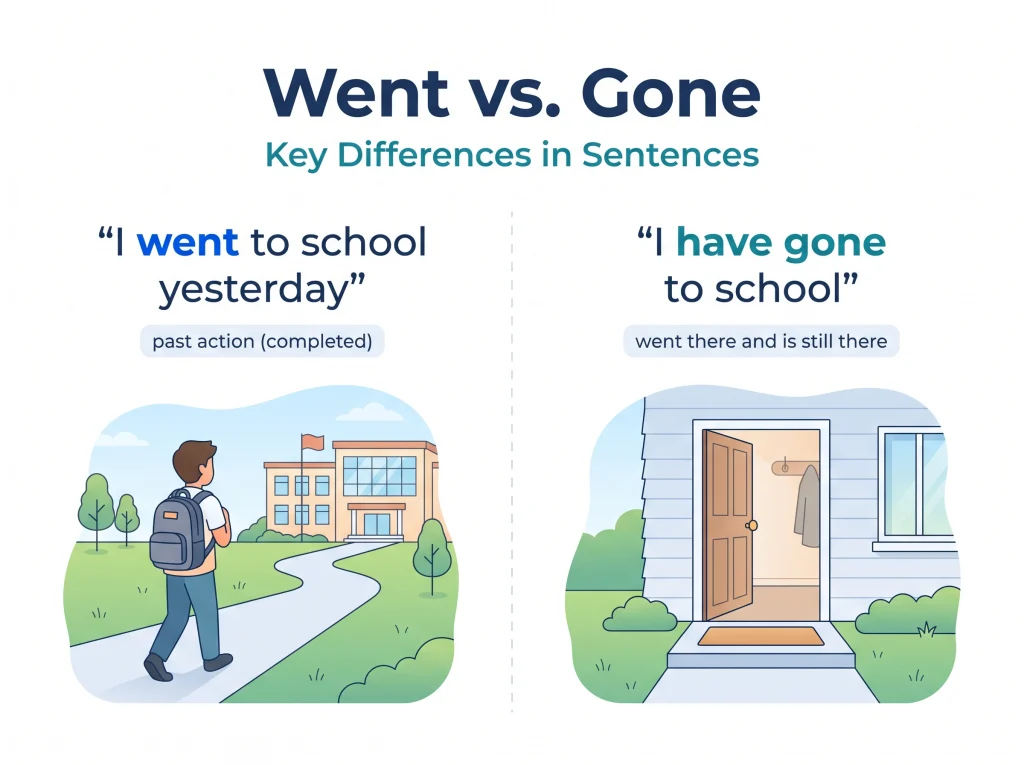
Went vs. Gone: Key Differences in Sentences
Comparing similar sentences is one of the easiest ways to understand how these words work.
| Sentence with Went | Sentence with Gone | Difference |
|---|---|---|
| I went to New York last year. | I have gone to New York several times. | Went describes a past event; have gone forms the present perfect. |
| She went home before dinner. | She had gone home before dinner started. | Had gone shows that the action happened before another past event. |
| They went to the store. | They have gone to the store. | The second sentence connects the action to the present. |
| He went out an hour ago. | He has gone out. | The second sentence commonly suggests that he is still away. |
| We went to the park yesterday. | We will have gone to the park by noon. | The second sentence uses the future perfect. |
Notice that the difference is not simply about whether an action happened in the past. Both words refer to past-related actions, but their grammatical roles determine which form belongs in a sentence.
Went vs. Gone vs. Been
Another common source of confusion is the difference between went, gone, and been. Although all three relate to the verb go or describe movement and visits, they do not mean exactly the same thing.
Went describes a past action.
Example: I went to Chicago last summer.
Gone is the past participle of go and often indicates that someone has left and remains away.
Example: My parents have gone to Chicago.
Been is the past participle of be. In expressions such as “have been to,” it commonly indicates a visit or experience, with the person having returned.
Example: My parents have been to Chicago.
Compare these sentences:
- She went to the doctor yesterday. The sentence reports a past visit.
- She has gone to the doctor. She has left to visit the doctor and is likely still away.
- She has been to the doctor. She visited the doctor and has returned, or the sentence emphasizes the completed visit rather than her current location.
The context can affect the precise meaning, but this distinction is useful in everyday conversations.
Common Mistakes When Using Went and Gone
Even English learners who understand the basic rule can make mistakes when forming questions, negative sentences, and perfect tenses. The following examples show what to avoid.
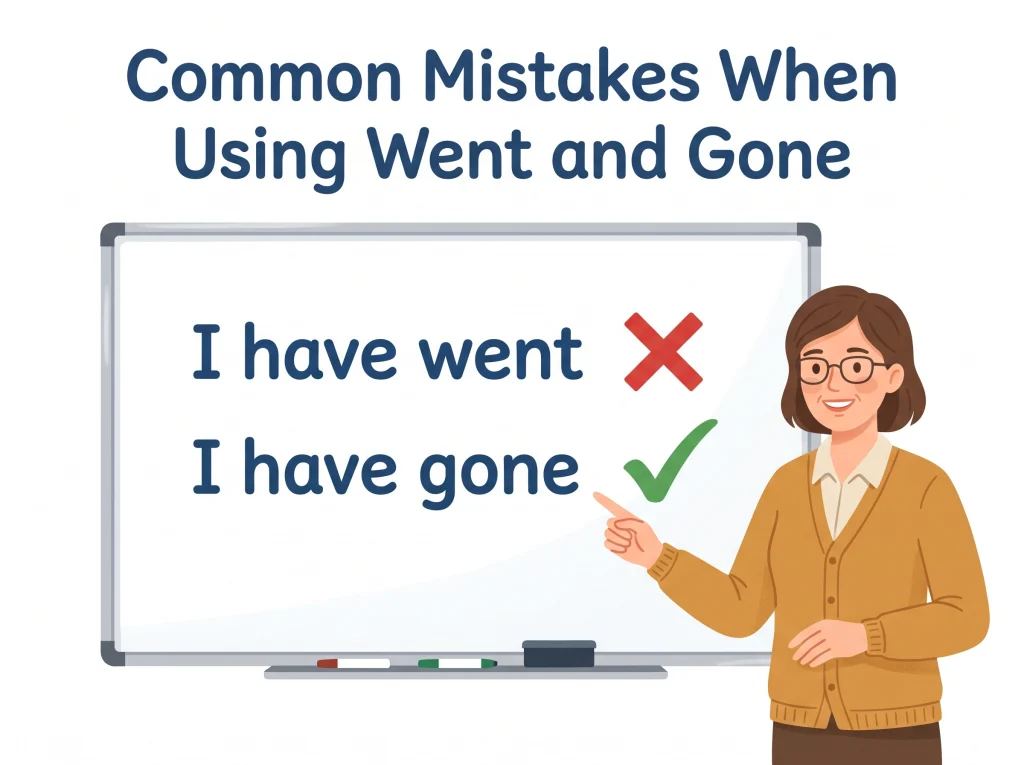
1. Using Went After Have, Has, or Had
Incorrect: I have went to the supermarket.
Correct: I have gone to the supermarket.
Have, has, and had require the past participle in perfect-tense constructions. Because gone is the past participle of go, it is the correct choice.
2. Using Gone Without a Helping Verb
Incorrect: She gone to school yesterday.
Correct: She went to school yesterday.
The sentence describes a completed past action, so went is the appropriate simple past form.
3. Using Went After Did
Incorrect: Did he went to the game?
Correct: Did he go to the game?
The helping verb did already expresses the past tense. Use the base form go after it.
4. Using Went After Didn’t
Incorrect: They didn’t went to the restaurant.
Correct: They didn’t go to the restaurant.
The same rule applies to negative sentences. After didn’t, use go rather than went or gone.
5. Confusing Gone With Been
Incorrect for the intended meaning: I have gone to that museum many times, but I have never visited it.
Better: I have been to that museum many times.
When talking about past visits and experiences, have been to is usually the natural choice if you mean that you visited a place and returned. Have gone to often suggests that someone has left for a place and is still away.
Went and Gone in Everyday American English
Americans use went and gone in conversations about work, school, travel, shopping, entertainment, and daily routines. Choosing the right form makes your sentences clearer and more natural.
At Work and School
- I went to the office early this morning.
- The manager has gone to a meeting.
- We went to class after lunch.
- My classmates have gone home.
While Traveling
- We went to Florida for spring break.
- My cousins have gone to Seattle for a business trip.
- They had gone to the airport before I woke up.
- By next summer, we will have gone on several road trips.
During Everyday Activities
- I went grocery shopping after work.
- Dad has gone to pick up the kids.
- We went out for coffee yesterday.
- The neighbors have gone away for the weekend.
These examples show how both words fit into common American conversations. Pay attention to the helping verbs and the time relationships in each sentence.
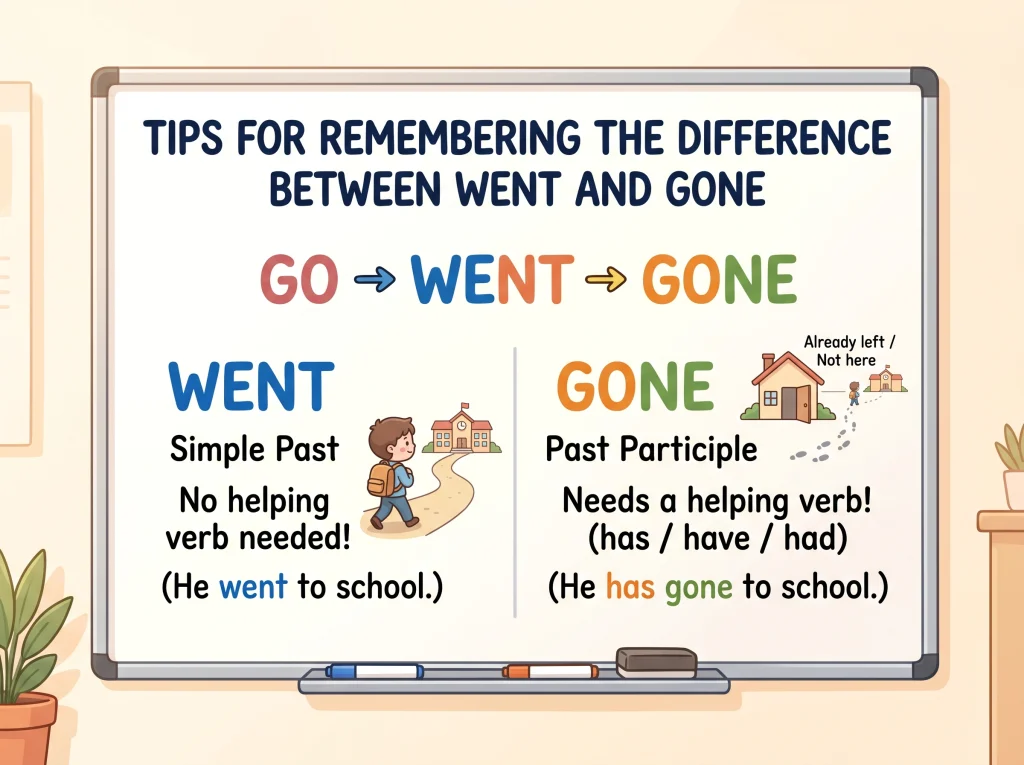
Tips for Remembering the Difference Between Went and Gone
A few simple techniques can make the distinction easier to remember.
Remember the three forms of go. The basic forms are go, went, and gone. Go is the base form, went is the simple past, and gone is the past participle.
Look for a helping verb. If you are forming a perfect tense with has, have, or had, use gone. For example, “She has gone home” is correct, while “She has went home” is not.
Use went for simple past statements. When reporting a completed past action without a perfect-tense helping verb, use went. For example, “We went to the movies last night.”
Check questions and negative sentences. After did or didn’t, use go. Say “Did you go?” and “I didn’t go,” not “Did you went?” or “I didn’t went.”
Read your sentence aloud. Practice pairs such as “He went to work” and “He has gone to work.” Hearing the different structures can help you recognize which form sounds right.
With regular practice, choosing between went and gone becomes easier, especially when you pay attention to the helping verbs in your sentences.
FAQs:
Conclusion
Went and gone are two forms of the irregular verb go, but each has a specific grammatical purpose. Went is the simple past tense, as in “I went to the store yesterday.” Gone is the past participle, used in sentences such as “I have gone to the store” and “They had gone home.”
To choose the correct word, identify the structure of your sentence. Use gone with have, has, or had when forming perfect tenses, and remember to use the base form go after did or didn’t. Understanding these simple rules will help you avoid common grammar mistakes and communicate more confidently in American English.