
Spanish Idioms With Tener: 30 Common Expressions With Meanings and Examples
Learning Spanish becomes easier when you understand how everyday expressions work. One verb that appears in countless conversations is tener, which usually means “to have.” However, Spanish speakers also use tener in expressions that English speakers translate with verbs such as “to be,” “to feel,” or “to need.”
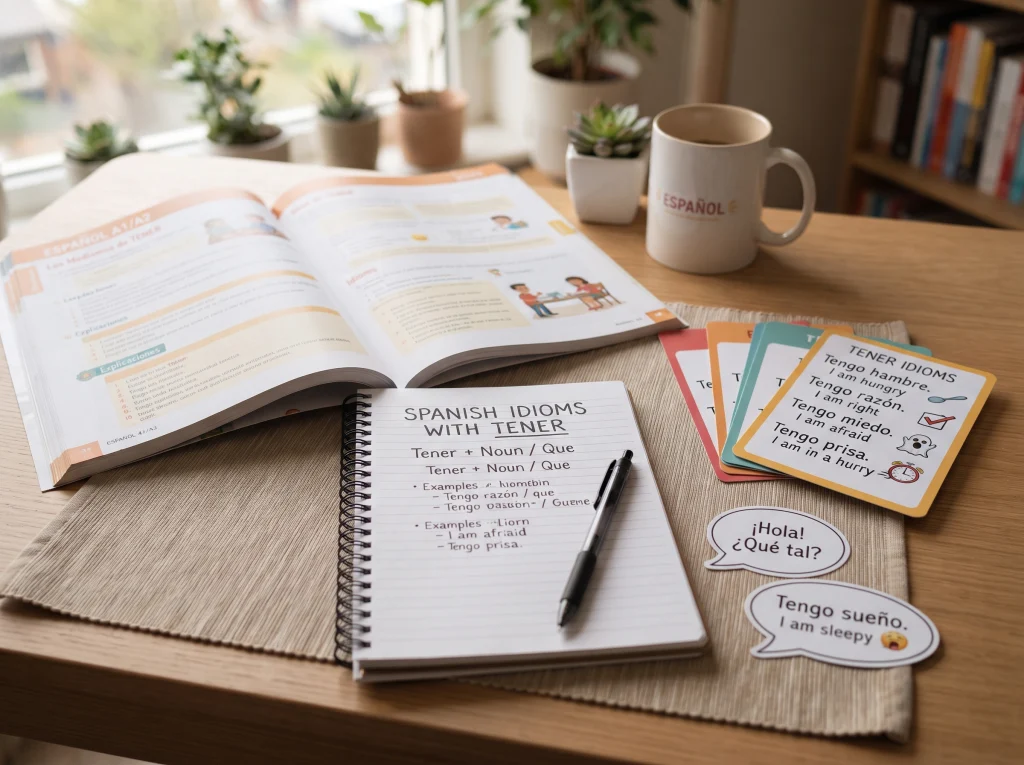
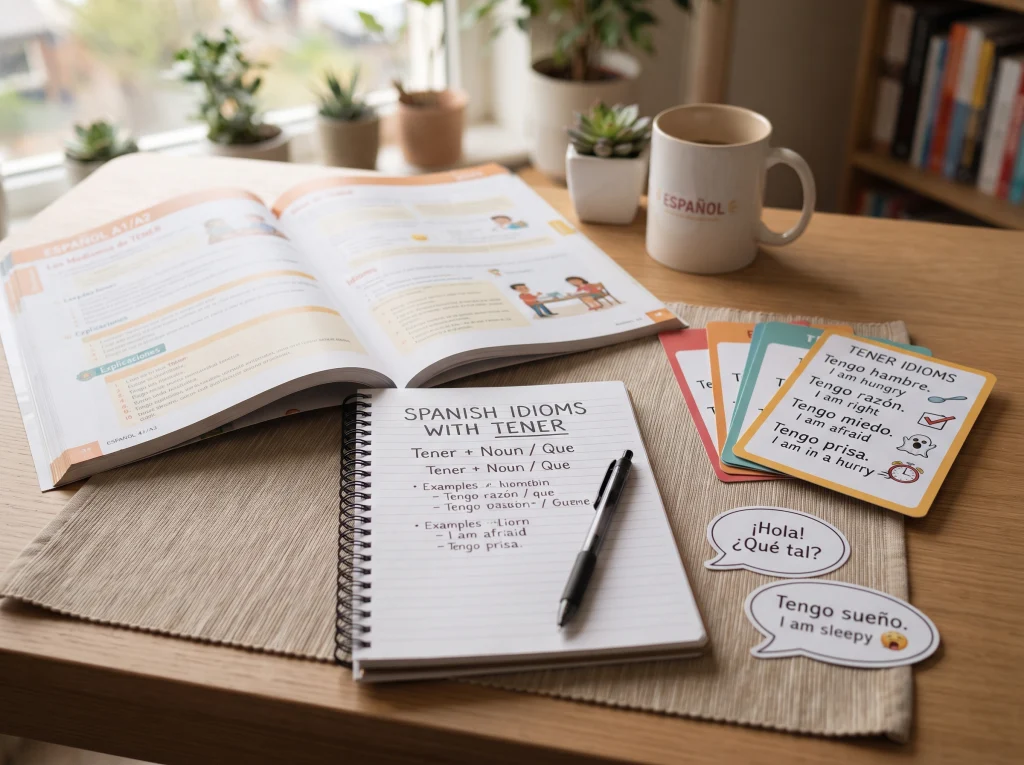
For example, tengo hambre means “I am hungry,” while tienes razón means “you are right.” Translating these phrases word for word can be confusing, but learning them as complete expressions helps you understand and use them naturally.
This guide covers 30 useful Spanish expressions with tener, including their English meanings, example sentences, and practical grammar tips. Whether you are a beginner or an intermediate learner, these phrases can help you communicate more comfortably in everyday Spanish.
What Are Spanish Idioms With Tener?
Spanish idioms with tener are common expressions built around the verb tener. Some are fixed idiomatic phrases, while others are conventional expressions whose meanings are not translated literally into English.

For instance, Spanish speakers say tener sed, which literally means “to have thirst,” but the natural English translation is “to be thirsty.” Similarly, tener miedo means “to be afraid,” and tener prisa means “to be in a hurry.”
These expressions are especially useful because they describe physical sensations, emotions, personal circumstances, opinions, and obligations. Learning them together also helps you recognize familiar sentence patterns.
Vacation Idioms: https://learnidioms.com/vacation-idioms/
30 Common Spanish Idioms With Tener
Idioms About Physical Needs and Feelings
These expressions help you talk about hunger, thirst, temperature, tiredness, and other physical sensations.
| Spanish Expression | English Meaning |
|---|---|
| 1. Tener hambre | To be hungry |
| 2. Tener sed | To be thirsty |
| 3. Tener sueño | To be sleepy |
| 4. Tener frío | To be cold |
| 5. Tener calor | To be hot |
| 6. Tener dolor de cabeza | To have a headache |
| 7. Tener fiebre | To have a fever |
| 8. Tener ganas de | To feel like doing something |
1. Tener hambre
Meaning: To be hungry.
Example: Tengo hambre. ¿Podemos comer algo?
English: I’m hungry. Can we eat something?
2. Tener sed
Meaning: To be thirsty.
Example: Después de caminar, tenemos mucha sed.
English: After walking, we are very thirsty.
3. Tener sueño
Meaning: To be sleepy.
Example: Tengo mucho sueño porque me acosté tarde.
English: I’m very sleepy because I went to bed late.
4. Tener frío
Meaning: To be cold.
Example: ¿Tienes frío? Puedo cerrar la ventana.
English: Are you cold? I can close the window.
5. Tener calor
Meaning: To feel hot.
Example: Tenemos mucho calor después de hacer ejercicio.
English: We feel very hot after exercising.
6. Tener dolor de cabeza
Meaning: To have a headache.
Example: Tengo dolor de cabeza y necesito descansar.
English: I have a headache, and I need to rest.
7. Tener fiebre
Meaning: To have a fever.
Example: Mi hermano tiene fiebre desde anoche.
English: My brother has had a fever since last night.
8. Tener ganas de
Meaning: To feel like doing something or to want to do something.
Example: Tengo ganas de ver una película esta noche.
English: I feel like watching a movie tonight.
When followed by an action, this expression uses de + an infinitive, such as tener ganas de salir (to feel like going out).
Idioms About Emotions and Personal States
These expressions describe fear, embarrassment, jealousy, confidence, and other emotional or personal experiences.
| Spanish Expression | English Meaning |
|---|---|
| 9. Tener miedo de | To be afraid of |
| 10. Tener vergüenza | To feel embarrassed or ashamed |
| 11. Tener celos | To be jealous |
| 12. Tener envidia | To envy or feel envious |
| 13. Tener confianza en | To have confidence in |
| 14. Tener paciencia | To be patient |
| 15. Tener orgullo | To feel pride or be proud |
9. Tener miedo de
Meaning: To be afraid of something or someone.
Example: Tengo miedo de las arañas.
English: I’m afraid of spiders.
You can also use tener miedo de + infinitive to describe fear of doing something.
Example: Tengo miedo de hablar en público.
English: I’m afraid of speaking in public.
10. Tener vergüenza
Meaning: To feel embarrassed or ashamed.
Example: Me da vergüenza cantar delante de otras personas.
English: I feel embarrassed singing in front of other people.
A common alternative is tener vergüenza de, particularly when identifying what causes the embarrassment.
11. Tener celos
Meaning: To feel jealous.
Example: Él tiene celos cuando su mejor amigo pasa tiempo con otras personas.
English: He gets jealous when his best friend spends time with other people.
12. Tener envidia
Meaning: To envy someone or feel envious.
Example: No tengo envidia de su éxito; me alegro por ella.
English: I’m not envious of her success; I’m happy for her.
13. Tener confianza en
Meaning: To have confidence or trust in someone or something.
Example: Tengo confianza en mi equipo.
English: I have confidence in my team.
14. Tener paciencia
Meaning: To be patient.
Example: Debes tener paciencia mientras aprendes un idioma nuevo.
English: You must be patient while learning a new language.
15. Tener orgullo
Meaning: To feel pride or have pride.
Example: Sus padres tienen mucho orgullo de sus logros.
English: His parents feel great pride in his achievements.
In many everyday contexts, Spanish speakers may also use estar orgulloso de to say “to be proud of.”

Idioms About Opinions, Experiences, and Everyday Situations
These expressions are useful when discussing correctness, luck, responsibility, success, and daily activities.
| Spanish Expression | English Meaning |
|---|---|
| 16. Tener razón | To be right |
| 17. Tener suerte | To be lucky |
| 18. Tener cuidado | To be careful |
| 19. Tener la culpa | To be to blame |
| 20. Tener éxito | To be successful |
| 21. Tener prisa | To be in a hurry |
| 22. Tener lugar | To take place |
| 23. Tener que ver con | To have to do with |
| 24. Tener en cuenta | To keep in mind |
16. Tener razón
Meaning: To be right or correct.
Example: Tienes razón; deberíamos salir más temprano.
English: You’re right; we should leave earlier.
17. Tener suerte
Meaning: To be lucky.
Example: Tuvimos mucha suerte con el clima durante las vacaciones.
English: We were very lucky with the weather during vacation.
18. Tener cuidado
Meaning: To be careful.
Example: Ten cuidado al cruzar la calle.
English: Be careful when crossing the street.
19. Tener la culpa
Meaning: To be responsible for something wrong or to be to blame.
Example: No tienes la culpa de lo que pasó.
English: You’re not to blame for what happened.
20. Tener éxito
Meaning: To be successful or to achieve success.
Example: La empresa tuvo éxito con su nuevo producto.
English: The company was successful with its new product.
21. Tener prisa
Meaning: To be in a hurry.
Example: Tengo prisa porque mi clase empieza en diez minutos.
English: I’m in a hurry because my class starts in ten minutes.
22. Tener lugar
Meaning: To take place or occur.
Example: La reunión tendrá lugar el próximo lunes.
English: The meeting will take place next Monday.
23. Tener que ver con
Meaning: To have to do with or be related to something.
Example: Este problema tiene que ver con la falta de comunicación.
English: This problem has to do with a lack of communication.
24. Tener en cuenta
Meaning: To keep in mind, consider, or take into account.
Example: Debemos tener en cuenta las opiniones de todos.
English: We should take everyone’s opinions into account.
Idioms With Tener That Express Obligation and Age
Some common tener expressions are not figurative idioms in the strictest sense, but they are essential patterns for everyday Spanish.
| Spanish Expression | English Meaning |
|---|---|
| 25. Tener que + infinitive | To have to do something |
| 26. Tener años | To be a certain age |
| 27. Tener la palabra | To have the floor or be the one speaking |
| 28. Tener hambre de | To hunger for something, literally or figuratively |
| 29. Tener buena memoria | To have a good memory |
| 30. Tener razón en algo | To be right about something |
25. Tener que + infinitive
Meaning: To have to or need to do something.
Example: Tengo que terminar mi tarea antes de cenar.
English: I have to finish my homework before dinner.
Use tener que directly before the infinitive. Do not add de between que and the verb.
26. Tener años
Meaning: To be a certain age.
Example: Mi prima tiene veinte años.
English: My cousin is twenty years old.
Spanish uses tener to express age, rather than the English verb “to be.”
27. Tener la palabra
Meaning: To have the floor or be the person whose turn it is to speak.
Example: Ahora tiene la palabra la directora.
English: The director has the floor now.
28. Tener hambre de
Meaning: To hunger for something, sometimes figuratively expressing a strong desire.
Example: Tiene hambre de conocimiento y siempre está leyendo.
English: He has a hunger for knowledge and is always reading.
29. Tener buena memoria
Meaning: To have a good memory.
Example: Mi abuelo tiene buena memoria para los nombres.
English: My grandfather has a good memory for names.
30. Tener razón en algo
Meaning: To be right about a particular matter.
Example: Tenías razón en lo que dijiste ayer.
English: You were right about what you said yesterday.

How to Conjugate Tener in Spanish
The verb tener is irregular in the present tense, so it is important to learn its forms before using these expressions in conversation.
| Subject | Present Tense | Example |
|---|---|---|
| Yo | tengo | Tengo hambre. |
| Tú | tienes | Tienes razón. |
| Él, ella, usted | tiene | Tiene sueño. |
| Nosotros/as | tenemos | Tenemos prisa. |
| Vosotros/as | tenéis | Tenéis suerte. |
| Ellos, ellas, ustedes | tienen | Tienen miedo. |
Note: Vosotros/as is commonly used in Spain. In most of Latin America, ustedes is used for plural “you.”
The verb also changes when you talk about the past or future.
- Ayer tuve mucha suerte. (Yesterday I was very lucky.)
- Cuando era niño, tenía miedo de los perros. (When I was a child, I was afraid of dogs.)
- Mañana tendremos una reunión. (Tomorrow we will have a meeting.)
Learning the conjugation alongside the expressions helps you use them with different subjects and in different situations.
Idioms With Illustrations: https://learnidioms.com/idioms-with-illustrations-and-meanings/
How to Use Tener Idioms Naturally in American English Learning Contexts
For English speakers learning Spanish, the main challenge is often avoiding direct translations from English. Spanish uses tener in many places where English uses “to be,” so it helps to memorize the complete Spanish phrase rather than translating each word separately.
Consider these examples:
| English | Natural Spanish |
|---|---|
| I am hungry. | Tengo hambre. |
| She is sleepy. | Ella tiene sueño. |
| We are in a hurry. | Tenemos prisa. |
| You are right. | Tienes razón. |
| They are afraid. | Tienen miedo. |
A useful way to practice is to build short conversations around everyday situations.
At home
¿Tienes hambre? (Are you hungry?)
Sí, tengo mucha hambre. (Yes, I’m very hungry.)
Before class
¿Tenemos que estudiar hoy? (Do we have to study today?)
Sí, tenemos que preparar el examen. (Yes, we have to prepare for the exam.)
Making plans
¿Tienes ganas de salir esta noche? (Do you feel like going out tonight?)
No, tengo sueño y quiero descansar. (No, I’m sleepy and want to rest.)
These examples show how tener expressions fit naturally into questions, answers, and everyday exchanges.

Common Mistakes to Avoid When Using Tener Idioms
Learning these expressions is easier when you recognize a few common errors.
1. Using ser or estar instead of tener
English speakers may try to translate “I am hungry” word for word.
Incorrect: Estoy hambre.
Correct: Tengo hambre.
Use tener with this expression because Spanish describes hunger as something a person has.
2. Using muy instead of mucho or mucha
When intensifying a noun in a tener expression, use the appropriate form of mucho.
Incorrect: Tengo muy hambre.
Correct: Tengo mucha hambre.
Other examples include mucho frío, mucho sueño, and mucha prisa. The form agrees with the noun.
3. Forgetting the preposition in tener ganas de
When followed by an infinitive, the expression requires de.
Incorrect: Tengo ganas salir.
Correct: Tengo ganas de salir.
4. Adding de after tener que
The obligation pattern is tener que + infinitive.
Incorrect: Tengo que de estudiar.
Correct: Tengo que estudiar.
5. Translating idioms literally
A phrase such as tener razón does not mean “to have reason” in natural English. Its normal meaning is “to be right.”
Learning the intended meaning of each complete expression will help you avoid awkward translations.
Pain Idioms: https://learnidioms.com/pain-idioms/
FAQ: Spanish Idioms With Tener
Conclusion
Spanish idioms with tener are an important part of everyday communication. Expressions such as tener hambre, tener miedo, tener razón, and tener ganas de help you talk about feelings, needs, opinions, and plans in a natural way.
Start by practicing a few expressions each day. Pay attention to how tener changes with the subject, and remember that many phrases use a different structure from their English translations. With regular practice, these expressions will become easier to recognize and use in conversations.






One Comment