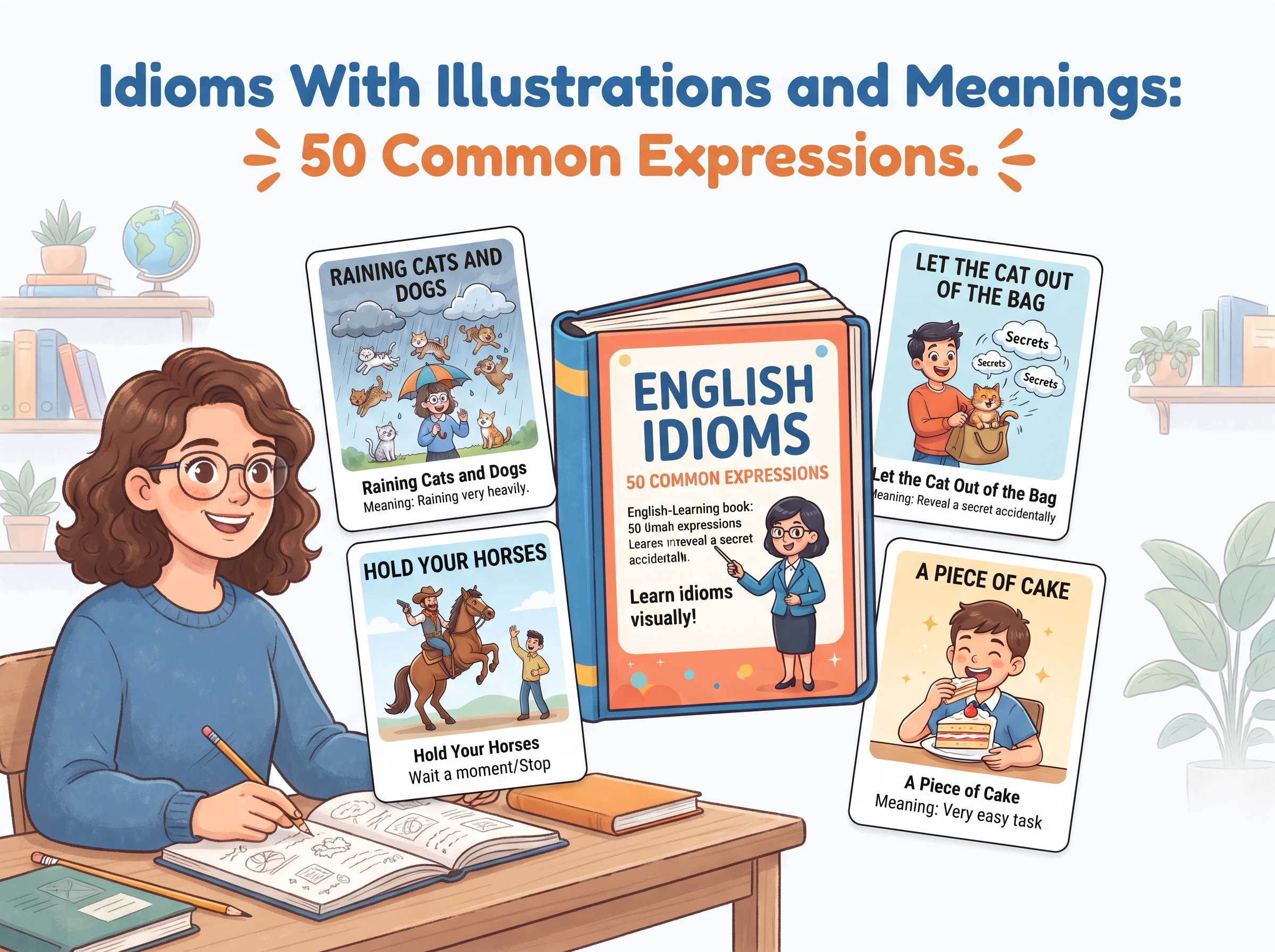
Idioms With Illustrations and Meanings: 50 Common Expressions
English idioms can be confusing when you try to understand every word literally. An expression such as “spill the beans” has nothing to do with accidentally dropping food. It means revealing information that was supposed to remain secret. Pairing an idiom with a simple illustration can make the difference between its literal wording and figurative meaning easier to remember.
This guide explains 50 common English idioms with definitions, example sentences, and visual ideas. The illustration descriptions show a scene that can help you remember each expression. They are especially useful for English learners, students, teachers, and anyone who wants to understand everyday American English more confidently.
What Are Idioms With Illustrations and Meanings?
An idiom is a phrase whose intended meaning differs from the ordinary meanings of its individual words. For example, “a piece of cake” means something is easy, not that a task is a slice of dessert.
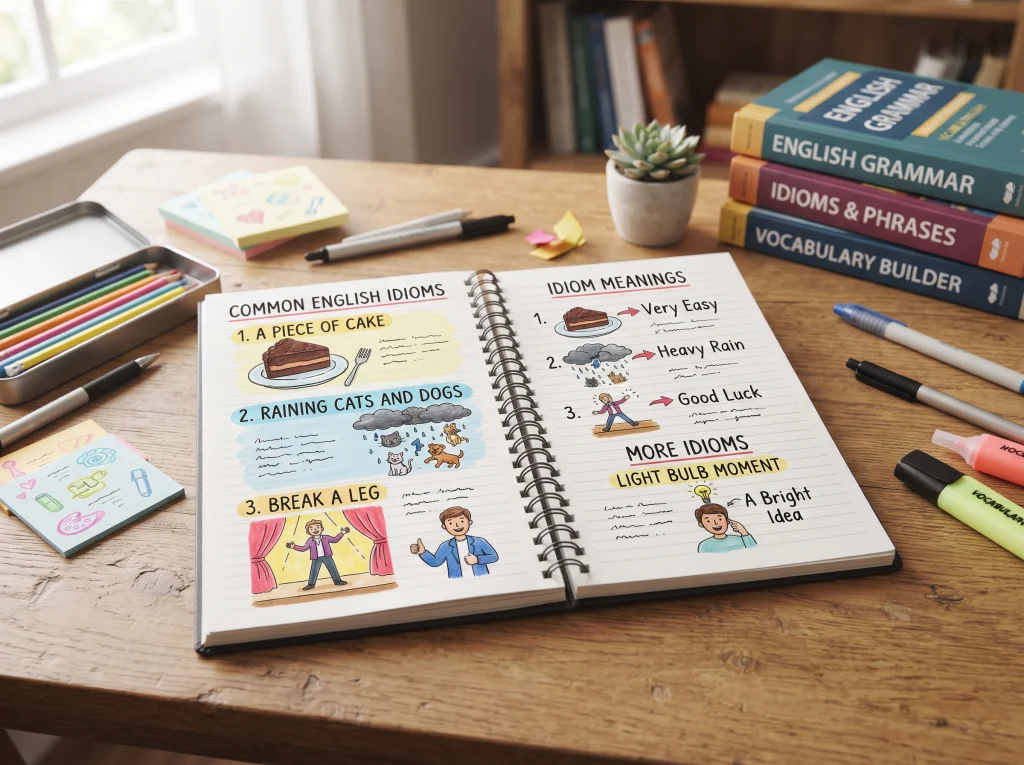
Idioms with illustrations and meanings combine three learning elements:
- The idiom: The expression you want to learn.
- The meaning: A clear explanation of what the expression communicates.
- The illustration: A visual scene that helps you connect the words with the intended meaning.
Some illustrations show the phrase literally, such as a cat escaping from a bag. Others show the real-life situation, such as someone accidentally revealing a secret. Both approaches can help, as long as you also learn how the expression is actually used.
IdiomNews
+1
Vacation Idioms: https://learnidioms.com/vacation-idioms/
50 Common English Idioms With Meanings and Examples
Everyday Life and Communication
1. Break the ice
Meaning: To make people feel more comfortable in a new or awkward social situation.
Example: “I asked everyone about their weekend to break the ice at the meeting.”
Illustration idea: A person using a friendly greeting to help a group of strangers relax, with a small piece of ice cracking nearby.
2. A piece of cake
Meaning: Something that is very easy to do.
Example: “The math quiz was a piece of cake for Maya.”
Illustration idea: A student finishing a simple quiz beside a slice of cake.
3. Spill the beans
Meaning: To reveal a secret or share information that was meant to be kept private.
Example: “Don’t spill the beans about the surprise party.”
Illustration idea: A person tipping over a bowl of beans while another person reacts to hearing a secret.
4. Get the ball rolling
Meaning: To begin an activity, project, or process.
Example: “Let’s get the ball rolling by choosing a date for the event.”
Illustration idea: Someone pushing a large ball forward as a group starts working together.
5. Hit the nail on the head
Meaning: To say or identify exactly the right thing.
Example: “You hit the nail on the head when you said we needed clearer instructions.”
Illustration idea: A hammer striking a nail precisely in the center, with a person looking pleased about solving a problem.
6. Beat around the bush
Meaning: To avoid talking about the main subject directly.
Example: “Stop beating around the bush and tell me what happened.”
Illustration idea: A person walking in circles around a bush instead of approaching a sign marked “The Point.”
7. Get the picture
Meaning: To understand a situation or what someone is explaining.
Example: “Now that you’ve shown me the schedule, I get the picture.”
Illustration idea: A puzzled person looking at scattered puzzle pieces that come together to form a clear scene.
8. Bite your tongue
Meaning: To stop yourself from saying something, especially something rude or unhelpful.
Example: “I wanted to criticize the design, but I bit my tongue.”
Illustration idea: A person pressing their lips together while a speech bubble fades away.
9. Keep an eye on
Meaning: To watch or look after someone or something carefully.
Example: “Could you keep an eye on my bag while I order?”
Illustration idea: A person watching a bag while standing in a café line, with a large symbolic eye nearby.
10. Hear it through the grapevine
Meaning: To hear news or information through informal conversation rather than directly from an official source.
Example: “I heard through the grapevine that our team may move to a new office.”
Illustration idea: A vine with grapes connecting several people who are quietly passing along a message.

Feelings, Relationships, and Behavior
11. Under the weather
Meaning: Feeling sick or generally unwell.
Example: “I’m feeling under the weather, so I’m going to rest today.”
Illustration idea: A tired person resting beneath a gray cloud, with a blanket and a cup of tea.
12. On cloud nine
Meaning: Extremely happy.
Example: “He was on cloud nine after finding out he got the job.”
Illustration idea: A smiling person sitting on a fluffy cloud while celebrating good news.
13. Get cold feet
Meaning: To become nervous or lose confidence before doing something.
Example: “She got cold feet just before giving her speech.”
Illustration idea: A person waiting backstage with visibly chilly feet and a nervous expression.
14. Give someone the cold shoulder
Meaning: To deliberately ignore someone or treat them in an unfriendly way.
Example: “After their argument, Jake gave his friend the cold shoulder.”
Illustration idea: One person turning away while another tries to start a conversation, with a frosty shoulder shown symbolically.
15. Have a heart of gold
Meaning: To be very kind, generous, and caring.
Example: “Our neighbor has a heart of gold and helps anyone who needs it.”
Illustration idea: A warm-hearted person helping someone carry groceries, with a glowing golden heart symbol.
16. Cry over spilled milk
Meaning: To be upset about something that has already happened and cannot be changed.
Example: “We missed the bus, but there’s no use crying over spilled milk.”
Illustration idea: A person looking sadly at spilled milk while a friend points toward a clock and the next bus.
17. Let the cat out of the bag
Meaning: To reveal a secret, often by accident.
Example: “Lena let the cat out of the bag when she mentioned the birthday gift.”
Illustration idea: A cat jumping out of an open bag while someone looks surprised.
18. A couch potato
Meaning: Someone who spends a lot of time sitting and watching television or otherwise being inactive.
Example: “I was a couch potato all weekend and watched movies.”
Illustration idea: A potato-shaped character lounging on a couch with a remote control and snacks.
19. Wear your heart on your sleeve
Meaning: To show your emotions openly.
Example: “You can always tell when he’s excited because he wears his heart on his sleeve.”
Illustration idea: A person with a heart symbol displayed on their sleeve, showing happiness and excitement.
20. Get on someone’s nerves
Meaning: To annoy or irritate someone.
Example: “That loud tapping is getting on my nerves.”
Illustration idea: A person trying to concentrate while repeated tapping sounds are shown as jagged lines around them.

Work, Success, and Challenges
21. Go the extra mile
Meaning: To make more effort than is expected or required.
Example: “Our teacher went the extra mile to help us prepare for the exam.”
Illustration idea: A person continuing along a road past a marker labeled “One More Mile,” helping someone along the way.
22. Learn the ropes
Meaning: To learn how to do a job or activity.
Example: “It took me a week to learn the ropes at my new job.”
Illustration idea: A new employee learning from an experienced coworker while holding a rope with several knots.
23. Back to the drawing board
Meaning: To start planning again after an idea or attempt has failed.
Example: “Our first design didn’t work, so it’s back to the drawing board.”
Illustration idea: An inventor returning to a blank drawing board after a model falls apart.
24. Think outside the box
Meaning: To come up with creative or unusual ideas.
Example: “We need to think outside the box to solve this problem.”
Illustration idea: A lightbulb rising out of an open box while other ideas float around it.
25. Pull your weight
Meaning: To do your fair share of the work or responsibility.
Example: “Everyone on the team needs to pull their weight.”
Illustration idea: Several teammates carrying a heavy object together, each contributing equally.
26. Bite the bullet
Meaning: To face a difficult or unpleasant situation with courage.
Example: “I finally bit the bullet and made the phone call I’d been avoiding.”
Illustration idea: A determined person taking a deep breath before making a difficult call, with a symbolic bullet nearby.
27. Throw in the towel
Meaning: To give up or admit that you cannot continue.
Example: “After several attempts, the team refused to throw in the towel.”
Illustration idea: A boxer considering a towel in the corner of a ring while a teammate encourages them to continue.
28. Cut corners
Meaning: To do something in a cheaper, quicker, or easier way that may reduce quality.
Example: “The contractor cut corners, and the repairs didn’t last.”
Illustration idea: A person trimming the corner off a checklist while a poorly finished project sits nearby.
29. On the same page
Meaning: To share the same understanding or agree about a plan.
Example: “Let’s review the schedule so we’re all on the same page.”
Illustration idea: Coworkers looking at the same page of a plan and nodding in agreement.
30. The ball is in your court
Meaning: It is your turn to make a decision or take action.
Example: “I’ve sent you the proposal, so the ball is in your court.”
Illustration idea: A tennis ball resting on one side of a court while a player on the other side waits to respond.

Time, Choices, and Situations
31. Call it a day
Meaning: To stop working on something for the time being, often at the end of the workday.
Example: “We’ve finished the important tasks, so let’s call it a day.”
Illustration idea: Coworkers closing their laptops as the sun sets outside an office window.
32. Once in a blue moon
Meaning: Very rarely.
Example: “We eat at that restaurant once in a blue moon.”
Illustration idea: A blue-tinted moon above a calendar with only one date circled.
33. Better late than never
Meaning: Doing something late is better than not doing it at all.
Example: “He finally sent his thank-you note. Better late than never.”
Illustration idea: A person delivering a letter after a clock has passed the expected time, while the recipient smiles.
34. Miss the boat
Meaning: To miss an opportunity or be too late to take advantage of it.
Example: “I missed the boat on the early-bird tickets.”
Illustration idea: A person arriving at a dock just as a boat carrying opportunity-themed signs pulls away.
35. In hot water
Meaning: In trouble or in a difficult situation.
Example: “He was in hot water after forgetting to submit the report.”
Illustration idea: A worried person standing beside a steaming tub labeled “Trouble,” with papers scattered nearby.
36. A blessing in disguise
Meaning: Something that seems unfortunate at first but later leads to a good result.
Example: “Missing that flight was a blessing in disguise because I met my future business partner at the airport.”
Illustration idea: A gray cloud opening to reveal sunshine and a helpful opportunity.
37. Out of the blue
Meaning: Unexpectedly or without warning.
Example: “Out of the blue, my old friend called me.”
Illustration idea: A phone ringing suddenly beneath a clear blue sky, surprising its owner.
38. At the drop of a hat
Meaning: Immediately or without needing much preparation.
Example: “She’s ready to help at the drop of a hat.”
Illustration idea: A hat falling from someone’s hand as another person quickly jumps into action.
39. The last straw
Meaning: The final problem or annoyance that makes someone lose patience.
Example: “When the printer broke again, that was the last straw.”
Illustration idea: A camel carrying a load as one tiny straw is added, causing the load to topple.
40. Add fuel to the fire
Meaning: To make an already difficult, tense, or angry situation worse.
Example: “Arguing about the mistake only added fuel to the fire.”
Illustration idea: A person tossing more wood onto a fire while two people argue nearby.

Money, Value, and Practical Wisdom
41. Cost an arm and a leg
Meaning: To be extremely expensive.
Example: “That new gaming computer cost an arm and a leg.”
Illustration idea: A shopper looking shocked at a price tag, with exaggerated arm-and-leg symbols beside it.
42. Bring home the bacon
Meaning: To earn money to support yourself or your household.
Example: “Both of them work hard to bring home the bacon.”
Illustration idea: A worker returning home with groceries and a paycheck, including a package of bacon.
43. Make ends meet
Meaning: To have enough money to pay for basic expenses.
Example: “They’re working extra hours to make ends meet.”
Illustration idea: A person carefully balancing bills, a budget, and a wallet with limited cash.
44. A dime a dozen
Meaning: Common and easy to find, so not especially unusual or valuable.
Example: “Cheap phone cases are a dime a dozen.”
Illustration idea: A large display of nearly identical phone cases with a small dime in the foreground.
45. Worth its weight in gold
Meaning: Extremely useful or valuable.
Example: “A reliable babysitter is worth their weight in gold.”
Illustration idea: A helpful babysitter surrounded by children, with a golden scale symbolizing their value.
46. Penny for your thoughts
Meaning: A friendly way to ask someone what they are thinking.
Example: “You’ve been quiet all morning. A penny for your thoughts?”
Illustration idea: One person offering a penny to a thoughtful friend sitting with a thought bubble above their head.
47. Keep your chin up
Meaning: Stay positive and hopeful during a difficult time.
Example: “I know the interview didn’t go well, but keep your chin up.”
Illustration idea: A person lifting their chin and standing confidently while a friend offers encouragement.
48. Every cloud has a silver lining
Meaning: Even a difficult situation may have a positive side.
Example: “The canceled trip gave us time to visit family. Every cloud has a silver lining.”
Illustration idea: A dark cloud with a bright silver edge above a person noticing a sunny opening.
49. Don’t put all your eggs in one basket
Meaning: Don’t risk everything on a single plan, choice, or investment.
Example: “She applied to several colleges because she didn’t want to put all her eggs in one basket.”
Illustration idea: A person dividing eggs among several baskets instead of carrying them all in one.
50. Look before you leap
Meaning: Think carefully about the risks and consequences before acting.
Example: “Read the contract before signing it. Look before you leap.”
Illustration idea: A person pausing at the edge of a small gap to check the landing before jumping.

How Illustrations Help You Learn Idioms
Illustrations can make idioms easier to remember by turning unfamiliar phrases into concrete scenes. A picture of a cat escaping from a bag, for example, gives “let the cat out of the bag” a memorable visual connection. The meaning still needs to be learned, but the image can act as a reminder.
IdiomNews
+1
Try these practical methods:
- Connect the image to the definition. Look at the picture, say the idiom, and explain what it means in your own words.
- Read the example aloud. Hearing the phrase in a complete sentence helps you notice how it works in context.
- Create your own illustration. Sketching a literal or figurative scene can make you think more carefully about the expression.
- Group idioms by situation. Study expressions about emotions, work, time, or relationships together.
- Review a few at a time. Learn a manageable group, then return to it later and test whether you can recall the meanings without looking.
Tips for Using Idioms Naturally in American English
Understanding an idiom is only the first step. To use it naturally, pay attention to the situation, tone, and people you are speaking with.
- Learn the whole expression. Memorize “call it a day” as a complete phrase rather than trying to build its meaning from each word.
- Use context to guide your choice. “Under the weather” fits a conversation about feeling sick, while “on cloud nine” describes great happiness.
- Notice the level of formality. Many idioms are common in casual conversation, but a direct and literal explanation may be clearer in formal writing.
- Listen for how people use them. Pay attention to idioms in conversations, books, shows, and workplace discussions.
- Avoid forcing them into every sentence. A well-placed idiom can make your meaning vivid, but too many can make your speech sound unnatural.
- Check unfamiliar expressions before using them. Some idioms may be more common in particular regions, age groups, or social settings.

Common Mistakes to Avoid
Taking an idiom literally: “Cost an arm and a leg” usually means something is very expensive, not that someone has lost a body part.
Using an idiom in the wrong situation: “On cloud nine” describes happiness, so it does not fit someone who is disappointed or worried.
Changing the wording: Idioms often have established forms. Saying “the ball is in your field” instead of “the ball is in your court” may confuse listeners.
Ignoring tone and audience: A casual expression may not be suitable for every formal or professional situation.
Memorizing meanings without examples: A short definition may not show how an idiom fits into a real sentence. Study example sentences and practice creating your own.
Rabbit idioms: https://learnidioms.com/rabbit-idioms/
FAQs
Conclusion
Idioms are an important part of everyday English, and illustrations can make their meanings easier to understand and recall. Learning the expression alongside its definition and an example sentence helps you connect the phrase to the situation where people use it. Start with a few idioms that match your daily conversations, review them regularly, and practice using them naturally. Over time, these expressions can become a more familiar part of your English vocabulary.




4 Comments