
Pain Idioms: 40 Common Expressions About Pain With Meanings and Examples
Pain is a part of life, and English speakers often use colorful expressions to describe it. Someone might say they are in pain after an injury, have a pain in the neck when dealing with a frustrating problem, or are heartbroken after a difficult breakup. These expressions help people communicate feelings and experiences in a more natural and memorable way.
Pain idioms are especially useful because they can describe much more than physical discomfort. They can express sadness, disappointment, frustration, emotional suffering, and the challenges people face in everyday life. In American English, expressions such as a thorn in my side, a pain in the neck, and no pain, no gain appear in conversations, books, movies, and workplaces.
Learning these idioms can help English learners understand what native speakers mean when their words are not intended literally. It can also make speaking and writing more expressive. Below are 40 common expressions related to pain, with clear meanings and practical examples to help you understand how they work.
What Are Pain Idioms?
Pain idioms are expressions that communicate physical discomfort, emotional suffering, frustration, or hardship. Their meanings are often different from the literal meanings of the individual words.
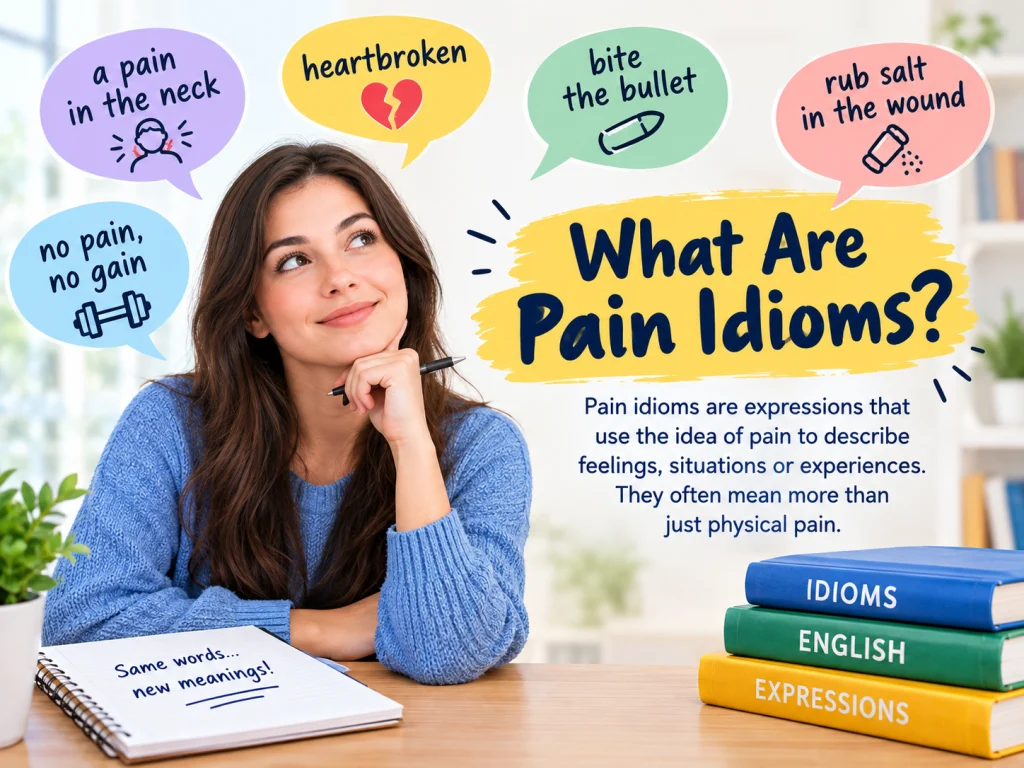
For example, when someone calls a coworker a pain in the neck, they usually do not mean that the person is causing an actual neck injury. They mean the person is annoying or difficult to deal with.
Some expressions describe pain directly, while others use pain as a metaphor for emotional or personal struggles. Understanding the context helps you determine whether an expression is being used literally or figuratively.
Archery Idioms: https://learnidioms.com/archery-idioms/
40 Common Pain Idioms With Meanings and Examples
The following expressions are grouped by meaning so you can understand when and how to use them in everyday American English.
1. Idioms About Emotional Pain and Heartbreak
These expressions describe sadness, disappointment, emotional suffering, and the hurt caused by difficult experiences.
1. Heartbroken
Meaning:
Feeling extremely sad, especially after losing someone or experiencing a painful disappointment.
Example:
“She was heartbroken when her longtime boyfriend ended their relationship.”
2. A broken heart
Meaning:
Deep emotional sadness, often caused by rejection, separation, or the loss of a loved one.
Example:
“It took him months to recover from a broken heart after the breakup.”
3. Twist the knife
Meaning:
To make someone’s emotional pain worse, especially by saying or doing something hurtful after they have already been upset.
Example:
“He twisted the knife by reminding her about the mistake in front of everyone.”
4. Rub salt in the wound
Meaning:
To make an already painful or embarrassing situation even worse.
Example:
“Losing the game was disappointing, and the opposing team’s celebration rubbed salt in the wound.”
5. Cry your eyes out
Meaning:
To cry intensely because of sadness, grief, or emotional distress.
Example:
“She cried her eyes out after saying goodbye to her best friend.”
6. Take something to heart
Meaning:
To be deeply affected by something someone says or does, especially criticism or advice.
Example:
“He took the criticism to heart and worked hard to improve his presentation.”
7. Eat your heart out
Meaning:
To suffer from jealousy or longing. It can also be used playfully to challenge someone who might be envious.
Example:
“Eat your heart out, everyone! I finally got tickets to the concert.”
8. A thorn in your side
Meaning:
A persistent source of irritation, trouble, or difficulty.
Example:
“The unresolved paperwork has been a thorn in my side for weeks.”
9. Wound someone’s pride
Meaning:
To hurt someone’s feelings by damaging their sense of dignity or self-respect.
Example:
“His joke about her performance wounded her pride.”
10. Hit someone where it hurts
Meaning:
To affect someone at their most sensitive point, emotionally or otherwise.
Example:
“Bringing up his failed business hit him where it hurt.”
2. Idioms About Physical Pain and Discomfort
These expressions refer to bodily discomfort or use physical pain to describe something unpleasant.
11. A pain in the neck
Meaning:
A person or situation that is very annoying or troublesome.
Example:
“Having to restart the computer every hour is a real pain in the neck.”
12. A pain in the butt
Meaning:
Something or someone that is irritating or difficult to deal with. This expression is informal and can sound mildly vulgar.
Example:
“Finding a parking spot downtown can be a pain in the butt.”

13. A pain in the rear
Meaning:
An indirect, more polite alternative to a pain in the butt, describing an irritating person or task.
Example:
“Filling out all these forms is a pain in the rear.”
14. Feel like you’ve been hit by a truck
Meaning:
To feel extremely exhausted, sore, or unwell.
Example:
“After that long hike, I feel like I’ve been hit by a truck.”
15. My head is killing me
Meaning:
An informal way to say that you have a very bad headache.
Example:
“Could you turn down the music? My head is killing me.”
16. Hurt like hell
Meaning:
To hurt extremely badly. This expression is informal and contains mild profanity.
Example:
“My ankle hurt like hell after I twisted it during practice.”
17. Be in agony
Meaning:
To experience extreme physical or emotional suffering.
Example:
“He was in agony after accidentally hitting his thumb with a hammer.”
18. Be a sore point
Meaning:
A subject that causes embarrassment, sadness, or irritation when mentioned.
Example:
“The canceled vacation is still a sore point for the family.”
19. A bitter pill to swallow
Meaning:
An unpleasant or disappointing fact that is difficult to accept.
Example:
“Being passed over for the promotion was a bitter pill to swallow.”
20. No pain, no gain
Meaning:
The idea that achieving something worthwhile often requires effort, discomfort, or sacrifice.
Example:
“Training for the marathon is tough, but no pain, no gain.”
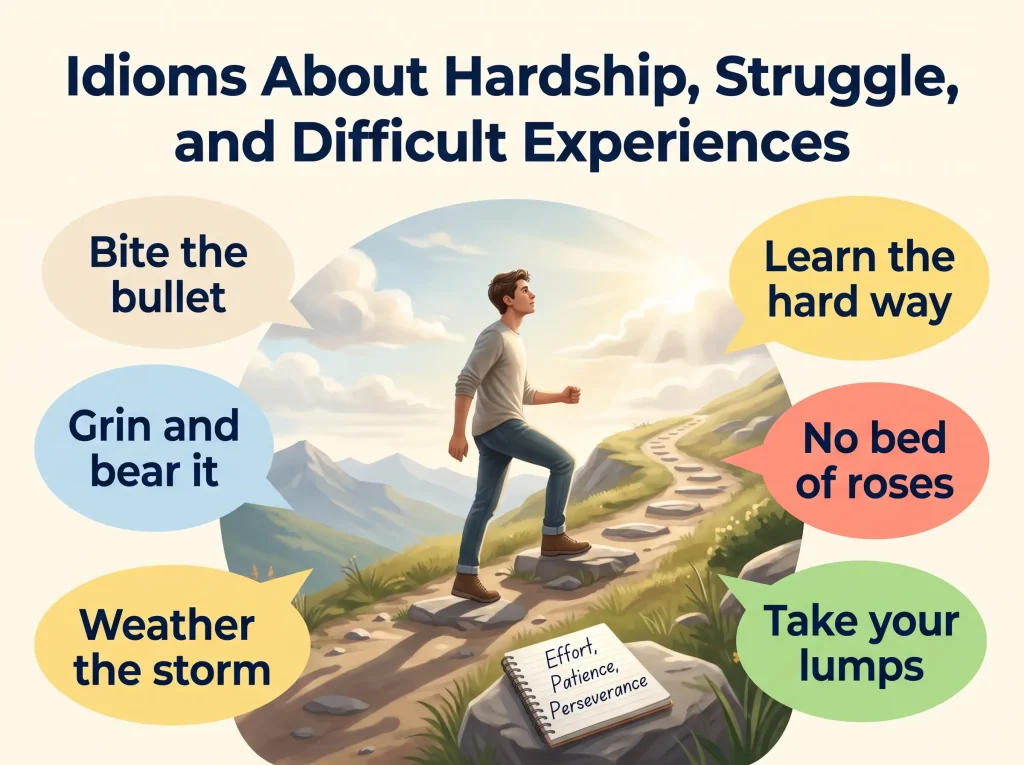
3. Idioms About Hardship, Struggle, and Difficult Experiences
These expressions help describe challenging circumstances, painful lessons, and the effort required to overcome obstacles.
21. Go through the mill
Meaning:
To experience a difficult, exhausting, or unpleasant period.
Example:
“The family went through the mill while dealing with financial problems.”
22. Learn the hard way
Meaning:
To learn something through a difficult or unpleasant experience rather than through advice.
Example:
“I learned the hard way that ignoring deadlines can cost you a job.”
23. Bite the bullet
Meaning:
To face a difficult or unpleasant situation with courage and determination.
Example:
“I finally bit the bullet and made the difficult phone call.”
24. Grin and bear it
Meaning:
To tolerate pain, discomfort, or an unpleasant situation without complaining.
Example:
“The line was moving slowly, so we had to grin and bear it.”
25. Feel the pinch
Meaning:
To experience financial pressure or difficulty because money is limited.
Example:
“With grocery prices going up, many families are feeling the pinch.”
26. Add insult to injury
Meaning:
To make a bad situation even worse by adding another unpleasant or offensive experience.
Example:
“My flight was delayed for five hours, and to add insult to injury, my luggage was lost.”
27. A hard pill to swallow
Meaning:
A difficult or upsetting truth that someone must accept.
Example:
“It was a hard pill to swallow when she realized her business was losing money.”
28. Take your lumps
Meaning:
To accept criticism, punishment, or the unpleasant consequences of your actions.
Example:
“He made a poor decision and knew he would have to take his lumps.”
29. Weather the storm
Meaning:
To survive or endure a difficult period without giving up.
Example:
“The small business managed to weather the storm during a challenging year.”
30. No bed of roses
Meaning:
A situation that is not easy, comfortable, or pleasant.
Example:
“Working two jobs while attending college is no bed of roses.”
4. Idioms About Causing Pain or Making Situations Worse
These expressions describe actions that hurt people, create frustration, or make an existing problem more difficult.
31. Twist someone’s arm
Meaning:
To pressure or persuade someone into doing something they are reluctant to do.
Example:
“My friends twisted my arm and convinced me to join them for dinner.”
32. Rub someone the wrong way
Meaning:
To annoy or irritate someone, often without intending to.
Example:
“His habit of interrupting people rubs me the wrong way.”
33. Hit below the belt
Meaning:
To behave unfairly or make a hurtful personal attack, especially during an argument.
Example:
“Bringing up her family problems during the debate was hitting below the belt.”
34. Open old wounds
Meaning:
To bring back painful memories or revive an emotional problem that had started to heal.
Example:
“Talking about their old disagreement opened old wounds.”
35. Twist the knife in the wound
Meaning:
To deliberately make someone’s distress worse. This is a variation of twist the knife.
Example:
“Instead of apologizing, he twisted the knife in the wound by making another cruel comment.”
36. Kick someone when they’re down
Meaning:
To treat someone cruelly or criticize them when they are already experiencing difficulties.
Example:
“She had already lost her job, so making fun of her situation was like kicking her when she was down.”
37. Pour oil on the fire
Meaning:
To make an argument, conflict, or difficult situation more intense.
Example:
“His angry response poured oil on the fire instead of calming everyone down.”
38. Make matters worse
Meaning:
To cause a difficult situation to become even more troublesome.
Example:
“The heavy traffic made matters worse when we were already running late.”
39. Salt in the wound
Meaning:
Something that increases someone’s existing pain, disappointment, or embarrassment. The phrase is commonly used in the expression rub salt in the wound.
Example:
“The extra fee felt like salt in the wound after the company had already canceled our reservation.”
40. Twist the knife a little deeper
Meaning:
To intensify someone’s emotional suffering with another hurtful remark or action. This is an expanded form of twist the knife.
Example:
“When he mentioned her mistake again, it felt as though he was twisting the knife a little deeper.”
How to Use Pain Idioms Naturally in American English
Pain idioms are common in everyday American conversations, but the right expression depends on the situation, the relationship between speakers, and the level of formality.
Here are some useful ways to use them naturally.

Choose the expression that matches the feeling
Use heartbroken when describing deep sadness, a pain in the neck when talking about an annoying task, and bite the bullet when someone needs to face something unpleasant.
For example:
- “I’m heartbroken that my friend is moving away.”
- “This paperwork is a pain in the neck.”
- “I need to bite the bullet and finish my taxes.”
Pay attention to formality
Some expressions are suitable for casual conversations, while others are more appropriate for professional or formal settings.
For example, a pain in the neck is generally more suitable for polite conversation than a pain in the butt. Similarly, hurt like hell is informal and may not be appropriate in a formal meeting.
Understand literal and figurative meanings
Some expressions can describe real physical pain or a metaphorical experience.
For example, “My head is killing me” usually means that someone has a severe headache. However, “That loud noise is killing me” may be an exaggerated way of expressing irritation or discomfort.
Context helps listeners understand the intended meaning.
Avoid using too many idioms together
Although idioms make language expressive, using too many in a single sentence can sound unnatural or confusing.
Instead of saying, “I was heartbroken, hit below the belt, and had salt rubbed in my wound,” choose the expression that communicates the main feeling most clearly.
Common Mistakes When Learning Pain Idioms
English learners sometimes misunderstand pain idioms because they interpret each word literally. Here are several mistakes to avoid.
| Common mistake | Correct understanding |
|---|---|
| Thinking a pain in the neck always refers to physical pain | It usually describes an annoying person, task, or situation. |
| Using heartbroken for a minor inconvenience | It generally describes deep emotional sadness or distress. |
| Assuming no pain, no gain means every painful activity is beneficial | It is a saying about effort and achievement, not medical advice or a guarantee of success. |
| Using hurt like hell in every professional setting | It is informal and may be unsuitable in formal communication. |
| Confusing add insult to injury with simply causing an injury | It means making an already bad situation worse with an additional unpleasant experience. |
| Treating every expression as a literal description | Many pain idioms are figurative and require context to understand correctly. |
Learning the meaning, tone, and typical context of each expression will help you avoid these mistakes and communicate more naturally.

Frequently Asked Questions
Conclusion
Pain idioms add depth and personality to English by helping speakers describe emotional suffering, physical discomfort, frustration, and difficult experiences. Expressions such as heartbroken, a pain in the neck, bite the bullet, and rub salt in the wound can communicate feelings and situations more vividly than literal descriptions alone.





One Comment