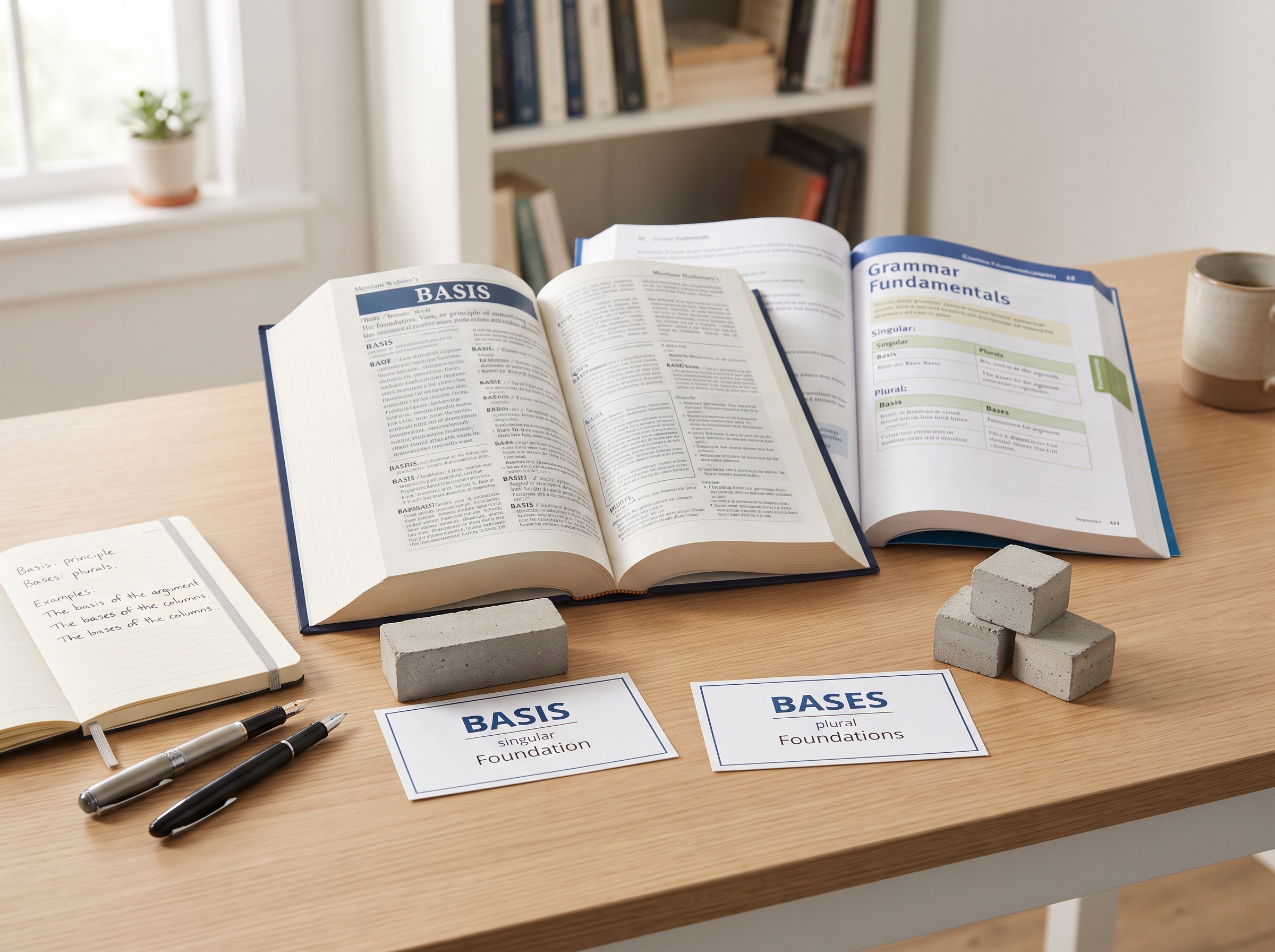
Bases or Basis? Meaning, Plural Form, and Examples
Basis and bases are both correct English words, but they are used differently. Basis is singular and usually means a foundation, reason, principle, or method. Bases is the plural of basis, meaning more than one foundation or reason. However, bases is also the plural of the separate word base, so the intended meaning depends on the sentence.
For example:
- Singular: “Trust is the basis of their friendship.”
- Plural: “Trust and honesty are the bases of their friendship.”
The first sentence refers to one foundation. The second refers to more than one. Here’s how to tell which word you need and how to use each form correctly.
What Does Basis Mean?
Basis is a singular noun that refers to the foundation, reason, principle, or method behind something. It can describe the information used to make a decision, the idea that supports an argument, or the arrangement under which something happens.

Example:
- “The report provides a basis for further discussion.”
- “She was selected on the basis of her experience.”
- “We meet on a regular basis.”
- “There is no scientific basis for that claim.”
- “The company changed its payment basis.”
A particularly common phrase is “on the basis of,” which means “because of,” “using,” or “according to” a particular reason or set of facts.
Example: “The committee made its decision on the basis of the evidence.”
Another frequent expression is “on a regular basis,” meaning regularly. In many cases, the shorter word regularly is more direct, but “on a regular basis” is also widely used.
Vacation Idioms: https://learnidioms.com/vacation-idioms/
What Does Bases Mean?
Bases has two grammatical uses:
- It is the plural of basis, meaning multiple reasons, foundations, principles, or methods.
- It is the plural of base, meaning multiple supports, starting points, military installations, or other things called bases.
Oxford Learner’s Dictionaries+2
Bases as the Plural of Basis
When bases refers to multiple foundations or reasons, it is the plural form of basis.
- “The researchers considered several bases for their conclusion.”
- “The proposal rests on two main bases.”
- “The court examined the legal bases for the claim.”
- “The theories have different philosophical bases.”
- “We need clear bases for comparing the results.”
In these examples, bases does not refer to physical objects. It refers to multiple underlying reasons, principles, or foundations.
Bases as the Plural of Base
The word base has several meanings. It can refer to the bottom or supporting part of an object, a military installation, or one of the four positions in baseball. Its plural is also bases.
Oxford Learner’s Dictionaries
+1
Examples:
- “The table has a wide base.”
- “The sculptures stand on stone bases.”
- “The troops returned to their bases.”
- “The runner advanced around the bases.”
In these sentences, bases is the plural of base, not basis.
Bases vs. Basis: Examples and Comparison Table
| Word | Grammatical form | Meaning | Example |
|---|---|---|---|
| Basis | Singular noun | One foundation, reason, or principle | “Evidence is the basis of the argument.” |
| Bases | Plural of basis | More than one foundation or reason | “The report identifies several bases for the decision.” |
| Base | Singular noun | A support, bottom, starting point, or installation | “The lamp has a sturdy base.” |
| Bases | Plural of base | More than one support, starting point, or installation | “The lamps have sturdy bases.” |
The key is to look at what the word means in context. If it refers to multiple reasons or principles, bases is the plural of basis. If it refers to multiple physical supports or other things called bases, it is the plural of base.
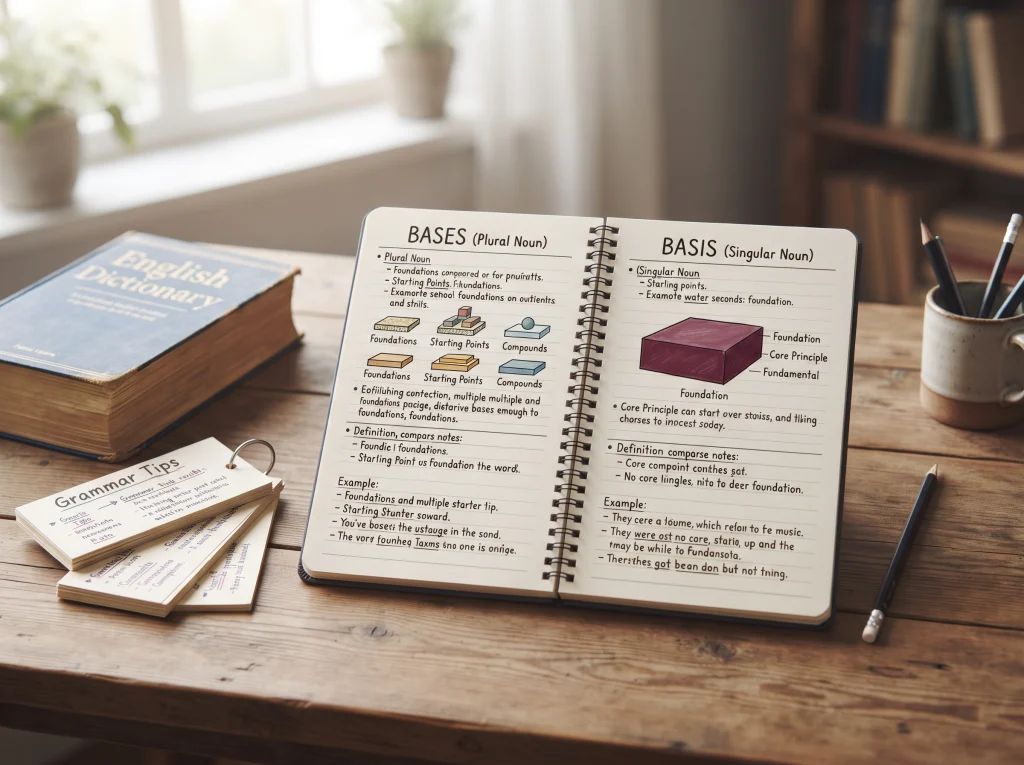
Basis or Bases in a Sentence?
Use basis when you mean one underlying reason or foundation:
- “This document forms the basis of our plan.”
- “The decision was made on the basis of cost.”
- “Her argument has a strong basis in research.”
Use bases when you mean more than one:
- “The plan has several bases.”
- “The researchers used different bases for comparison.”
- “There are multiple bases for the conclusion.”
Notice that the singular and plural forms can appear in similar sentence structures. The number of foundations or reasons determines whether basis or bases is appropriate.
How to Pronounce Basis and Bases
The words have different pronunciations, and bases has two pronunciations because it can be the plural of either basis or base. Cambridge and Oxford distinguish these forms in their pronunciation entries.
Cambridge Dictionary
+2
| Word | Pronunciation guide | IPA |
|---|---|---|
| basis | BAY-sis | /ˈbeɪ.sɪs/ |
| bases, plural of basis | BAY-seez | /ˈbeɪ.siːz/ |
| base | BAYS | /beɪs/ |
| bases, plural of base | BAY-siz | /ˈbeɪ.sɪz/ |
For example, in “The researchers considered several bases for the theory,” bases is pronounced BAY-seez. In “The soldiers returned to their bases,” it is pronounced BAY-siz.
The context usually makes the intended meaning clear, even when you see the word in writing.
Why Is the Plural of Basis Bases?
The standard plural of basis is bases, not basises. The spelling changes from -is to -es, a pattern also found in several other English nouns with Greek or Latin origins.
Dictionary.com
+1
| Singular | Plural |
|---|---|
| basis | bases |
| analysis | analyses |
| crisis | crises |
| thesis | theses |
| hypothesis | hypotheses |
For example:
- “The analysis supports the conclusion.”
- “The analyses support the conclusion.”
Likewise:
- “One basis supports the decision.”
- “Several bases support the decision.”
Remember the standard form basis → bases rather than adding an ordinary -s to make basises.
Common Mistakes to Avoid
1. Writing “Basises”
Incorrect: “The proposal has several basises.”
Correct: “The proposal has several bases.”
The accepted plural form of basis is bases.
Oxford Learner’s Dictionaries
+1
2. Using “Basis” After a Plural Word
Incorrect: “There are several basis for the decision.”
Correct: “There are several bases for the decision.”
Words such as several, many, and multiple indicate that the noun should be plural in this sentence.

3. Assuming “Bases” Always Refers to Physical Objects
Incorrect interpretation: “The bases of the argument” must mean physical supports.
Actually, bases can mean multiple reasons or foundations when it is the plural of basis. For example, “The argument rests on several bases” refers to supporting reasons, not objects.
Oxford Learner’s Dictionaries
+1
4. Confusing “Basis” With “Base”
These words overlap in some contexts, but they are not interchangeable in every expression.
- Natural: “The evidence is the basis for the decision.”
- Natural: “The statue rests on a stone base.”
- Unnatural for the intended physical meaning: “The statue rests on a stone basis.”
Choose the word that matches the meaning you want to communicate.
A Simple Way to Remember the Difference
Use this quick rule:
- One reason or foundation: basis
- More than one reason or foundation: bases
- One physical support or starting point: base
- More than one physical support or starting point: bases
When you see bases, ask yourself whether the sentence refers to multiple foundations or multiple physical or conceptual bases. That will help you identify the correct meaning.

Rabbit idioms: https://learnidioms.com/rabbit-idioms/
FAQs
Conclusion
The difference between bases and basis comes down to number and meaning. Basis is singular and usually refers to one foundation, reason, principle, or method. Bases is the plural of basis, but it is also the plural of base, which can refer to a physical support, starting point, or installation.
Remember that the standard plural is basis → bases, not basises. Also keep in mind that bases has different pronunciations depending on which word it represents. Once you check the meaning and context, choosing between bases or basis becomes much easier.






3 Comments