Wisp or Whisp? Meaning, Difference, and Correct Spelling
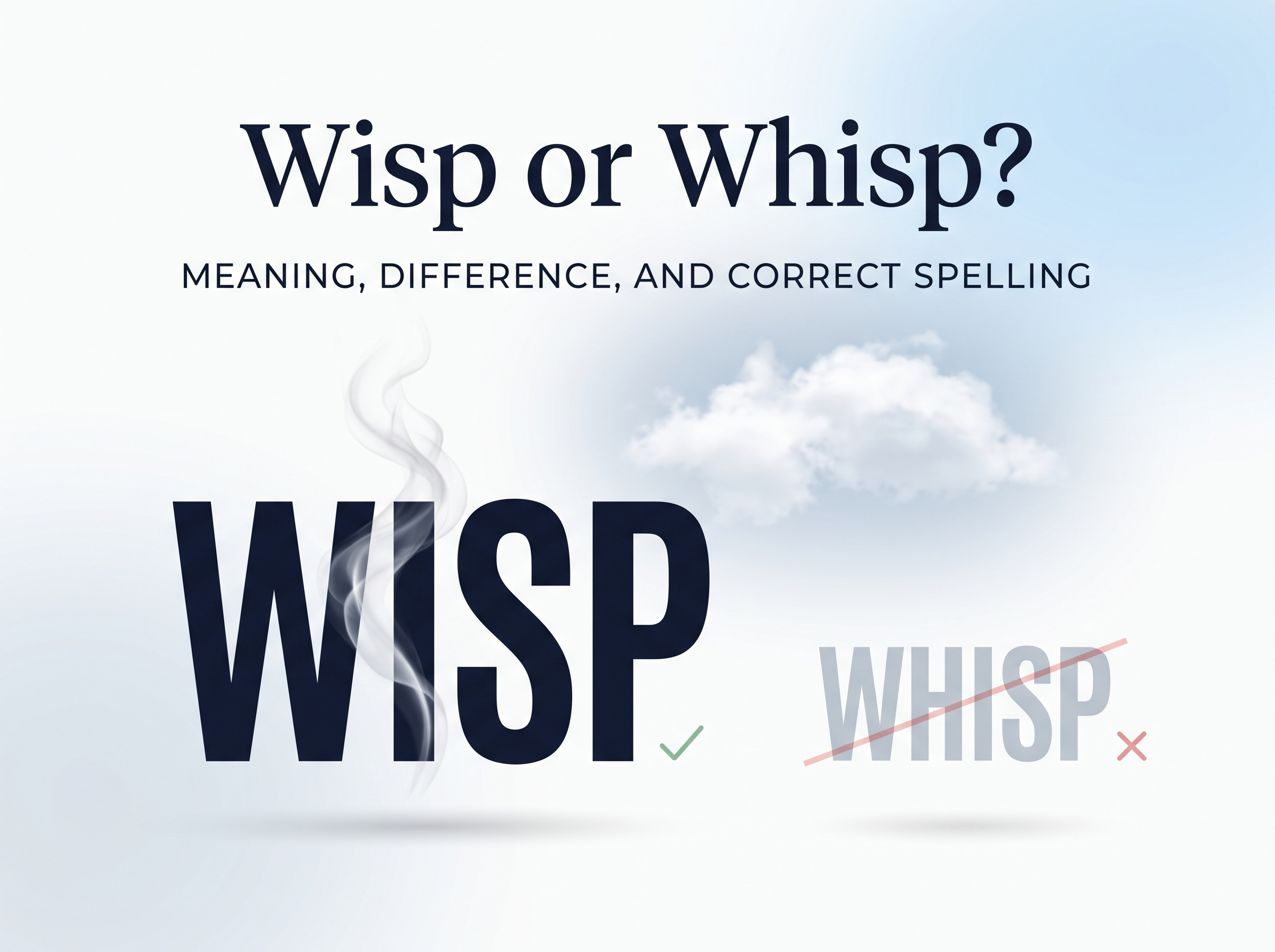
When deciding between wisp or whisp, the correct spelling for standard American English is wisp. It describes a small, thin, delicate piece of something, such as a strand of hair, a trail of smoke, or a faint patch of cloud. The spelling whisp is generally a nonstandard form when used with this meaning.

Although the difference is only one letter, choosing the correct spelling helps make your writing clearer and more professional. Whether you are writing a school assignment, an email, a story, or a blog post, understanding the meaning of wisp will help you use it naturally.
What Does Wisp Mean?
The word wisp is a noun that describes a small, thin strand, tuft, or amount of something. It often refers to something light, delicate, or barely visible. The word can describe physical objects, including hair and grass, as well as smoke, mist, and clouds.
According to standard dictionary usage, a wisp can also refer to a small bundle of hay or straw. In figurative language, it may describe a slight trace of a feeling or quality.
Here are some common examples:
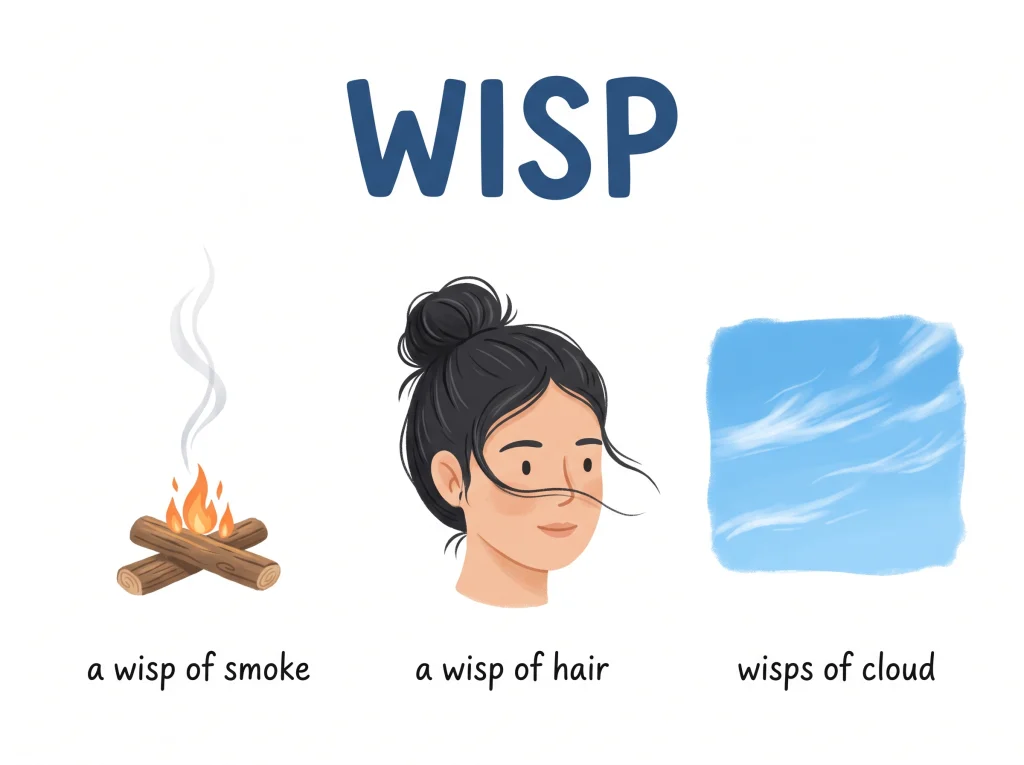
- A wisp of smoke: A thin trail of smoke rising into the air.
- A wisp of hair: A small, loose strand of hair.
- A wisp of cloud: A thin, delicate patch of cloud.
- A wisp of mist: A faint layer or trail of mist.
- A wisp of hay: A small bundle or handful of dried grass.
For example, you might write, “A wisp of smoke rose from the campfire.” The word wisp helps readers picture a narrow, delicate trail rather than a large cloud of smoke.
Similarly, the sentence “She brushed a wisp of hair away from her face” describes a small strand that has fallen loose.
The central meaning remains consistent: a wisp is something small, thin, or slight.
Is Whisp a Correct Spelling?
In standard modern American English, whisp is not the spelling to use when you mean a thin strand or small amount of something. The correct spelling is wisp, without an h.
The confusion is understandable because English contains many words beginning with wh, including whisper, whistle, and white. However, these words follow their own spelling patterns, and their initial letters do not determine how wisp should be written.
Compare these examples:
| Nonstandard spelling | Correct spelling |
|---|---|
| A whisp of smoke rose from the fire. | A wisp of smoke rose from the fire. |
| She tucked a whisp of hair behind her ear. | She tucked a wisp of hair behind her ear. |
| A whisp of cloud crossed the sky. | A wisp of cloud crossed the sky. |
| The wind carried a whisp of mist away. | The wind carried a wisp of mist away. |
In each example, removing the extra h gives you the standard spelling.
You may encounter whisp in unusual or historical contexts, but it is not a standard alternative spelling for everyday writing. For schoolwork, professional documents, and general American English, choose wisp.
Wisp vs. Whisp: Key Differences
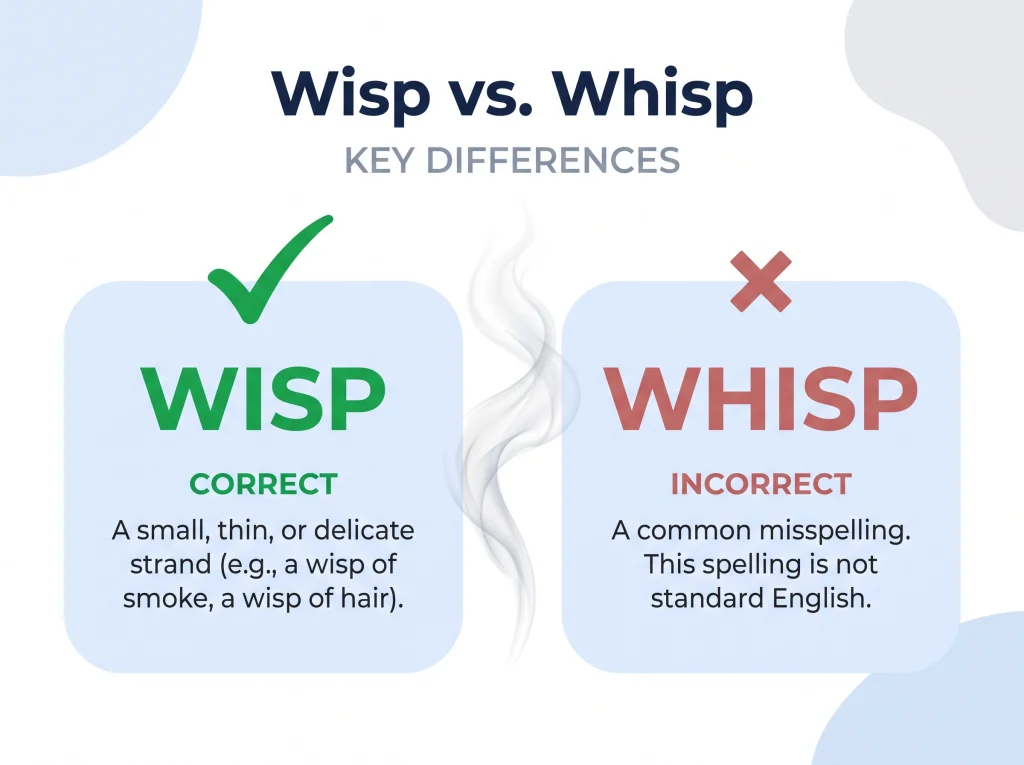
The main difference between wisp and whisp is standard spelling. Wisp is an established English word with a clear meaning, while whisp is generally an incorrect spelling when used in its place.
| Feature | Wisp | Whisp |
|---|---|---|
| Standard spelling | Correct | Nonstandard for the intended meaning |
| Meaning | A thin strand, small tuft, or faint trace | Usually intended to mean wisp |
| Common usage | Everyday and formal writing | Usually a spelling mistake |
| American English | Accepted | Avoid in standard writing |
| Example | A wisp of smoke drifted away. | A whisp of smoke drifted away. |
Unlike spelling pairs such as color and colour, which reflect accepted American and British English conventions, wisp and whisp are not standard regional alternatives.
You do not need to memorize separate American and British versions. The normal spelling is wisp in both varieties of English.
Common Phrases That Use Wisp
Learning common expressions can make it easier to recognize and use the correct spelling. Wisp frequently appears in phrases describing something delicate, narrow, or faint.
A Wisp of Smoke
This phrase refers to a thin trail of smoke rising or drifting through the air.
Example: A wisp of smoke escaped from the chimney on the cold morning.
The phrase creates a picture of a small amount of smoke rather than a thick, heavy cloud.
A Wisp of Hair
A wisp of hair is a small, loose strand that often falls away from the rest of someone’s hair.
Example: A wisp of hair fell across her forehead as she ran.
This expression is common in descriptions of appearance and can be used in both everyday conversation and creative writing.
A Wisp of Cloud
This phrase describes a small, thin patch of cloud in the sky.
Example: A single wisp of cloud floated above the mountains.
It is especially useful when describing a mostly clear sky with only a little cloud cover.
A Wisp of Mist
A wisp of mist is a faint, narrow area of moisture suspended in the air.
Example: A wisp of mist drifted across the lake at sunrise.
The phrase helps convey a light, delicate appearance rather than dense fog.
A Wisp of Hope
Wisp can also be used figuratively to describe something slight or fragile. In a phrase such as a wisp of hope, it suggests a small amount of hope that remains in a difficult situation.
Example: Even after several setbacks, she held on to a wisp of hope.
This figurative use demonstrates how a word associated with physical things can also express an abstract idea.
Examples of Wisp in Everyday American English Sentences
The best way to remember a word is to see how it works in different contexts. The following sentences show how Americans can use wisp naturally.
- A wisp of smoke rose from the backyard fire.
- He moved a wisp of hair away from his eyes.
- Wisps of clouds appeared above the open fields.
- A wisp of fog lingered over the road early in the morning.
- The breeze carried a wisp of perfume through the room.
- A few wisps of hay remained in the old barn.
- She noticed a wisp of steam escaping from the coffee mug.
- A wisp of doubt crossed his mind before he answered.
- The artist painted wisps of white cloud against the blue sky.
- A wisp of mist disappeared as the sun warmed the valley.
Notice that the plural form is wisps, not whisps. When you describe more than one strand, trace, or tuft, add an s to the correct spelling.
For example, “Wisps of smoke rose above the trees” is correct.
Common Mistakes When Using Wisp and Whisp
Spelling mistakes often happen when a word looks similar to another familiar word. Knowing the most common errors can help you avoid them.
Adding an Unnecessary H
The most common mistake is writing whisp instead of wisp.
Incorrect: A whisp of smoke drifted through the room.
Correct: A wisp of smoke drifted through the room.
Remember that the standard word begins with w followed by i, not wh.
Misspelling the Plural Form
The plural of wisp is wisps. Adding an unnecessary h produces the nonstandard spelling whisps.
Incorrect: Thin whisps of fog covered the field.
Correct: Thin wisps of fog covered the field.
Confusing Wisp With Whisper
The words wisp and whisper may seem related because both can appear in descriptions of something faint or quiet. However, they have different meanings and spellings.
A wisp is a small strand, tuft, or trace of something. A whisper is a quiet way of speaking.
Examples:
- A wisp of smoke rose into the air.
- She spoke in a whisper so she would not wake the baby.
The similarity in appearance should not lead you to add an h to wisp.
Assuming Both Spellings Are Equally Acceptable
Because readers can usually understand what whisp means, they may assume it is an acceptable alternative. However, a reader’s ability to understand a spelling does not make that spelling standard.
Use wisp in essays, emails, articles, and other writing where correct spelling matters.
Tips for Remembering the Difference Between Wisp and Whisp
A simple spelling trick can help you remember the correct form without looking it up every time.
Remember the word wispy. The adjective wispy describes something thin, light, or delicate, such as wispy clouds or wispy hair. It contains no h, just like the noun wisp.
You can also remember this short rule:
- Wisp is correct.
- Wisps is the plural.
- Wispy is the related adjective.
- Whisp is not the standard spelling for this meaning.
Try using the word in a sentence whenever you practice spelling it. For example, “A wisp of cloud floated across the sky.” Connecting the spelling to a familiar image makes it easier to recall.
If you are proofreading an article or assignment, search for whisp and check whether you intended to write wisp. A quick review can catch this small but noticeable mistake.
FAQs:
Conclusion
When choosing between wisp or whisp, use wisp in standard American English. The word describes a thin strand, small tuft, or faint trace of something, such as hair, smoke, mist, or cloud. The spelling whisp is generally nonstandard when used with this meaning.
Remember the related word wispy to help you keep the spelling straight. Once you recognize common phrases such as “a wisp of smoke” and “a wisp of hair,” you can use the word confidently in everyday, academic, and professional writing.