Eat Idioms: 100 Common English Expressions With Meanings and Example
The verb eat appears in many English idioms and expressions that have meanings far beyond food. In American English, these expressions can describe hunger, embarrassment, regret, competition, worry, financial loss, hard work, and even someone’s personality.
For example, if someone says, “I had to eat my words,” they usually do not mean that they literally ate anything. They mean they had to admit that something they said was wrong. Likewise, eat humble pie means to admit a mistake or accept that you were wrong.
English dictionaries list many established idioms containing eat, including eat like a bird, eat like a horse, eat your words, eat humble pie, eat someone out of house and home, eat someone alive, eat someone’s lunch, eat your heart out, and eat, sleep, and breathe something.
What Are Eat Idioms?
Eat idioms are fixed or familiar English expressions that use the word “eat” but have a figurative meaning. Their meaning often cannot be understood simply by looking at the individual words.
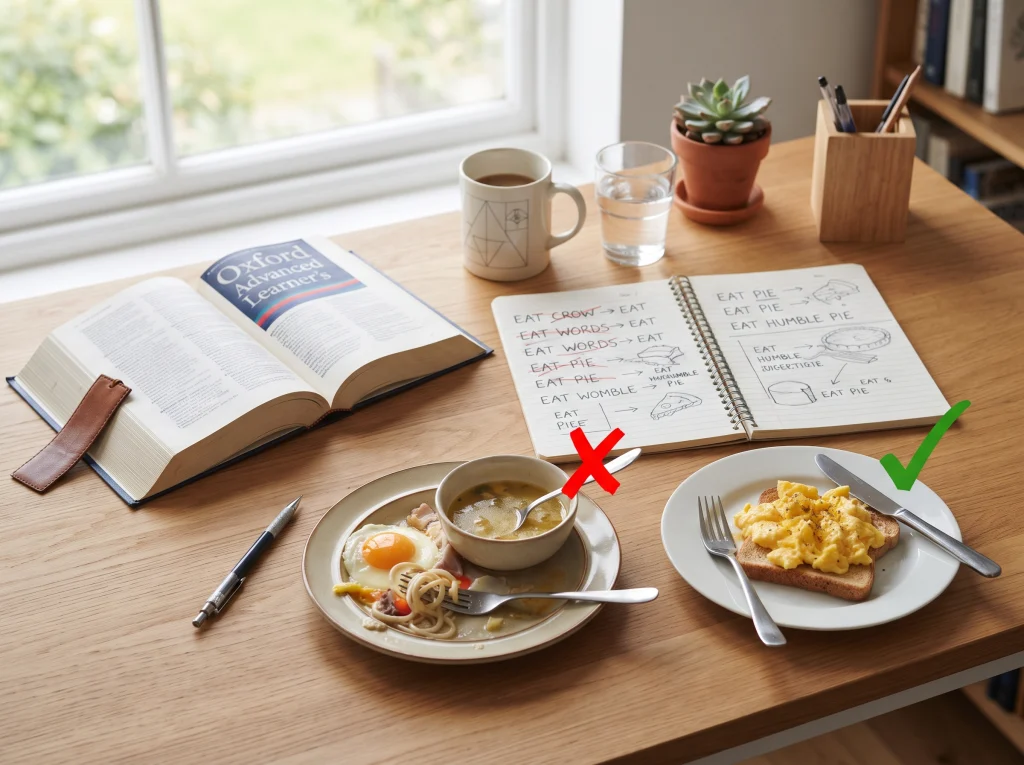
For example:
- Eat your words means to admit that what you said was wrong.
- Eat humble pie means to admit a mistake and accept embarrassment.
- Eat like a horse means to eat a large amount of food.
- What’s eating you? means “What is bothering or worrying you?”
- Have your cake and eat it too means to want two advantages that normally cannot both be kept.
Some expressions with eat are idioms, while others are phrasal verbs or common expressions. Cambridge lists idioms and phrasal verbs separately, so it is useful to distinguish them when learning English.
100 Common Eat Idioms and Expressions
| # | Eat Idiom | Meaning | Example |
|---|---|---|---|
| 1 | Eat your words | Admit that what you said was wrong | I said the plan would fail, so now I have to eat my words. |
| 2 | Eat humble pie | Admit a mistake | He had to eat humble pie after blaming the wrong person. |
| 3 | Eat like a horse | Eat a lot | My teenage son can eat like a horse after practice. |
| 4 | Eat like a bird | Eat very little | She eats like a bird at breakfast. |
| 5 | Eat like a pig | Eat messily or excessively | He was so hungry that he ate like a pig. |
| 6 | Eat someone alive | Defeat or criticize someone severely | The opposing team will eat us alive if we are not prepared. |
| 7 | Eat someone for breakfast | Easily defeat or overpower someone | Our debate coach could eat nervous students for breakfast. |
| 8 | Eat someone’s lunch | Outperform or take an advantage from someone | The new company is eating our lunch in online sales. |
| 9 | Eat someone out of house and home | Consume so much food that it becomes expensive | With three hungry teenagers, guests can eat us out of house and home. |
| 10 | Eat your heart out | Used to express jealousy, admiration, or playful comparison | I made homemade pizza tonight, so eat your heart out, restaurant chefs! |
| 11 | Have your cake and eat it too | Have two desirable things that normally conflict | You cannot work fewer hours and expect the same schedule flexibility while having your cake and eating it too. |
| 12 | Eat crow | Admit you were wrong | I thought he would quit, but I had to eat crow when he got promoted. |
| 13 | Eat dirt | Accept humiliation or defeat | The arrogant player was forced to eat dirt after losing the match. |
| 14 | Eat your hat | Say you will be extremely surprised if something happens | I’ll eat my hat if he finishes the project today. |
| 15 | Could eat a horse | Be extremely hungry | I skipped lunch, and now I could eat a horse. |
| 16 | What’s eating you? | What is bothering you? | You seem quiet today. What’s eating you? |
| 17 | Eat, sleep, and breathe something | Be completely devoted to something | She eats, sleeps, and breathes basketball. |
| 18 | Eat out | Eat at a restaurant rather than at home | Let’s eat out tonight. |
| 19 | Eat in | Eat at home | We decided to eat in because it was raining. |
| 20 | Eat away at something | Gradually damage or reduce something | The repairs are eating away at our savings. |
| 21 | Eat away at someone | Gradually cause worry or distress | The secret kept eating away at him. |
| 22 | Eat into something | Gradually reduce or consume something | Rising costs are eating into our profits. |
| 23 | Eat up something | Use or consume something quickly | The new machine eats up electricity. |
| 24 | Eat it up | Enjoy something enthusiastically | The audience ate up every joke. |
| 25 | Eat up someone’s time | Use a large amount of someone’s time | These meetings eat up most of my afternoon. |
| 26 | Eat your way through | Eat a large variety or quantity of something | We ate our way through the food festival. |
| 27 | Eat one’s fill | Eat until satisfied | Everyone sat down and ate their fill. |
| 28 | Eat to one’s heart’s content | Eat as much as desired | Guests could eat to their heart’s content. |
| 29 | Eat like there’s no tomorrow | Eat a very large amount | After the long hike, we ate like there was no tomorrow. |
| 30 | Eat for two | Eat more because one is pregnant | People sometimes jokingly say that a pregnant woman is eating for two. |
| 31 | Eat clean | Follow a diet based mainly on minimally processed foods | He is trying to eat clean during the week. |
| 32 | Eat healthy | Choose nutritious foods | I am trying to eat healthy this month. |
| 33 | Eat well | Have enough or good-quality food | Make sure you eat well while you are traveling. |
| 34 | Eat one’s way out of a problem | Try to deal with a problem through excessive eating | Stress can sometimes lead people to eat their way out of a problem. |
| 35 | Eat one’s feelings | Eat because of emotional distress | After the breakup, he joked that he was eating his feelings. |
| 36 | Eat one’s stress | Eat in response to stress | She tends to eat her stress when work gets overwhelming. |
| 37 | Eat one’s emotions | Use food as a response to strong emotions | He noticed that he often ate his emotions after difficult days. |
| 38 | Eat one’s troubles away | Try to forget problems by eating | She realized she could not eat her troubles away. |
| 39 | Eat away one’s confidence | Gradually weaken confidence | Constant criticism can eat away at someone’s confidence. |
| 40 | Eat one’s heart out | Suffer from jealousy or longing | He watched his former team win and ate his heart out. |
| 41 | Eat someone alive | Attack or criticize someone intensely | The reporters ate the politician alive over the controversial statement. |
| 42 | Eat someone out of house and home | Consume a household’s food excessively | The visiting college students nearly ate us out of house and home. |
| 43 | Dog-eat-dog | Extremely competitive and ruthless | The technology industry can be dog-eat-dog. |
| 44 | Eat or be eaten | Either succeed or be defeated | In that highly competitive market, some businesses feel it is eat or be eaten. |
| 45 | Eat someone’s dust | Be left far behind by someone | Step on the gas and you will eat my dust! |
| 46 | Eat someone’s lunch | Beat or outperform a competitor | The smaller company is eating the larger competitor’s lunch. |
| 47 | Eat the competition | Defeat competitors decisively | The team hopes to eat the competition this season. |
| 48 | Eat up the competition | Overcome competitors easily | The brand quickly ate up the competition in the local market. |
| 49 | Eat one’s own words | Admit one’s statement was wrong | She had to eat her own words after seeing the results. |
| 50 | Eat crow | Publicly admit an error | I was certain he was wrong, so I had to eat crow later. |
| 51 | Eat humble pie | Accept humiliation after being wrong | The manager ate humble pie and apologized to the staff. |
| 52 | Eat dirt | Suffer humiliation or defeat | The champion refused to eat dirt without a fight. |
| 53 | Eat one’s pride | Suppress pride and accept an unpleasant situation | I had to eat my pride and ask for help. |
| 54 | Eat one’s ego | Put aside one’s ego | Sometimes you have to eat your ego and listen to criticism. |
| 55 | Eat the cost | Pay or absorb a cost yourself | The store decided to eat the cost of the damaged shipment. |
| 56 | Eat the loss | Accept a financial loss | We had to eat the loss when the deal fell apart. |
| 57 | Eat the expense | Absorb an expense rather than passing it on | The company agreed to eat the expense of the replacement. |
| 58 | Eat into profits | Reduce profits | Higher shipping fees are eating into profits. |
| 59 | Eat into savings | Reduce saved money | Unexpected medical bills can quickly eat into savings. |
| 60 | Eat up resources | Consume a large amount of resources | The project is eating up valuable resources. |
| 61 | Eat up the budget | Consume most of an available budget | Construction delays ate up the budget. |
| 62 | Eat up time | Take a lot of time | Social media can eat up hours if you are not careful. |
| 63 | Eat away at savings | Gradually reduce savings | Small expenses can eat away at savings over time. |
| 64 | Eat into the bottom line | Reduce overall profit | Higher labor costs are eating into the company’s bottom line. |
| 65 | Eat your way around town | Visit many places to eat | We spent Saturday eating our way around town. |
| 66 | Eat your way through a city | Try many foods in different places | Tourists can eat their way through the city in a weekend. |
| 67 | Eat your way through a menu | Try many menu items | We decided to eat our way through the menu. |
| 68 | Eat out of someone’s hand | Be completely controlled or strongly influenced by someone | The speaker had the audience eating out of her hand. |
| 69 | Have someone eating out of your hand | Control or charm someone completely | The performer had the crowd eating out of his hand. |
| 70 | Eat someone out of house and home | Consume another person’s household supplies excessively | His friends stayed for a week and ate him out of house and home. |
| 71 | Eat someone alive | Make someone feel severely criticized or defeated | My boss will eat me alive if I miss another deadline. |
| 72 | Eat someone for breakfast | Overpower someone easily | That attorney eats weak arguments for breakfast. |
| 73 | Eat your way into something | Gain access or involvement through food or meals | The phrase can be used humorously when someone builds relationships through shared meals. |
| 74 | Eat one’s words with a smile | Admit being wrong without resentment | He ate his words with a smile after his prediction failed. |
| 75 | Eat one’s words and apologize | Admit an error and apologize | She ate her words and apologized to her coworker. |
| 76 | Eat away at a relationship | Gradually damage a relationship | Lack of trust can eat away at a relationship. |
| 77 | Eat away at peace of mind | Gradually cause worry | Financial uncertainty was eating away at his peace of mind. |
| 78 | Eat away at morale | Gradually weaken confidence or enthusiasm | Constant changes can eat away at employee morale. |
| 79 | Eat away at patience | Gradually make someone less patient | Repeated delays began to eat away at her patience. |
| 80 | Eat away at motivation | Gradually reduce motivation | Repeated failures can eat away at motivation. |
| 81 | Eat your way into someone’s good graces | Gain favor through food or hospitality | He joked that he ate his way into his new neighbors’ good graces. |
| 82 | Eat your way to the top | Reach success through excessive effort involving food or, humorously, eating | The food blogger joked about eating her way to the top. |
| 83 | Eat high on the hog | Live comfortably or enjoy expensive things | After the promotion, they felt they were eating high on the hog. |
| 84 | Eat low on the hog | Live modestly or economically | During college, we were eating low on the hog. |
| 85 | Eat one’s terms | Accept an unpleasant condition | The expression is uncommon in modern American English and may sound dated. |
| 86 | Eat the wind out of someone | Take away someone’s confidence or enthusiasm | The unexpected criticism ate the wind out of him. |
| 87 | Eat fire | Show fierce determination or anger | The phrase can describe someone who seems ready to fight or confront a challenge. |
| 88 | Eat lightning | Act with exceptional speed or energy | The phrase is usually humorous or literary rather than everyday speech. |
| 89 | Eat one’s hat | Express strong disbelief about something happening | I’ll eat my hat if they finish before Friday. |
| 90 | Eat your hat over it | Be extremely surprised if something occurs | He said he would eat his hat over the unexpected result. |
| 91 | Eat a horse | Be extremely hungry | After the marathon, I could eat a horse. |
| 92 | Eat like a horse | Have a very large appetite | My brother eats like a horse after a workout. |
| 93 | Eat like a bird | Have a very small appetite | My grandmother eats like a bird. |
| 94 | Eat like a pig | Eat messily or greedily | The kids ate like pigs at the barbecue. |
| 95 | Eat like a king | Eat very well or enjoy luxurious food | We ate like kings during our vacation. |
| 96 | Eat like a queen | Eat very well or enjoy excellent food | She ate like a queen at the fancy restaurant. |
| 97 | Eat one’s fill | Eat enough to feel satisfied | We sat outside and ate our fill. |
| 98 | Eat to one’s heart’s content | Eat as much as one wants | Everyone could eat to their heart’s content at the buffet. |
| 99 | Eat someone else’s lunch | Take another person’s opportunity or advantage | A faster competitor can eat someone else’s lunch in a crowded market. |
| 100 | Have one’s cake and eat it | Keep something while also enjoying the benefit of giving it up | You cannot always have your cake and eat it. |
Many of these expressions are established dictionary entries, while others are common extensions or conversational combinations built around established eat expressions. Cambridge and Collins both document a broad range of idioms and expressions using eat.

Eat Idioms About Food and Appetite
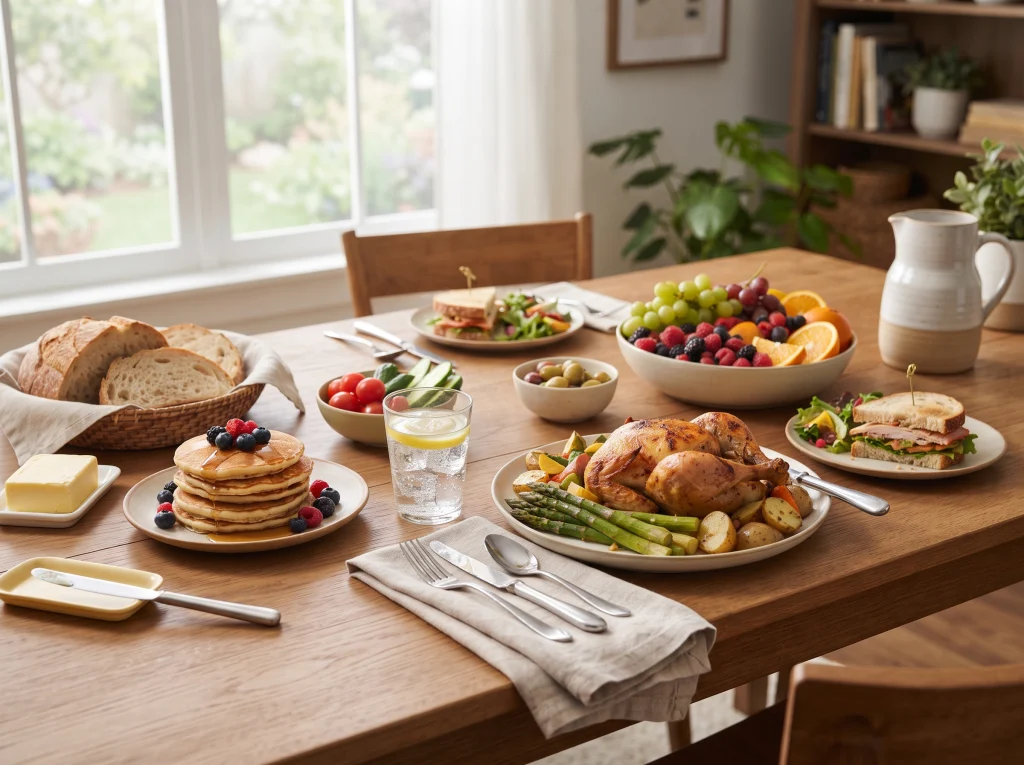
Some of the easiest eat idioms to recognize describe how much or how well someone eats.
Eat like a horse means to eat a large amount. It is usually informal and does not literally refer to eating the way a horse eats.
My son eats like a horse after football practice.
The opposite idea appears in eat like a bird, which means to eat very little.
She eats like a bird, so a small sandwich is enough for lunch.
When someone says I could eat a horse, the speaker is emphasizing extreme hunger. It is an exaggeration rather than a literal statement.
I haven’t eaten since breakfast. I could eat a horse.
Cambridge specifically lists eat like a bird, eat like a horse, and I could eat a horse among its established expressions containing eat.
Eat Idioms About Mistakes and Regret
Several eat idioms are useful when talking about being wrong.
Eat your words means to admit that something you said was wrong.
I said the restaurant would be empty, but after seeing the line, I had to eat my words.
Eat humble pie has a similar meaning. It refers to admitting that you were wrong, often after acting too confidently.
The manager had to eat humble pie after blaming the wrong employee.
Eat crow is another American English expression for admitting that you were wrong.
I said the team had no chance, so I had to eat crow when they won.
These expressions are particularly useful in conversations about predictions, arguments, mistakes, and disagreements.

Eat Idioms About Conflict and Competition
English also uses eat to describe competition.
Eat someone alive can mean to defeat someone completely or criticize someone very severely.
The experienced attorney will eat the inexperienced argument alive.
Eat someone for breakfast suggests that someone can easily defeat or overpower another person.
Our coach eats excuses for breakfast.
Eat someone’s lunch is used when one person or business outperforms another or takes an opportunity from a competitor.
The smaller company is eating the larger company’s lunch.
Dog-eat-dog describes a situation in which people or businesses compete aggressively against one another.
The industry has become increasingly dog-eat-dog.
The figurative use of eat for competition and conflict is well established in American English dictionaries.

Eat Idioms About Money, Costs, and Resources
The verb eat can also describe absorbing or consuming money and resources.
If something eats into your savings, it gradually reduces the amount of money you have saved.
The unexpected repairs ate into our savings.
If an expense eats into profits, it reduces the amount of money a business earns.
Higher transportation costs are eating into profits.
To eat the cost means to absorb an expense instead of passing it on to someone else.
The store decided to eat the cost of the damaged item.
Cambridge and Collins both document this broader financial use of eat, including absorbing a loss or cost and gradually consuming resources.

Eat Idioms About Feelings and Emotions
The word eat can describe emotional pressure as well.
What’s eating you? is an informal way to ask what is bothering or worrying someone.
You have been quiet all afternoon. What’s eating you?
Eat away at someone means to cause continuing worry, guilt, or distress.
The uncertainty was eating away at her.
Eat away at your confidence means to gradually weaken your confidence.
Constant negative comments can eat away at your confidence.
These expressions use the idea of something gradually consuming a person’s emotional well-being.

Eat Idioms With Eat in Everyday American English
Not every common expression with eat should be treated as a traditional idiom. Some are phrasal verbs or ordinary combinations.
For example, eat out means to have a meal at a restaurant or somewhere other than home, while eat in means to have a meal at home. Cambridge identifies these as phrasal-verb uses rather than traditional idioms.
Similarly, eat away at, eat into, and eat up can have literal or figurative meanings.
Compare:
The acid ate through the metal.
with:
Rising expenses are eating into our budget.
The first sentence describes physical damage. The second uses eat into figuratively to describe a gradual reduction.

How to Use Eat Idioms Naturally
The best way to use eat idioms is to learn them as complete expressions instead of translating each word separately.
For example, do not assume that eat your words has anything to do with food. Learn the whole expression:
eat your words = admit that something you said was wrong
Then practice it in different situations:
I thought the store would close, but I had to eat my words.
She said I was wrong, and I eventually had to eat my words.
If the project succeeds, I’ll happily eat my words.
Pay attention to tone, too. Eat like a horse and eat like a bird are generally informal. Eat humble pie can sound humorous, while what’s eating you? is an informal way to ask about someone’s problem.
Common Mistakes With Eat Idioms
One common mistake is taking an idiom literally. If someone says, “I had to eat my words,” they are not talking about eating paper or words. They are admitting that their earlier statement was wrong.
Another mistake is changing the structure of a fixed expression. For example, the familiar expression is eat your words, not “eat your sentences.”
Learners should also avoid using every eat expression in every situation. Some are casual, humorous, old-fashioned, or highly figurative. Choose an expression that matches the tone of the conversation.
Finally, remember that eat out, eat in, and eat away at are generally classified as phrasal verbs rather than ordinary idioms. Cambridge separates these uses from its list of idioms.

FAQs:
Conclusion
Eat idioms are useful because they allow English speakers to express much more than hunger or food. Expressions such as eat your words, eat humble pie, eat like a horse, eat like a bird, eat someone’s lunch, eat someone alive, and what’s eating you? appear in everyday conversations and writing.
Learning these expressions as complete phrases makes them easier to understand and use naturally. Start with the most common expressions, pay attention to their tone, and practice them in realistic American English sentences.