
50 Idioms on Life: Meanings, Examples, and Everyday Uses
Life can be happy, difficult, surprising, exciting, or completely unpredictable. English speakers use many idioms to describe these experiences in a short and memorable way. These expressions can help you talk about challenges, success, change, relationships, choices, and everyday experiences more naturally.
If you searched for idioms on life, you are likely looking for expressions that describe what life feels like and how people respond to different situations. Some phrases are directly connected to the word “life,” while others describe common life experiences such as starting over, facing difficulties, enjoying success, or learning from mistakes.
Here are 50 useful idioms and expressions about life, with simple meanings and natural example sentences.
What Are Idioms on Life?
Idioms on life are figurative expressions used to describe experiences, emotions, challenges, choices, and situations that people encounter throughout life. Their meanings are often different from the literal meanings of their individual words.
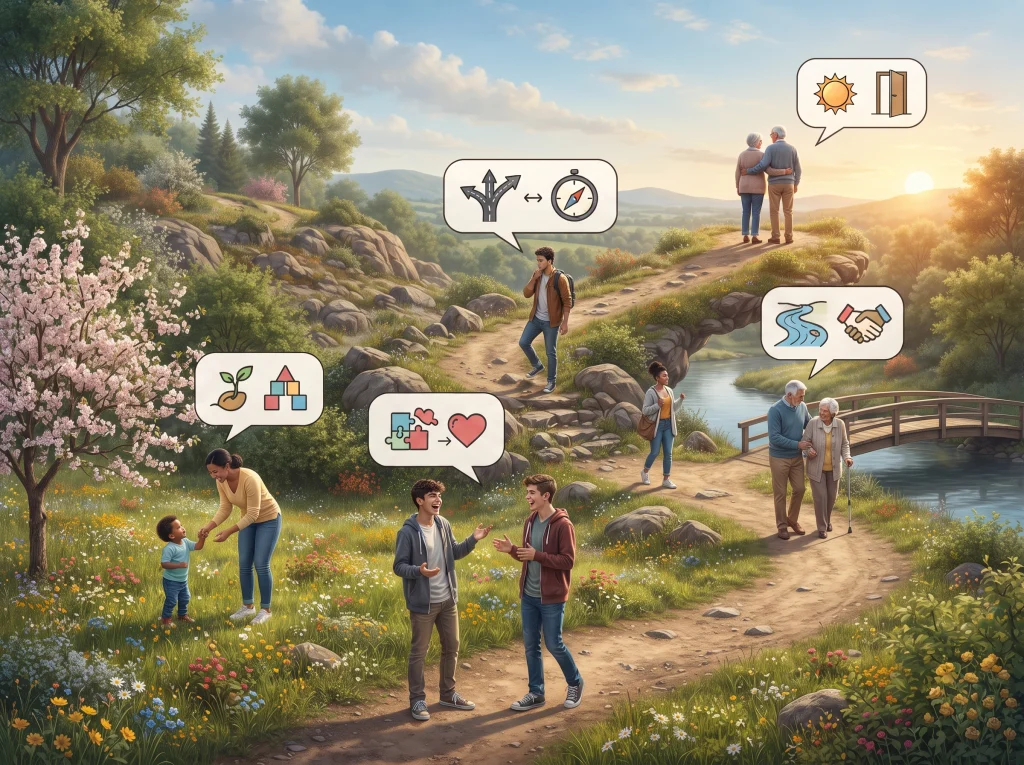
For example, “life is a roller coaster” does not mean that a person is actually riding an amusement park ride. It means life has many ups and downs.
Learning these expressions can help English learners understand conversations, books, movies, and everyday American English more easily.
Idioms About History: https://learnidioms.com/idioms-about-history/
50 Idioms on Life With Meanings and Examples
| Idiom | Meaning | Example |
|---|---|---|
| 1. Life goes on | Life continues despite difficulties | I was disappointed about the decision, but life goes on. |
| 2. Life is a roller coaster | Life has many ups and downs | Life is a roller coaster, so enjoy the good days and handle the difficult ones. |
| 3. A new lease on life | A renewed sense of energy, purpose, or opportunity | Her new job gave her a new lease on life. |
| 4. Life of the party | A lively person who makes social events more enjoyable | Marcus is always the life of the party. |
| 5. Life in the fast lane | A busy, exciting, and sometimes risky lifestyle | He enjoyed life in the fast lane when he was younger. |
| 6. This is the life | An expression of satisfaction with a comfortable or enjoyable situation | Sitting by the lake with a cold drink, I thought, “This is the life.” |
| 7. Larger than life | Extremely noticeable, exciting, or impressive | Her larger-than-life personality made everyone remember her. |
| 8. Live and learn | Learn from an experience or mistake | I forgot to check the schedule, but you live and learn. |
| 9. That’s life | An expression accepting that unpleasant things sometimes happen | We missed the last train, but that’s life. |
| 10. The spice of life | Variety makes life more interesting | Traveling to new places is the spice of life for her. |
| 11. A matter of life and death | Something extremely serious or important | For the rescue team, the situation was a matter of life and death. |
| 12. Walk of life | A person’s background, profession, or social position | People from every walk of life attended the festival. |
| 13. For the life of me | Used to emphasize that you cannot remember or understand something | For the life of me, I can’t remember where I put my keys. |
| 14. Bring something to life | Make something interesting, lively, or realistic | The actor brought the character to life. |
| 15. Come to life | Become lively or active | The neighborhood comes to life after sunset. |
| 16. Breathe life into something | Give new energy or activity to something | The new owner breathed life into the old bookstore. |
| 17. Have a life of its own | Develop independently or beyond someone’s control | The small idea soon took on a life of its own. |
| 18. Get a life | An informal way of telling someone to do something more interesting | Stop worrying about every little comment and get a life. |
| 19. Make a life for yourself | Build an independent and satisfying life | After moving to Chicago, she worked hard to make a life for herself. |
| 20. Life’s work | The most important work someone produces over a lifetime | The museum displayed the artist’s life’s work. |
| 21. Life is not a bed of roses | Life is not always easy or pleasant | Life is not a bed of roses, so we have to deal with problems as they come. |
| 22. Weather the storm | Successfully get through a difficult period | The family worked together to weather the storm. |
| 23. Bite the bullet | Face a difficult situation with courage | I didn’t want to make the phone call, but I had to bite the bullet. |
| 24. When the going gets tough | When a situation becomes difficult | When the going gets tough, she stays focused. |
| 25. Keep your chin up | Remain hopeful during a difficult time | Keep your chin up. You will have another opportunity. |
| 26. Take it in stride | Deal with something calmly | He took the unexpected change in stride. |
| 27. Ride out the storm | Survive a difficult period until conditions improve | The company managed to ride out the storm. |
| 28. Light at the end of the tunnel | A sign that a difficult period is nearing its end | After months of hard work, we finally saw a light at the end of the tunnel. |
| 29. Every cloud has a silver lining | A difficult situation may have a positive side | Losing the job was hard, but every cloud has a silver lining. |
| 30. A blessing in disguise | Something that seems bad but later produces a good result | Missing that flight was a blessing in disguise because the next flight was canceled. |
| 31. Turn over a new leaf | Start behaving or living differently | After graduation, he decided to turn over a new leaf. |
| 32. Start from scratch | Begin again from the beginning | After the move, we had to start from scratch. |
| 33. Back to square one | Return to the beginning after a plan fails | The deal fell through, so we were back to square one. |
| 34. At a crossroads | At a point where an important choice must be made | After college, she found herself at a crossroads. |
| 35. Take the plunge | Make an important or risky decision | They finally took the plunge and opened their own business. |
| 36. Go with the flow | Accept a situation instead of trying to control everything | We didn’t have a strict plan, so we decided to go with the flow. |
| 37. Make the most of it | Get the best possible result from a situation | The weather was rainy, but we made the most of it. |
| 38. Live life to the fullest | Enjoy life as much as possible | She believes in living life to the fullest. |
| 39. Seize the day | Make the most of the present opportunity | You may not get another chance, so seize the day. |
| 40. Make ends meet | Have enough money to cover basic expenses | It was difficult for them to make ends meet after the rent increased. |
| 41. Learn the hard way | Learn through a difficult or unpleasant experience | I learned the hard way that rushing a project causes mistakes. |
| 42. You reap what you sow | Your actions eventually produce corresponding results | If you treat people well, you often reap what you sow. |
| 43. What goes around comes around | People’s actions can eventually return to them | Be kind to others because what goes around comes around. |
| 44. The best things in life are free | Some of life’s most valuable experiences do not require money | A walk with family reminds me that the best things in life are free. |
| 45. At the end of the day | When everything is considered | At the end of the day, family matters most to him. |
| 46. Go through a lot | Experience many difficulties or stressful events | She went through a lot before reaching her goal. |
| 47. In the prime of life | At a period when someone is especially active or successful | He traveled extensively while he was in the prime of life. |
| 48. Put your life on hold | Delay normal plans or activities because of a situation | She put her life on hold while caring for her family. |
| 49. Have the time of your life | Have an extremely enjoyable experience | We had the time of our lives at the wedding. |
| 50. Life is what you make it | Your choices and actions strongly influence your experience of life | He believes life is what you make it, so he focuses on making positive choices. |

Idioms About Enjoying Life
Several life idioms describe happiness, excitement, and satisfaction.
“This is the life” is useful when you are enjoying comfort or relaxation. You might say it while sitting on a beach, enjoying a quiet weekend, or relaxing after finishing a difficult project.
“Have the time of your life” describes an especially enjoyable experience. It is common when talking about vacations, celebrations, concerts, weddings, and other memorable events.
“Live life to the fullest” expresses the idea of making meaningful use of your time and opportunities. It often appears in conversations about goals, travel, relationships, and personal experiences.
“Life of the party” describes a person rather than an experience. If someone keeps a party lively and entertaining, you can call that person the life of the party.
Idioms About Challenges and Difficult Times
Life idioms are also useful when discussing problems.
“Life is not a bed of roses” reminds us that life includes difficulties. “Weather the storm” and “ride out the storm” describe successfully getting through a challenging period.
When someone must face something unpleasant, “bite the bullet” is a common expression. For example, you might bite the bullet and have a difficult conversation that you have been avoiding.
After a setback, “keep your chin up” offers encouragement. Meanwhile, “light at the end of the tunnel” suggests that a difficult period may soon improve.
These expressions are especially useful in conversations because they communicate complicated feelings in just a few words.

Idioms About Change and New Beginnings
Life often involves starting over, making decisions, and adjusting to change.
“Turn over a new leaf” means to make a fresh start, often after changing unwanted behavior. “Start from scratch” means beginning again from the beginning.
If a plan fails and you have to return to the starting point, you can say you are “back to square one.”
A person facing an important decision may be “at a crossroads.” This expression is useful when someone must choose between different paths in life, education, work, or relationships.
“A new lease on life” describes renewed energy, purpose, or enthusiasm. It can apply to a new career, a fresh opportunity, or a major positive change.
Idioms About Choices, Experience, and Growth
Some expressions about life focus on learning and personal decisions.
“Live and learn” is commonly used after an experience teaches you something. It can be serious or lighthearted.
“Learn the hard way” is more specific. It means learning something because you experienced the negative consequences yourself.
“Go with the flow” describes accepting circumstances instead of trying to control every detail. “Take the plunge” means finally making a significant decision, especially when some uncertainty is involved.
Another useful expression is “you reap what you sow.” It suggests that your actions can produce corresponding results. Similarly, “what goes around comes around” expresses the idea that actions can eventually return to the person who performed them.
How to Use Life Idioms Naturally
The best way to use life idioms is to pay attention to context. An expression that sounds natural in a conversation with friends may not be appropriate in a formal report or professional document.
For example, “get a life” is informal and can sound rude depending on the situation. “Bite the bullet” is also conversational, while “at a crossroads” can work in both everyday and more formal contexts.
Do not try to use several idioms in every sentence. One well-chosen expression usually sounds more natural than a group of unrelated idioms.
It also helps to learn each idiom as a complete phrase. Instead of memorizing individual words, remember the expression, its meaning, and a sentence showing how it works.
Archery Idioms: https://learnidioms.com/archery-idioms/
Common Mistakes With Life Idioms
Taking an Idiom Literally
Idioms usually have figurative meanings. If someone says “life is a roller coaster,” they are describing the ups and downs of life, not talking about an actual amusement park ride.
Changing the Words
Many idioms have fixed forms. For example, the established expression is “turn over a new leaf,” not “turn over a new page” when you mean changing your behavior or starting fresh.
Using an Informal Idiom in a Formal Situation
Some expressions are strongly conversational. “Get a life” can sound dismissive, while “this is the life” is casual and enthusiastic. Always consider who you are speaking to and the setting.
Using Too Many Idioms
Idioms should support communication rather than make it difficult to understand. Use them when they express an idea more naturally or memorably than ordinary wording.

FAQs About Idioms on Life
Conclusion
Idioms on life give English speakers memorable ways to describe happiness, difficulties, change, decisions, opportunities, and personal experiences. Expressions such as “life goes on,” “a new lease on life,” “turn over a new leaf,” “at a crossroads,” and “live life to the fullest” appear in many everyday contexts.
For English learners, the most effective approach is to study each expression with its meaning and a natural example. Then practice using a few of them in your own conversations and writing. Over time, these phrases will become easier to recognize and use naturally.


2 Comments