Skip to content

Learn Idioms

  • Easy Idioms Drawing
  • Pant or Pant
Learn Idioms
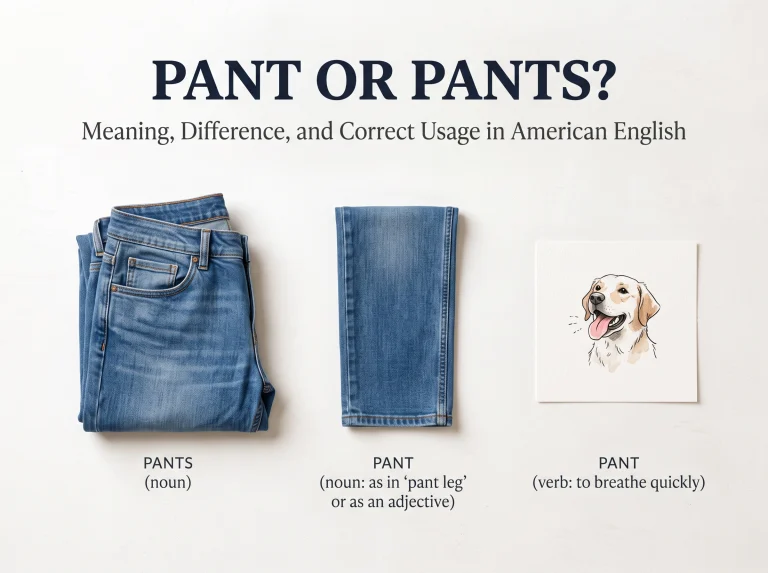
  • Pant or Pants? Meaning, Difference, and Correct Usage in American English.
    Idioms

    Pant or Pants? Meaning, Difference, and Correct Usage in American English

    ByEmma Collins October 17, 2026October 17, 2026

    The difference between pant and pants can be confusing for English learners because the two words look almost identical but have different uses. In American English, pants is the standard word for a piece of clothing that covers the body from the waist to the ankles, while pant usually refers to breathing quickly and heavily,…


    Read More Pant or Pants? Meaning, Difference, and Correct Usage in American EnglishContinue

  • Wisp or Whisp? Meaning, Difference, and Correct Spelling.
    Idioms

    Wisp or Whisp? Meaning, Difference, and Correct Spelling

    ByEmma Collins October 17, 2026October 17, 2026

    When deciding between wisp or whisp, the correct spelling for standard American English is wisp. It describes a small, thin, delicate piece of something, such as a strand of hair, a trail of smoke, or a faint patch of cloud. The spelling whisp is generally a nonstandard form when used with this meaning. Although the…

    Read More Wisp or Whisp? Meaning, Difference, and Correct SpellingContinue

  • Internship or Apprenticeship_ Meaning, Differences, and Examples.
    Idioms

    Internship or Apprenticeship? Meaning, Differences, and Examples

    ByEmma Collins October 17, 2026October 17, 2026

    Choosing between an internship and an apprenticeship can be confusing, especially for students, recent graduates, and people starting a new career. Both offer opportunities to gain practical experience, learn workplace skills, and prepare for future employment. However, they differ in their training structure, typical length, responsibilities, and long-term career goals. An internship usually gives someone…

    Read More Internship or Apprenticeship? Meaning, Differences, and ExamplesContinue

  • Asset or Liability_ Meaning, Differences, and Examples in American English.
    Idioms

    Asset or Liability? Meaning, Differences, and Examples in American English

    ByEmma Collins October 17, 2026October 17, 2026

    Understanding the difference between an asset and a liability is important for managing money, making financial decisions, and learning basic accounting. Both terms describe important parts of a person’s or business’s financial situation, but they represent different things. An asset is something you own or control that has economic value, while a liability is a…

    Read More Asset or Liability? Meaning, Differences, and Examples in American EnglishContinue

  • Saucey or Saucy_ Meaning, Difference, and Correct Spelling.
    Idioms

    Saucey or Saucy? Meaning, Difference, and Correct Spelling

    ByEmma Collins October 17, 2026October 17, 2026

    When deciding between saucey or saucy, the correct spelling for standard American English is saucy. Although saucey may appear in brand names, usernames, or creative writing, saucy is the established spelling of the adjective in standard English. The word has several meanings depending on context, including food covered in sauce and a person who is…

    Read More Saucey or Saucy? Meaning, Difference, and Correct SpellingContinue

  • Temporarily or Temporary? Meaning, Difference, and Correct Usage.
    Idioms

    Temporarily or Temporary? Meaning, Difference, and Correct Usage

    ByEmma Collins October 17, 2026October 17, 2026

    Choosing between temporarily and temporary can be confusing because both words describe something that lasts for a limited time. However, they serve different grammatical purposes in a sentence. Temporary is an adjective, while temporarily is an adverb. Knowing this difference helps you write clearer sentences in emails, school assignments, workplace messages, and everyday American English….

    Read More Temporarily or Temporary? Meaning, Difference, and Correct UsageContinue

  • Went or Gone? Meaning, Difference, and Correct Usage in American English.
    Idioms

    Went or Gone? Meaning, Difference, and Correct Usage in American English

    ByEmma Collins October 17, 2026October 17, 2026

    Have you ever wondered whether to say “I went to the store” or “I have gone to the store”? Both words come from the verb “go,” but they serve different grammatical purposes. Understanding when to use went and gone will help you speak and write more naturally in American English. Went is the simple past…

    Read More Went or Gone? Meaning, Difference, and Correct Usage in American EnglishContinue

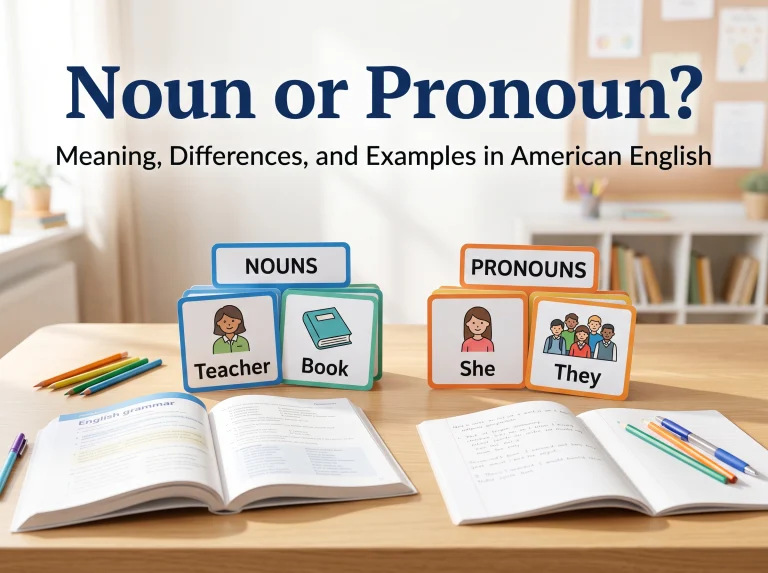
  • Noun or Pronoun? Meaning, Differences, and Examples in American English.
    Idioms

    Noun or Pronoun? Meaning, Differences, and Examples in American English

    ByEmma Collins October 17, 2026October 17, 2026

    Understanding the difference between a noun and a pronoun is an important part of learning English grammar. Both help us talk about people, places, things, and ideas, but they serve different purposes in a sentence. A noun names someone or something, while a pronoun usually replaces a noun or refers to someone or something already…

    Read More Noun or Pronoun? Meaning, Differences, and Examples in American EnglishContinue

  • “20 Spanish Idioms_ Meanings and Examples in English.”
    Idioms

    20 Spanish Idioms: Meanings and Examples in English

    ByEmma Collins October 17, 2026October 17, 2026

    Spanish idioms, known as modismos or expresiones idiomáticas, are phrases whose intended meanings often differ from their literal translations. They help speakers express feelings, describe situations, and communicate ideas in a more natural way. For English speakers learning Spanish, these expressions are especially useful because they appear in everyday conversations, movies, music, and informal writing….

    Read More 20 Spanish Idioms: Meanings and Examples in EnglishContinue

  • Urban or Suburban? Meaning, Differences, and Examples in American English.
    Idioms

    Urban or Suburban? Meaning, Differences, and Examples in American English

    ByEmma Collins October 16, 2026October 16, 2026

    The words urban and suburban both describe places where people live, work, and spend their time, but they refer to different types of communities. Urban usually describes cities and densely developed areas, while suburban describes residential communities located in or around the edges of cities and metropolitan areas. The main differences involve population density, housing,…

    Read More Urban or Suburban? Meaning, Differences, and Examples in American EnglishContinue

Page navigation

Previous PagePrevious 1 2 3 4 5 6 … 17 Next PageNext

2026

© 2026 Learn Idioms - WordPress Theme by Kadence WP

  • Easy Idioms Drawing
  • Pant or Pant