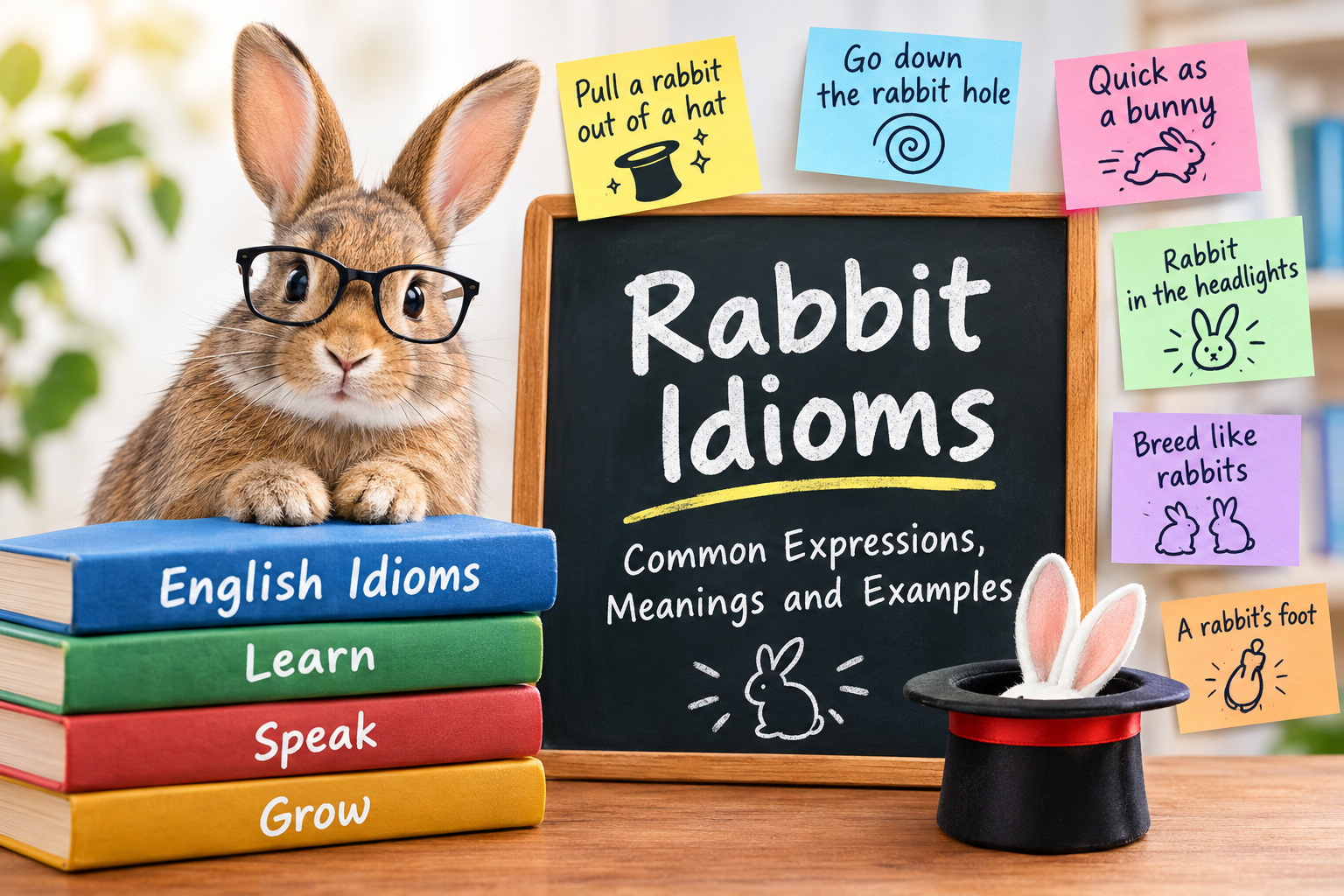
Rabbit idioms: 25 Common Expressions, Meanings, and Examples
Rabbit idioms add color and personality to everyday English. In American conversations, rabbit-related expressions can describe an unexpected solution, a person who moves quickly, someone who becomes deeply interested in a subject, or a situation that leaves someone frightened and confused. Some expressions are widely recognized across the United States, while others are more informal, playful, or associated with British English.
Learning these expressions can help you understand conversations, books, movies, and online discussions more easily. The key is to learn what each phrase means in context rather than interpreting every word literally.
What Are Rabbit Idioms?
Rabbit idioms are expressions that use the words rabbit or bunny, or draw on rabbit-related imagery, to communicate an idea beyond their literal meaning. For example, when someone says they went down a rabbit hole, they usually mean they became deeply involved in a subject, not that they entered an animal’s home.
Some expressions are established idioms, such as “pull a rabbit out of a hat.” Others are familiar sayings or playful comparisons, such as “quick as a bunny.” A few rabbit expressions are more common in British English, so learners should understand their regional usage before using them in American conversations.
Pain Idioms: https://learnidioms.com/pain-idioms/
25 Common Rabbit Idioms and Expressions
The following expressions include their meanings, examples, and practical usage notes. The examples are original and show how the phrases can fit into everyday communication.
Usage note: Not every expression below is equally common in the United States. Regional and informal expressions are identified where useful.
1. Pull a Rabbit Out of a Hat
Meaning: To produce a surprising solution or achieve something unexpected, especially when the situation seems difficult.
The expression comes from the familiar magic trick in which a magician appears to pull a rabbit from a hat.
Collins English Dictionary
+1
Example: We were running out of time, but our designer pulled a rabbit out of a hat and finished the presentation.
When to use it: Use this phrase when someone finds an unexpectedly clever answer or manages to succeed against the odds.
2. Go Down the Rabbit Hole
Meaning: To become deeply involved in a subject, investigation, or activity, often for much longer than intended.
The phrase is especially familiar in conversations about internet searches, videos, research, and complicated topics.
Example: I looked up one gardening tip and went down a rabbit hole reading about rare plants for three hours.
When to use it: This expression works well when curiosity leads you into a long or complicated exploration.
3. Breed Like Rabbits
Meaning: To reproduce or multiply very quickly.
This informal expression refers to the well-known reproductive rate of rabbits. It can describe animals, populations, or things that seem to increase rapidly. When applied to people, it may sound judgmental or insensitive.
Example: The weeds in our backyard are breeding like rabbits after all that rain.
When to use it: Use it cautiously, particularly when discussing someone’s family or personal choices.
4. Quick as a Bunny
Meaning: Very fast or quick to react.
This playful comparison uses the speed and alertness associated with rabbits. It is easy to understand in casual American English.
Example: My little brother was quick as a bunny when the ice cream truck came down the street.
When to use it: Use it in informal conversations about speed, movement, or a fast reaction.
5. Rabbit Food
Meaning: An informal, sometimes teasing term for vegetables or a meal made mostly of greens.
The expression comes from the idea that rabbits eat plants. Depending on the speaker’s tone, it can be affectionate, humorous, or dismissive.
Example: My friend called my spinach salad rabbit food, but she asked for a second helping.
When to use it: This phrase is casual. Avoid using it to criticize another person’s food choices if you want to sound respectful.
6. Rabbit in the Headlights
Meaning: A person who becomes frozen with fear, shock, or uncertainty when faced with a difficult or unexpected situation.

The image is of an animal caught in the beam of approaching headlights and unable to react effectively. The related expression “deer in the headlights” is more familiar to many Americans.
Example: When the teacher asked him to explain the answer, he looked like a rabbit in the headlights.
When to use it: Use it to describe someone who appears stunned or unable to respond.
7. A Rabbit’s Foot
Meaning: A traditional good-luck charm.
A rabbit’s foot has historically been carried as a symbol of good luck in some traditions. The expression can also refer humorously to someone who seems unusually lucky.
Example: My uncle always jokes that his old keychain is his rabbit’s foot before a big game.
When to use it: Use it when discussing luck, superstitions, or a lucky object. It does not mean the object has proven supernatural powers.
8. Happy as a Rabbit in Clover
Meaning: Extremely happy, comfortable, or satisfied.
This is a less common expression, particularly in everyday American English. It uses the image of a rabbit surrounded by clover to suggest contentment.
Example: After settling into her new home, she was happy as a rabbit in clover.
When to use it: Recognize it as a colorful expression, but remember that many Americans would more naturally say “happy as a clam” or simply “very happy.”
9. Rabbit On
Meaning: To talk at length, often about something other people find uninteresting.
This informal verb phrase is chiefly associated with British English rather than standard American usage.
Example: He can rabbit on about his favorite TV show for hours.
When to use it: Understand it when reading or listening to British English. In the United States, “go on and on” or “ramble” is generally more natural.
10. Quick Like a Rabbit
Meaning: Very quickly.
This is a straightforward comparison that uses a rabbit’s quick movements to emphasize speed.
Example: Get your shoes on, quick like a rabbit, or we’ll miss the bus.
When to use it: It is playful and informal, so it fits friendly conversations better than formal writing.
11. Hop to It
Meaning: Start doing something promptly or get moving.
Although the phrase does not mention a rabbit directly, hopping is closely associated with rabbits and bunnies. The expression is used as a lively way to encourage action.
Example: We’ve got guests arriving in an hour, so hop to it and help me set the table.
When to use it: Use it casually when encouraging someone to begin a task. Depending on your tone, it can sound cheerful or commanding.
12. Bunny Hop
Meaning: A hopping movement, or a playful reference to moving with small jumps.
“Bunny hop” can refer literally to a hopping dance or movement. It is not always an idiom, so its meaning depends on context.
Example: The children did a bunny hop across the playground during the party game.
When to use it: Use it when describing a hopping movement or a playful activity rather than as a substitute for every kind of quick movement.
13. Rabbit Ears
Meaning: A pair of antennae used to receive television signals, especially the older indoor antennas with two projecting rods.
This is a familiar American term rooted in the antenna’s resemblance to rabbit ears.
Example: Grandma still has rabbit ears on her old television.
When to use it: The expression is useful when discussing older television equipment. It is a literal descriptive term rather than a figurative idiom.
14. Rabbit Punch
Meaning: A blow to the back of the head or neck, especially in boxing terminology.
The phrase is associated with combat sports and is not a casual expression for an ordinary punch. It describes a dangerous type of blow.
Example: The boxing referee warned the fighters against rabbit punches.
When to use it: You are most likely to encounter this term in discussions of boxing rules, sports safety, or fighting.
15. Rabbit Hole of Research
Meaning: A long, absorbing research process that leads from one question to another.
This is an expanded use of “go down the rabbit hole,” rather than a completely separate traditional idiom.
Example: My search for the history of our town turned into a rabbit hole of research involving old maps and newspaper archives.
When to use it: Use it when a topic keeps leading you toward more questions, sources, or details.
16. Fall Down a Rabbit Hole
Meaning: To become unexpectedly immersed in a complicated, strange, or fascinating subject.
This is a variation of “go down the rabbit hole.” It often emphasizes how someone became involved without planning to.
Example: I fell down a rabbit hole of cooking videos while looking for a simple dinner recipe.
When to use it: It is especially natural in casual storytelling and online conversations.
17. Pop Out of a Hat Like a Rabbit
Meaning: To appear suddenly or unexpectedly.
This is an understandable, descriptive comparison based on the magician’s trick, but it is not as established as “pull a rabbit out of a hat.”
Example: My coworker popped out of nowhere like a rabbit out of a hat and startled everyone.
When to use it: Treat it as playful wording, not a fixed idiom that every American English speaker will recognize.
18. A Rabbit’s Tale
Meaning: A story involving a rabbit, or a phrase used creatively to describe a fanciful account.
This is not a standard everyday English idiom with one established figurative meaning. Its interpretation depends on the speaker or the title of a particular story.
Example: The children gathered around for a rabbit’s tale about a curious animal in the forest.
When to use it: Use it as creative wording rather than presenting it as a common expression with a fixed meaning.
19. Rabbit-Brained
Meaning: Sometimes used informally to suggest that an idea is foolish or impractical, though the expression is uncommon and can be confused with the much more familiar “harebrained.”
Example: He called the plan rabbit-brained, but the team decided to examine it before rejecting it.
When to use it: Be aware that “harebrained” is the established expression in American English for a silly or poorly thought-out idea. “Rabbit-brained” is not a reliable substitute.
20. Run Like a Rabbit
Meaning: To run away quickly or move very fast.
This comparison draws on the rabbit’s quick movement and instinct to flee from danger.
Example: When the sprinklers suddenly turned on, the kids ran like rabbits across the lawn.
When to use it: Use it in informal descriptions of fast movement or a quick escape.
21. Scared as a Rabbit
Meaning: Very frightened or nervous.
This is a descriptive comparison rather than a widely fixed American idiom. It draws on the popular image of rabbits as alert, easily startled animals.
Example: The little dog was scared as a rabbit when the fireworks began.
When to use it: It can work in informal or creative writing, but “scared stiff” and “frightened out of one’s wits” are more established expressions.
22. Like a Rabbit Caught in a Trap
Meaning: Feeling helpless, frightened, or unable to escape a difficult situation.
This is a descriptive simile that uses an animal-in-danger image. Its meaning is usually clear from context, even though it is not a standard fixed idiom.
Example: He felt like a rabbit caught in a trap when everyone turned toward him for an explanation.
When to use it: Use it in storytelling or descriptive writing when you want to emphasize someone’s feeling of helplessness.
23. Rabbiting Around
Meaning: A playful, nonstandard way of describing hopping or moving around like a rabbit.
It is not a widely established American idiom. Depending on the context, a reader may interpret it literally or as an invented expression.
Example: The toddlers were rabbiting around the living room during their game.
When to use it: Treat this as creative language rather than a conventional phrase for formal writing.
24. A Rabbit’s Pace
Meaning: A descriptive phrase suggesting quick, hopping movement.
This is not a fixed idiom with a universally agreed figurative meaning. Writers may use it creatively to describe a particular rhythm or style of movement.
Example: The children crossed the yard at a rabbit’s pace, stopping and starting as they played.
When to use it: Use it for imaginative description, not as a standard replacement for “very quickly.”
25. Rabbit-Like Reflexes
Meaning: A descriptive way to suggest quick, alert reactions.
This is a creative comparison rather than a traditional idiom. It can describe someone who reacts quickly to a sudden movement or event.
Example: The goalkeeper had rabbit-like reflexes when he blocked the unexpected shot.
When to use it: It can add variety to creative writing, while “quick reflexes” is the more natural choice in everyday American English.
Rabbit Expressions About Luck, Speed, and Fear
Rabbit imagery appears in several kinds of English expressions. Understanding the difference between established idioms and creative comparisons helps you choose words that sound natural.
| Expression | Main idea | Usage |
|---|---|---|
| Pull a rabbit out of a hat | Unexpected success or a clever solution | Common figurative expression |
| Go down the rabbit hole | Become deeply involved in a topic | Common in American English |
| A rabbit’s foot | A good-luck charm | Traditional cultural expression |
| Quick as a bunny | Moving or reacting quickly | Informal comparison |
| Rabbit in the headlights | Shock or fear that prevents a response | Recognizable, but “deer in the headlights” is more familiar in the U.S. |
| Rabbit on | Talk for too long | Mainly British English |
| Breed like rabbits | Reproduce or multiply rapidly | Informal, potentially insensitive when used about people |
Rabbit Idioms vs. Hare Expressions
Rabbits and hares are related animals, but English expressions do not always treat their names as interchangeable. For example, “mad as a March hare” is a traditional expression about a hare, not a rabbit. Similarly, “harebrained” is the established word for an idea that is foolish or poorly thought out.
Knowing this distinction prevents you from accidentally changing a familiar expression into a phrase that sounds unusual to native speakers.
How to Use Rabbit Idioms Naturally in American English
The easiest way to use rabbit idioms is to match the expression to the situation. Some are suitable for everyday conversation, while others are better understood as regional expressions or creative language.
Choose the Right Expression for the Situation
- For an unexpected solution, say, “She pulled a rabbit out of a hat.”
- For an absorbing online search, say, “I went down a rabbit hole.”
- For someone who reacts quickly, say, “He was quick as a bunny.”
- For a person who freezes under pressure, say, “He looked like a deer in the headlights,” a more familiar American expression.
Pay Attention to Tone
Expressions such as “rabbit food” and “breed like rabbits” can sound dismissive or judgmental, depending on the conversation. Use them carefully when discussing other people’s diets, families, or personal decisions.
Playful comparisons like “quick as a bunny” and “hop to it” are generally better suited to friendly, informal settings than professional reports or formal academic writing.
Learn the Meaning Instead of Translating Literally
If someone says they have gone down a rabbit hole, they are usually talking about becoming absorbed in a subject. Thinking only about the animal’s burrow can make the expression confusing.
Read the entire sentence and consider what the speaker is trying to communicate. Context is often the clearest guide to an idiom’s intended meaning.
Common Mistakes When Learning Rabbit Idioms
English learners sometimes assume that every phrase involving rabbits is a recognized idiom. In reality, some are established expressions, some are regional, and others are simply creative comparisons.
Here are a few mistakes to avoid:
- Confusing rabbits with hares. “Mad as a March hare” and “harebrained” use hare, not rabbit.
- Using British expressions as if they were common American phrases. “Rabbit on” is more characteristic of British English. Americans are more likely to say “go on and on.”
- Treating every rabbit comparison as a fixed idiom. Phrases such as “rabbit-like reflexes” are understandable, but they are descriptive wording rather than traditional idioms.
- Ignoring the tone of an expression. “Rabbit food” can be teasing or dismissive, so the relationship between speakers matters.
- Taking figurative language literally. “Pull a rabbit out of a hat” normally describes a surprising achievement, not an actual magic trick.
FAQ: Rabbit Idioms
Conclusion
Rabbit idioms and expressions make English more colorful by connecting familiar animal imagery with ideas about luck, speed, surprise, fear, and curiosity. Phrases such as “pull a rabbit out of a hat” and “go down the rabbit hole” are especially useful because they communicate complex situations in a few memorable words.






One Comment