Worksheet on Idioms: Free Practice Exercises With Answers
Idioms make everyday English more interesting, but their meanings can be confusing for students who interpret every word literally. Expressions such as “a piece of cake,” “break the ice,” and “spill the beans” have meanings that are different from the individual words they contain. Practicing these expressions in sentences helps learners understand how native English speakers use them.
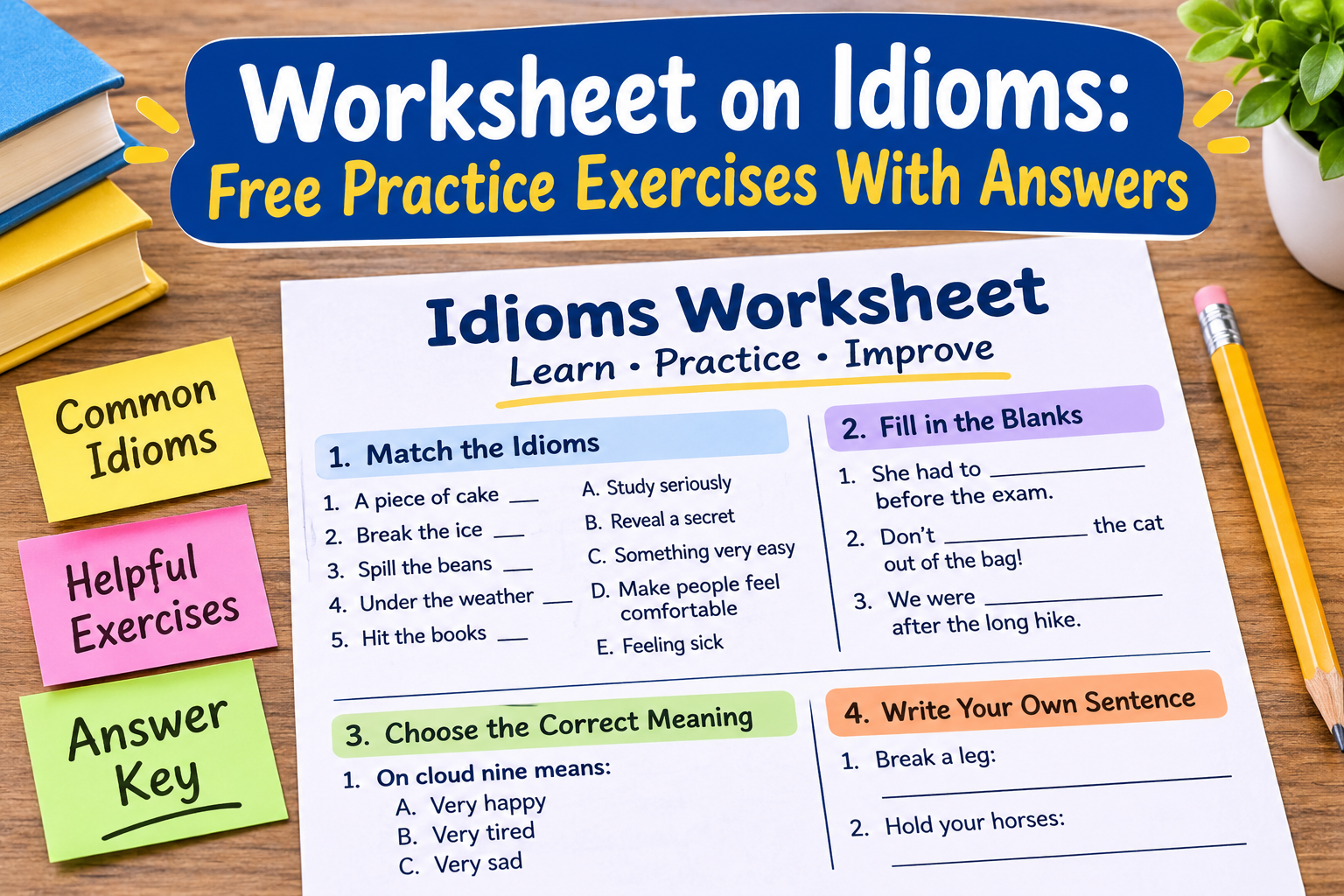
A worksheet on idioms provides structured practice through matching activities, fill-in-the-blank questions, multiple-choice exercises, and sentence-writing tasks. These activities are useful for elementary and middle school students, English language learners, teachers, and anyone who wants to improve their vocabulary.
This guide includes five practical idiom worksheets with exercises and a complete answer key. Students can use them for classroom activities, homework, independent study, or English language practice.
What Is an Idiom?
An idiom is a commonly used expression whose figurative meaning is different from the literal meaning of its individual words. People use idioms to communicate ideas, feelings, and situations in a more natural and expressive way.
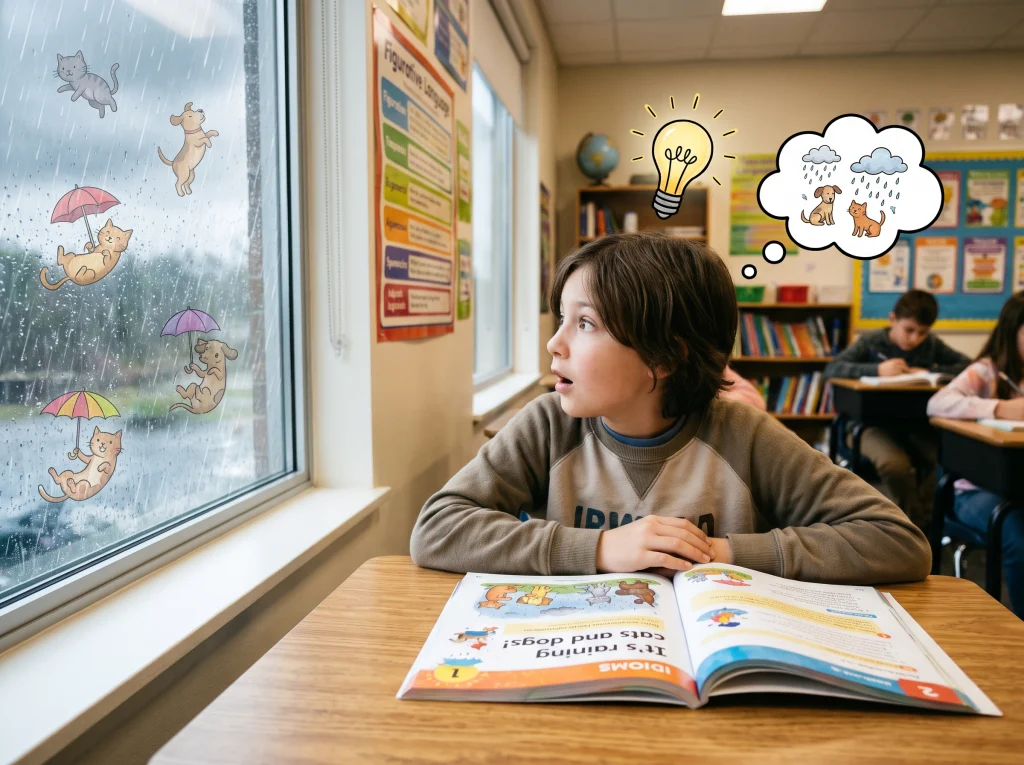
For example, “It’s raining cats and dogs” does not mean that cats and dogs are falling from the sky. It means that it is raining very heavily.
Here are some common idioms and their meanings:
| Idiom | Meaning |
|---|---|
| A piece of cake | Something very easy |
| Break the ice | Make people feel comfortable |
| Spill the beans | Reveal a secret |
| Under the weather | Feeling sick |
| Hit the books | Study seriously |
| Cost an arm and a leg | Be very expensive |
| Hold your horses | Wait or be patient |
| Once in a blue moon | Very rarely |
| On cloud nine | Extremely happy |
| Let the cat out of the bag | Reveal a secret accidentally |
Understanding idioms requires more than memorizing definitions. Students should also learn how expressions work in different situations and how surrounding words provide clues to their meanings.
What Is a Worksheet on Idioms?
A worksheet on idioms is an educational activity sheet that helps students recognize, understand, and correctly use figurative expressions.
These worksheets usually contain short exercises that test different language skills. Some ask students to match idioms with their definitions, while others require them to complete sentences, identify expressions in passages, or write original examples.
Teachers can use idiom worksheets during English language arts lessons, vocabulary practice, and figurative language instruction. Parents can also use them to help children improve reading comprehension and everyday communication.
Types of Idiom Worksheets
Different worksheet formats help students develop different skills. Combining several activities makes idiom practice more effective.
| Worksheet Type | Main Learning Skill |
|---|---|
| Matching exercises | Connecting expressions with meanings |
| Fill-in-the-blank | Understanding idioms in context |
| Multiple-choice questions | Recognizing figurative meanings |
| Sentence identification | Finding idioms in written language |
| Sentence writing | Using expressions correctly |
| Reading comprehension | Understanding idioms in longer passages |
| Literal vs. figurative meaning | Recognizing nonliteral language |
For beginners, matching activities are a useful starting point. More advanced learners can benefit from reading passages and creating their own sentences.
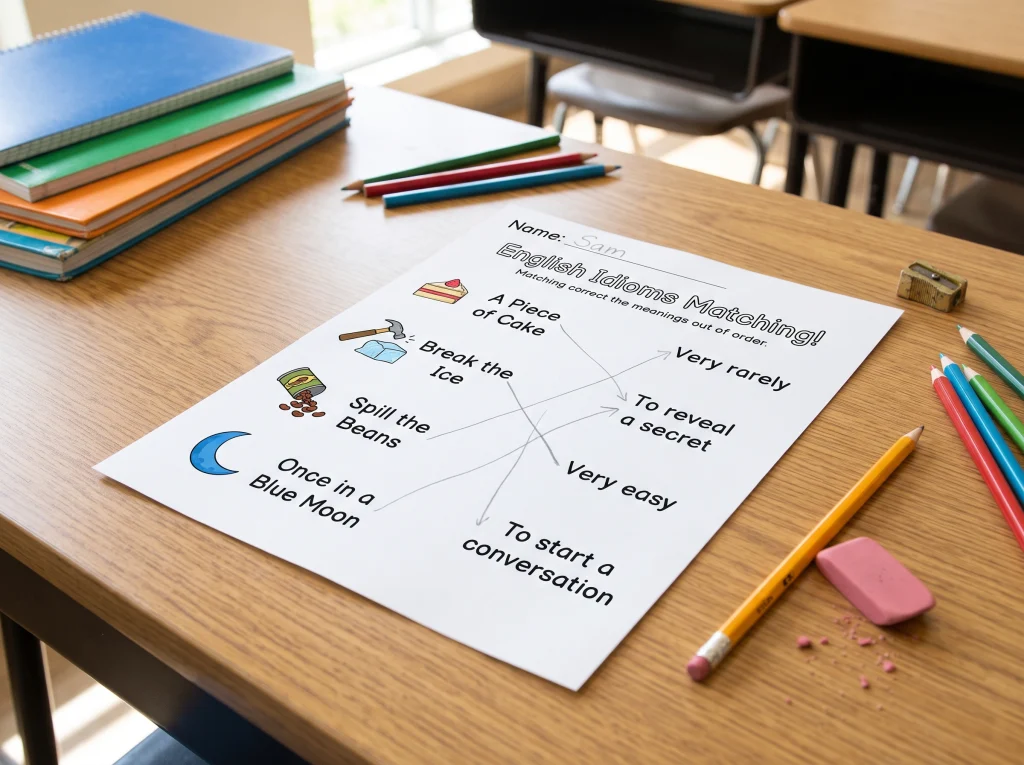
Worksheet 1: Match Idioms With Their Meanings
Instructions: Read each idiom in Column A and match it with the correct meaning in Column B. Write the corresponding letter next to each number.
| No. | Idiom | Answer |
|---|---|---|
| 1 | A piece of cake | _____ |
| 2 | Break the ice | _____ |
| 3 | Spill the beans | _____ |
| 4 | Under the weather | _____ |
| 5 | Hit the sack | _____ |
| 6 | Hold your horses | _____ |
| 7 | On cloud nine | _____ |
| 8 | Cost an arm and a leg | _____ |
| 9 | Once in a blue moon | _____ |
| 10 | Bite the bullet | _____ |
Meanings
A. Go to bed
B. Reveal a secret
C. Something very expensive
D. Accept a difficult situation and face it
E. Feeling sick
F. Something very easy
G. Be patient or wait
H. Make people feel comfortable
I. Extremely happy
J. Very rarely
Worksheet 2: Fill in the Blanks
Instructions: Complete each sentence using the correct idiom from the word bank. Use each expression only once.
Word Bank:
- A blessing in disguise
- Burn the midnight oil
- Keep an eye on
- Get cold feet
- In hot water
- Pull someone’s leg
- Back to square one
- Call it a day
- Learn the ropes
- The ball is in your court
Questions
1. Sarah had to __________ before her final examination because she had not finished studying.
2. My little brother thought I was serious, but I was only trying to __________.
3. After making a serious mistake at work, Daniel found himself __________.
4. Losing that job seemed terrible at first, but it became __________ when she found a better opportunity.
5. Please __________ my backpack while I go to the restroom.
6. We tried several solutions, but none worked, so we were __________.
7. After working for ten hours, the team decided to __________.
8. Mark wanted to start his own business, but he began to __________ before making the final decision.
9. The new employee needs some time to __________ at the company.
10. I have explained all the options. Now __________.
Worksheet 3: Choose the Correct Meaning
Instructions: Read each sentence and select the correct meaning of the underlined idiom.
1. The math test was a piece of cake for Emily.
A. The test was about baking.
B. The test was very easy.
C. The test was difficult.
2. Jason finally broke the ice by telling a funny story.
A. He damaged something frozen.
B. He made everyone feel more comfortable.
C. He started an argument.
3. My sister let the cat out of the bag about the surprise party.
A. She revealed the secret.
B. She lost her pet.
C. She bought a new cat.
4. We see our old neighbors once in a blue moon.
A. Every day
B. Every weekend
C. Very rarely
5. After receiving the good news, Mia was on cloud nine.
A. She was extremely happy.
B. She was confused.
C. She was disappointed.
6. My father told me to hold my horses before making a decision.
A. Take care of the horses.
B. Be patient and wait.
C. Run faster.
7. The new smartphone cost an arm and a leg.
A. It was very inexpensive.
B. It was very expensive.
C. It was free.
8. I am feeling under the weather today.
A. I am feeling sick.
B. I am enjoying the weather.
C. I am going outside.
9. The students need to hit the books before their final exams.
A. Throw their books away.
B. Buy more books.
C. Study seriously.
10. After several failed attempts, we had to go back to the drawing board.
A. Start planning again.
B. Stop working permanently.
C. Draw a picture.
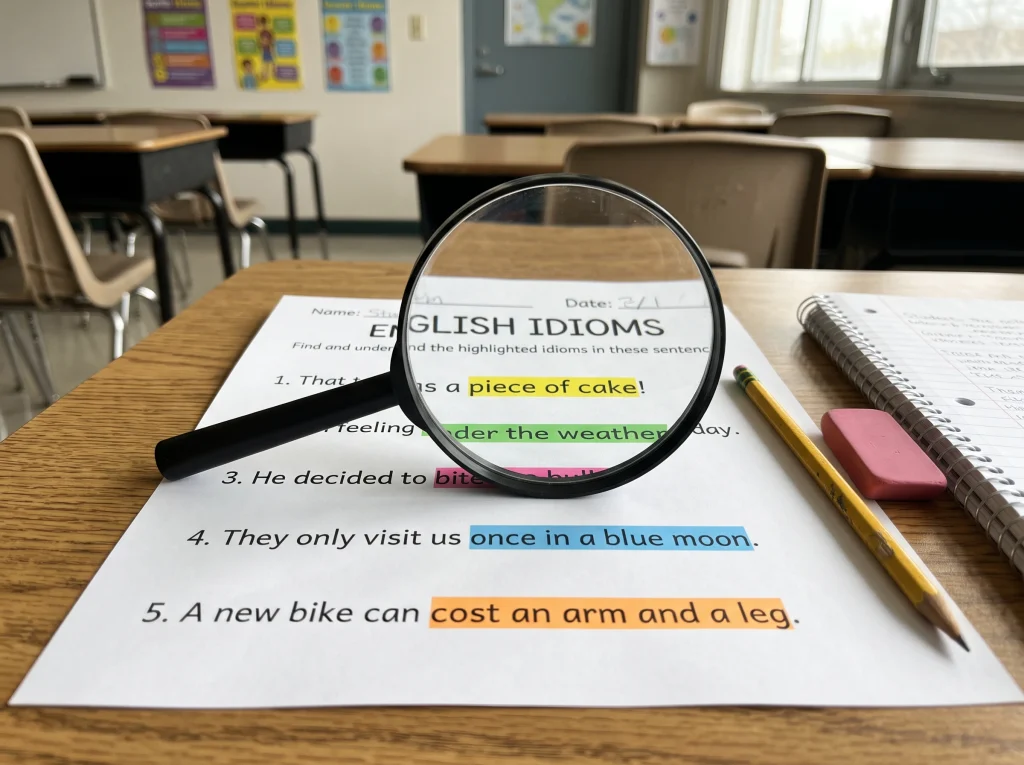
Worksheet 4: Identify Idioms in Sentences
Instructions: Read each sentence, identify the idiom, and write its figurative meaning.
| No. | Sentence | Idiom | Meaning |
|---|---|---|---|
| 1 | Don’t cry over spilled milk because the mistake cannot be changed. | _____ | _____ |
| 2 | Alex was walking on eggshells around his angry brother. | _____ | _____ |
| 3 | My teacher told me to keep my chin up after failing the test. | _____ | _____ |
| 4 | We need to get the ball rolling on our school project. | _____ | _____ |
| 5 | Jessica has a heart of gold and always helps others. | _____ | _____ |
| 6 | Stop beating around the bush and tell me the truth. | _____ | _____ |
| 7 | The new student passed the test with flying colors. | _____ | _____ |
| 8 | My grandfather told us to make hay while the sun shines. | _____ | _____ |
Worksheet 5: Write Your Own Sentences
Instructions: Write one original sentence for each idiom. Make sure the situation clearly demonstrates the expression’s figurative meaning.
| No. | Idiom | Your Sentence |
|---|---|---|
| 1 | Break a leg | __________________ |
| 2 | A dime a dozen | __________________ |
| 3 | Bite off more than you can chew | __________________ |
| 4 | Add fuel to the fire | __________________ |
| 5 | See eye to eye | __________________ |
| 6 | When pigs fly | __________________ |
| 7 | Get out of hand | __________________ |
| 8 | The last straw | __________________ |
| 9 | Keep your fingers crossed | __________________ |
| 10 | Burn bridges | __________________ |
Challenge Activity: Choose any three idioms from the table and write a short paragraph using all three naturally. Try to create a situation in which each expression makes sense.
Answer Key for Idiom Worksheets
Students can check their answers after completing all five exercises. Teachers and parents can also use this section to review the activities.
Worksheet 1: Matching Answers
| No. | Correct Answer |
|---|---|
| 1 | F. Something very easy |
| 2 | H. Make people feel comfortable |
| 3 | B. Reveal a secret |
| 4 | E. Feeling sick |
| 5 | A. Go to bed |
| 6 | G. Be patient or wait |
| 7 | I. Extremely happy |
| 8 | C. Something very expensive |
| 9 | J. Very rarely |
| 10 | D. Accept a difficult situation and face it |
Worksheet 2: Fill-in-the-Blank Answers
- Burn the midnight oil
- Pull someone’s leg
- In hot water
- A blessing in disguise
- Keep an eye on
- Back to square one
- Call it a day
- Get cold feet
- Learn the ropes
- The ball is in your court
Worksheet 3: Multiple-Choice Answers
| Question | Correct Answer |
|---|---|
| 1 | B. The test was very easy |
| 2 | B. He made everyone feel more comfortable |
| 3 | A. She revealed the secret |
| 4 | C. Very rarely |
| 5 | A. She was extremely happy |
| 6 | B. Be patient and wait |
| 7 | B. It was very expensive |
| 8 | A. I am feeling sick |
| 9 | C. Study seriously |
| 10 | A. Start planning again |
Worksheet 4: Identify Idioms Answers
- Cry over spilled milk: Feel upset about something that cannot be changed.
- Walk on eggshells: Act very carefully to avoid upsetting someone.
- Keep your chin up: Stay positive during a difficult situation.
- Get the ball rolling: Start an activity or process.
- A heart of gold: A very kind and generous personality.
- Beat around the bush: Avoid talking directly about something.
- With flying colors: Successfully or very well.
- Make hay while the sun shines: Take advantage of a good opportunity while it lasts.
Worksheet 5: Sample Sentence Answers
These are examples. Students may write different sentences as long as they use each idiom correctly.
- Break a leg: Everyone told Sarah to break a leg before her school performance.
- A dime a dozen: Cheap plastic toys are a dime a dozen at that store.
- Bite off more than you can chew: I bit off more than I could chew when I agreed to complete five projects in one week.
- Add fuel to the fire: His angry comments added fuel to the fire during the argument.
- See eye to eye: My best friend and I see eye to eye on most important issues.
- When pigs fly: My brother will clean his room without being asked when pigs fly.
- Get out of hand: The classroom discussion started to get out of hand.
- The last straw: His repeated lateness was the last straw for his manager.
- Keep your fingers crossed: I am keeping my fingers crossed for good results.
- Burn bridges: Never burn bridges with people you may work with again.
Benefits of Practicing Idioms
Regular practice with idiom worksheets helps learners develop several important English language skills.
1. Improves vocabulary: Students learn expressions that appear in everyday conversations, books, movies, and classroom discussions.
2. Strengthens reading comprehension: Understanding figurative language helps readers interpret sentences without confusing literal and intended meanings.
3. Develops contextual understanding: Worksheets with complete sentences encourage students to use surrounding information to determine what an expression means.
4. Builds writing skills: Using idioms correctly makes personal stories, conversations, and informal writing more expressive.
5. Improves speaking confidence: Familiarity with common expressions helps English learners understand conversations and communicate more naturally.
6. Encourages critical thinking: Students must consider the situation, speaker’s intention, and context instead of simply translating individual words.
Tips for Teaching Idioms to Students
Teaching idioms becomes easier when students can connect expressions with familiar situations.
- Start with familiar expressions: Introduce simple idioms such as “a piece of cake,” “break the ice,” and “under the weather.”
- Explain literal and figurative meanings: Show why the actual meaning differs from the literal words.
- Use everyday examples: Connect idioms with school, family, sports, shopping, and friendships.
- Practice with context clues: Give students sentences that help them understand an unfamiliar expression.
- Include pictures and illustrations: Visual activities can make unusual expressions easier to remember.
- Encourage original sentences: Ask learners to create examples based on their own experiences.
- Review regularly: Short matching games, quizzes, and worksheets help reinforce previously learned expressions.

For elementary students, begin with simple matching and multiple-choice exercises. Middle school students can work with longer sentences, reading passages, and independent writing activities. ESL learners benefit from clear explanations and examples showing when an expression sounds natural.
Frequently Asked Questions:
Conclusion
A worksheet on idioms is a practical way to help students understand figurative language and improve their English vocabulary. Matching activities, fill-in-the-blank exercises, multiple-choice questions, and sentence-writing tasks provide different opportunities to recognize and use common expressions.