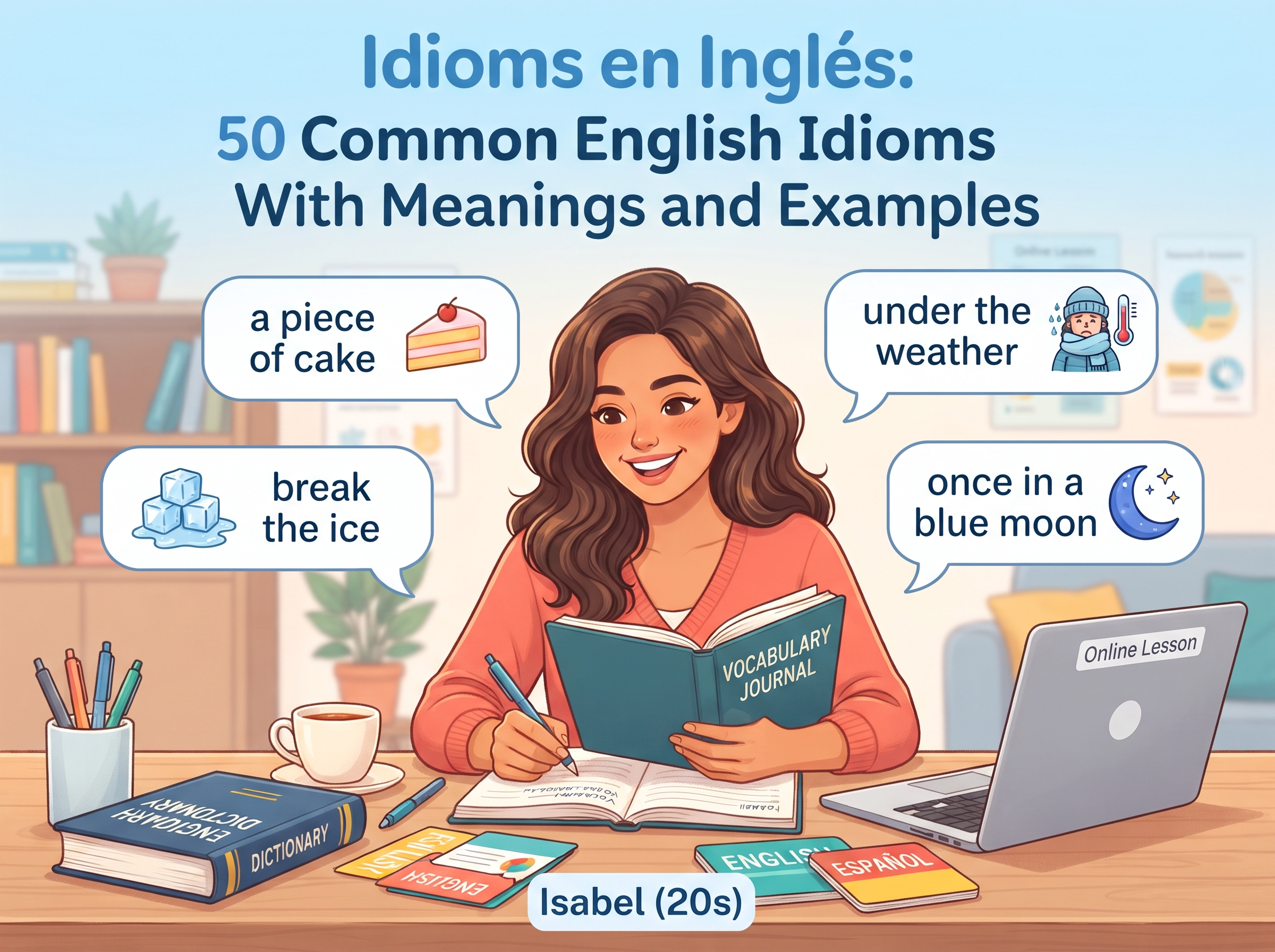
Idioms en Inglés: 50 Common English Idioms With Meanings and Examples
Learning English involves more than memorizing vocabulary and grammar rules. Many everyday conversations include idioms, expressions whose intended meanings cannot always be understood by translating each word separately. For Spanish speakers, learning these phrases alongside clear Spanish explanations can make English conversations, movies, books, and workplace discussions easier to follow.
For example, “It’s a piece of cake” does not mean that something is literally a piece of dessert. It means the task is easy. In Spanish, a similar expression is “Es pan comido.” The words are different, but the idea is much the same.
This guide covers 50 common idioms in English with their meanings in Spanish and example sentences. The expressions are organized by topic so you can study them in manageable groups and practice using them in everyday American English.
What Are Idioms en Inglés?
Idioms en inglés means English idioms. An idiom is a fixed or familiar expression whose figurative meaning differs from the literal meaning of its individual words. Idioms are common in informal conversations, stories, entertainment, and other forms of communication.
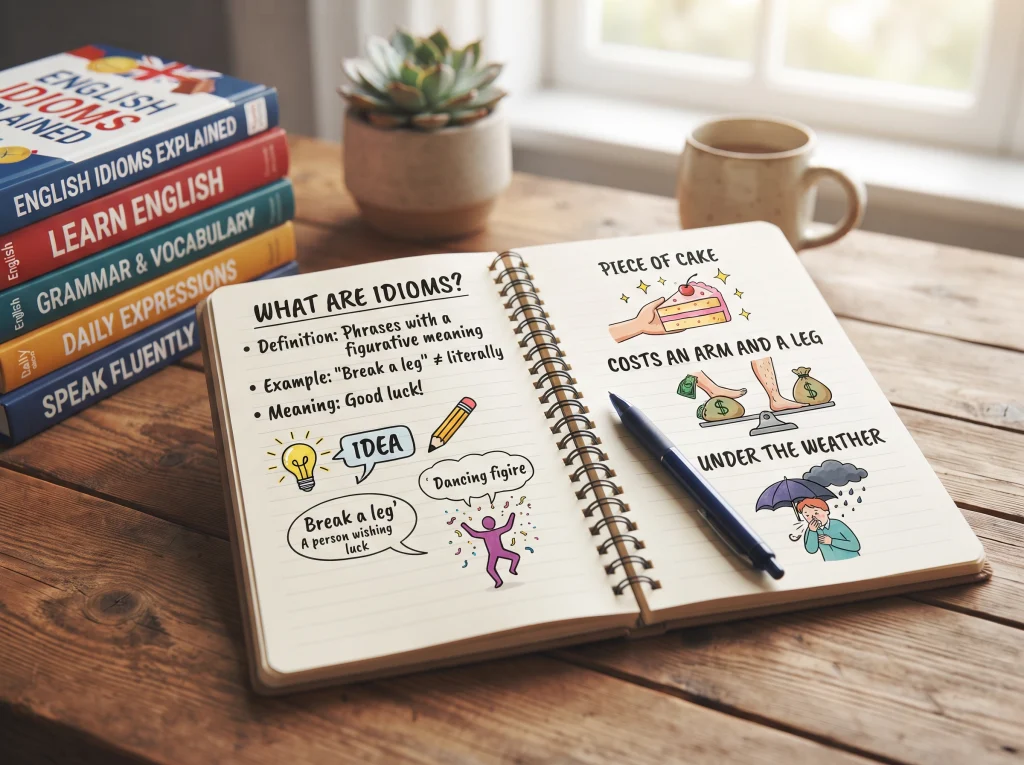
Some English idioms have close Spanish equivalents, while others are better translated by explaining the intended meaning. For instance, “break the ice” has a close equivalent in Spanish, “romper el hielo.” However, translating an idiom word for word may sound confusing if the same expression is not commonly used in Spanish.
mytranscriptionplace.com
+1
When learning an idiom, focus on three things:
- Expression: The exact English phrase.
- Meaning: What the expression communicates in context.
- Example: A complete sentence that shows how people use it.
Pain Idioms: https://learnidioms.com/pain-idioms/
50 Common English Idioms With Meanings and Examples
Everyday Communication
1. Break the ice
Meaning in English: To make people feel more comfortable when they first meet or when a conversation feels awkward.
Significado en español: Romper el hielo; hacer que una situación social sea más cómoda.
Example: “I told a funny story to break the ice at the meeting.”
En español: “Conté una historia divertida para romper el hielo en la reunión.”
2. A piece of cake
Meaning in English: Something that is very easy to do.
Significado en español: Pan comido; algo muy fácil.
Example: “The homework was a piece of cake.”
En español: “La tarea fue pan comido.”
3. Spill the beans
Meaning in English: To reveal a secret or information that was supposed to stay private.
Significado en español: Revelar un secreto; irse de la lengua.
Example: “Please don’t spill the beans about the surprise.”
En español: “Por favor, no reveles el secreto de la sorpresa.”
4. Beat around the bush
Meaning in English: To avoid saying something directly.
Significado en español: Andarse por las ramas; evitar ir al grano.
Example: “Stop beating around the bush and tell me what happened.”
En español: “Deja de andarte por las ramas y dime qué pasó.”
5. Hit the nail on the head
Meaning in English: To describe or identify something exactly right.
Significado en español: Dar en el clavo.
Example: “You hit the nail on the head when you said we need better communication.”
En español: “Diste en el clavo cuando dijiste que necesitamos comunicarnos mejor.”
6. Get the ball rolling
Meaning in English: To start an activity or process.
Significado en español: Poner algo en marcha; dar el primer paso.
Example: “Let’s get the ball rolling by introducing ourselves.”
En español: “Pongamos esto en marcha presentándonos.”
7. Be all ears
Meaning in English: To be ready and willing to listen carefully.
Significado en español: Escuchar con mucha atención; estar todo oídos.
Example: “Tell me what happened. I’m all ears.”
En español: “Cuéntame qué pasó. Te escucho con atención.”
8. Get the picture
Meaning in English: To understand what is happening or what someone means.
Significado en español: Entender la situación; hacerse una idea.
Example: “Now I get the picture. You need more time to finish the project.”
En español: “Ahora entiendo la situación. Necesitas más tiempo para terminar el proyecto.”
9. Let the cat out of the bag
Meaning in English: To reveal a secret, often by accident.
Significado en español: Revelar un secreto sin querer; descubrir el secreto.
Example: “He let the cat out of the bag when he mentioned the gift.”
En español: “Reveló el secreto cuando mencionó el regalo.”
10. Get straight to the point
Meaning in English: To talk about the main subject without unnecessary details.
Significado en español: Ir directamente al grano.
Example: “We only have five minutes, so let’s get straight to the point.”
En español: “Solo tenemos cinco minutos, así que vayamos directamente al grano.”
Feelings and Relationships
11. Under the weather
Meaning in English: To feel sick or unwell.
Significado en español: Sentirse mal; no encontrarse bien.
Example: “I’m feeling under the weather, so I’ll stay home today.”
En español: “Me siento mal, así que hoy me quedaré en casa.”
12. On cloud nine
Meaning in English: To be extremely happy.
Significado en español: Estar muy feliz; estar en una nube de felicidad.
Example: “She was on cloud nine after getting accepted into college.”
En español: “Estaba muy feliz después de que la aceptaran en la universidad.”
13. Get cold feet
Meaning in English: To become nervous or afraid before doing something.
Significado en español: Echarse atrás por miedo; ponerse nervioso antes de actuar.
Example: “He got cold feet before the wedding.”
En español: “Se puso nervioso antes de la boda y empezó a dudar.”
14. Give someone the cold shoulder
Meaning in English: To deliberately ignore someone or treat them in an unfriendly way.
Significado en español: Hacerle el vacío a alguien; tratar a alguien con frialdad.
Example: “She gave me the cold shoulder after our disagreement.”
En español: “Me hizo el vacío después de nuestro desacuerdo.”

15. Have a heart of gold
Meaning in English: To be very kind and generous.
Significado en español: Tener un corazón de oro; ser muy buena persona.
Example: “My aunt has a heart of gold and is always helping others.”
En español: “Mi tía tiene un corazón de oro y siempre ayuda a los demás.”
16. Be in the same boat
Meaning in English: To be in the same difficult or challenging situation as someone else.
Significado en español: Estar en la misma situación; estar en el mismo barco.
Example: “We’re all in the same boat because everyone has to meet the deadline.”
En español: “Estamos todos en la misma situación porque tenemos que cumplir con la fecha límite.”
17. Wear your heart on your sleeve
Meaning in English: To show your emotions openly.
Significado en español: Mostrar abiertamente los sentimientos; no ocultar las emociones.
Example: “He wears his heart on his sleeve, so everyone knows when he’s upset.”
En español: “Él muestra abiertamente sus sentimientos, así que todos saben cuándo está molesto.”
18. Get on someone’s nerves
Meaning in English: To annoy or irritate someone.
Significado en español: Poner de los nervios a alguien.
Example: “That constant buzzing is getting on my nerves.”
En español: “Ese zumbido constante me está poniendo de los nervios.”
19. Make someone’s day
Meaning in English: To make someone feel very happy.
Significado en español: Alegrarle el día a alguien.
Example: “Your kind message really made my day.”
En español: “Tu mensaje amable realmente me alegró el día.”
20. Cry over spilled milk
Meaning in English: To be upset about something that has already happened and cannot be changed.
Significado en español: Lamentarse por algo que ya no tiene remedio.
Example: “We made a mistake, but there’s no point crying over spilled milk.”
En español: “Cometimos un error, pero no tiene sentido lamentarse por algo que ya no se puede cambiar.”
Work, Learning, and Challenges
21. Hit the books
Meaning in English: To study seriously.
Significado en español: Ponerse a estudiar; hincar los codos.
Example: “I have an exam tomorrow, so I need to hit the books tonight.”
En español: “Tengo un examen mañana, así que esta noche necesito ponerme a estudiar.”
22. Learn the ropes
Meaning in English: To learn how to do a job or activity.
Significado en español: Aprender cómo funciona algo; aprender los procedimientos.
Example: “It took me a few days to learn the ropes at my new job.”
En español: “Tardé unos días en aprender cómo funcionaba mi nuevo trabajo.”
23. Go the extra mile
Meaning in English: To make more effort than is expected.
Significado en español: Hacer un esfuerzo adicional; dar más de lo esperado.
Example: “Our coach went the extra mile to help us prepare.”
En español: “Nuestro entrenador hizo un esfuerzo adicional para ayudarnos a prepararnos.”
24. Back to the drawing board
Meaning in English: To start planning again because the first attempt did not work.
Significado en español: Volver a empezar; replantear el plan desde el principio.
Example: “The design failed the test, so it’s back to the drawing board.”
En español: “El diseño no superó la prueba, así que tenemos que replantearlo desde el principio.”
25. Think outside the box
Meaning in English: To think creatively and consider unusual solutions.
Significado en español: Pensar de forma creativa; salir de lo convencional.
Example: “We need to think outside the box to solve this problem.”
En español: “Tenemos que pensar de forma creativa para resolver este problema.”
26. Pull your weight
Meaning in English: To do your fair share of the work.
Significado en español: Hacer la parte que le corresponde a uno.
Example: “Everyone must pull their weight if we want to finish on time.”
En español: “Todos deben hacer la parte que les corresponde si queremos terminar a tiempo.”
27. Bite the bullet
Meaning in English: To face a difficult or unpleasant situation bravely.
Significado en español: Afrontar algo difícil; armarse de valor y hacerlo.
Example: “I finally bit the bullet and told my manager about the mistake.”
En español: “Por fin me armé de valor y le conté a mi gerente el error.”
28. Throw in the towel
Meaning in English: To give up or stop trying.
Significado en español: Tirar la toalla; darse por vencido.
Example: “The problem was difficult, but she refused to throw in the towel.”
En español: “El problema era difícil, pero ella se negó a tirar la toalla.”
29. Cut corners
Meaning in English: To do something in a quick or cheap way that sacrifices quality.
Significado en español: Hacer algo de manera descuidada para ahorrar tiempo o dinero.
Example: “The company cut corners, and the product broke after a week.”
En español: “La empresa escatimó en calidad y el producto se rompió después de una semana.”
30. Be on the same page
Meaning in English: To have the same understanding or agreement about something.
Significado en español: Estar de acuerdo; tener la misma comprensión de una situación.
Example: “Let’s review the plan to make sure we’re on the same page.”
En español: “Repasemos el plan para asegurarnos de que todos estamos de acuerdo.”
Time, Decisions, and Opportunities
31. Call it a day
Meaning in English: To stop working for the day or finish an activity.
Significado en español: Dar por terminado el trabajo por hoy.
Example: “We’ve finished the main tasks, so let’s call it a day.”
En español: “Hemos terminado las tareas principales, así que demos por terminado el trabajo por hoy.”
32. Once in a blue moon
Meaning in English: Very rarely.
Significado en español: Muy de vez en cuando; casi nunca.
Example: “We eat at that restaurant once in a blue moon.”
En español: “Comemos en ese restaurante muy de vez en cuando.”
33. Better late than never
Meaning in English: Doing something late is better than not doing it at all.
Significado en español: Más vale tarde que nunca.
Example: “He finally apologized. Better late than never.”
En español: “Por fin se disculpó. Más vale tarde que nunca.”
34. Miss the boat
Meaning in English: To miss an opportunity by acting too late.
Significado en español: Perder una oportunidad por llegar tarde.
Example: “I missed the boat on the early registration discount.”
En español: “Perdí la oportunidad de conseguir el descuento por inscripción anticipada.”

35. Out of the blue
Meaning in English: Suddenly and unexpectedly.
Significado en español: De repente; inesperadamente.
Example: “Out of the blue, my old classmate called me.”
En español: “De repente, me llamó un antiguo compañero de clase.”
36. At the drop of a hat
Meaning in English: Immediately, without hesitation or much preparation.
Significado en español: Inmediatamente; sin pensarlo demasiado.
Example: “She would help her friends at the drop of a hat.”
En español: “Ayudaría a sus amigos inmediatamente, sin dudarlo.”
37. The last straw
Meaning in English: The final problem or annoyance that makes someone lose patience.
Significado en español: La gota que colma el vaso.
Example: “The missed deadline was the last straw for the frustrated client.”
En español: “El incumplimiento de la fecha límite fue la gota que colmó el vaso para el cliente frustrado.”
38. A blessing in disguise
Meaning in English: Something that seems bad at first but later turns out to have a positive result.
Significado en español: Una bendición disfrazada; algo malo que termina siendo beneficioso.
Example: “Losing that job was a blessing in disguise because it led me to a better opportunity.”
En español: “Perder ese trabajo terminó siendo algo positivo porque me llevó a una oportunidad mejor.”
39. In hot water
Meaning in English: To be in trouble.
Significado en español: Estar en problemas; meterse en un lío.
Example: “He was in hot water after missing an important meeting.”
En español: “Se metió en problemas después de faltar a una reunión importante.”
40. Look before you leap
Meaning in English: Think carefully about the risks before taking action.
Significado en español: Pensar antes de actuar; mirar antes de saltar.
Example: “Read the terms carefully before signing. Look before you leap.”
En español: “Lee las condiciones con cuidado antes de firmar. Piensa antes de actuar.”
Money and Everyday Wisdom
41. Cost an arm and a leg
Meaning in English: To be extremely expensive.
Significado en español: Costar un ojo de la cara; ser muy caro.
Example: “That new laptop cost an arm and a leg.”
En español: “Ese portátil nuevo costó un ojo de la cara.”
42. Bring home the bacon
Meaning in English: To earn money to support yourself or your family.
Significado en español: Ganarse la vida; llevar dinero a casa.
Example: “They both work hard to bring home the bacon.”
En español: “Los dos trabajan duro para ganarse la vida y mantener a la familia.”
43. Make ends meet
Meaning in English: To have enough money to cover basic expenses.
Significado en español: Llegar a fin de mes.
Example: “It’s difficult to make ends meet when rent keeps increasing.”
En español: “Es difícil llegar a fin de mes cuando el alquiler sigue subiendo.”
44. A dime a dozen
Meaning in English: Very common and easy to find.
Significado en español: Muy común; algo que se encuentra por todas partes.
Example: “You can find inexpensive phone cases a dime a dozen.”
En español: “Puedes encontrar fundas baratas para teléfonos por todas partes.”
45. Worth its weight in gold
Meaning in English: Extremely valuable or useful.
Significado en español: Valer su peso en oro; ser de gran valor.
Example: “A reliable babysitter is worth her weight in gold.”
En español: “Una niñera de confianza vale su peso en oro.”
46. Penny for your thoughts
Meaning in English: A friendly way to ask what someone is thinking.
Significado en español: ¿En qué piensas?; ¿qué te pasa por la cabeza?
Example: “You’ve been quiet. A penny for your thoughts?”
En español: “Has estado muy callado. ¿En qué piensas?”
47. Keep your chin up
Meaning in English: Stay hopeful and positive during a difficult time.
Significado en español: Mantener el ánimo; no desanimarse.
Example: “Keep your chin up. You’ll have another chance.”
En español: “No te desanimes. Tendrás otra oportunidad.”
48. Every cloud has a silver lining
Meaning in English: Even a difficult situation may have a positive aspect.
Significado en español: No hay mal que por bien no venga.
Example: “The trip was canceled, but every cloud has a silver lining: we got to spend more time with family.”
En español: “Se canceló el viaje, pero no hay mal que por bien no venga: pudimos pasar más tiempo con la familia.”
49. Don’t put all your eggs in one basket
Meaning in English: Don’t risk everything on a single plan or opportunity.
Significado en español: No poner todos los huevos en la misma canasta; no depender de una sola opción.

Example: “Apply to several jobs so you don’t put all your eggs in one basket.”
En español: “Solicita varios empleos para no depender de una sola opción.”
50. Add fuel to the fire
Meaning in English: To make a tense or difficult situation worse.
Significado en español: Echar leña al fuego; empeorar una situación conflictiva.
Example: “His angry comments only added fuel to the fire.”
En español: “Sus comentarios enojados solo echaron leña al fuego.”
Archery Idioms: https://learnidioms.com/archery-idioms/
English Idioms With Spanish Meanings: Quick Comparison
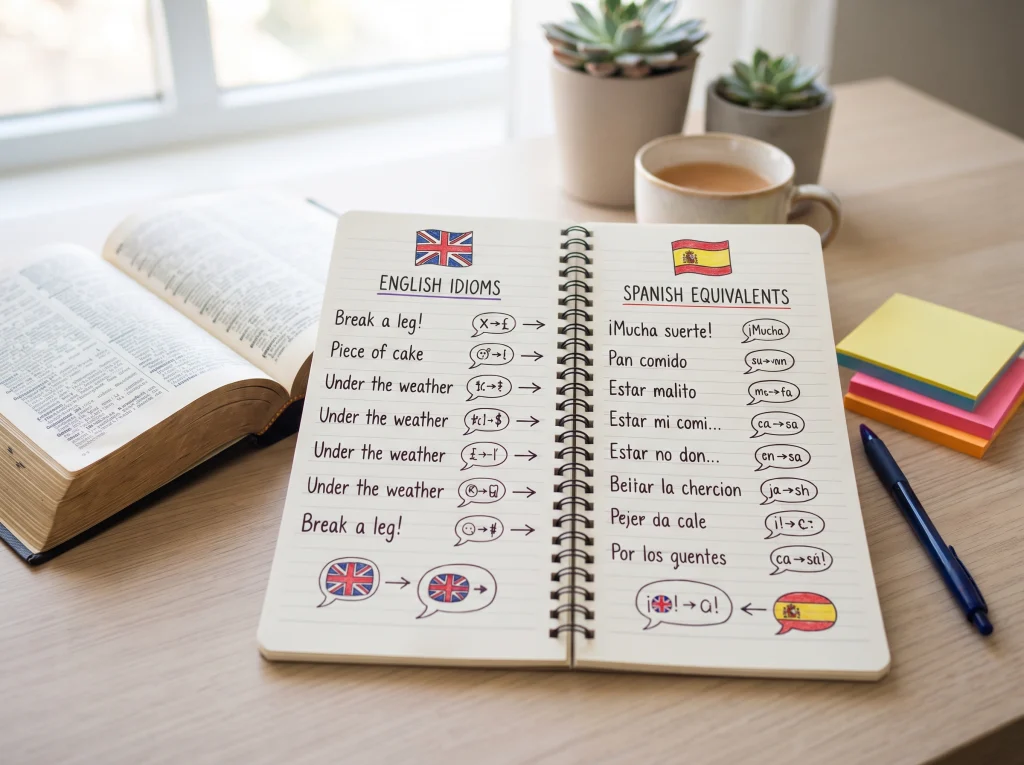
Some idioms have close equivalents in Spanish, while others are best explained with a phrase that conveys the same idea. The following table brings together several useful matches.
| English idiom | Spanish equivalent or explanation |
|---|---|
| Break the ice | Romper el hielo |
| A piece of cake | Ser pan comido |
| Hit the nail on the head | Dar en el clavo |
| Beat around the bush | Andarse por las ramas |
| Be all ears | Escuchar con atención |
| Under the weather | Encontrarse mal |
| On cloud nine | Estar muy feliz |
| Throw in the towel | Tirar la toalla |
| Better late than never | Más vale tarde que nunca |
| Cost an arm and a leg | Costar un ojo de la cara |
| Make ends meet | Llegar a fin de mes |
| Add fuel to the fire | Echar leña al fuego |
| The last straw | La gota que colma el vaso |
| Every cloud has a silver lining | No hay mal que por bien no venga |
| Think outside the box | Pensar de forma creativa |
These are useful equivalents, not a guarantee that the expressions are identical in every context or Spanish-speaking region. Choose the translation that fits the situation and the audience.
How to Learn and Use English Idioms Naturally
Learning idioms is more effective when you study how they work in complete sentences rather than memorizing isolated definitions. English and Spanish do not always use the same imagery, so concentrate on the intended message instead of translating each word literally.
mytranscriptionplace.com
+1
Try this simple routine:
- Choose five idioms. Start with expressions you are likely to hear in daily conversations.
- Read the meaning in both languages. Make sure you understand the idea before practicing the English phrase.
- Say the example sentence aloud. Notice which words come before and after the idiom.
- Write a sentence about your own life. For example, “The quiz was a piece of cake” or “I need to hit the books tonight.”
- Review the expressions later. Cover the definitions and see whether you can remember what each idiom means.
- Listen for idioms in context. Pay attention to conversations, shows, podcasts, and other English-language material.

Choose Idioms That Fit the Situation
Many idioms are especially common in casual conversation. “I’m all ears” is a friendly way to show that you are listening, while “get straight to the point” asks someone to speak directly. In a formal report or academic paper, a literal explanation may be clearer than an idiom.
Learn the Grammar Around Each Idiom
Some idioms change slightly depending on the subject or tense:
- “I hit the books last night.”
- “She hits the books every evening.”
- “They were in hot water after the mistake.”
- “He is in hot water right now.”
Learn the expression as a phrase, but also practice fitting it into different sentences.
Common Mistakes to Avoid
Translating word for word: The literal meaning of an idiom may not communicate its intended message. Learn what the full expression means before using it.
Using an idiom in the wrong context: “On cloud nine” expresses happiness, while “under the weather” describes feeling unwell. Make sure the expression matches the situation.
Changing the wording unnecessarily: Idioms often have established forms. Learn the complete phrase, including small words such as the, a, and in.
Using too many idioms at once: A few natural expressions can make a conversation lively. Forcing several into every sentence may make your speech harder to follow.
Assuming every English idiom has an exact Spanish match: Some expressions have close equivalents, while others need a short explanation. Choose a translation based on meaning and context rather than the individual words.
Insulting Idioms: https://learnidioms.com/insulting-idioms/
FAQS
Conclusion
Idioms en inglés are an important part of understanding how people communicate in everyday English. Learning their meanings alongside Spanish equivalents and complete example sentences can help you recognize expressions and use them more confidently. Start with a small group, practice each one in a realistic sentence, and review it regularly. With steady practice, common idioms will become easier to recognize in conversations and use when speaking or writing.





3 Comments