Idioms With Story: 20 Common English Idioms Explained Through Short Stories
English idioms can be confusing because their meanings are often different from the meanings of the individual words. For example, when someone says, “The test was a piece of cake,” they are not talking about dessert. They mean the test was very easy.
One effective way to understand idioms is to read them in short stories. Stories show how expressions work in real situations, making their meanings easier to remember and use. In this guide, you will learn 20 common English idioms through simple stories, clear definitions, and everyday examples.
What Are Idioms With Stories?
Idioms with stories are figurative expressions taught through short situations or narratives. Instead of memorizing a phrase and its definition separately, readers see how a character uses the expression in context.

An idiom is a group of words with a meaning that is different from the literal meaning of the individual words. For example, “break the ice” means to make people feel more comfortable in a social situation, not to break a frozen piece of water. English meaning – Cambridge Dictionary+1
Stories make these expressions easier to understand because readers can connect each phrase with an action, feeling, or event. This approach is useful for English learners, students, teachers, and anyone who wants to improve everyday communication.
Why Learn English Idioms Through Stories?
Learning idioms through stories provides context that a simple vocabulary list cannot always offer. You can see who uses an expression, why they use it, and what it communicates in a conversation.
Stories also help readers:
- Understand figurative meanings: A situation makes the intended meaning clearer.
- Remember expressions: Characters and events create memorable connections.
- Improve reading comprehension: Idioms appear naturally in conversations and passages.
- Learn sentence structure: Examples show how expressions fit into everyday English.
- Build speaking confidence: Context helps learners decide when an idiom sounds natural.
For example, reading that someone felt nervous before a performance helps explain the expression “get cold feet” more clearly than memorizing its definition alone.
20 Common English Idioms With Short Stories
The following short stories use familiar situations from school, work, family life, and friendships. Each one introduces an idiom, explains its meaning, and provides an additional example.
1. A Piece of Cake
Meaning: Something that is very easy to do.
Short story:
Emma was nervous about her first computer class. She thought the typing test would be difficult, so she practiced every evening. When the test began, she completed all the exercises in just ten minutes. Her teacher checked her work and gave her a perfect score.
Emma smiled and said, “That test was a piece of cake!”
Example: The math homework looked difficult, but it was a piece of cake.
2. Break the Ice
Meaning: To make people feel more relaxed and comfortable when they first meet.
Short story:
A new student named Daniel joined a class halfway through the semester. Everyone already knew one another, so he felt uncomfortable sitting alone. During lunch, another student asked him about his favorite sports team. They started talking, and soon several classmates joined the conversation.
That friendly question helped break the ice.
Example: The teacher told a funny story to break the ice before the meeting.
3. Once in a Blue Moon
Meaning: Something that happens very rarely.
Short story:
Sophia usually stayed home on weekends because she had a busy schedule. Her friends often invited her to concerts, but she rarely had time to go. One Saturday, she finished all her work early and joined them for a live music show.
Her brother joked, “You go out with friends once in a blue moon!”
Example: We eat at that expensive restaurant once in a blue moon.
4. Hit the Books
Meaning: To begin studying seriously.
Short story:
Michael spent most of Saturday playing video games. On Sunday morning, he remembered that his final exams were only three days away. He collected his textbooks, organized his notes, and turned off his phone.
His mother smiled and said, “It’s time to hit the books.”
Example: I need to hit the books tonight because my science exam is tomorrow.
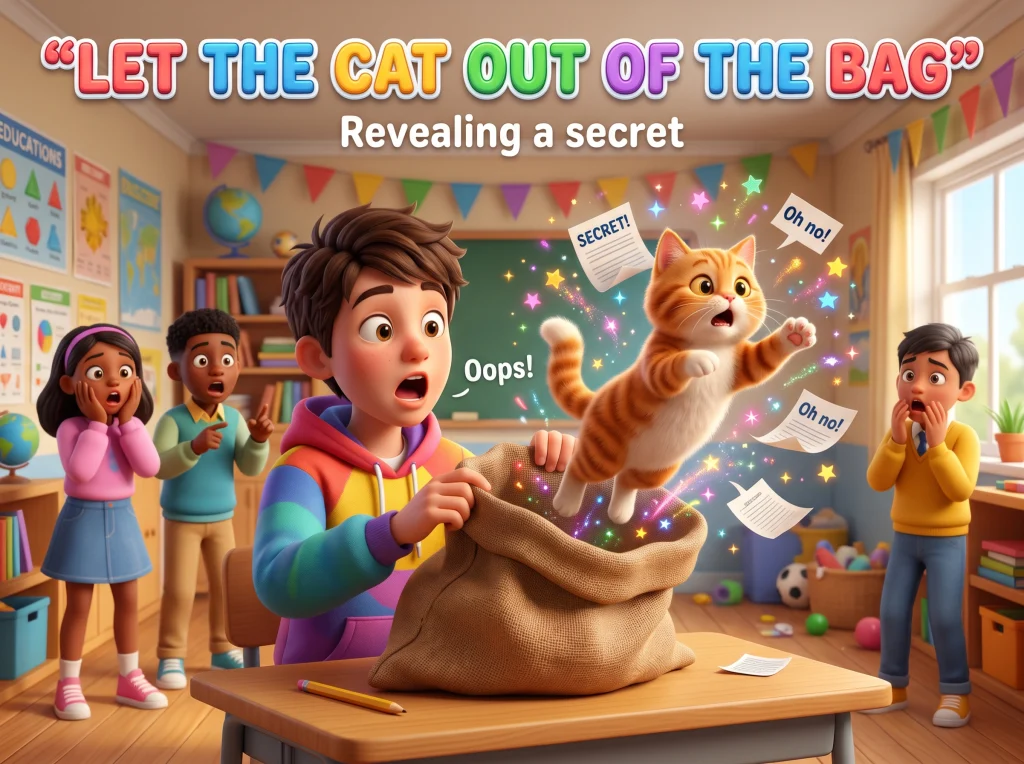
5. Let the Cat Out of the Bag
Meaning: To reveal a secret, often by accident.
Short story:
Lily and her brother were planning a surprise birthday party for their mother. They decorated the living room and invited all her friends. Their mother had no idea what was happening.
At dinner, Lily became excited and asked, “Mom, do you think you’ll like the surprise party tomorrow?” Her brother covered his face because she had let the cat out of the bag.
Example: Don’t let the cat out of the bag about the engagement party.
6. Under the Weather
Meaning: Feeling sick or slightly unwell.
Short story:
Jake planned to play basketball with his friends after school. However, he woke up with a headache and a sore throat. He tried getting ready, but he felt too tired to leave the house.
When his friend called, Jake explained that he was feeling under the weather.
Example: I’m staying home today because I feel a little under the weather.
7. When Pigs Fly
Meaning: Something that is extremely unlikely or will probably never happen.
Short story:
Noah’s younger brother never cleaned his bedroom. His clothes were always on the floor, and his books were scattered everywhere. One morning, he announced that he would clean everything without being asked.
Noah laughed and replied, “I’ll believe that when pigs fly!”
Example: My brother will wake up at 5 a.m. every day when pigs fly.
8. Bite the Bullet
Meaning: To face a difficult or unpleasant situation with courage.
Short story:
Olivia had been avoiding a dentist appointment for months because she was afraid of dental treatment. Eventually, her tooth began hurting so badly that she could not sleep. She called the dentist and scheduled an appointment for the next morning.
Although she was nervous, she decided to bite the bullet and get the treatment.
Example: I don’t enjoy public speaking, but I need to bite the bullet and give the presentation.
9. The Ball Is in Your Court
Meaning: It is your turn to make a decision or take action.
Short story:
Two friends wanted to start a small online business. They discussed different ideas and agreed that both could contribute money. Alex prepared a business plan and sent it to his friend, Ryan.
Ryan needed to decide whether to move forward. Alex told him, “I’ve done my part. The ball is in your court now.”
Example: I’ve sent you the proposal, so the ball is in your court.
10. Spill the Beans
Meaning: To reveal secret information.
Short story:
A group of coworkers planned a farewell lunch for their manager. They agreed to keep everything secret until Friday. However, one employee accidentally mentioned the restaurant while talking to the manager.
Everyone realized that he had spilled the beans.
Example: My sister spilled the beans about our vacation plans.
11. A Blessing in Disguise
Meaning: Something that seems bad at first but later leads to a good result.
Short story:
When Ethan lost his part-time job, he felt disappointed and worried about paying his expenses. He spent the next few weeks learning graphic design online. A small company noticed his work and offered him a position with better pay and flexible hours.
Looking back, Ethan realized that losing his old job had been a blessing in disguise.
Example: Missing that flight was a blessing in disguise because I met an old friend at the airport.
12. Burn the Midnight Oil
Meaning: To work or study late into the night.
Short story:
Ava had a major school project due on Monday. She had completed most of the research but still needed to prepare her presentation. On Sunday evening, she organized her notes and worked until after midnight.
Her father noticed the lights were still on and said, “You’re burning the midnight oil again.”
Example: The team burned the midnight oil to finish the project before the deadline.
13. Cost an Arm and a Leg
Meaning: To be extremely expensive.
Short story:
Lucas wanted to buy a new laptop for college. He visited several stores and compared different models. One computer had excellent features, but its price was much higher than his budget.
Lucas looked at the price tag and said, “That laptop costs an arm and a leg!”
Example: The hotel near the beach costs an arm and a leg during summer.

14. On Cloud Nine
Meaning: Extremely happy or excited.
Short story:
After several interviews, Mia finally received a job offer from her favorite company. She immediately called her parents and shared the news. They congratulated her and celebrated with dinner.
Mia was on cloud nine because she had achieved an important goal.
Example: He was on cloud nine after winning the championship.
15. The Last Straw
Meaning: The final problem or unpleasant event that makes someone lose patience.
Short story:
For several weeks, Ben’s roommate had been leaving dirty dishes in the kitchen. Ben politely asked him to clean up, but nothing changed. One morning, Ben found food-covered plates on the counter again, just before an important meeting.
That was the last straw. He decided they needed to discuss their living arrangements.
Example: The missed deadline was the last straw for the frustrated manager.
16. Call It a Day
Meaning: To stop working or doing an activity for the time being.
Short story:
A group of volunteers spent the afternoon cleaning a local park. They collected trash, painted benches, and planted flowers. By sunset, everyone was tired, and the park looked much better.
The team leader thanked them and said, “Let’s call it a day.”
Example: We’ve finished most of the work, so let’s call it a day.
17. Get Cold Feet
Meaning: To become nervous or lose confidence before doing something important.
Short story:
Ryan had prepared for his first public speech for weeks. He practiced in front of a mirror and asked his friends for feedback. However, when he stood backstage and heard the audience, he suddenly felt nervous.
For a moment, he got cold feet. Then he took a deep breath and walked onto the stage.
Example: She got cold feet before her driving test but completed it successfully.
18. Keep an Eye On
Meaning: To watch or look after someone or something carefully.
Short story:
Nora asked her older brother to watch her puppy while she went shopping. The puppy was playful and liked running around the garden. Her brother agreed to keep an eye on him and make sure he did not leave the yard.
When Nora returned, the puppy was sleeping safely on the porch.
Example: Could you keep an eye on my bag while I get a coffee?
19. Pull Someone’s Leg
Meaning: To joke with someone by making them believe something that is not true.
Short story:
When Sam arrived at work, his friend told him that the office had decided to replace all the chairs with exercise balls. Sam looked confused and started asking questions. His friend finally laughed and admitted that he was only pulling Sam’s leg.
Example: Don’t worry about what she said. She’s just pulling your leg.
20. Through Thick and Thin
Meaning: To remain loyal to someone during both good and difficult times.
Short story:
Olivia and Grace had been best friends since elementary school. They celebrated each other’s achievements and supported one another through difficult periods. Even when Grace moved to another state, they stayed in touch and continued helping each other.
Their friendship lasted through thick and thin.
Example: True friends stand by each other through thick and thin.
How to Learn Idioms Through Short Stories
Reading stories is a useful starting point, but practicing each expression helps you remember it and use it correctly. Follow these simple steps:
- Read the entire story: Understand what is happening before focusing on the idiom.
- Identify the expression: Find the phrase that has a figurative meaning.
- Learn its definition: Write the meaning in simple English.
- Create your own sentence: Use the expression in a situation from your daily life.
- Retell the story: Explain the situation using your own words.
- Review regularly: Revisit familiar idioms and practice using them in conversation.
For example, after reading the story about “hit the books,” you could write: “I have a history test next week, so I need to hit the books this weekend.”
A vocabulary notebook can also help. Record each idiom, its meaning, a short example, and a situation in which you might use it.
Tips for Using Idioms Naturally in Everyday English
Understanding an idiom does not automatically mean you can use it in every conversation. Pay attention to the situation, tone, and people you are speaking with.
Learn the context: Some expressions are informal and work better in conversations with friends than in formal business writing.
Avoid literal translations: An idiom may not make sense when translated word for word into another language. Learn the complete expression and its intended meaning.
Use complete sentences: Practice expressions in natural sentences instead of repeating them without context.
Do not overuse idioms: A few well-placed expressions can make your English sound natural. Using too many in one conversation can make your message difficult to follow.
Listen to everyday English: Notice how people use idioms in conversations, movies, interviews, and podcasts. Pay attention to the situations in which the expressions appear.

The goal is not to use as many idioms as possible. It is to understand them and choose the right expression when it communicates your meaning clearly.
Frequently Asked Questions:
Conclusion
Learning idioms with stories makes English vocabulary more practical and memorable. Each short story connects an expression with a familiar situation, helping readers understand both its figurative meaning and its everyday use.
Start with a few expressions, such as “a piece of cake,” “break the ice,” and “hit the books.” Read their stories, practice making your own sentences, and gradually add more idioms to your vocabulary. With regular practice, you can understand these expressions more easily and use them with greater confidence.