Jibe or Jive? Meaning, Difference, and Correct Usage in American English
If you are wondering whether jibe or jive is correct, the answer depends on what you mean. The two words sound alike in American English, but their meanings are different.
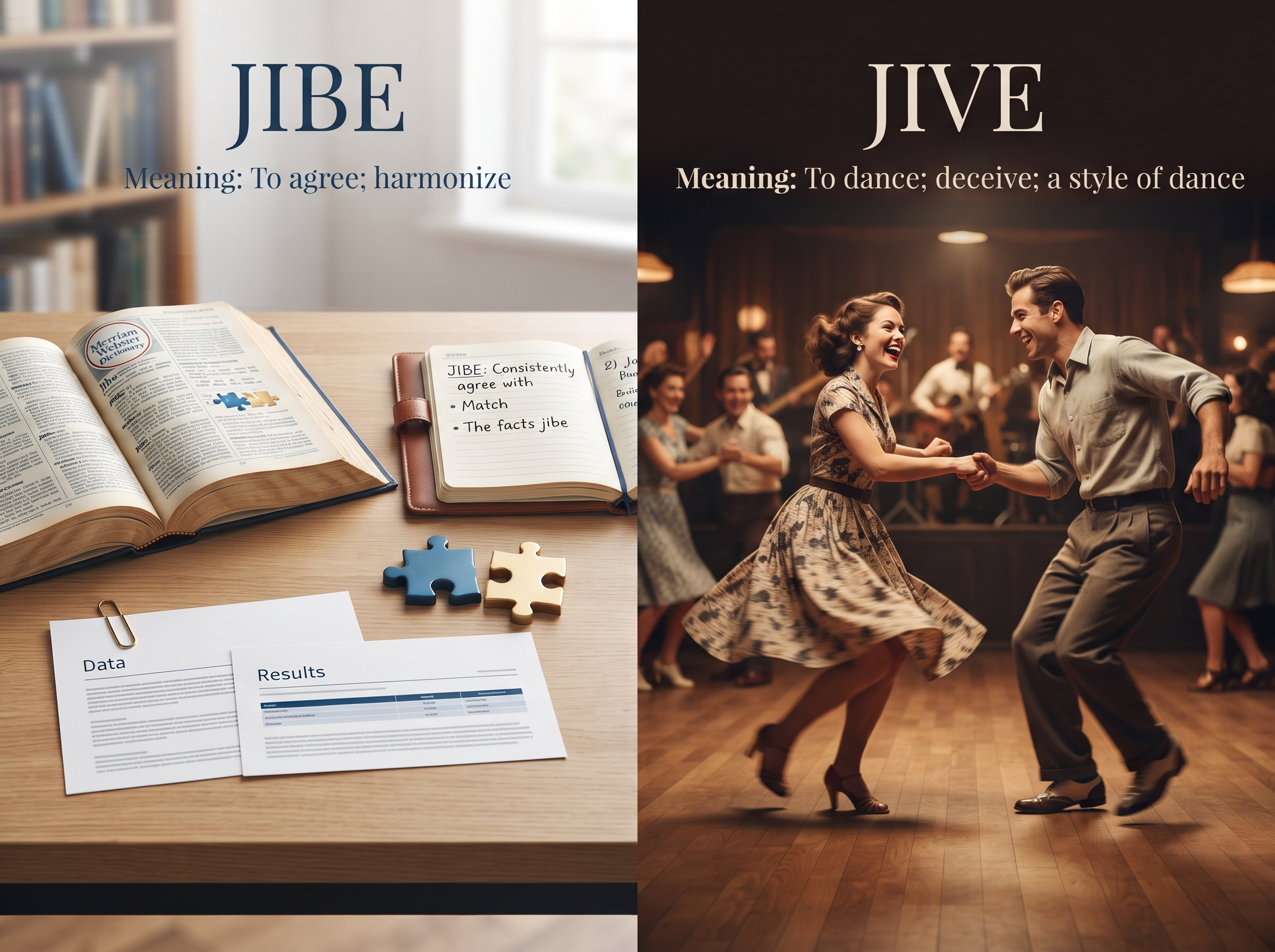
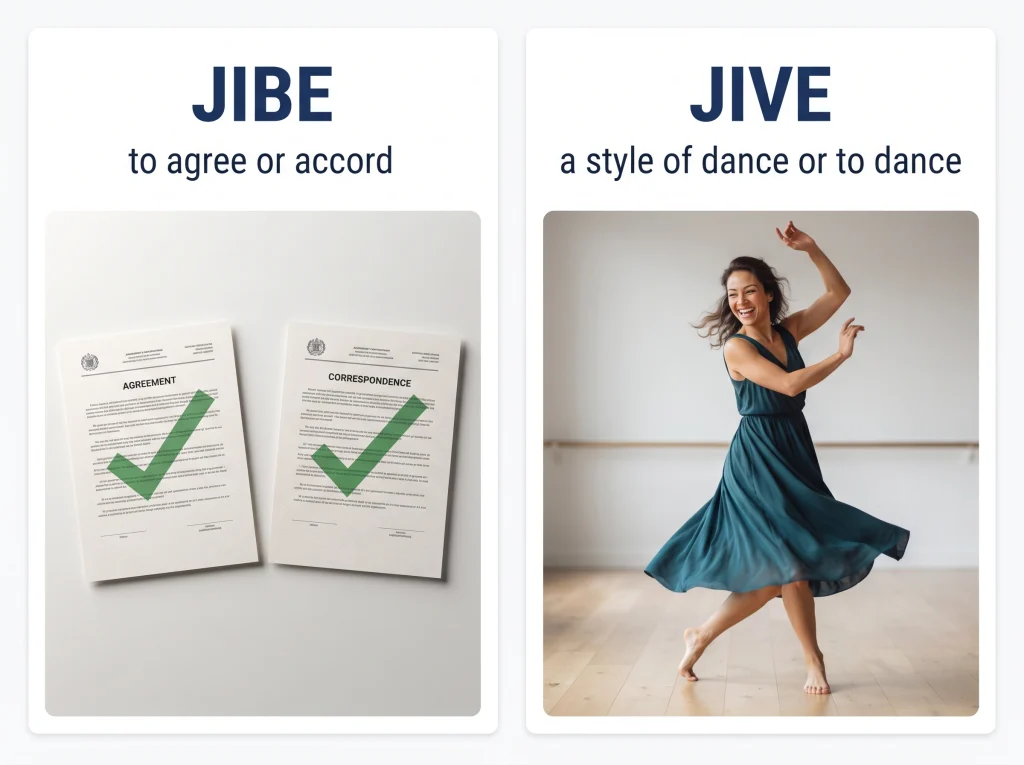
Use jibe when you mean “agree,” “match,” or “be consistent with.” For example, Her explanation does not jibe with the evidence. Jive usually refers to a type of dance or to informal language meaning nonsense, dishonest talk, or an attempt to deceive.
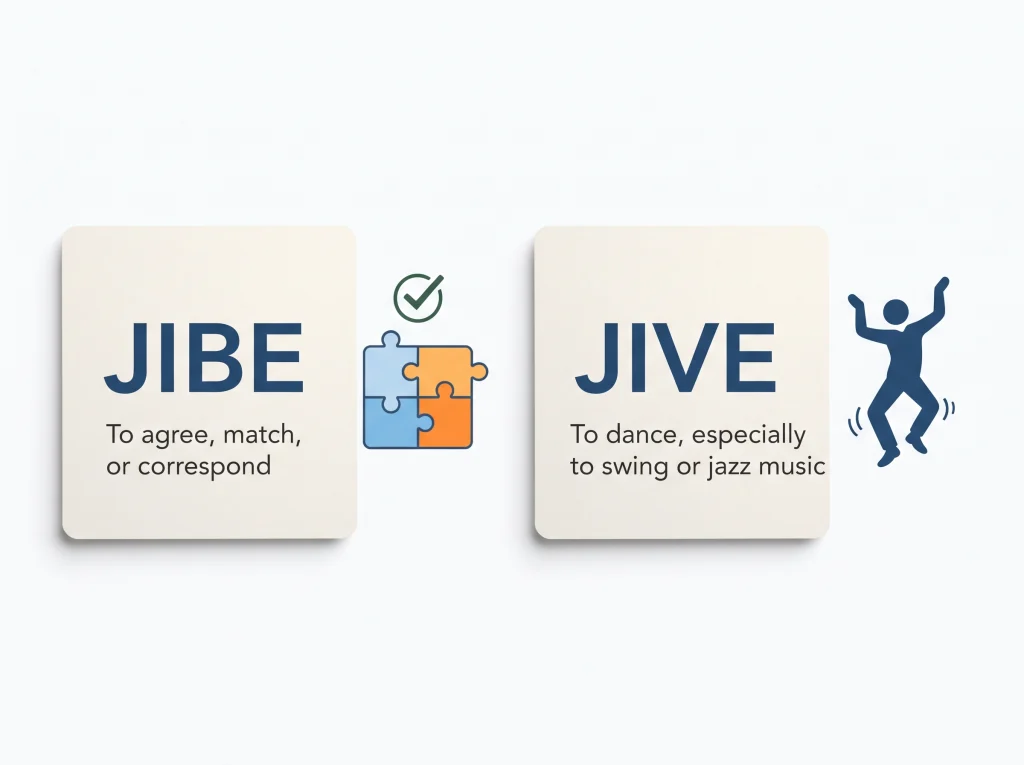
There is one important complication. In U.S. informal English, jive with is also used to mean “agree with” or “match.” Cambridge recognizes jive with as an informal alternative, but jibe with remains the clearest choice when you are writing carefully or professionally.
Jibe Meaning in American English
Jibe has several meanings, but one of the most useful in everyday American English is to agree, match, or be consistent with something.
The most common construction is jibe with.
For example:
The witness’s story does not jibe with the evidence.
Here, jibe with means that the two things do not agree or match. Merriam Webster lists jibe as a verb meaning to be in agreement, with synonyms such as agree, correspond, match, and coincide.
You can use jibe when talking about facts, statements, opinions, explanations, records, numbers, or other information.
Examples of Jibe Meaning “Agree”
- The results jibe with our original prediction.
- Her explanation doesn’t jibe with the facts.
- His account of the accident jibes with mine.
- The numbers do not jibe with the company’s report.
- Their stories don’t jibe with each other.
- The evidence seems to jibe with what the witness said.
Jibe also has another meaning as a noun or verb: a mocking or insulting remark. Cambridge lists jibe as a synonym or alternative spelling of gibe in this sense.
For example:
He made a cruel jibe about her mistake.
So, jibe can mean agreement in one context and a mocking remark in another.
Jive Meaning in American English
Jive has meanings that are quite different from the usual agreement meaning of jibe.
One common meaning is a type of fast dance associated with the 1940s and 1950s. It can also be used as a verb meaning to dance the jive.
For example:
They learned how to jive at the dance class.
Jive can also refer to informal or slang speech, especially talk that is dishonest, meaningless, or intended to deceive.
For example:
Don’t give me that jive. Tell me what really happened.
Cambridge also gives jive as a verb meaning to try to make someone believe something untrue, as in Quit jiving me and tell me where you were.
Examples of Jive
- They danced the jive all night.
- She loves old jive music.
- Don’t give me that jive.
- He was just jiving me.
- The comedian used some old-fashioned jive talk.
In these examples, jive has nothing to do with two facts agreeing with each other.
Jibe vs. Jive Comparison
| Word | Main meaning | Example |
|---|---|---|
| Jibe | Agree, match, or be consistent | The facts don’t jibe with his story. |
| Jibe | A mocking or insulting remark | He made a cruel jibe. |
| Jive | A type of dance | They learned to jive. |
| Jive | Dishonest, meaningless, or deceptive talk | Don’t give me that jive. |
| Jive with | Informally, agree or match | Her explanation jives with the evidence. |
The easiest rule for most American English writing is simple:
Jibe = agree or match.
Jive = dance, slang, or deceptive talk.
When you mean that two things are consistent, jibe with is the safest choice.
Jibe and Jive in Common American English Sentences
Seeing the words in context makes the difference easier to understand.
Jibe for Agreement
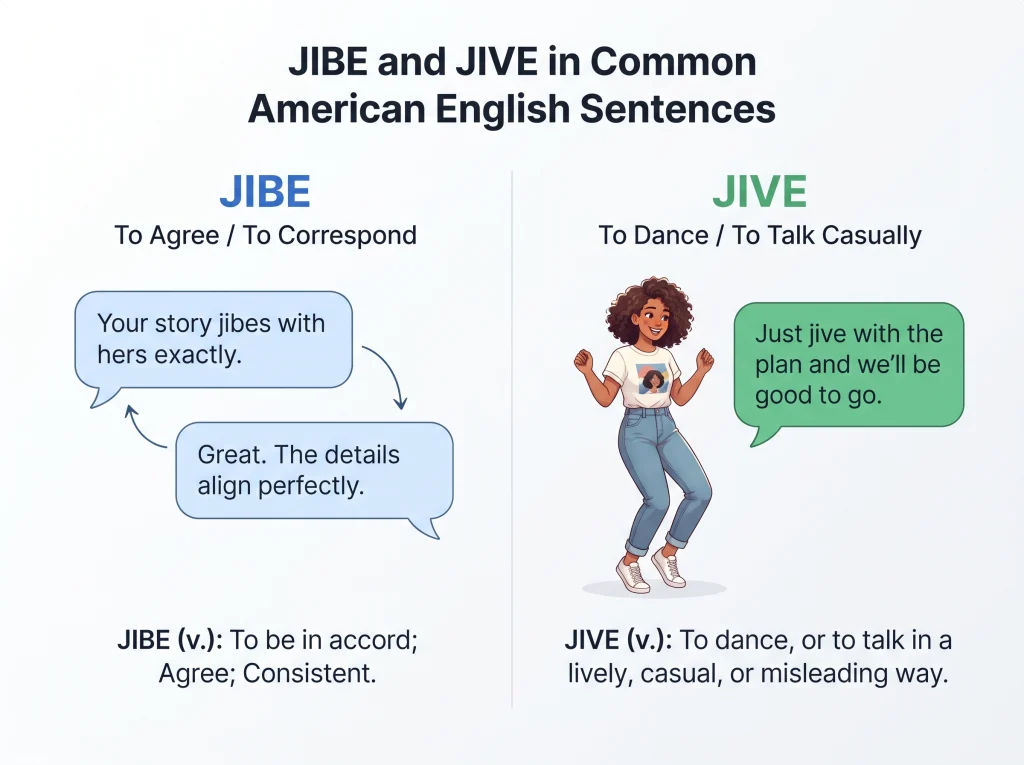
The new evidence doesn’t jibe with the original report.
Here, jibe means “agree with” or “match.”
Her explanation jibes with what we already know.
The explanation is consistent with the existing information.
The sales figures don’t jibe with the financial forecast.
The two sets of information do not match.
His version of events doesn’t jibe with the security footage.
His account conflicts with the available evidence.
Jive for Dance
They spent the evening learning to jive.
Here, jive refers to dancing.
The couple performed a lively jive at the competition.
The word identifies the dance.
Jive for Informal or Deceptive Talk
Don’t try to jive me. I know what happened.
Here, jive means to deceive or mislead someone.
That’s just jive. I don’t believe a word of it.
In this sentence, jive refers to dishonest or meaningless talk.
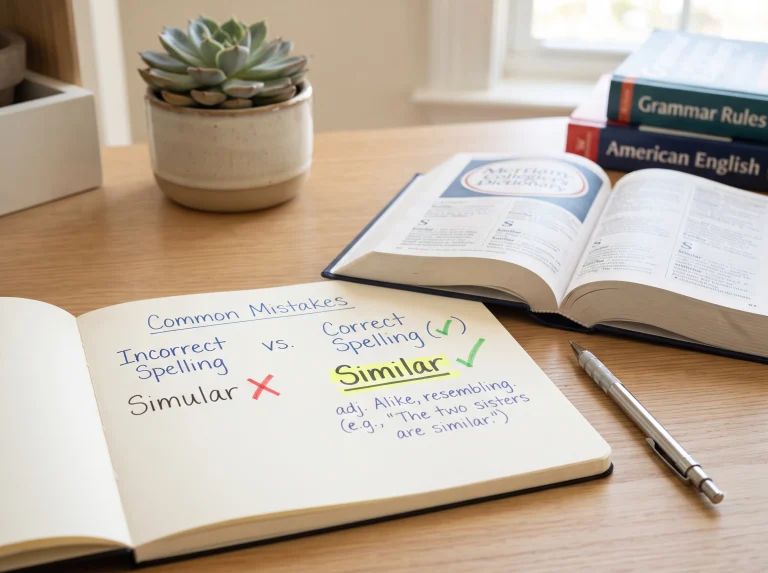
Common Mistakes With Jibe and Jive
Mistake 1: Using Jive When You Mean “Agree”
A common mistake is writing:
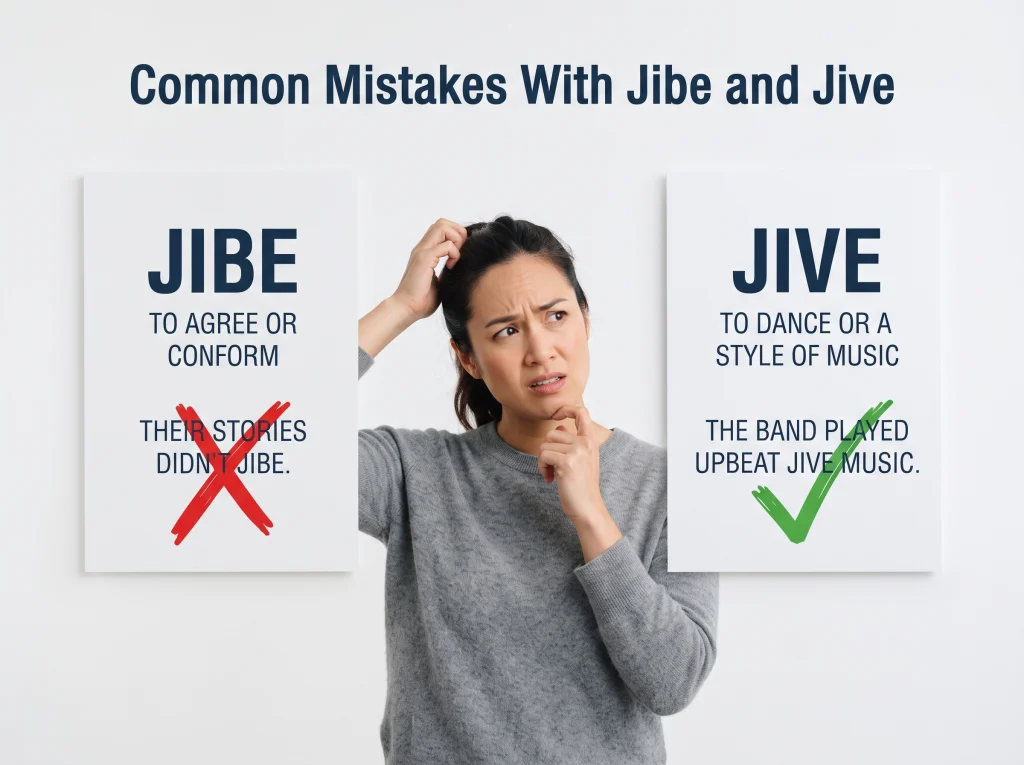
The report doesn’t jive with the facts.
For careful American English, use:
The report doesn’t jibe with the facts.
Jibe with is the traditional and clearer form for saying that something agrees or corresponds with something else.
Mistake 2: Using Jibe for a Dance
If you are talking about the dance, use jive:
They learned to jive at the dance studio.
Using jibe in this sentence would change the meaning and make the sentence incorrect.
Mistake 3: Thinking Jibe and Jive Are Always Interchangeable
They are not generally interchangeable.
Compare:
Her story doesn’t jibe with the evidence.
and:
They jived to the music.
The first sentence is about agreement. The second is about dancing.
Mistake 4: Forgetting That “Jive With” Exists in Informal U.S. English
Modern American English does sometimes use jive with to mean “agree with.” Cambridge specifically lists it as an informal alternative to jibe with.
That does not mean the distinction is useless. If you are writing an email, report, essay, application, or other formal material, jibe with is the clearer choice when you mean “agree with.”
Jibe, Jive, and Gibe: What Is the Difference?
A third word makes this group even more confusing: gibe.
Gibe means a mocking or insulting remark. It can also be spelled jibe when used with this meaning. Cambridge identifies gibe as another spelling of jibe.
Compare the three:
- Jibe: to agree or match
- Jibe/Gibe: a mocking or insulting remark
- Jive: a dance, slang, or deceptive talk
For example:
The facts jibe with the report.
Here, jibe means “agree.”
He made a sharp jibe about her mistake.
Here, jibe means an insulting remark.
They danced the jive.
Here, jive refers to the dance.
This distinction is especially useful because jibe has more than one established meaning, while jive has its own separate set of meanings.
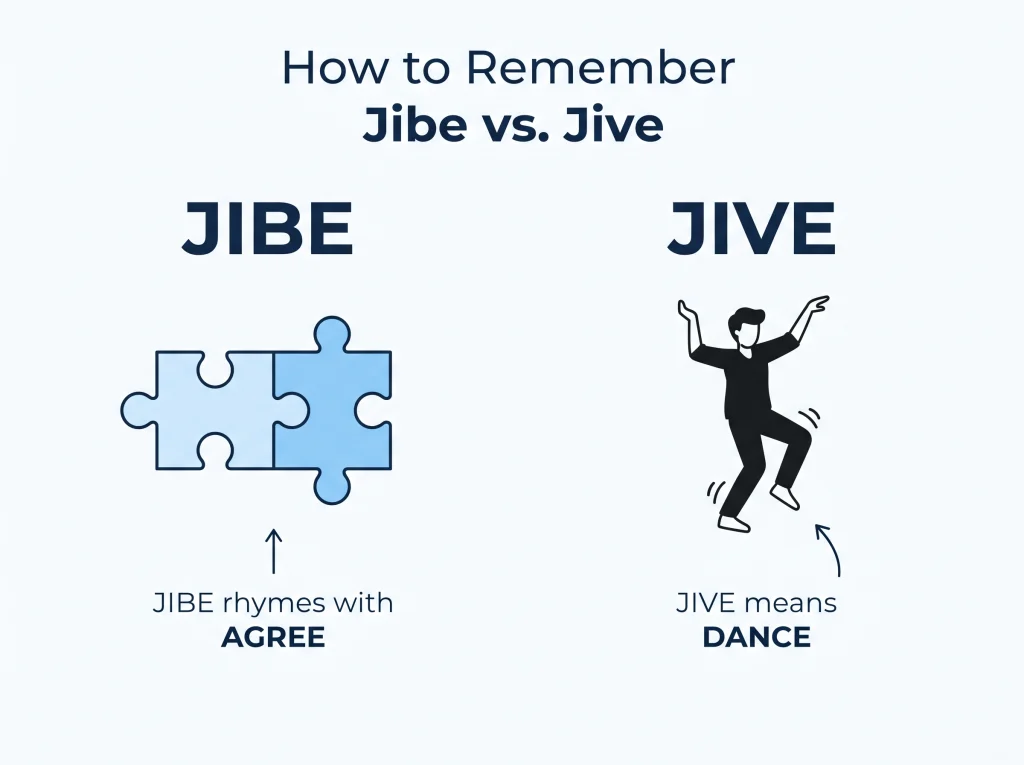
How to Remember Jibe vs. Jive
A simple memory trick is:
Jibe = fit.
Jive = dance.
If two pieces of information fit together, they jibe.
The facts jibe with her explanation.
If you are thinking about music, dancing, or slang, think jive.
They danced the jive.
Another useful test is to replace the word in your sentence.
If you can replace it with agree, match, or correspond, choose jibe.
The two accounts don’t agree.
The two accounts don’t jibe.
If you can replace it with dance, nonsense, or deceptive talk, jive may be the word you need.
For professional American English, this quick test will prevent most jibe and jive mistakes.