Idioms Wiki: 100+ English Idioms With Meanings and Examples
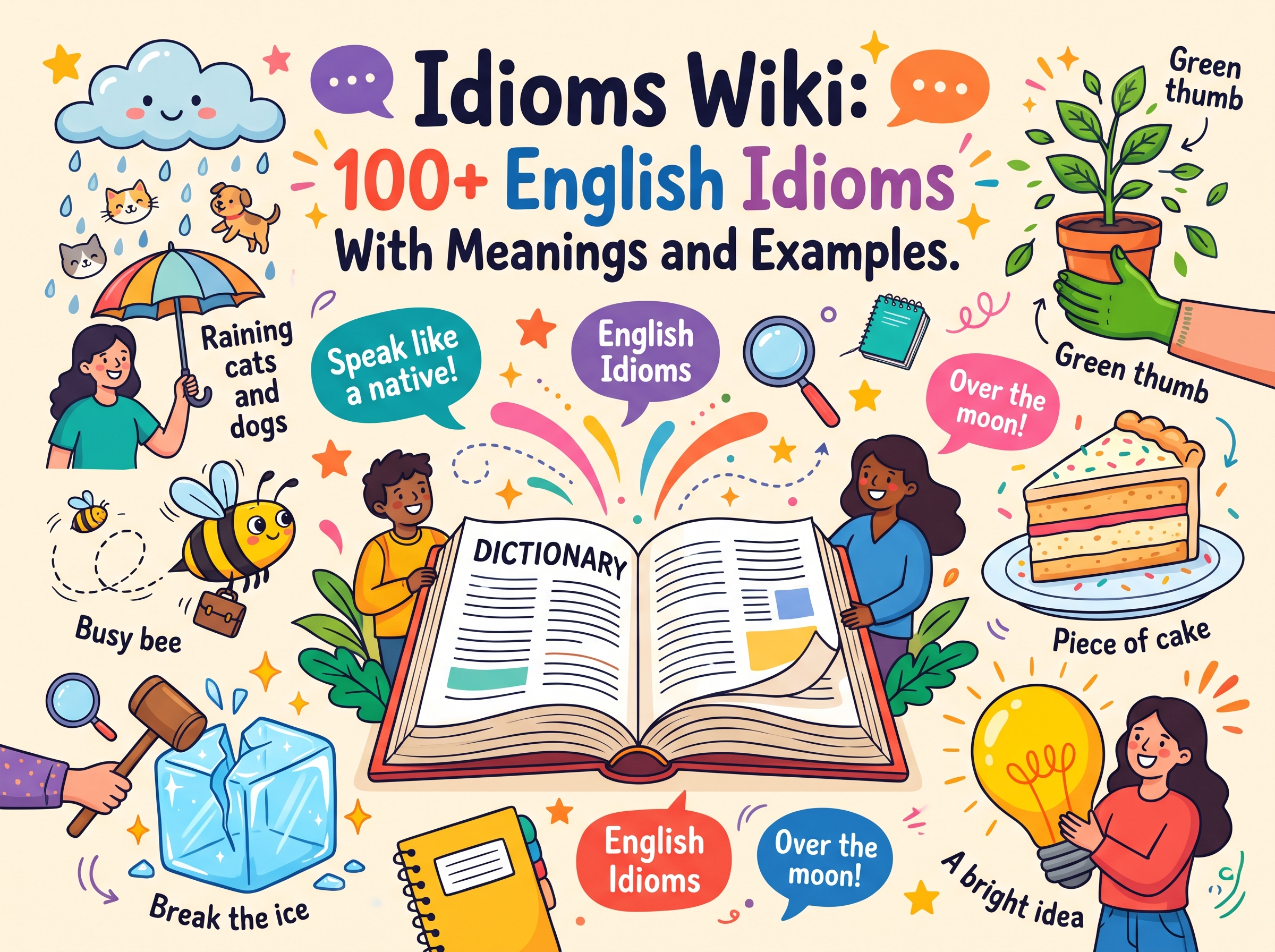
English idioms make everyday conversations more colorful, expressive, and natural. From familiar expressions such as “break the ice” to unusual phrases such as “let the cat out of the bag,” these expressions communicate ideas that cannot always be understood from their individual words.
An idioms wiki is a useful reference for finding English idioms, understanding their meanings, exploring different categories, and learning how to use them correctly. Whether you are an English learner, student, teacher, or native speaker, an organized collection of idioms can help improve vocabulary and communication skills.

This guide covers common English idioms, their meanings, practical examples, popular categories, and effective ways to learn figurative expressions. It also explains how idioms differ from proverbs, slang, and ordinary phrases.
What Is an Idioms Wiki?
An idioms wiki is an organized reference or collection of idiomatic expressions that explains their meanings, usage, and examples. It helps readers understand phrases whose intended meanings are different from the literal meanings of their individual words.
For example, the expression “spill the beans” does not usually mean dropping actual beans. It means revealing secret information, often accidentally.
A useful idioms reference may organize expressions alphabetically, by keyword, or into categories such as animals, food, emotions, relationships, and everyday situations.
An idioms wiki can include:
- Idioms and definitions: Clear explanations of common and uncommon expressions.
- Example sentences: Practical examples showing how idioms work in context.
- Categories: Collections grouped by topic or subject.
- Usage information: Guidance about formal, informal, humorous, or outdated expressions.
- Related expressions: Similar idioms that communicate comparable ideas.
The goal is to make figurative English easier to understand and use in real conversations.
Why Use an English Idioms Wiki?
Learning idioms can help English speakers communicate more naturally. These expressions appear in conversations, movies, television shows, books, workplace discussions, and online content.
An organized idioms reference makes learning easier because readers can find expressions according to their interests and language needs.
Here are some important benefits.
Improves vocabulary: Learning idioms introduces new expressions and helps readers understand how familiar words can communicate figurative meanings.
Develops listening skills: Many Americans use idioms in everyday conversations. Understanding expressions such as “hang in there” and “on the same page” makes spoken English easier to follow.
Makes communication more natural: Using appropriate idioms can make conversations sound more fluent and expressive.
Supports English learning: Students can use idiom collections to practice sentence construction, reading comprehension, and vocabulary development.
Helps with cultural understanding: Some expressions reflect traditional activities, historical references, popular culture, and everyday American experiences.
Common English Idioms With Meanings and Examples
The following expressions are widely recognized in English. Their meanings and example sentences show how they work in everyday communication.
| Idiom | Meaning | Example |
|---|---|---|
| Break the ice | Make people feel comfortable | Sarah told a joke to break the ice. |
| A piece of cake | Something very easy | The math exercise was a piece of cake. |
| Spill the beans | Reveal a secret | Don’t spill the beans about the party. |
| Hit the nail on the head | Describe something exactly right | You hit the nail on the head with that answer. |
| Under the weather | Feeling slightly sick | I’m feeling under the weather today. |
| Once in a blue moon | Very rarely | We eat at that restaurant once in a blue moon. |
| Cost an arm and a leg | Be very expensive | That new car costs an arm and a leg. |
| Let the cat out of the bag | Reveal a secret accidentally | He let the cat out of the bag about the surprise. |
| Bite the bullet | Face a difficult situation | I finally bit the bullet and paid the bill. |
| Burn the midnight oil | Work or study late | She burned the midnight oil before her exam. |
| Call it a day | Stop working | We’ve finished enough, so let’s call it a day. |
| Get cold feet | Become nervous before an important event | He got cold feet before the wedding. |
| In hot water | In trouble | Mark was in hot water after missing the deadline. |
| Keep an eye on | Watch something carefully | Please keep an eye on my bag. |
| On cloud nine | Extremely happy | She was on cloud nine after getting the job. |
| Pull someone’s leg | Joke with someone | Relax! I’m just pulling your leg. |
| The ball is in your court | It is your turn to act | I’ve made my offer, and now the ball is in your court. |
| Through thick and thin | During good and bad times | True friends stay together through thick and thin. |
| A blessing in disguise | Something that seems bad but brings a benefit | Losing that job was a blessing in disguise. |
| Back to square one | Return to the beginning | Our first plan failed, so we’re back to square one. |
These expressions cover different situations, from friendship and emotions to work, school, and daily activities. Learning them in context helps readers understand when each one sounds appropriate.
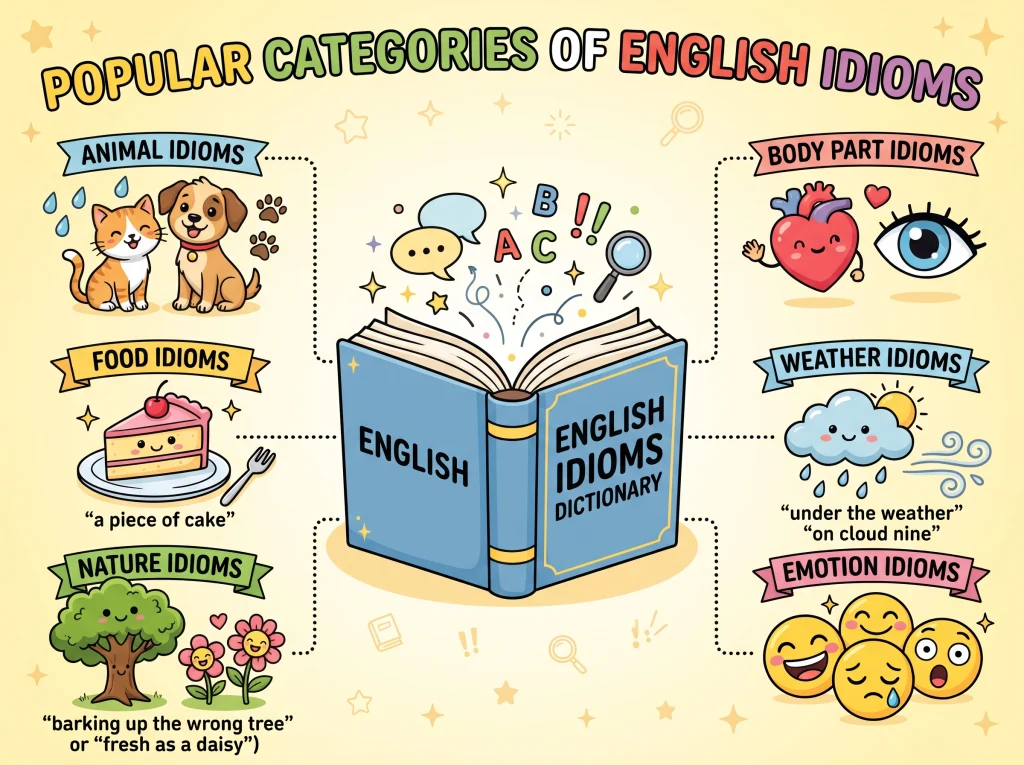
Popular Categories of English Idioms
English idioms can be organized into different groups based on their meanings, keywords, and subjects. Learning by category makes it easier to remember expressions connected to familiar experiences.
Animal Idioms
Animal idioms use the names or characteristics of animals to describe human behavior, situations, and relationships.
| Idiom | Meaning |
|---|---|
| Hold your horses | Be patient |
| Let sleeping dogs lie | Avoid bringing up an old problem |
| The elephant in the room | An obvious issue people avoid discussing |
| A fish out of water | Someone uncomfortable in a particular situation |
| Kill two birds with one stone | Achieve two things with one action |
| The lion’s share | The largest portion |
| A wild goose chase | A pointless search |
| Take the bull by the horns | Face a difficult situation directly |
Example: When the team noticed the problem, Maria decided to take the bull by the horns and find a solution.
Food Idioms
Food idioms are common in informal English and often describe emotions, relationships, experiences, and situations.
| Idiom | Meaning |
|---|---|
| A piece of cake | Very easy |
| Big cheese | An important person |
| Bring home the bacon | Earn money for a family |
| Cry over spilled milk | Be upset about something that cannot be changed |
| Have bigger fish to fry | Have more important things to do |
| In a nutshell | In a few words |
| Full of beans | Energetic and lively |
| Take something with a grain of salt | Avoid believing something completely |
Example: Don’t worry about the small mistake. There’s no point crying over spilled milk.
Weather and Nature Idioms
Weather and nature expressions use images from the natural world to communicate emotions, difficulties, and changes.
| Idiom | Meaning |
|---|---|
| Every cloud has a silver lining | Something good can come from a difficult situation |
| Under the weather | Feeling sick |
| Come rain or shine | Regardless of the circumstances |
| Chase rainbows | Pursue unrealistic goals |
| Calm before the storm | A peaceful period before trouble |
| A ray of sunshine | Someone or something that brings happiness |
| Make hay while the sun shines | Take advantage of a good opportunity |
| Weather the storm | Survive a difficult situation |
Example: Business has been difficult, but the company is working hard to weather the storm.
Body Part Idioms
Body part idioms use references to the eyes, hands, feet, head, heart, and other body parts to express feelings and actions.
| Idiom | Meaning |
|---|---|
| Keep your chin up | Stay positive |
| Cost an arm and a leg | Be extremely expensive |
| Get cold feet | Become nervous |
| Learn by heart | Memorize something |
| See eye to eye | Agree with someone |
| Give someone a hand | Help someone |
| Keep your fingers crossed | Hope for a positive result |
| Have a change of heart | Change your opinion or feelings |
Example: My brother and I don’t always see eye to eye, but we respect each other’s opinions.
Money and Work Idioms
Money and work idioms frequently appear in American workplaces, business conversations, and discussions about financial situations.
| Idiom | Meaning |
|---|---|
| Make ends meet | Have enough money for basic expenses |
| Bring home the bacon | Earn money |
| Tighten your belt | Spend less money |
| In the red | Owe money or operate at a loss |
| Break even | Have equal income and expenses |
| Learn the ropes | Learn how to do a job |
| Climb the ladder | Advance in a career |
| Go the extra mile | Make an additional effort |
Example: Jessica worked hard and went the extra mile to complete the project before the deadline.
Feelings and Emotions Idioms
These expressions describe happiness, anger, sadness, excitement, disappointment, and other emotional experiences.
| Idiom | Meaning |
|---|---|
| Over the moon | Extremely happy |
| Down in the dumps | Feeling sad |
| Lose your temper | Become angry |
| Get on someone’s nerves | Annoy someone |
| Have a heavy heart | Feel sad |
| Blow off steam | Release stress or frustration |
| On top of the world | Feel extremely happy |
| Wear your heart on your sleeve | Show your emotions openly |
Example: After receiving the good news, David was over the moon.
How to Find the Meaning of an Idiom
Understanding an unfamiliar expression becomes easier when you follow a few simple steps.
1. Identify the complete expression. Look at the entire phrase rather than interpreting each word separately. For example, “kick the bucket” has a figurative meaning that cannot be understood by considering the words individually.
2. Check a reliable idiom dictionary. Use established references such as Cambridge Dictionary, Oxford learner resources, or other reputable English dictionaries.
3. Read example sentences. Examples show how an expression works in real communication and help explain its intended meaning.
4. Check its tone and context. Some idioms are informal, humorous, old-fashioned, or more appropriate for particular situations.
5. Look for alternative forms. Certain idioms allow small grammatical changes, while others have relatively fixed wording.
These steps help prevent misunderstandings and make it easier to use expressions correctly.
How to Learn and Remember English Idioms
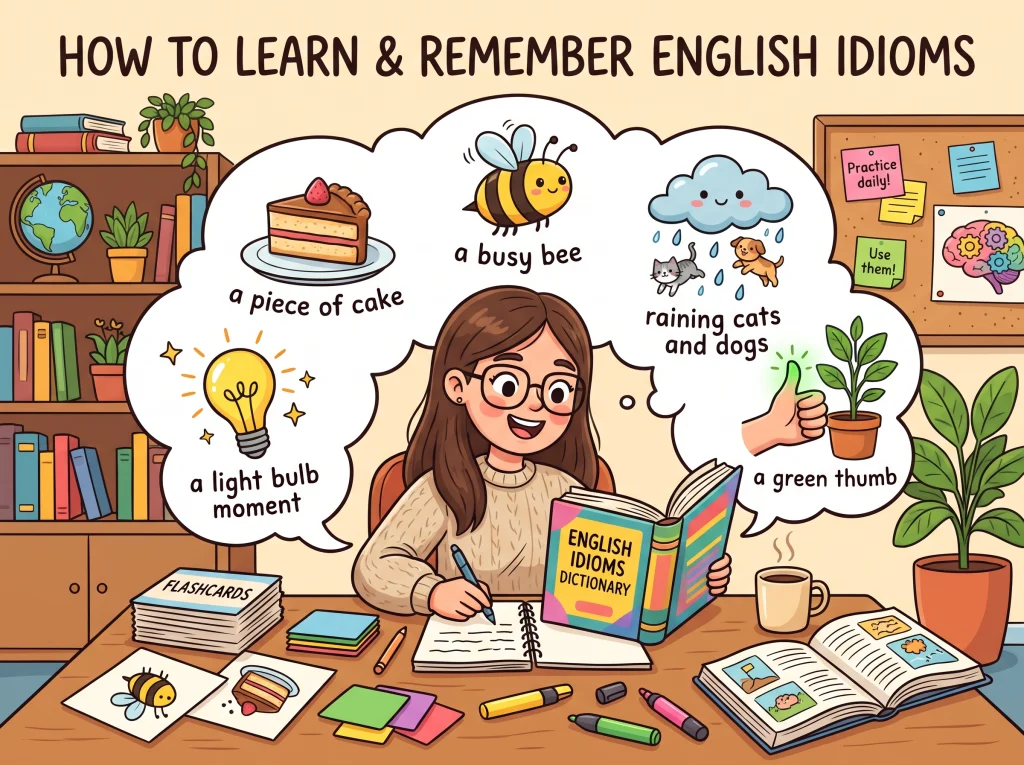
Memorizing long lists of expressions is not always the most effective approach. Learning idioms through examples, conversations, and regular practice can make their meanings easier to remember.
Here are some practical techniques.
- Learn a few expressions daily: Focus on three to five useful idioms instead of memorizing dozens at once.
- Create example sentences: Write original sentences using each expression.
- Group related idioms: Study expressions about animals, food, emotions, work, or relationships together.
- Use visual learning: Pictures can help connect an idiom’s literal image with its figurative meaning.
- Practice conversations: Try using appropriate expressions when speaking with friends or classmates.
- Review regularly: Revisit previously learned idioms to strengthen long-term memory.
For example, when learning “break the ice,” imagine someone telling a funny story at a meeting to make everyone comfortable. Connecting the expression with a recognizable situation makes it easier to recall.
Common Mistakes When Using Idioms
Even advanced English learners sometimes use idioms incorrectly. Understanding their structure and context can prevent common mistakes.
Taking Idioms Literally
Some expressions have meanings that are completely different from their individual words.
Incorrect understanding: “It’s raining cats and dogs” means animals are falling from the sky.
Correct meaning: It is raining very heavily.
Changing Fixed Expressions
Many idioms have established wording that should not be changed randomly.
Incorrect: He kicked a bucket.
Correct: He kicked the bucket.
The first sentence usually describes a literal action, while the second can mean that someone died.
Using Informal Idioms in Formal Writing
Expressions such as “piece of cake” and “pull someone’s leg” are common in casual conversations. However, formal reports, academic papers, and professional documents often benefit from clearer, more direct wording.
Ignoring the Context
An idiom may be appropriate in one situation but confusing or unsuitable in another. Always consider the audience, subject, and tone before using an expression.
Idioms vs. Proverbs, Phrases, and Slang
Idioms are often confused with other types of expressions. Although these language forms sometimes overlap, they serve different purposes.
| Language form | Meaning | Example |
|---|---|---|
| Idiom | An expression with a figurative or conventional meaning | Break the ice |
| Proverb | A traditional saying expressing advice or wisdom | Actions speak louder than words |
| Phrase | A group of words that functions as a unit | In the morning |
| Slang | Informal language used by particular groups or communities | Hang out |
| Metaphor | A comparison that describes something in terms of something else | Time is money |
The main difference is that idioms have established meanings that are not always predictable from their individual words. Proverbs generally communicate advice or a general observation, while slang reflects informal language and social usage.
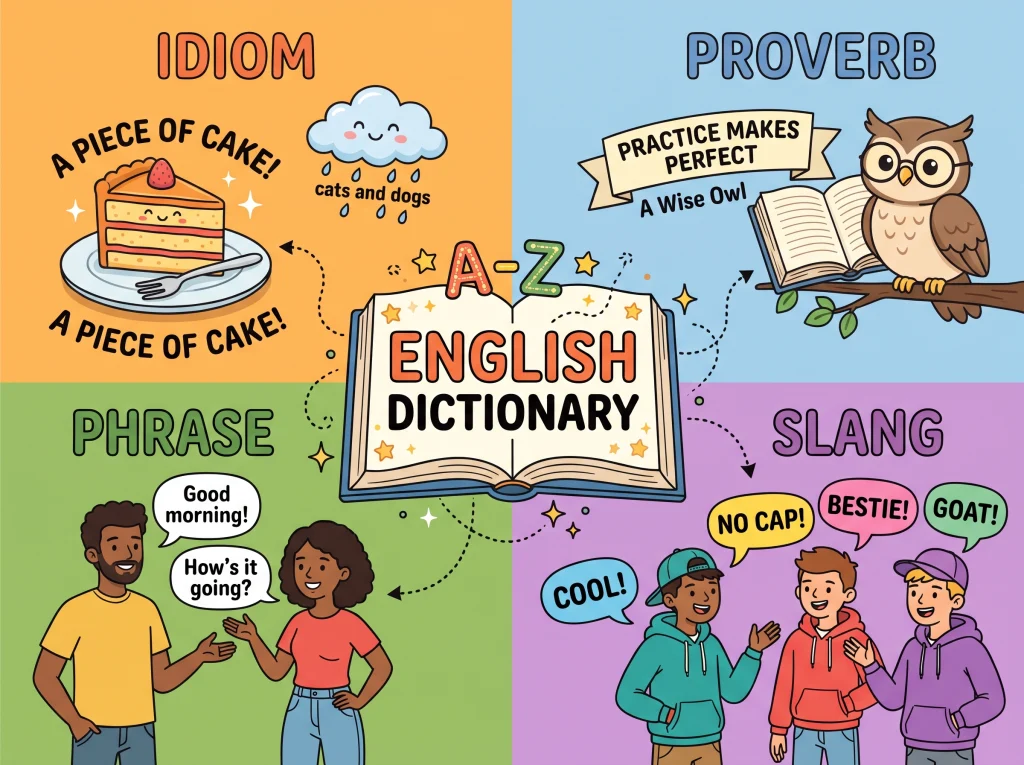
Understanding these distinctions helps English learners build a stronger vocabulary and recognize different forms of expression.
FAQs:
Conclusion
An idioms wiki is a helpful reference for understanding English expressions, their meanings, and their use in everyday communication. From animal and food idioms to expressions about emotions, money, and work, these phrases make English more descriptive and engaging.
The best way to learn idioms is to study their meanings, read example sentences, and practice using them in appropriate situations. Instead of memorizing long lists without context, focus on expressions that appear in conversations, books, movies, and daily life. With consistent practice, understanding and using English idioms can become a natural part of your communication skills.