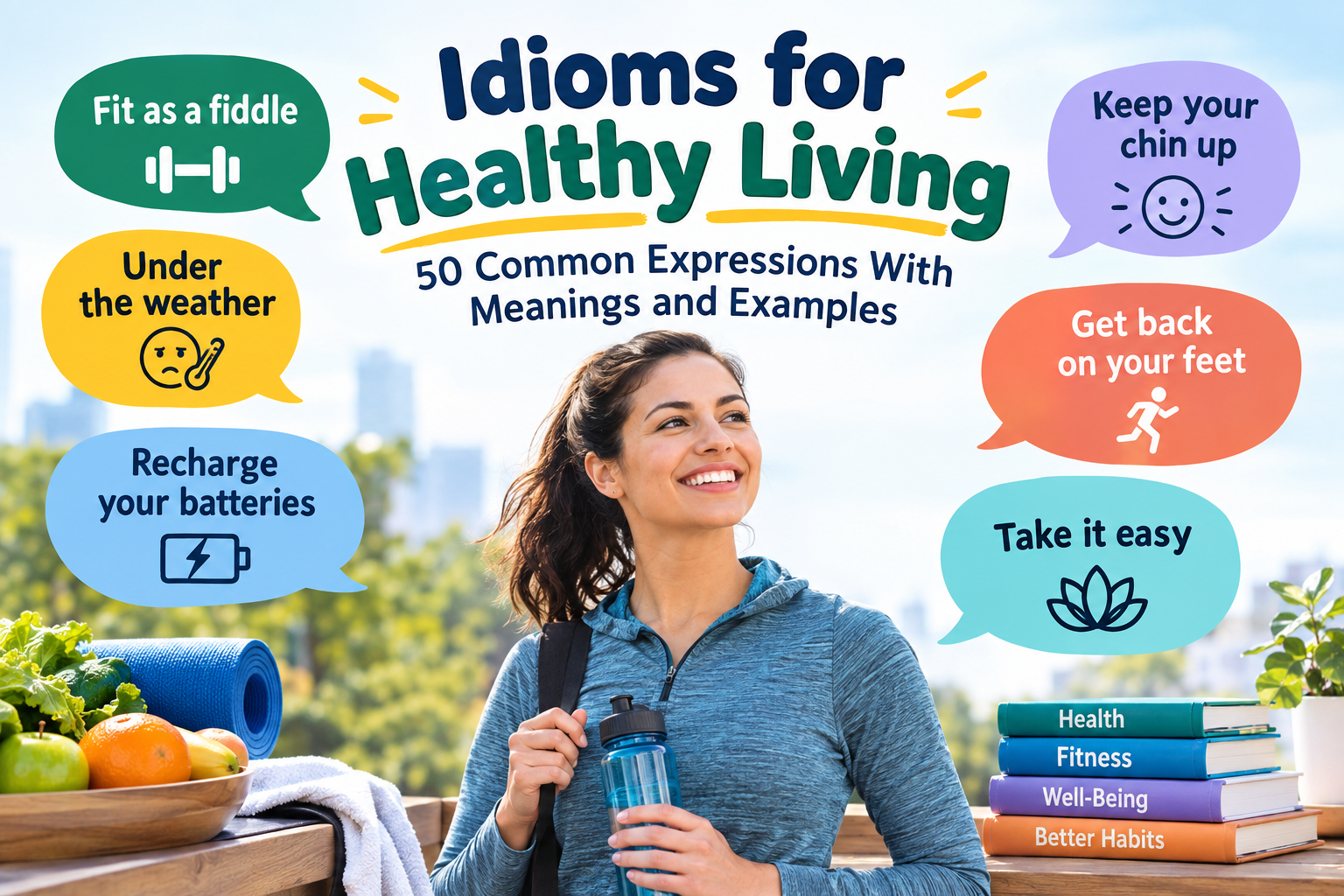
Idioms for Healthy Living: 50 Common Expressions With Meanings and Examples
Health and well-being are common topics in everyday American English. People talk about staying fit, getting enough rest, recovering from illness, managing stress, and feeling full of energy. Many use idioms to make these conversations sound more natural, friendly, and expressive.
Learning idioms for healthy living can help English learners understand conversations at work, school, the gym, and home. Some expressions describe physical strength, while others refer to emotional well-being, healthy habits, or the process of feeling better after a difficult time.
This guide explains 50 useful health-related idioms and expressions with simple meanings and example sentences. You will also learn how to use them naturally in American English and avoid common mistakes.
What Are Idioms for Healthy Living?
Idioms for healthy living are expressions that people use when talking about health, fitness, energy, recovery, rest, and well-being. Their meanings are often figurative rather than strictly literal.

For example, “fit as a fiddle” means being in very good physical condition. Someone who says, “My grandfather is 80, but he is fit as a fiddle,” is describing a person who seems healthy and active.
Similarly, “under the weather” means feeling slightly ill or unwell. It does not mean that someone is physically beneath the weather.
These expressions are useful in casual conversations, personal stories, and everyday discussions about how people feel. Some are specifically connected to physical health, while others describe emotional balance, stress, or recovery.
I Love You Idioms: https://learnidioms.com/i-love-you-idioms/
50 Common Idioms for Healthy Living With Meanings and Examples
Idioms About Health and Well-Being
These expressions describe good health, physical condition, and general well-being.
1. Fit as a fiddle
Meaning: To be in very good physical condition and feel healthy.
Example: “My aunt is 75, but she is still fit as a fiddle and walks every morning.”
2. In good shape
Meaning: To be physically fit or in a healthy condition.
Example: “Jordan has been exercising regularly and is in good shape.”
3. In the pink of health
Meaning: To be in excellent health.
Example: “After a few weeks of rest, Dad was back in the pink of health.”
4. As right as rain
Meaning: To feel completely well again, especially after being unwell.
Example: “I felt tired yesterday, but after a good night’s sleep, I’m as right as rain.”
5. The picture of health
Meaning: Someone who looks very healthy and well.
Example: “After spending the summer outdoors, Mia looked the picture of health.”
6. Hale and hearty
Meaning: Strong, healthy, and full of energy, often used to describe an older person.
Example: “Our neighbor is 82 and still hale and hearty.”
7. Bursting with health
Meaning: Looking or seeming extremely healthy and energetic.
Example: “The kids came home from camp bursting with health and enthusiasm.”
8. Full of beans
Meaning: To have lots of energy and enthusiasm.
Example: “After breakfast, the children were full of beans and ready to play.”
9. Alive and kicking
Meaning: To be active, lively, or still functioning well.
Example: “Even after a long day at work, Grandma was alive and kicking at the family dinner.”
10. Up and about
Meaning: To be out of bed and moving around again, especially after illness or injury.
Example: “Sam had the flu last week, but he’s up and about now.”

Idioms About Fitness, Energy, and Strength
These expressions are helpful when discussing exercise, stamina, physical activity, and feeling energetic.
11. Full of life
Meaning: To be energetic, lively, and enthusiastic.
Example: “The new fitness instructor is full of life and makes every class enjoyable.”
12. Have a spring in your step
Meaning: To walk with energy and enthusiasm, often because you feel happy or healthy.
Example: “After returning to her morning walks, Elena had a spring in her step.”
13. In peak condition
Meaning: To be at the highest level of physical fitness or performance.
Example: “The runners trained for months to be in peak condition for the race.”
14. Keep your strength up
Meaning: To maintain your energy and physical strength.
Example: “Make sure you eat enough during the hike to keep your strength up.”
15. Get your second wind
Meaning: To regain energy after feeling tired.
Example: “I was exhausted halfway through the workout, but I got my second wind and finished it.”
16. Work up a sweat
Meaning: To exercise or do physical activity hard enough to start sweating.
Example: “I like to work up a sweat with a brisk walk before dinner.”
17. Burn off energy
Meaning: To use up excess energy through physical activity.
Example: “The kids went outside to burn off energy after sitting in class all day.”
18. Get into shape
Meaning: To improve your physical fitness.
Example: “Marcus joined a local gym because he wanted to get into shape.”
19. Keep on your toes
Meaning: To stay alert, active, and ready to respond.
Example: “Taking dance classes keeps me on my toes and gives me a fun way to move.”
20. Have energy to spare
Meaning: To have more energy than is needed for a particular activity.
Example: “After a restful weekend, I had energy to spare for the Monday morning workout.”

Happend or Happened: https://learnidioms.com/happend-or-happened/
Idioms About Recovery and Feeling Better
These expressions describe getting back to normal, overcoming a difficult period, or returning to everyday activities.
21. Under the weather
Meaning: To feel slightly ill or unwell.
Example: “I’m feeling a little under the weather, so I’m going to stay home tonight.”
22. Back on your feet
Meaning: To recover from an illness, injury, or difficult situation.
Example: “After several days of rest, Priya was back on her feet and ready to return to work.”
23. On the mend
Meaning: Gradually recovering from an illness or injury.
Example: “My brother is on the mend after catching a bad cold.”
24. Up to snuff
Meaning: Meeting an expected standard or being in satisfactory condition.
Example: “I’m feeling better today, but I’m not quite up to snuff for a long workout.”
25. Back in the saddle
Meaning: Returning to an activity after a break or setback.
Example: “After recovering from his ankle injury, Leo was back in the saddle at the cycling club.”
26. A clean bill of health
Meaning: Confirmation that someone or something has no identified health problem after an examination or check.
Example: “The doctor gave her a clean bill of health after the routine checkup.”
27. Get back to normal
Meaning: To return to your usual condition or routine after a disruption.
Example: “It took a few days after the flu to get back to normal.”
28. Turn the corner
Meaning: To pass the most difficult stage of an illness or challenging situation and begin improving.
Example: “He was feeling worse earlier in the week, but he seems to have turned the corner.”
29. Pull through
Meaning: To survive or recover from a serious illness, injury, or difficult experience.
Example: “The family was relieved when their grandfather pulled through the operation.”
30. A new lease on life
Meaning: A renewed feeling of energy, hope, or purpose.
Example: “Joining the walking group gave Denise a new lease on life and helped her make new friends.”

Idioms About Balance, Rest, and Healthy Habits
These expressions relate to taking breaks, managing daily responsibilities, and making room for personal well-being.
31. Burn the candle at both ends
Meaning: To exhaust yourself by staying up late and getting up early or by doing too much.
Example: “If you keep burning the candle at both ends, you’ll feel worn out by the weekend.”
32. Recharge your batteries
Meaning: To rest and regain energy.
Example: “I spent Saturday reading and relaxing to recharge my batteries.”
33. Take a breather
Meaning: To pause an activity for a short rest.
Example: “We took a breather halfway through the hike and enjoyed the view.”
34. Catch some Z’s
Meaning: To get some sleep.
Example: “I’m going to catch some Z’s before my early morning shift.”
35. Hit the hay
Meaning: To go to bed.
Example: “I have a workout at 6 a.m., so I’m going to hit the hay early.”
36. Let your hair down
Meaning: To relax, have fun, and stop worrying about responsibilities for a while.
Example: “After finishing her exams, Olivia went dancing with friends and let her hair down.”
37. Take it easy
Meaning: To relax, avoid unnecessary strain, or reduce activity.
Example: “You’ve had a busy week, so take it easy this weekend.”
38. Slow down
Meaning: To reduce your speed, activity, or workload.
Example: “I realized I needed to slow down and make more time for rest.”
39. Find your feet
Meaning: To become comfortable and confident in a new situation or routine.
Example: “It took me a few weeks to find my feet with my new morning exercise schedule.”
40. Strike a balance
Meaning: To find a reasonable balance between different activities or needs.
Example: “I’m trying to strike a balance between work, exercise, and spending time with my family.”

Idioms About Stress and Emotional Well-Being
These expressions help people describe pressure, emotional strain, and the importance of maintaining a sense of balance.
41. Keep your cool
Meaning: To remain calm in a stressful or difficult situation.
Example: “When the gym was crowded, I kept my cool and adjusted my workout plan.”
42. Let off steam
Meaning: To release built-up frustration or tension.
Example: “After a stressful day, I went for a walk to let off steam.”
43. A weight off your shoulders
Meaning: A feeling of relief after a worry or responsibility has been removed.
Example: “Finishing my final exam was a weight off my shoulders.”
44. Get something off your chest
Meaning: To talk about something that has been bothering you.
Example: “I spoke to my friend about my worries and finally got them off my chest.”
45. At your wit’s end
Meaning: To feel so worried, frustrated, or overwhelmed that you do not know what to do next.
Example: “With deadlines piling up, I was at my wit’s end and needed a quiet evening.”
46. A breath of fresh air
Meaning: Someone or something that feels refreshing, new, or different in a positive way.
Example: “Our weekend trip to the mountains was a breath of fresh air after weeks of busy city life.”
47. Clear your head
Meaning: To calm your thoughts and think more clearly.
Example: “I went for a short walk to clear my head before making the decision.”
48. Get out of a rut
Meaning: To break free from a dull or repetitive routine.
Example: “Trying a new swimming class helped me get out of a rut with my exercise routine.”
49. Look on the bright side
Meaning: To focus on the positive aspects of a difficult situation.
Example: “Even though I had to miss the race, I looked on the bright side and used the extra time to recover.”
50. Keep your chin up
Meaning: To remain hopeful and positive during a difficult time.
Example: “The training program was challenging, but my coach encouraged me to keep my chin up.”

Idioms With Illustrations: https://learnidioms.com/idioms-with-illustrations-and-meanings/
How to Use Health Idioms Naturally in American English
Using idioms naturally means understanding not only their meanings but also when and how people use them. In American English, many health-related expressions appear in casual conversations with friends, family members, coworkers, and fitness partners.
Here are a few practical ways to use them.

1. Match the idiom to the situation
Choose an expression that accurately describes what you want to say.
- Feeling slightly sick: “I’m a little under the weather today.”
- Recovering from an illness: “She’s on the mend.”
- Feeling energetic: “The kids are full of beans.”
- Taking a break: “Let’s take a breather.”
- Feeling relieved: “That’s a weight off my shoulders.”
2. Use idioms in everyday conversations
You do not need to use complicated language to sound natural. A familiar expression can make a short sentence more conversational.
For example:
- “I’m going to hit the hay. I have an early workout tomorrow.”
- “I took the afternoon off to recharge my batteries.”
- “He’s back on his feet and enjoying his usual routine.”
3. Pay attention to tone and context
Some idioms are casual and friendly, while others can sound more serious. “Pull through,” for example, is often used when someone survives a serious illness or difficult experience. “Catch some Z’s” is informal and works well in relaxed conversation.
Choose expressions that fit the relationship and situation. In formal medical discussions, direct language is usually clearer than idioms.
4. Practice with your own sentences
Create sentences about familiar routines, such as going for a walk, getting enough rest, or returning to exercise after a break.
For example, instead of simply saying, “I was tired, but then I felt energetic again,” you could say, “I got my second wind.”
Practicing expressions in realistic situations helps you remember their meanings and use them more comfortably.
Common Mistakes to Avoid When Using Health Idioms
Even familiar idioms can sound confusing when used in the wrong context. Keep these common mistakes in mind.
| Idiom | Common mistake | Correct usage |
|---|---|---|
| Under the weather | Using it to mean feeling happy or energetic | Use it when someone feels slightly ill or unwell. |
| Fit as a fiddle | Using it to describe someone who is exhausted | Use it to describe someone in very good physical condition. |
| On the mend | Using it to describe someone whose condition is getting worse | Use it when someone is gradually recovering. |
| Burn the candle at both ends | Using it to mean taking a relaxing break | Use it when someone is overworking or sacrificing rest. |
| Recharge your batteries | Using it to mean starting a stressful task | Use it when someone is resting and regaining energy. |
| Pull through | Using it for an ordinary short break | Use it when someone survives or recovers from a serious difficulty. |
| Keep your chin up | Using it as a literal instruction about posture | Use it to encourage someone who is facing a difficult situation. |
| Get something off your chest | Using it to mean carrying a heavy object | Use it when someone talks about a worry or troubling feeling. |
Remember that idioms are often informal. When speaking with a healthcare professional, describing symptoms directly is generally clearer than relying on figurative expressions. For example, say “I have a sore throat and a fever” rather than expecting an idiom to communicate specific symptoms.
Why Learning Health Idioms Is Useful
Health-related idioms can help English learners communicate more naturally and understand expressions they hear in everyday American conversations.
They are particularly useful in these situations:
- Everyday conversations: Talk about how you feel, whether you need rest, or how your day is going.
- Fitness and exercise: Describe energy levels, physical activity, and returning to a routine.
- Work and school: Explain that you feel unwell, need a break, or are recovering from a busy period.
- Social situations: Encourage a friend, express relief, or talk about stress in a conversational way.
- English comprehension: Understand figurative expressions in movies, television shows, podcasts, and casual discussions.
Learning idioms in context is more useful than memorizing isolated definitions. When you connect each expression to a realistic situation, it becomes easier to understand what people mean and decide whether the expression fits your own conversation.
Idioms About History: https://learnidioms.com/idioms-about-history/
FAQ
Conclusion
Idioms for healthy living give you practical ways to talk about physical fitness, energy, recovery, rest, and emotional well-being in American English. Expressions such as “fit as a fiddle,” “under the weather,” “recharge your batteries,” and “keep your chin up” can make everyday conversations more expressive and natural.




One Comment